
René Belbenoît did not begin his famous 1935 escape by breaking out of a cell on Devil's Island. On 2 May he was already a libéré—an ex-convict who had completed the custodial part of his punishment but was still legally compelled to remain in French Guiana. His final escape was from that compulsory colonial residence.
What followed was extraordinary even after the legend is stripped away. Belbenoît left the Saint-Laurent-du-Maroni area with five companions in a small open boat, reached Trinidad, was later detained in Colombia, separated from the men with whom he had begun the journey, and continued north through the Americas. By 1937 he was in Los Angeles. The broad route is strong; many of the famous scenes along it depend heavily on Belbenoît himself.
At a Glance
- Departure: 2 May 1935
- Status at departure: libéré under compulsory residence
- Departure area: Saint-Laurent-du-Maroni / lower Maroni River
- Companions: five
- First major destination: Trinidad
- Reported time to Trinidad: 14–17 days, source-dependent
- Next secure route anchor: Colombia
- Long-distance continuation: Panama and Central America
- United States outcome: Los Angeles, 1937
- Contemporary Los Angeles evidence: present there by 20 June 1937
- Memoir: Dry Guillotine, published 1938
- Core evidence caution: Belbenoît was a compelling storyteller whose archive also reveals rewriting, reconstruction, and exaggeration
French Guiana was larger than Devil's Island
The name Devil's Island came to stand for the entire French penal colony in popular culture, but that shorthand can distort Belbenoît's actual geography. French Guiana's penal system stretched across mainland camps, the transportation center at Saint-Laurent-du-Maroni, forest sites, and the offshore Îles du Salut. Devil's Island itself was one island in that system. Belbenoît had experienced imprisonment on Devil's Island during earlier punishment. His final 1935 journey, however, began on the mainland around Saint-Laurent and the Maroni River.
Calling the whole episode an "escape from Devil's Island" reproduces the language that made the penal colony famous. Calling it an escape from French Guiana is more precise.
Convict 46635
Belbenoît arrived at Saint-Laurent-du-Maroni in June 1923 and received convict number 46635. He had been sentenced to eight years of hard labor after theft convictions in France. His penal history soon became a cycle of confinement, attempted escape, recapture, and additional punishment. The Harry Ransom Center's archival finding aid records an escape attempt only weeks after his arrival and another in 1924. Later attempts brought harsher punishment, including solitary confinement.
By the time of the final 1935 flight, the important issue was no longer whether Belbenoît knew how difficult escape could be. He had already failed repeatedly.
The libéré trap
French Guiana's penal regime did not necessarily release a man from colonial control when his labor sentence ended. The category libéré described a former convict who had completed the sentence of hard labor but remained subject to mandatory residence. The policy formed part of the system known as doublage. Historian Clare Anderson's archival work on the 1930s colony describes a substantial population of released men forced to remain in French Guiana. Many struggled to find work because the colonial labor market was already saturated and penal status continued to shape their lives.
Belbenoît entered that world in 1931. He was no longer simply a prisoner behind bars. He was also not free to return home.
A legal departure that ended badly
The Ransom Center records an episode that helps explain his final decision. After becoming a libéré, Belbenoît received a one-year authorization to leave the colony but was forbidden to return to France. He worked in Panama, then violated the terms by going to France anyway. He was arrested at Le Havre.
French authorities sent him back to the penal system in Guiana, where further punishment followed. The experience demonstrated that travel permission was not the same as unrestricted freedom. If he wanted to end the colony's power over him permanently, he would have to do it outside the legal framework.
Released again
Belbenoît was officially released again on 2 November 1934. The release did not remove the compulsory-residence problem. He began planning another illegal departure.
This distinction changes the tone of the 1935 story. Belbenoît was not trying to unlock a cell door while guards slept. He was trying to leave a territory from which the colonial state still barred him from lawfully departing.
2 May 1935
The strongest sources converge on 2 May 1935. Belbenoît left with five other men connected to the penal-colony population. His memoir says the group assembled in Saint-Laurent, moved toward the Maroni, and used a small craft to reach the river mouth before going to sea. The broad departure by boat is secure.
The fine mechanics come mostly from Belbenoît. That pattern will repeat throughout the journey.
The boat
The vessel has often been described as a dugout or open canoe. The Ransom Center summarizes it as a nineteen-foot boat. Belbenoît's prose elsewhere describes an approximately eighteen-foot craft. The one-foot difference matters mainly because it warns against treating a memoir object as if it had been measured for a technical report.
The evidence supports a small open boat, roughly eighteen to nineteen feet in later accounts. Six men were attempting to take that craft from the Guianese coast into the Caribbean.
Trinidad first
Belbenoît's own planning narrative makes Trinidad a temporary objective rather than the ultimate destination. The United States was the distant goal. Trinidad offered something more immediate: a place outside French colonial control where the group might avoid instant return and prepare for another stage. The voyage there became one of the most famous parts of Dry Guillotine. It also produced one of the book's clearest internal contradictions.
Fourteen days—or seventeen?
In the body of his memoir, Belbenoît says the men had spent fourteen days at sea when Trinidad appeared. The introduction to the same book gives seventeen days, attributing that number to reporting by the Trinidad Guardian. The Harry Ransom Center finding aid also uses seventeen days. TIME's 1938 review uses fourteen.
There is no reason to force those sources into a false agreement. The crossing lasted approximately two weeks, with credible published traditions ranging from fourteen to seventeen days. That is enough to understand the scale of the ordeal without manufacturing a precision the sources do not possess.
A memoir at sea
Dry Guillotine turns the crossing into a sequence of hunger, storms, equipment failure, interpersonal conflict, and danger. Some of that is entirely plausible. The problem is evidentiary, not imaginative. For most of the sea passage, Belbenoît's polished memoir is the principal detailed witness. No ship's log, official French pursuit record, or independent diary from another companion verifies each confrontation and each day.
The memoir therefore remains indispensable, but its vivid mechanics require attribution. Phrases such as "Belbenoît recalled" distinguish his testimony from independently anchored events.
Trinidad
The six men reached Trinidad. That event appears in Belbenoît's memoir, the Harry Ransom Center's archival summary, and contemporary publicity surrounding Dry Guillotine. British authorities did not immediately deliver the group back to French custody. Belbenoît's account turns the reception into a striking scene of colonial officials openly sympathizing with fugitives from the French penal system. It includes dialogue, moral declarations, supplies, and assistance for the next departure.
The broad sanctuary is well supported. The dialogue is not.
Why TIME does not solve the problem
A 1938 TIME review repeated many of the most dramatic details of the escape. Because TIME was a major contemporary publication, its version can look like independent confirmation. It was not functioning that way. The article was reviewing Dry Guillotine just as the book reached the American market. Its fourteen-day voyage, Colombian newspaper episode, canoe count, and stowaway story substantially reproduce the memoir's narrative.
TIME is excellent evidence for what readers were being told in 1938. It is weaker evidence for whether each episode happened exactly as told.
Leaving Trinidad
The group continued from Trinidad in another maritime phase. Belbenoît's memoir gives detailed claims about the next boat, provisions, intended destination, weather, and the changing number of men who continued. The archival finding aid offers a safer summary: after Trinidad, the fugitives tried to continue toward Florida, bad weather displaced them, and they ended up in Colombia. That is the level at which the history becomes secure again.
Colombia
Colombia is one of the most important anchors in the route. The men were detained there. The Ransom Center's archive contains correspondence from Edouard Durand, identified as a friend, fellow inmate, and one of Belbenoît's 1935 companions. Durand was captured in Colombia and returned to French Guiana.
That letter trail matters because it confirms that the Colombian detention was not merely a later scene invented for the memoir. At least one other participant left an archival trace connected directly to that outcome. Belbenoît did not return with Durand.
A group breaks apart
The journey that had begun with six men now ceased to be one shared escape. The captured companions faced return to the penal colony. Belbenoît continued. The Ransom Center says he separated from the others and escaped toward Panama.
Its summary does not require the elaborate mechanism that Belbenoît later described. That is another important distinction between outcome and story. We know he remained free. We know much less securely how his Colombian custody ended.
The newspaper editor in Barranquilla
Belbenoît's version is almost perfectly structured for a memoir. A newspaper editor learns who he is, recognizes the value of his story, offers to publish his writing, improves his treatment, and becomes part of a chain of sympathy that leads toward escape. The prison authorities, in this telling, also become unusually accommodating. It is a memorable reversal: writing saves the man who has been imprisoned.
It may contain real elements. The available independent sources do not establish the whole scene. The newspaper-assisted escape remains a later claim, not a documented mechanism.
From Colombia toward Panama
The next stage was long and much less neatly recorded. The archival summary says Belbenoît reached Panama and then moved gradually north along the Pacific side of Central America by foot and canoe. That broad route is enough to explain why the journey lasted far beyond the original 1935 sea escape. Belbenoît's memoir fills the gap with a stream of incidents.
Those incidents made the book successful. They also make source discipline essential.
The canoe count
One famous version says Belbenoît used or stole more than twenty canoes as he moved north. TIME repeated a total of twenty-one. The memoir itself gives similarly extravagant detail. No archival source independently verifies an exact canoe count.
The route likely did include small coastal craft. The number twenty or twenty-one should remain part of the memoir tradition, not a key statistic of the historical reconstruction.
Indigenous communities in the memoir
Belbenoît described encounters with Indigenous communities across the region. His language reflects the colonial assumptions and racial vocabulary of the period, often turning people he met into scenery within his own adventure. The archival record securely supports that he spent time among Indigenous communities during the northward journey without requiring his racialized descriptions to be repeated.
Specific dialogue, exoticized customs, theft stories, or broad claims about entire groups should remain attributed to Belbenoît if they are mentioned at all. The journey belongs to more people than the fugitive who later wrote the bestselling version.
Butterflies and self-invention
Belbenoît also claimed to support himself partly by collecting butterflies. The Harry Ransom Center preserves photographs connected with his butterfly collection, so the motif is not purely literary. Even there, the evidence divides into different levels. That he collected and sold specimens is plausible and supported within the archive.
That every butterfly-related identity, negotiation, and border crossing unfolded exactly as his memoir describes is not. Belbenoît was becoming what he had already learned to be in French Guiana: a man able to survive by turning his own story and portable knowledge into resources.
Months become years
The final escape had begun in May 1935. By the time Belbenoît moved through Central America, it was no longer a single continuous boat escape in the ordinary sense. It had become long-distance fugitive migration. He moved whenever circumstances allowed, worked or traded when possible, and avoided routes that threatened formal identification or return.
The journey's length is important because it separates Belbenoît from the conventional image of the prison escapee who crosses one wall and reaches safety hours later. His freedom accumulated geographically.
El Salvador
The next firm route marker is El Salvador. The Ransom Center finding aid says Belbenoît reached the country and then stowed away on a ship to the United States. His memoir places the departure at La Libertad and gives a precise sequence involving a freighter, concealment aboard, food, and several days hidden before an American arrival. The broad stowaway mechanism is independently summarized.
The exact hiding compartment is not. That is where the public reconstruction should stop.
Los Angeles
Belbenoît reached Los Angeles in 1937. The Ransom Center gives the year and describes his arrival as more than two years after the French Guiana departure. A contemporary newspaper image adds a stronger anchor. The Spanish-language Los Angeles paper Opinión featured Belbenoît on 20 June 1937.
Whatever uncertainty remains about the exact ship-arrival day, he was demonstrably in Los Angeles by that date. The long flight had succeeded.
The manuscript came with him
Belbenoît's writing is inseparable from the escape. He had been recording penal-colony life since the 1920s. Notes were destroyed, lost, recopied, and rewritten. He carried material with him during escape attempts.
The Ransom Center's surviving composite manuscript contains writing, drawings, photographs, correspondence, and official penal-colony documents. That richness makes the collection exceptional. It also means the published memoir cannot be treated as a notebook written once, day by day, during the 1935 route. It is a reconstructed text built over years.
A man who rewrote what was lost
The archive explicitly records that when Belbenoît lost writing, he rewrote it. That practice does not prove dishonesty. It does change the nature of the evidence. A scene reconstructed from memory after loss is different from a diary page preserved from the night it describes.
Belbenoît later said his manuscript was true to his memory. For a historian, memory is evidence. It is not automatic verification.
The Ransom Center's warning
The institution that preserves Belbenoît's manuscripts gives unusually direct guidance. Its magazine describes him as a gifted storyteller and known exaggerator. That assessment does not invalidate everything he wrote. The archive itself confirms major elements of his life and route.
Instead, it should determine the burden of proof. The more spectacular the detail, the more independent support it needs before moving from "Belbenoît said" to "this happened."
The legend begins almost immediately
By 1938, Dry Guillotine had turned the escape into a mass-market adventure. TIME summarized the story for American readers. The book was reprinted and translated. Belbenoît himself became a public figure associated with the horrors of French Guiana.
His testimony contributed to the wider cultural condemnation of the penal colony. The story's influence is historically real even where some of its details remain uncertain.
A penal-colony witness with an incentive to dramatize
Belbenoît had several reasons to tell a powerful story. He wanted to expose a penal system he hated. He needed to earn money. He was trying to establish a life in countries where his immigration status could remain precarious.
Publishers and journalists rewarded vivid scenes. He had also learned before 1935 that his knowledge of the penal colony could be sold. None of those motives automatically makes the memoir false. Together they make uncritical reading impossible.
What the archive independently gives us
The strongest reconstruction requires surprisingly few dramatic details. Belbenoît was transported to French Guiana and repeatedly attempted escape. He became a libéré but remained subject to compulsory residence. After a failed effort to use legal travel and return to France, he was sent back.
He was released again in 1934. On 2 May 1935 he left by sea with five companions. They reached Trinidad. They later reached Colombia and were detained.
At least one companion, Edouard Durand, was returned to French Guiana. Belbenoît remained free and continued north. He moved through Panama and Central America. He stowed away from El Salvador and reached Los Angeles in 1937. Those facts already make a remarkable escape.
What remains mainly Belbenoît's story
The exact quarrels in the boat. The exact generosity and dialogue of British officials. The sympathetic newspaper editor in Colombia. The prison officials who supposedly created an opportunity for him to walk out.
The precise tally of stolen canoes. Many named encounters on the Central American coast. The exact hiding place aboard the final freighter. The claim that no comparable man had ever completed such a journey.
These details belong to the memoir tradition rather than to the independently anchored spine of the route.
Why "Devil's Island escapee" endured
The less precise label was far more marketable. "Former convict illegally leaves compulsory residence at Saint-Laurent-du-Maroni" does not have the same cultural force as "Devil's Island escapee." Belbenoît himself benefited from the broader label. Publishers benefited from it.
Later newspaper and popular histories repeated it. The result is a case where the famous title and the literal geography diverge. History becomes clearer once they are separated.
The final escape was real enough
Aggressive source criticism does not make Belbenoît's achievement disappear. It makes the achievement more defensible. Six men left French Guiana in a small boat in May 1935. They survived long enough to reach Trinidad.
They continued and were caught in Colombia. Belbenoît alone among the documented group avoided return and spent roughly two years moving north until he reached the United States. That broad history does not need twenty-one stolen canoes or perfectly remembered dialogue to be extraordinary.
From libéré to fugitive author
The route ended geographically in Los Angeles. Its cultural afterlife began there. Belbenoît transformed years of notes, memories, drawings, and reconstructed scenes into Dry Guillotine. The book made him one of the best-known witnesses to the French Guiana penal system.
The same qualities that made him a compelling witness make him a difficult one. He preserved details others did not. He also shaped them. The strongest account of his 1935 escape therefore has to follow two routes at once: the fugitive's route across the Americas and the story's route from memory into legend.
Evidence discipline
What the record supports
Status labels distinguish secure conclusions from uncertainty and rejected claims. Color is never the only signal.
MYTH
Belbenoît literally broke out of a prison cell on Devil's Island on 2 May 1935.
The archival finding aid records that he had been officially released in November 1934 and was a libéré under compulsory residence. His final departure began around Saint-Laurent and the Maroni, not from a Devil's Island cell.
Sources: SRC-001, SRC-005DOCUMENTED
Belbenoît was still constrained by French Guiana's penal-colony system despite being a released ex-convict.
The Ransom Center records his libéré status, while scholarship on doublage documents compulsory residence imposed on released convicts.
Sources: SRC-001, SRC-005WELL-SUPPORTED
Belbenoît left French Guiana with five companions on 2 May 1935.
The date and six-person departure recur in archival summary, memoir, and contemporary publication-era coverage.
Sources: SRC-001, SRC-003, SRC-004DISPUTED
The boat voyage to Trinidad lasted exactly fourteen days.
The body of Dry Guillotine and TIME use fourteen days, while the memoir introduction and Harry Ransom Center finding aid use seventeen.
Sources: SRC-001, SRC-003, SRC-004DISPUTED
The boat voyage to Trinidad lasted exactly seventeen days.
Seventeen days is preserved in the memoir introduction and Ransom Center summary but conflicts with the fourteen-day wording in Belbenoît's main narrative and TIME.
Sources: SRC-001, SRC-003, SRC-004DOCUMENTED
The group reached Trinidad and later Colombia.
These route anchors appear consistently in archival, memoir and contemporary reception sources, and the archive independently preserves a companion's Colombia-return correspondence.
Sources: SRC-001, SRC-003, SRC-004LATER CLAIM
A Colombian newspaper editor and prison officials deliberately engineered Belbenoît's escape from detention.
The story is vivid in Dry Guillotine and repeated by TIME while reviewing the book, but the independent archival sources used here do not establish the mechanism.
Sources: SRC-003, SRC-004LATER CLAIM
Belbenoît used exactly twenty or twenty-one stolen canoes during his northward flight.
The exact canoe tally belongs to the memoir/publicity tradition. The archive supports travel by foot and canoe at broad scale, not a verified exact count.
Sources: SRC-001, SRC-003, SRC-004UNKNOWN
Every detailed Indigenous encounter in Dry Guillotine can be treated as independently verified travel history.
The archive supports broad contact and travel through Indigenous regions, but the dialogue, racialized descriptions and individual episodes remain primarily Belbenoît's retrospective narrative.
Sources: SRC-001, SRC-003DOCUMENTED
Belbenoît reached Los Angeles in 1937.
The Harry Ransom Center records the 1937 arrival and a contemporary Opinión page dated 20 June 1937 independently confirms his presence in Los Angeles.
Sources: SRC-001, SRC-007UNKNOWN
The exact day on which Belbenoît's stowaway ship arrived in Southern California is independently documented in the current source set.
The memoir provides detailed timing, but the strongest independent source used here establishes presence in Los Angeles by 20 June 1937 rather than an exact arrival day.
Sources: SRC-001, SRC-003, SRC-007MYTH
Belbenoît was a fully reliable narrator whose vivid memoir scenes can be treated as straightforward factual reporting.
The Harry Ransom Center, which preserves his manuscript and associated records, explicitly characterizes him as a known exaggerator and documents repeated rewriting of lost material.
Sources: SRC-001, SRC-002Documentary reconstruction
Route evidence and memoir confidence
A case-local editorial visual separates the documented sequence from uncertainty without implying exact modern geography or operational detail.
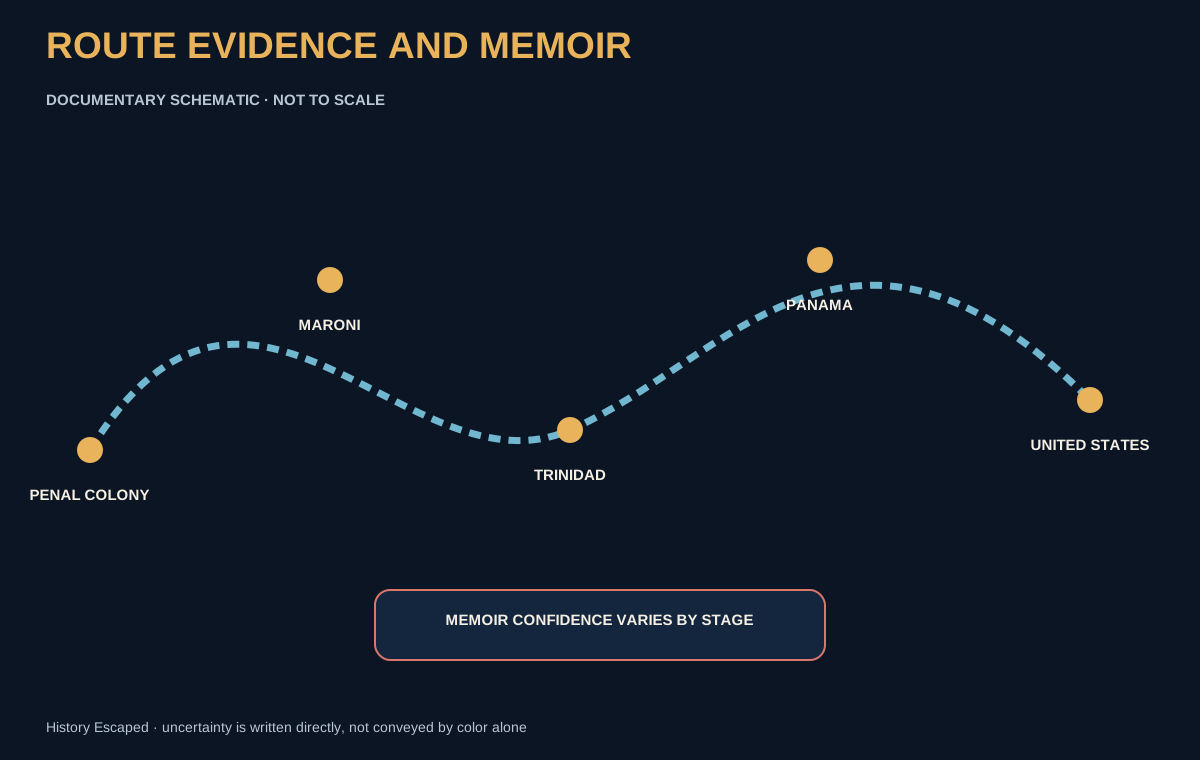
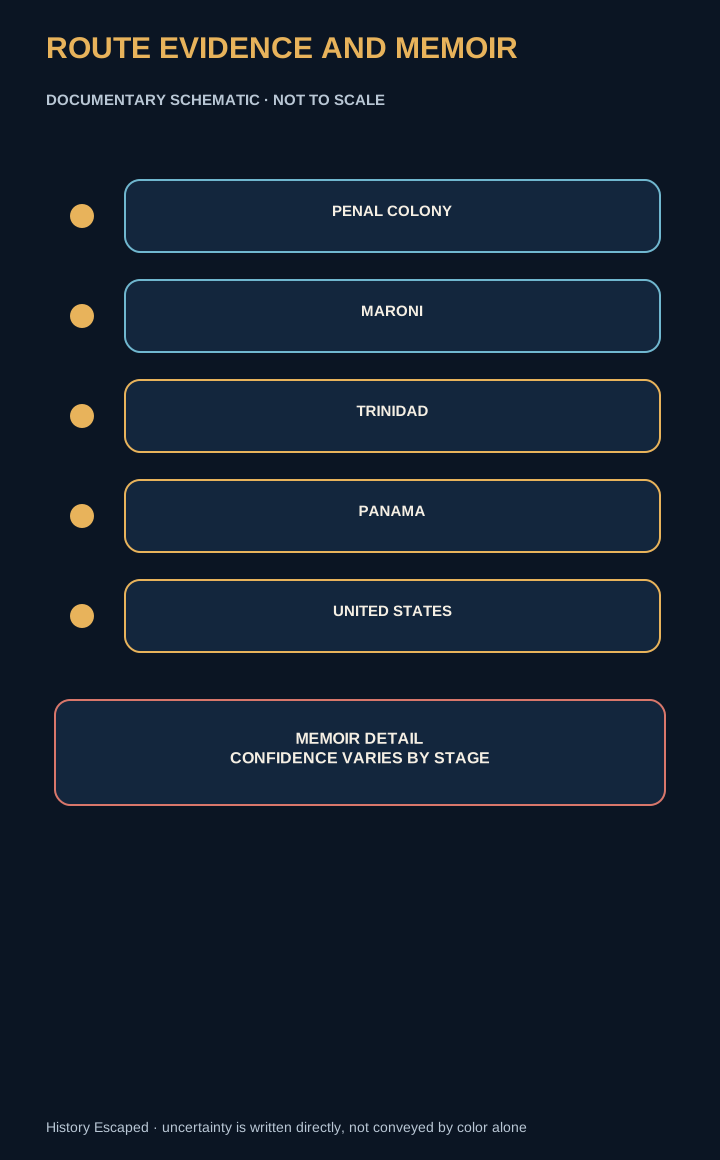
Simplified editorial reconstruction based on the cited historical record; not to scale. Uncertainty is stated directly in the visual and adjacent text.
