
Clément Duval’s best-known escape is often described as a “Devil’s Island” breakout. That phrase is convenient, but it obscures the actual geography of his last months in custody. Duval had spent most of his long sentence in the Îles du Salut, including Île Royale and periods associated with Saint-Joseph, but by 1900 he had been transferred to the Maroni penal system at Saint-Laurent-du-Maroni. His successful escape in April 1901 came from that mainland phase of his imprisonment, not from Île du Diable itself.
The distinction matters for more than geography. Duval was an anarchist whose crime and trial became politically charged, yet French penal law classified him as a transporté—a man sentenced to hard labor—not as a political déporté. His later memoir turned fourteen years in French Guiana into a powerful first-person indictment of the penal colony. It is indispensable testimony, but some of its most vivid escape and travel details are not independently established.
At a Glance
- Escape: April 1901, after transfer to the Saint-Laurent-du-Maroni penal system
- Escape party: Duval and eight other prisoners
- Sentence: Death in January 1887, commuted to hard labor for life
- French Guiana arrival: 24 April 1887 aboard L’Orne
- Firm post-escape anchor: British Guiana by 17 July 1901
- United States: Reached New York in 1903
- Key evidence problem: Later retellings supply a fuller sea route and dramatic escape mechanics than the independently supported record can confirm
An anarchist before the penal colony
Duval was already a committed anarchist before his transportation. In the autumn of 1882 he helped found La Panthère des Batignolles, an anarchist group in Paris’s 17th arrondissement. His politics developed in a milieu where arguments over property, direct action, and revolutionary violence divided not only the French public but anarchists themselves.
The case that ended his life in France began with a burglary at a private residence on the rue de Monceau in October 1886. The property was also set on fire. When police moved to arrest Duval, he violently resisted and wounded the officer Rossignol with a knife. These were not merely political accusations invented by the state: Duval did not try to present himself as an uninvolved victim. Instead, at his trial he gave the burglary an explicitly anarchist meaning, arguing that taking wealth from the propertied class was a form of “restitution.”
That ideological defense later made Duval important in histories of anarchist “individual reclamation” and illegalism. A modern Cambridge study treats his 1886–87 case as an important early moment in the development of illegalist arguments in France. Yet political significance should not erase the underlying acts. Duval was convicted after a burglary, fire, and violent resistance to arrest; his own revolutionary interpretation was a defense of those actions, not an alternative factual description of them.
On 12 January 1887 he was sentenced to death. The sentence was commuted the following month to hard labor for life. French authorities assigned him prisoner number 21551, and he reached French Guiana on 24 April 1887 aboard the transport L’Orne from Toulon.
A transporté, not a political déporté
English-language accounts often describe anyone sent to French Guiana as “deported,” and “Devil’s Island” became a catch-all label for the colony. The French penal administration made sharper distinctions. Men sentenced to hard labor were transportés; political convicts were déportés; repeat offenders assigned under a separate regime were relégués.
Duval’s anarchism therefore did not make him a political déporté in the administrative sense. His commuted sentence was hard labor for life, placing him among the transportés. This also helps explain why identifying his case simply with Île du Diable is misleading. The Îles du Salut consisted of Île Royale, Île Saint-Joseph, and Île du Diable, each serving different functions at different times. Île du Diable became especially associated with political deportees, while Royale and Saint-Joseph were deeply integrated into the wider hard-labor and disciplinary system.
The archival-informed Duval biography compiled by Daniel Dupuy and Marianne Enckell places him in the Îles du Salut for most of his imprisonment and specifically locates him on Île Royale during the anarchist revolt of October 1894. A fellow convict, Auguste Liard-Courtois, later wrote that he had known Duval at the islands and had shared quarters with him at Saint-Joseph. Enckell, who later worked from Duval’s surviving manuscript and checked his story against other sources, explicitly corrected the claim that Duval had been imprisoned on Devil’s Island itself.
Fourteen years inside the Guiana system
Duval spent roughly fourteen years under the French Guiana penal regime. The specialist biographical record says he endured many months in punishment cells and made eighteen escape attempts before the successful one. Later memoir-derived publicity sometimes says twenty or more. Because those figures do not agree, the precise total should not be treated as a settled statistic.
His long confinement also intersected with one of the bloodiest episodes in the history of the Îles du Salut. On 22–23 October 1894, an anarchist revolt at Saint-Joseph ended in killings and repression. Duval survived because he was on Île Royale at the time. Later romanticized accounts placed him closer to the planning than the checked record supports; Enckell specifically corrected that version and stated that he did not directly take part in preparing the revolt.
The broader penal system was itself designed to do more than confine. The 1854 transportation law sent men sentenced to hard labor outside metropolitan France, while the “doublage” rule could bind survivors to Guiana even after their formal sentences. Saint-Laurent-du-Maroni became the administrative center of this colonial penal geography, with convicts distributed among mainland camps, the islands, and other sites according to category and disciplinary status.
For Duval, survival did not produce resignation. His memoir presents the penal colony as a system he resisted at almost every stage, and his political identity remained central to the way he understood punishment. That first-person perspective is valuable for reconstructing his attitudes and memories. It is less secure when used alone to establish exact mechanics, dialogue, weather, or the sequence of every failed escape.
The move to the Maroni
The strongest evidence for Duval’s whereabouts immediately before the successful escape comes from Liard-Courtois’s 1903 book Après le bagne!. Liard-Courtois had tried to help Duval obtain a concession, a status that might have allowed a different form of life within the colonial penal order. He recorded that the administration did not send Duval from the Îles du Salut to the Maroni until July 1900.
A letter from Duval reproduced by Liard-Courtois is dated Saint-Laurent-du-Maroni, 18 August 1900. Duval complained that the concession process had not delivered what had been promised. He wrote that he had briefly been sent to the new camp at Saint-Maurice and returned to Saint-Laurent after four days. Whatever one makes of Duval’s judgments about the administration, the letter is an unusually strong positional anchor: by late summer 1900 he was on the mainland Maroni, not on Île du Diable.
Liard-Courtois added that Duval’s situation still had not materially changed in 1901 and that he escaped soon afterward. The later DIMA reconstruction is more precise: after transfer to Saint-Laurent-du-Maroni, Duval escaped with eight others on 14 April 1901.
The escape of April 1901
The exact date contains a small but genuine conflict. The archive-informed DIMA notice gives 14 April 1901. A 1984 article by Paul Albert, based heavily on the Italian version of Duval’s memoirs, gives 13 April and describes Duval and eight companions departing by canoe at night. Because the later article also contains errors that Enckell subsequently corrected, 14 April is the stronger date for the case chronology, while the one-day disagreement remains part of the evidence record.
The broad event is secure: Duval escaped with eight other prisoners after his transfer to Saint-Laurent. What is less secure is the cinematic sequence attached to it. Albert’s retelling describes a fragile canoe, a night departure, rowing toward open water, a sail raised the next morning, a passing warship, worsening weather, and a difficult night at sea before landfall near Paramaribo.
Those details may preserve genuine memories, but they pass through Duval’s retrospective narrative and later retelling rather than through an independently verified contemporary escape report used here. They should therefore be presented as later recollection, not as scene-by-scene fact. The identities and eventual fates of all eight companions are also not established by the sources assembled for this case, so the size of the party cannot be converted into a count of people who reached lasting freedom.
What the memoir adds—and what it cannot prove
Duval did not write his memoir in 1901. The CIRA archival finding aid states that he wrote it after reaching New York, where he was supported by French and Italian anarchists. Portions appeared in Italian translation beginning in 1907, and a large Italian edition followed later. The surviving French manuscript has its own archival history: it passed through anarchist editors, part of it was lost, and the remainder eventually reached CIRA.
That history does not make the memoir unreliable as a whole. It makes the type of evidence clear. Duval is a primary witness to what he later remembered, how he interpreted the penal colony, and how he wished to present his resistance. His memoir is not, by itself, contemporary administrative confirmation that every route stage, failed attempt, storm, exchange, or exact date happened exactly as later narrated.
The problem is visible in later summaries. A PM Press description of the English edition says Duval made twenty escape attempts and reached New York in 1901. The stronger specialist and archival sources instead give eighteen attempts and place his arrival in the United States in 1903. Those discrepancies are precisely why the memoir tradition and the penal chronology need separate lanes.
From Guiana to New York
The first firm post-escape waypoint is British Guiana. The DIMA notice records that on 17 July 1901 Duval wrote from there to the anarchist editor Jean Grave asking for 500 francs. According to the notice, he had neither work nor money and had only a limited period in which to leave the colony. This dated letter makes British Guiana substantially better supported than some of the more elaborate travel stages in later accounts.
DIMA then places Duval for a time in San Juan, Puerto Rico. The memoir-derived Albert account offers a fuller itinerary: Dutch Guiana near Paramaribo, British Guiana, Martinique, Puerto Rico, and finally departure for the United States on 16 June 1903. The Dutch Guiana and Martinique stages, the exact sailing mechanics, and the exact June departure date are best retained as later recollection unless independent records are produced.
What is well supported is that the escape did not end with an immediate arrival in New York. CIRA’s archival biography states that Duval arrived there in 1903 and was housed by Italian and French comrades. DIMA likewise places his entry into the United States in 1903. The approximately two-year interval between escape and New York was therefore part of the story, not an incidental gap.
After freedom
New York became Duval’s final refuge and the place where his prison experience was turned into a written political legacy. His memories circulated in anarchist publications, especially through Luigi Galleani’s Italian translation, and later editors recovered and republished portions of the French text. Duval remained in the United States for the rest of his life.
His escape matters partly because it survived two competing simplifications. One turns Duval into a romantic “Devil’s Island” escapee and transfers the whole event to the most famous island name. The other turns every autobiographical detail into verified history. The evidence supports a more precise story: an anarchist convicted of serious crimes, legally classified as a hard-labor transporté, spent most of fourteen years in the French Guiana penal system, was moved to Saint-Laurent-du-Maroni, escaped with eight others in April 1901, reached British Guiana, moved through the Caribbean, and arrived in New York in 1903.
That reconstruction leaves some of the most dramatic details unresolved. It is also stronger history for doing so.
Evidence discipline
What the record supports
Status labels distinguish secure conclusions from uncertainty and rejected claims. Color is never the only signal.
MYTH
Duval’s successful 1901 escape was directly from Île du Diable (Devil’s Island).
Contemporary-adjacent correspondence places him at Saint-Laurent-du-Maroni after a July 1900 transfer from the Îles du Salut, and Enckell explicitly corrected the claim that Duval had been jailed on Devil’s Island.
Sources: SRC-003, SRC-010MYTH
Duval was legally a political déporté because he was an anarchist.
French archival terminology distinguishes political déportés from hard-labor transportés. Duval’s death sentence was commuted to travaux forcés à perpétuité, placing him in the transporté category.
Sources: SRC-001, SRC-004, SRC-006DISPUTED
The successful escape occurred on 13 April 1901.
A 1984 memoir-derived retelling gives 13 April; the archive-informed specialist biography gives 14 April, which is used as the canonical case date.
Sources: SRC-001, SRC-009, SRC-010DISPUTED
Duval made exactly twenty or more escape attempts.
DIMA reports eighteen attempts; memoir-derived retelling and modern promotional material report more than twenty or twenty. Those incompatible counts remain unresolved.
Sources: SRC-001, SRC-008, SRC-009LATER CLAIM
The exact post-escape route ran through Dutch Guiana, British Guiana, Martinique, Puerto Rico, with departure for the United States on 16 June 1903.
That full itinerary and exact departure date are preserved in a later memoir-derived account. British Guiana by 17 July 1901, a later stay in Puerto Rico, and United States arrival in 1903 are better supported independently.
Sources: SRC-001, SRC-002, SRC-009MYTH
Duval reached New York in 1901 immediately after his escape.
CIRA and DIMA place his United States arrival in 1903; the 1901 claim appears in modern promotional copy and compresses a roughly two-year journey.
Sources: SRC-001, SRC-002, SRC-008Documentary reconstruction
French Guiana to New York: evidence layers
A case-local editorial visual separates the documented sequence from uncertainty without implying exact modern geography or operational detail.
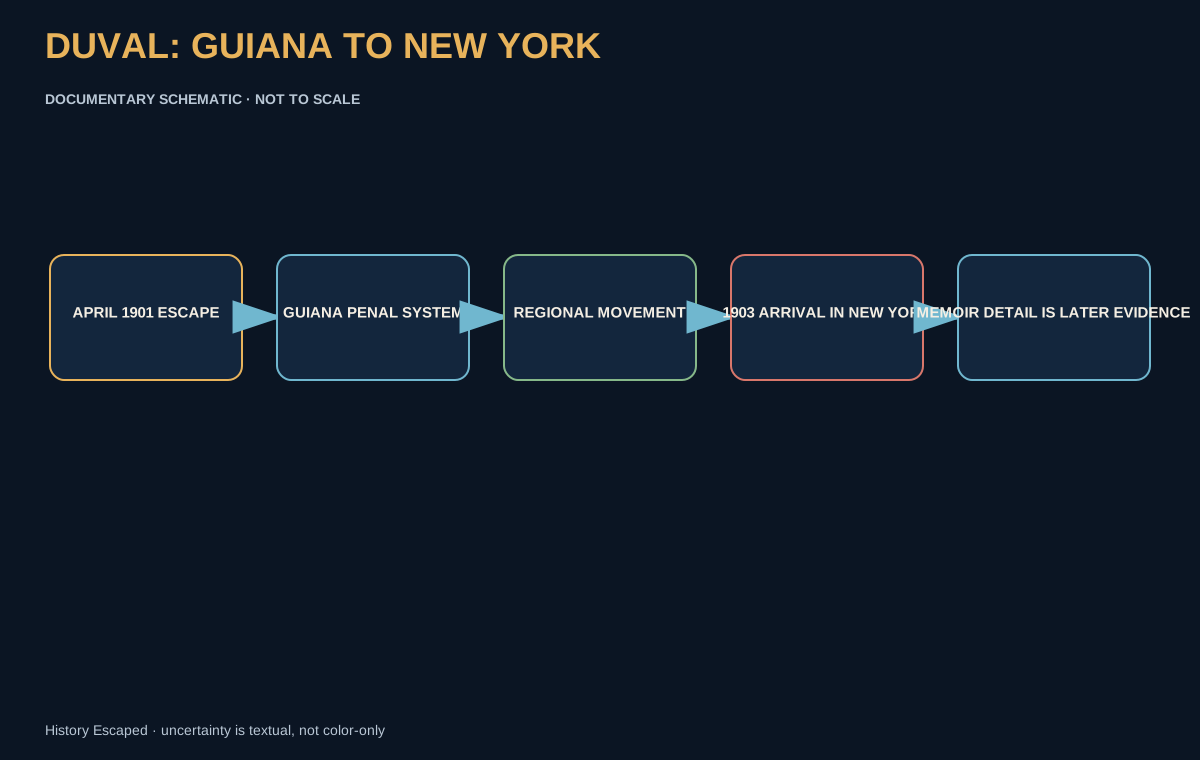
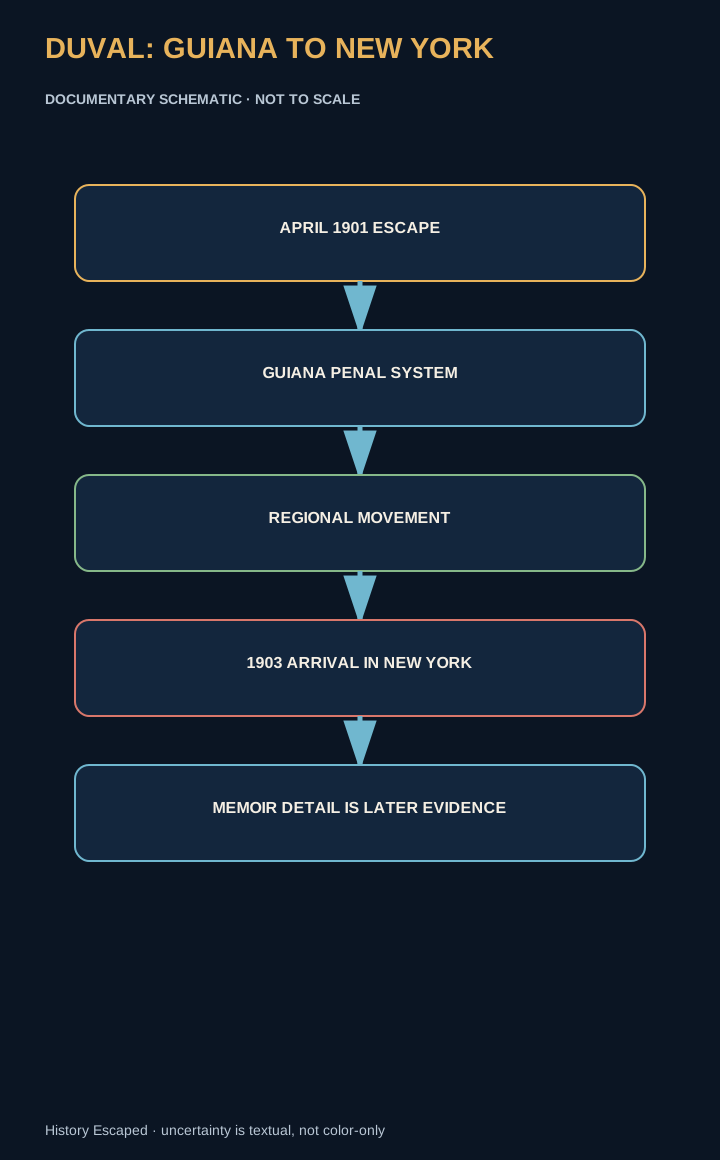
Simplified editorial reconstruction based on the cited historical record; not to scale. Uncertainty is stated directly in the visual and adjacent text.