
Napoleon's departure from Elba on February 26, 1815 was an escape in a political sense rather than a conventional prison break. The Treaty of Fontainebleau had made him sovereign of the island, with his own administration, troops, and vessels, but the settlement was also meant to keep him away from France. That evening he boarded the brig Inconstant at Portoferraio while soldiers, officers, sailors, and civilians loaded into a seven-vessel flotilla. He was not slipping away alone; he was carrying the nucleus of a force back toward France. Twenty-two days later, he was back in the Tuileries.
Elba was exile—but it was also Napoleon's country
The Treaty of Fontainebleau created one of history's strangest forms of exile. Napoleon renounced his claims to France and Italy. In return, Elba was made a separate principality that he would possess in sovereignty and property for life. The treaty also promised money.
Napoleon arrived at Portoferraio in May 1814 and began behaving like what the agreement said he was: a sovereign. He reorganized administration. He worked on roads and local resources. He maintained a small court.
Bertrand, Drouot and Cambronne held important posts. A compact military force remained loyal to him. The Inconstant gave him a naval instrument. Calling the departure an "escape from Elba" requires a distinction.
Napoleon was politically exiled and watched. He was not imprisoned in the way he would later be confined on Saint Helena.
The arrangement was already fraying
The Fontainebleau settlement looked more stable on paper than it felt on Elba. The French money promised to Napoleon did not arrive as expected. Fondation Napoléon scholarship treats the financial problem as a major pressure. Security fears mattered too.
European statesmen were already discussing whether Elba was too close to France and Italy. Napoleon also knew that the Bourbon Restoration was not universally popular. Former soldiers resented changes in status and opportunity. Supporters of the Revolution worried about restored émigrés and older privileges.
Napoleon's networks carried political information across the Mediterranean. None of these factors proves that his return was inevitable. Together they made staying on Elba look increasingly dangerous and leaving increasingly imaginable.

Neil Campbell watched him—but not as a jailer
Colonel Sir Neil Campbell represented British attention to Napoleon's behavior. His presence mattered. So did his absence. On February 16, Campbell left Elba for Florence.
Napoleon understood that this gave him a short window. Repairs and preparations around the Inconstant could now be pushed forward with less immediate British scrutiny. Fondation Napoléon research describes the brig being repaired, rearmed and altered in appearance. The vessel was associated so closely with Napoleon's island regime that reducing its obvious identity could matter at sea.
The preparations were not invisible. The goal was not to fool every person on Elba. The goal was to prevent the warning from reaching someone who could stop the flotilla.

The secret was the destination
This is another place where the legend becomes too cinematic. Napoleon did not vanish from an unsuspecting island. By February 26, people knew something was happening. Island dignitaries were informed.
Crowds gathered. Troops understood that they were going somewhere. But Napoleon controlled the crucial information. Observers who wanted to reach the mainland were prevented from leaving the ports in time.
The destination remained concealed until the expedition was committed. That was enough. A perfect secret was unnecessary. A delayed alarm was useful.
Seven vessels, not one
The Inconstant was the center of the expedition. It was not the whole expedition. Six smaller vessels accompanied it. Together they carried roughly 1,100 people.
The exact breakdown varies by source and the meaning of "men" changes depending on whether civilians and crews are counted, but the scale is secure. This was not Napoleon and ten friends. It was a compact political-military force containing veterans of the Guard, Polish lancers, Corsican troops, gendarmes, officers, servants and sailors. Napoleon was leaving exile with the nucleus of an army.
The fleet sailed on February 26
Napoleon boarded in the evening. Fondation Napoléon chronology places him aboard at roughly seven o'clock and the flotilla underway around nine. Behind him remained his mother and sister. Ahead was a sea crossed by vessels that could end the operation before it became a political crisis.
A British sloop could stop him. A French royal warship could stop him. Even a suspicious captain who reported what he had seen could give the Bourbon government time to prepare the coast. The next problem was therefore not France.
It was recognition.
The crossing was an exercise in not looking dangerous
The flotilla was small enough to be vulnerable and large enough to be suspicious. The expedition had to pass commercial and military traffic without provoking inspection. Men could be kept out of obvious sight. The Inconstant's appearance had been altered.
The ships did not need to sail in a dramatic tight formation announcing an expeditionary force. Surprise did most of the work. Then came the encounter that later writers loved.
The Zéphyr passed close enough to end the story
The French brig Zéphyr came near the Inconstant. Later accounts describe soldiers ordered to hide their distinctive appearance while officers of the two ships exchanged ordinary remarks. The captains or officers knew one another. The Zéphyr's commander reportedly asked after Napoleon's health.
According to the later narrative, Napoleon himself answered that he was very well. It is a remarkable story. It is also exactly the kind of polished scene that should be handled carefully. The close encounter is well supported in multiple later accounts.
The precise dialogue is retrospective. The secure point is operational:
a royal French warship came close enough to discover the expedition and did not stop it.
Was the French Navy secretly helping Napoleon?
It is tempting to turn the missed interception into conspiracy. The evidence does not require it. Fondation Napoléon itself uses cautious language about the mixture of surprise, hesitation and possible sympathy that allowed the flotilla through. The simplest historical conclusion is stronger than the conspiracy:
the surveillance system failed. Napoleon got past it.
March 1: France
The flotilla reached the coast on March 1. The landing point was Golfe-Juan. Not Cannes. Cannes came next.
That distinction seems small until a route map is built. Golfe-Juan was the beachhead, positioned between Cannes and Antibes.
The expedition began unloading men and equipment. Napoleon was back on French soil. But the first political test went badly.
Antibes refused him
Napoleon sent men toward Antibes hoping the garrison would rally. It did not. The detachment was detained. That failure mattered because it exposed the weakness beneath all the confidence.
Napoleon could not conquer France with the force he had brought from Elba. He needed French soldiers to change sides. Every hour spent waiting on the coast gave the Bourbon state time to organize. The expedition therefore moved.
Why he did not march straight up the Rhône
The easiest road was not necessarily the safest road. Lower Provence contained strong royalist sentiment and royal troops. Napoleon chose the harder interior route. The column moved through Cannes and toward Grasse.
Then it climbed into the Alpine interior. The modern commemorative Route Napoléon preserves the broad line through places such as Castellane, Digne, Gap, Corps and Laffrey before Grenoble. The road is remembered today because it solved a political geography problem in 1815. Napoleon was not merely moving north.
He was choosing where he believed he could survive until the army began joining him.
The physical march was harder than the map suggests
A modern road compresses the difficulty. In 1815 the expedition used steep roads, mountain paths and sections more suited to pack animals than heavy military movement. Artillery and baggage slowed the column. Some equipment had to be improvised or abandoned.
The force had little room for a major fight. Its advantage was speed. Its greatest weapon was news. Every village that welcomed Napoleon made the next village more likely to believe he was winning.
Every soldier who defected made the next regiment more likely to hesitate. The expedition was creating momentum faster than the Bourbon government could destroy it.
The proclamations were part of the escape equipment
Napoleon had prepared appeals to the French people and the army. During the voyage, copies were made. The language was calculated. He did not present himself simply as an invader returning with a private faction.
He presented himself as the embodiment of military glory and revolutionary-national achievements betrayed by the Restoration. The most famous image was the eagle flying from steeple to steeple toward Notre-Dame. That phrase gave the march its enduring nickname:
the Flight of the Eagle.
The proclamation was not decoration. It was recruitment.
Gap proved the message was spreading
By March 5 Napoleon was in Gap. The expedition was still vulnerable. But it was no longer unknown. Proclamations circulated.
Crowds gathered. Local officials and soldiers had to decide how seriously to resist a man who might be emperor again in a week. Then the column moved toward the point where persuasion would either become power or fail.
Laffrey was the hinge
On March 7, near Laffrey, royal troops blocked the road. A battalion of the 5th Regiment of the Line had orders to stop Napoleon. This was the moment the whole enterprise had been avoiding. At sea, he had avoided a naval fight.
In Provence, he had avoided strong royalist concentrations. Now there was no route around the soldiers in front of him. If they fired effectively, the Elban force could be shattered. Napoleon moved toward them.
The famous open-coat speech belongs partly to legend
The story told in countless paintings and schoolbooks is irresistible. Napoleon walks forward alone. He opens his gray coat. He challenges any soldier who wants to kill his emperor to fire.
The soldiers break ranks and rush to him. The core event is real. The exact speech is less secure. Fondation Napoléon explicitly introduces the polished quotation with the equivalent of "according to legend."
That matters. The scene belongs in the story, but only as later remembered tradition rather than verbatim fact. It should separate two levels of evidence. Documented: Napoleon personally confronted the troops, they did not fire, and the 5th rallied.
Later legendary form: the exact theatrical wording and gesture as repeated in art and commemoration. The event needs no invented certainty to remain extraordinary.
The 5th Regiment changes sides
Delessart's men did not stop the column. They joined it. That changed the mathematics of the expedition. The obstacle had become reinforcement.
Then came another crucial defection. Colonel Charles de La Bédoyère brought the 7th Regiment of the Line over to Napoleon. By the time the column reached Grenoble, Napoleon was no longer relying only on the men who had sailed from Elba. The French army itself was beginning to move with him.
Grenoble turned an expedition into a restoration
Grenoble's authorities tried to resist. The gates were closed. Royal commanders had artillery. But soldiers and civilians inside the city were increasingly unwilling to defend the Bourbon government against Napoleon.
The resistance collapsed. Napoleon entered on the evening of March 7. Later he summarized the transformation with a line remembered from Saint Helena: before Grenoble he had been an adventurer;
at Grenoble he was a prince. Whether or not every remembered phrase is exact, the political logic is right. Before Grenoble, the government could still portray him as a fugitive landing with a private band. After Grenoble, an important city and regular French regiments had joined him.
The march became harder to stop because everyone could see it becoming harder to stop
Napoleon reached Lyon on March 10. That was another threshold. He could issue decrees. He could act increasingly like a ruler rather than a rebel.
Officials who had remained loyal to Louis XVIII now faced the possibility that obedience to the king might soon become politically dangerous. Troops sent against Napoleon had to wonder whether the units beside them would actually fire. This is why the return accelerated. It became self-reinforcing.
The appearance of success generated real success.
Europe saw something different
The powers at Vienna did not treat the return as a romantic homecoming. On March 13 they formally declared Napoleon an enemy and disturber of the peace. From their perspective, the system built after two decades of revolutionary and Napoleonic war was being challenged by one man who had renounced the French throne and then reclaimed it.
The peaceful character of the march to Paris did not mean the event was peaceful in its consequences. Europe began preparing for war again.
Ney did not stop Napoleon at Laffrey
Another common memory error compresses several military episodes. Marshal Ney is sometimes placed directly into the famous Laffrey confrontation. He was not the commander facing Napoleon there. The immediate obstacle involved the 5th Regiment under Delessart.
La Bédoyère and the 7th joined later the same day. Ney's change of sides came later in the march. The distinction matters because Napoleon's success did not begin with one giant marshal changing his mind. It began lower down.
Ordinary line soldiers refused to fire. Then regiments changed sides. Then senior commanders followed the new political reality.
Auxerre and the road to Paris
By March 17 Napoleon was at Auxerre. The tiny Elban expedition had effectively disappeared inside a much larger political movement. The Bourbon government's options narrowed. Louis XVIII still occupied the throne legally.
Napoleon increasingly controlled the loyalty that made the throne enforceable. On March 19, the king left Paris. The capital was open.
March 20: the Tuileries
Napoleon entered Paris on March 20. Contemporary and near-contemporary prints quickly transformed the return into popular spectacle. The Tuileries became the final visual symbol of the operation. Twenty-two days earlier Napoleon had been on Elba.
Nineteen days earlier he had stood on a beach with roughly 1,100 followers and no guarantee that France would accept him. Now the Bourbon king was gone. Napoleon was again governing from the imperial palace.
Why the escape worked
The popular explanation is charisma. Charisma mattered. It is not enough. The return worked because several systems failed together.
The Fontainebleau settlement put Napoleon too close to France and let him retain enough sovereignty to possess ships and troops. British observation was intermittent. The French payments promised to him were not fully honored. The Bourbon government had alienated parts of the army and public.
Naval interception failed. The Antibes setback did not trap him. The mountain route avoided some of the strongest immediate royalist opposition. The 5th Regiment would not fire.
The 7th joined. Grenoble opened. Lyon followed. Then the government lost the ability to convince the next regiment that resistance was worth the risk.
It was an escape that changed what “success” meant at every stage
At Portoferraio, success meant leaving before Campbell could intervene. At sea, success meant not being recognized and stopped. At Golfe-Juan, success meant getting the expedition ashore. In the mountains, success meant surviving long enough to reach a French army unit.
At Laffrey, success meant making that army refuse its orders. At Grenoble, success meant becoming politically credible. At Paris, success meant becoming emperor again. That is why the Elba episode is much larger than a maritime escape.
The ship only carried Napoleon out of exile. The road carried him back to power.
The legend and the evidence
The story later accumulated perfect scenes. The disguised brig. The friendly conversation with the Zéphyr. The open gray coat at Laffrey.
The eagle flying from steeple to steeple. The triumphant arrival at the Tuileries. Some are securely documented. Some are later polished versions of real events.
Some compress multiple events into one image. The strongest reconstruction does not need to choose between cynicism and legend. It can show why the legend formed. For twenty-two days in 1815, nearly every gamble worked.
Then Europe mobilized. The Hundred Days had begun.
Escape reconstruction
How the escape unfolded
An evidence-aware sequence of the principal stages.
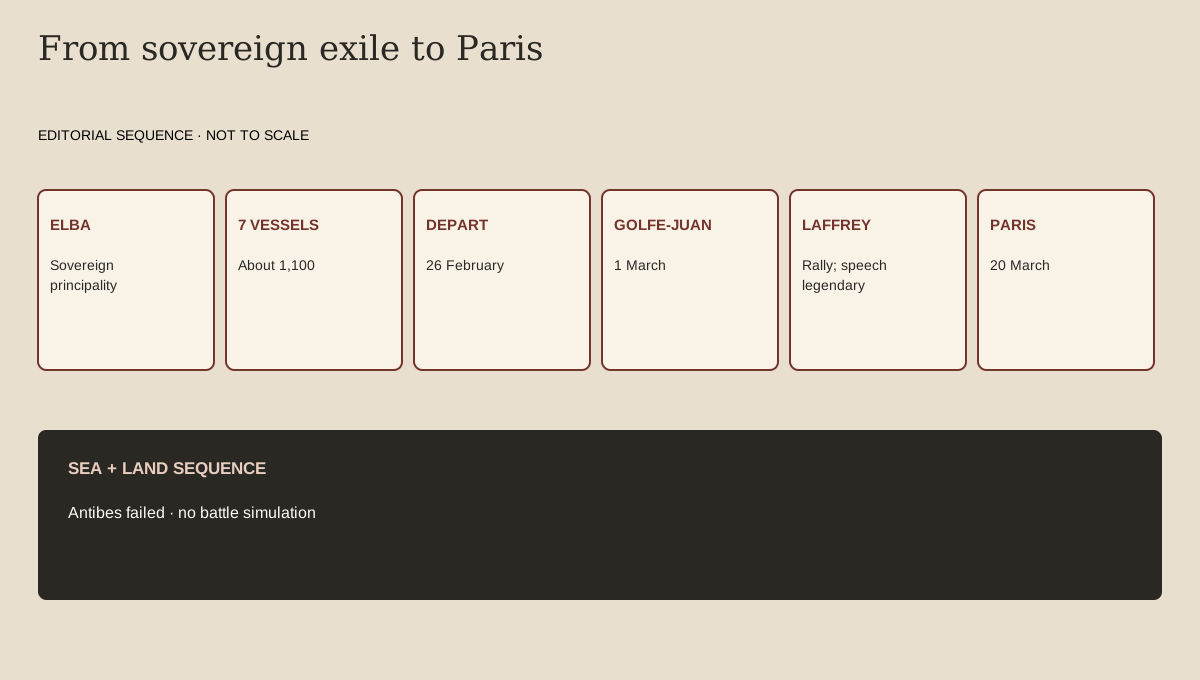
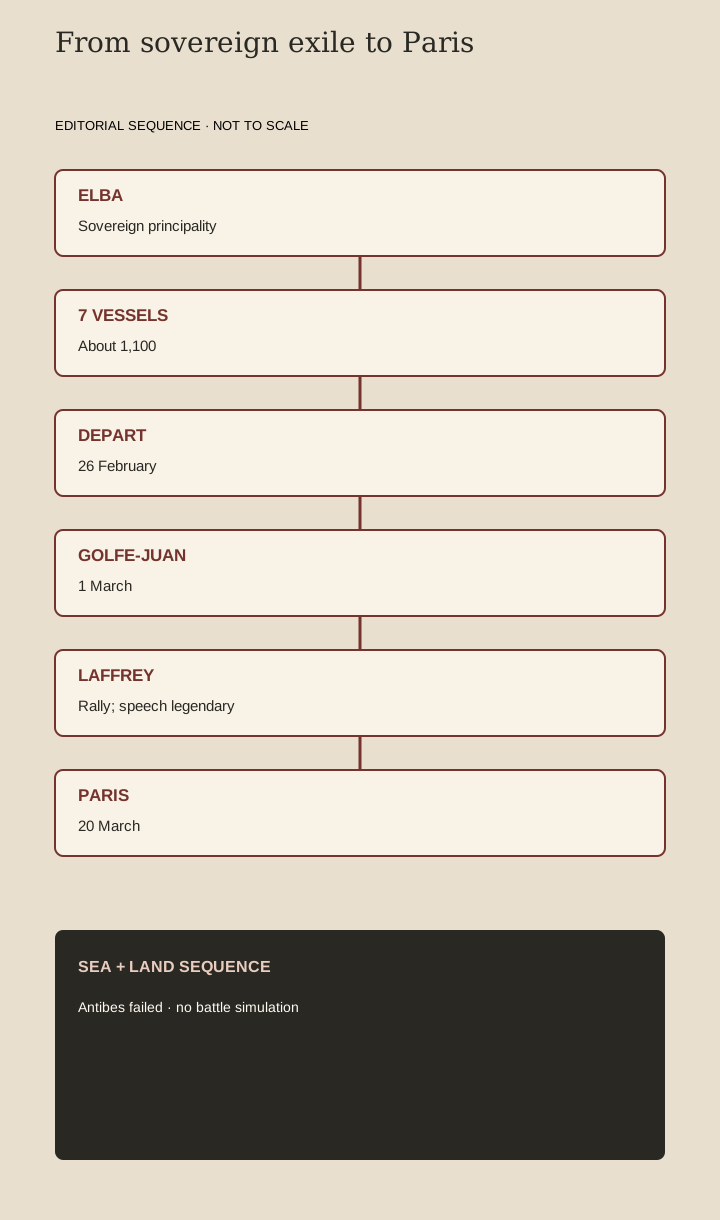
Simplified editorial reconstruction; not to scale. See adjacent text for evidence qualifications and unresolved details.
Material evidence
Tools of Escape
The objects used in an escape reveal how a plan worked under constraint.
- 01It carried Napoleon and much of his most loyal guard across the Mediterranean and was prepared to reduce the chance of easy recognition.
Inconstant
Napoleon's principal brig and the flagship of the seven-vessel expedition.
- 02The flotilla allowed Napoleon to move an expeditionary force rather than flee as an individual.
Seven-vessel flotilla
The Inconstant was accompanied by six smaller vessels carrying troops, equipment, officers, and civilians.
- 03The operation depended on converting a tiny landing force into a political movement before the Bourbon government could isolate it.
Army and popular proclamations
Napoleon dictated proclamations during the voyage and prepared them for distribution after landing.
- 04The choice reduced immediate exposure to strongly royalist areas and major garrisons.
Mountain roads
The inland route from the Mediterranean toward Grenoble used difficult Alpine roads and tracks rather than the easier Rhône corridor.
- 05At Laffrey, political legitimacy and military loyalty mattered more than numerical strength.
Personal military reputation
Napoleon deliberately approached troops ordered to stop him and relied on their memory of imperial service and reluctance to fire.
Problem → response
Escape was a sequence of problems
Each response solved a practical obstacle while often creating the next one.
- 01→
Obstacle
British observation on Elba
Campbell's presence and British naval attention made open preparation risky.
Response
Napoleon accelerated final preparations during Campbell's absence and restricted information leaving the island.
- 02→
Obstacle
Naval interception
British and French vessels in the Mediterranean could have ended the expedition before it reached France.
Response
The flotilla used surprise, a less recognizable appearance, dispersed movement, and ordinary exchanges to avoid provoking inspection.
- 03→
Obstacle
Failure at Antibes
A detachment sent to persuade the Antibes garrison to rally failed and was detained.
Response
Napoleon abandoned the attempt and moved quickly inland rather than waiting on the coast.
- 04→
Obstacle
Royalist strength in lower Provence
The most direct routes north risked stronger royalist resistance.
Response
The expedition took the more difficult mountain route through Grasse, Digne, Gap, and the Alpine interior.
- 05→
Obstacle
The 5th Regiment at Laffrey
Royal troops physically blocked the route to Grenoble and could have ended the expedition with disciplined fire.
Response
Napoleon approached and addressed them; the unit refused to fire and rallied to him.
- 06→
Obstacle
Closed gates at Grenoble
Grenoble's royal authorities attempted to deny entry even after nearby troops began defecting.
Response
The royal defense collapsed as troops and inhabitants sided with Napoleon, and he entered the city on March 7.
- 07→
Obstacle
Need for momentum
A force of roughly 1,100 could not defeat the Bourbon state by conventional invasion.
Response
Napoleon moved quickly, issued proclamations, absorbed defecting units, and treated each successful rally as evidence that the next one would follow.
The final accounting
Outcome
Napoleon reached France
He landed successfully at Golfe-Juan on March 1.
Initial expedition force
Roughly 1,100 people crossed from Elba in seven vessels.
Paris restored to Napoleon
Napoleon entered the Tuileries on March 20 after Louis XVIII withdrew.
Conventional battles fought on the march to Paris
The decisive advances to Grenoble, Lyon, and Paris came through defections, political collapse, and intimidation rather than a pitched battle.
Evidence discipline
What the record supports
Status labels distinguish secure conclusions from uncertainty and rejected claims. Color is never the only signal.
MYTH
Elba was a conventional prison island from which Napoleon physically broke custody.
The Treaty of Fontainebleau made Elba a separate principality held by Napoleon in sovereignty and property for his lifetime. He had a government, troops, and vessels. British observation mattered, but his departure was closer to a covert flight from supervised political exile than a prison break.
Sources: SRC-001, SRC-005, SRC-020MYTH
Napoleon escaped completely alone or with only a handful of companions.
He sailed with a seven-vessel flotilla and roughly 1,100 soldiers, sailors, officers, and civilians. The operation was a small invasion force, not an individual flight.
Sources: SRC-002, SRC-007, SRC-009MYTH
The departure was totally secret from everyone on Elba until the ships vanished.
Napoleon concealed the destination and controlled information, but final preparations were visible and island dignitaries and crowds knew he was leaving. The secrecy lay primarily in preventing timely warning and interception.
Sources: SRC-002, SRC-004WELL-SUPPORTED
The Inconstant was prepared to look less obviously like Napoleon's vessel.
Fondation Napoléon material describes the brig as altered or disguised in a British style during final preparations, part of a broader effort to avoid recognition at sea.
Sources: SRC-004, SRC-019MYTH
Napoleon landed at Cannes.
The expedition landed at Golfe-Juan on March 1 and then moved to Cannes, where the first mainland bivouac was established.
Sources: SRC-009, SRC-010MYTH
Napoleon returned to France with 11,000 men.
Strong Fondation Napoléon sources give approximately 1,100. Occasional secondary pages contain an extra zero or larger rounded figures that conflict with the better-supported expedition scale.
Sources: SRC-007, SRC-009LATER CLAIM
Napoleon's exact famous Laffrey speech is preserved as a verbatim contemporary transcript.
The confrontation with the 5th Regiment and its refusal to fire are well supported. Fondation Napoléon explicitly introduces the famous open-coat quotation as legend. The event is secure, while the polished quotation belongs to later memory.
Sources: SRC-007, SRC-008MYTH
Marshal Ney personally commanded the troops that confronted Napoleon at Laffrey.
The immediate Laffrey confrontation involved a battalion of the 5th Regiment under Delessart; La Bédoyère's 7th Regiment joined later that day. Ney's rally came later in the march.
Sources: SRC-003, SRC-007, SRC-008UNKNOWN
The Zéphyr episode proves the French Navy deliberately collaborated with Napoleon.
Later accounts describe the close encounter and failure to identify or stop the Inconstant. Fondation Napoléon notes that hesitation or even complicity is difficult to disentangle. The safe conclusion is that interception failed, not that an organized naval conspiracy is proven.
Sources: SRC-002, SRC-012MYTH
The promised French pension was irrelevant to Napoleon's decision to leave Elba.
The Fontainebleau settlement promised Napoleon substantial annual revenue, and Fondation Napoléon scholarship treats the Bourbon government's failure to make the expected payments as one important pressure among several, alongside security fears and political opportunity in France.
Sources: SRC-005, SRC-006Selected chronology
Selected chronology
Treaty of Fontainebleau
The settlement confirms Napoleon's abdication and grants him Elba as a separate principality held in sovereignty and property for life, together with promised financial provisions.
Napoleon reaches Elba
He lands at Portoferraio and begins ruling the island principality.
Campbell leaves Elba
British commissioner Neil Campbell departs for a stay in Florence, creating the surveillance gap Napoleon uses for final preparations.
Departure from Portoferraio
Napoleon boards the Inconstant and sails with six additional vessels.
Dangerous naval encounters
The flotilla passes through waters where British and French vessels could have intercepted it; the close meeting with Zéphyr becomes the best-known episode.
Golfe-Juan
The expedition lands in France and moves toward Cannes.
Grasse and the inland route
Napoleon passes through the Grasse area and commits to the mountain road toward Grenoble.
Gap
Napoleon reaches Gap as proclamations and news of the expedition spread through the region.
Laffrey and Grenoble
The 5th Regiment fails to stop Napoleon, La Bédoyère's 7th Regiment joins him, and he enters Grenoble that evening.
Lyon
Napoleon enters Lyon as his return shifts from a vulnerable expedition into a rapidly expanding restoration of imperial authority.
European powers outlaw Napoleon
The powers gathered at Vienna formally characterize Napoleon as an enemy and disturber of the peace.
Auxerre
Napoleon reaches Auxerre as military defections and political momentum continue.
Louis XVIII leaves Paris
The Bourbon king abandons the capital as Napoleon approaches.
The Tuileries
Napoleon enters Paris and resumes power, opening the political phase conventionally called the Hundred Days.