
How three convicts turned the geography meant to imprison them into the route that carried them out
Port Arthur did not depend on walls alone. Its strongest barrier was geography.
The penal settlement occupied the Tasman Peninsula, a place connected to the country farther north by the narrow land bridge at Eaglehawk Neck. Guards watched the crossing. A line of tethered dogs was intended to detect anyone trying to slip past. For a prisoner hoping to escape Port Arthur and remain free, getting away from a work party was only the beginning. The real problem was getting off the peninsula.
On 26 December 1842, Martin Cash, Lawrence Kavenagh and George Jones found a way around that problem. They absconded from a stone-quarry gang, disappeared into dense scrub, waited while the authorities searched for them, and then approached Eaglehawk Bay. Rather than attempt the guarded neck on land, they entered the water and swam around the barrier.
The escape was successful. The three men emerged beyond Port Arthur’s immediate system of control and became the bushranging band later known as Cash and Company. Cash would remain at large for months, not permanently. Yet the method of the escape made it one of the most memorable breakouts associated with Port Arthur: the security system concentrated force at the obvious route, and the fugitives chose the route the system was least designed to defend.
The prison was larger than the prison buildings
Port Arthur’s reputation for security rested partly on the landscape surrounding it. The settlement lay on the Tasman Peninsula, and Eaglehawk Neck formed the narrow connection toward the Forestier Peninsula and the rest of Van Diemen’s Land. Authorities fortified that bottleneck with a small military establishment and the famous dog line.
The dogs were not decorative. Tethered across the narrow isthmus, they were intended to give warning when an escaped prisoner tried to cross. Guards, military patrols and the difficulty of moving through the surrounding bush added further layers of control. A prisoner who merely vanished from Port Arthur still had to survive an environment in which the most practical land exit had been turned into a checkpoint.
That structure explains why Cash’s escape is more than a story about three men running from a work party. They had to solve two problems in sequence: first disappear from immediate custody, then bypass the peninsula’s main security barrier.
Martin Cash was already an experienced absconder
Cash was born in County Wexford, Ireland, in 1808. The official record places his 1827 conviction under housebreaking, followed by a seven-year sentence of transportation. Cash later gave a more dramatic account of the episode, claiming that he had fired at a romantic rival. That version became part of his legend, but it should not replace the recorded conviction.
After transportation to New South Wales, Cash eventually moved to Van Diemen’s Land. In 1840 he received another seven-year sentence after a larceny conviction. During the next several years he escaped repeatedly. One period of evasion lasted a long time before he was returned to custody, and further punishment ultimately brought him to Port Arthur.
This history matters because the Boxing Day escape was not an impulsive first attempt by a novice. Cash had practical experience of absconding, pursuit and recapture. His later published narrative says that, while at Port Arthur, he observed the settlement with escape in mind. That statement is plausible, but the memoir must be handled carefully: it was produced decades afterward with substantial literary involvement from James Lester Burke. The broad fact that Cash planned to escape fits the circumstances; the memoir’s precise conversations and dramatic details cannot automatically be treated as contemporary evidence.
Escape sequence
The guarded land route and the water bypass
The dog line controlled the road. Cash, Kavenagh, and Jones instead used the water, though exact swim points are unknown.
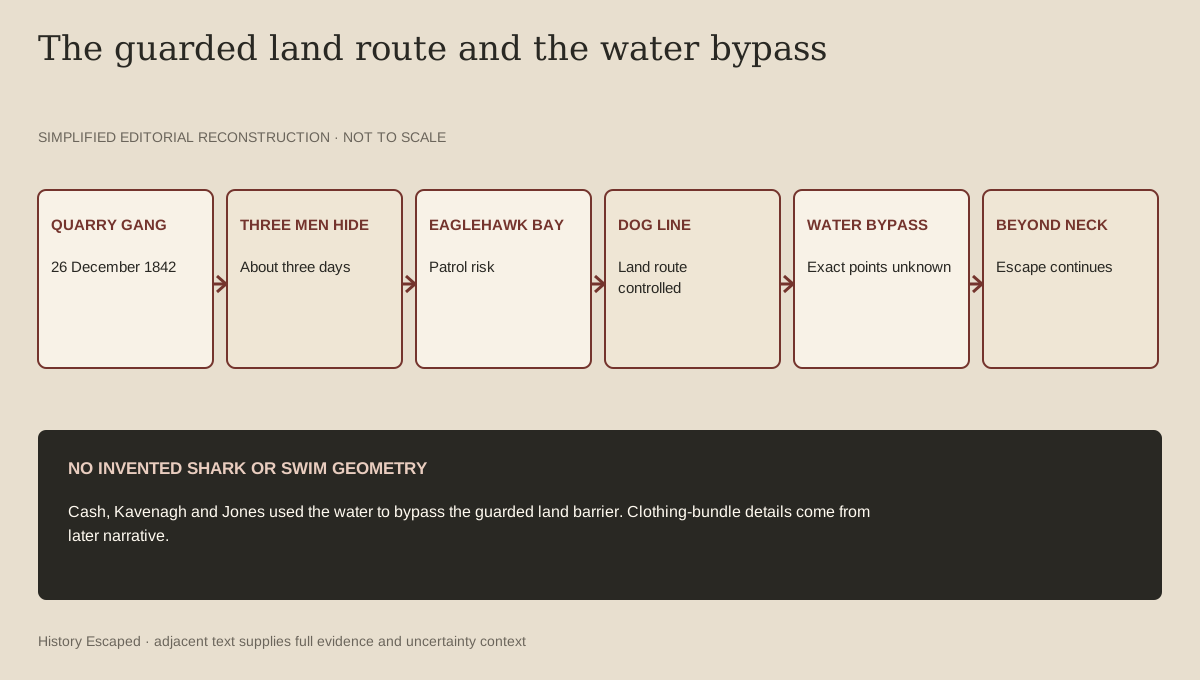
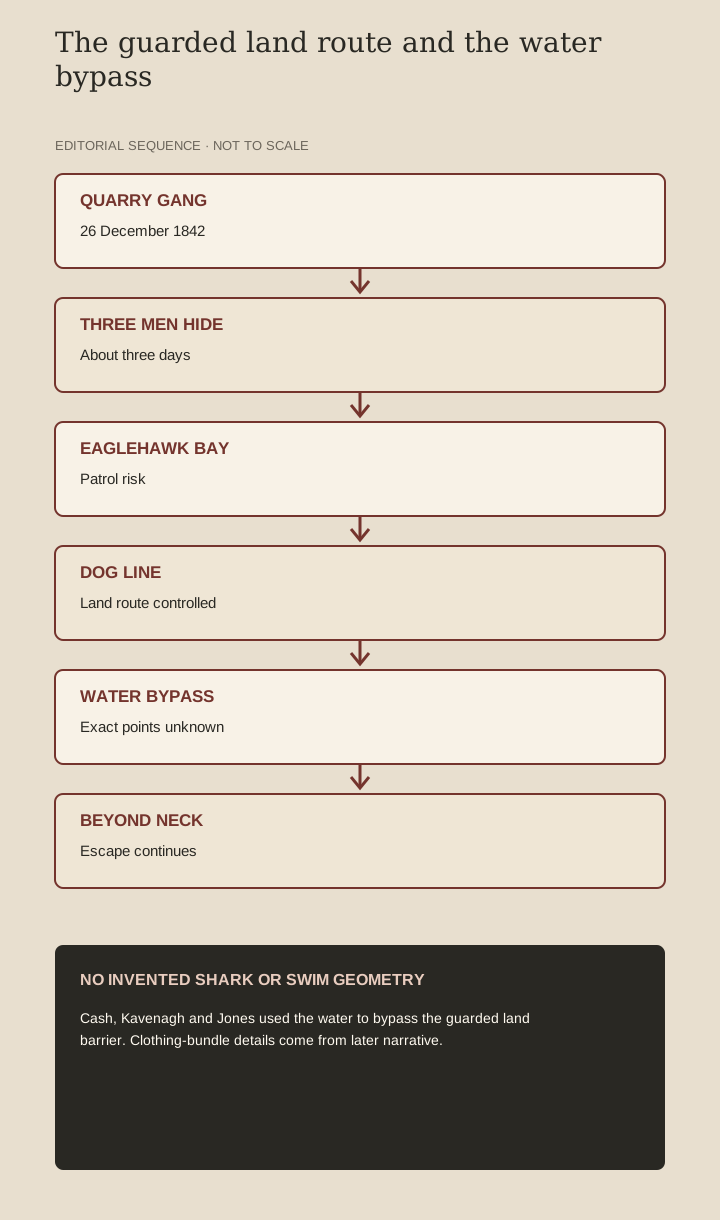
Simplified editorial sequence; not to scale. Exact route and swim points are unknown, and sharks are not depicted as observed fact.

Boxing Day: three men leave the quarry gang
The clearest modern institutional reconstruction places the breakout on Boxing Day, 26 December 1842. Cash, Lawrence Kavenagh and George Jones were working with a stone-quarry gang when they absconded into the bush.
Their first objective was not distance. It was concealment.
According to the State Library of New South Wales reconstruction, the fugitives hid in thick scrub for three days before moving across country toward Eaglehawk Bay. At points they had to move through heavy undergrowth while avoiding military patrols. The logic was strong: a rapid dash toward Eaglehawk Neck immediately after discovery would take them toward the place where the authorities most expected an escapee to appear. By remaining hidden, the trio let the first phase of the search develop while they stayed close enough to continue later.
The exact hour-by-hour route is not securely documented, and no responsible reconstruction should pretend otherwise. The important sequence is well supported: they left the quarry gang, concealed themselves, then worked toward the water near the guarded neck.
Problem → response
Escape was a sequence of problems
Each response solved a practical obstacle while often creating the next one.
- 01→
Obstacle
Military patrols
Search parties and military personnel watched routes away from Port Arthur and toward the peninsula’s chokepoints.
Response
The trio concealed themselves in thick scrub and moved covertly toward Eaglehawk Bay.
- 02→
Obstacle
Eaglehawk Neck dog line
A tethered line of dogs and guards watched the narrow land crossing from the Tasman Peninsula.
Response
Cash, Kavenagh and Jones bypassed the land barrier by entering the water and swimming around it.
- 03→
Obstacle
Peninsula geography
The landscape concentrated practical movement toward narrow connections watched by the authorities.
Response
The escapees substituted a hazardous water route for the controlled land route.
The dog line controlled the road. The water went around it.
Eaglehawk Neck was designed to turn geography into confinement. Anyone crossing the isthmus on land risked guards and the tethered dogs that watched the narrow passage. Cash, Kavenagh and Jones did not need to defeat that barrier in the way it was intended to be defended. They needed to avoid it.
They entered Eaglehawk Bay and swam around the guarded crossing.
Later retellings often make the scene even more dramatic. The State Library exhibition describes the men piling their clothes on their heads as they swam and notes sharks that were believed to inhabit the waters. Other later versions say the bundles were lost and that the men had to find clothing afterward. Those details are memorable, but the evidence is not equally strong for every part of the story. The swim itself is supported across major institutional accounts. An actual shark encounter is not. “Shark-infested” should therefore be treated as a feature of the historical danger story, not proof that sharks were physically present around the swimmers.
What can be said with confidence is already striking enough. The line of dogs covered the land crossing. The fugitives went into the bay and passed outside the barrier’s intended field of control.
Tasmania’s Parks and Wildlife Service still summarizes Cash’s solution in essentially those terms: he passed the Eaglehawk Neck barrier by detouring out to sea.
Escape did not mean safety
Reaching the other side of the security barrier was a major success, but it did not transform three convicts into permanently free men. Cash, Kavenagh and Jones still had to avoid a colonial police and military system that knew who they were and could circulate descriptions and rewards.
By 19 January 1843, less than a month after the escape, a reward poster named Martin Cash, George Jones and Lawrence Kavenagh as runaway convicts and offered fifty sovereigns for their capture. That surviving record is valuable because it is contemporary evidence that the trio were still fugitives after leaving Port Arthur. It also strips away some of the later romance: whatever reputation Cash and Company later acquired, the authorities were actively trying to apprehend them.
The men turned to bushranging. They robbed inns, houses and other targets and acquired the reputation of “gentlemen bushrangers,” a label connected to accounts that they avoided unnecessary violence. That reputation needs context. It was a reputation within a criminal career, not evidence that their actions were harmless. Their months at large included armed confrontation, and Cash’s eventual capture followed fatal violence.
Evidence discipline
What the record supports
Status labels distinguish secure conclusions from uncertainty and rejected claims. Color is never the only signal.
DOCUMENTED
Cash, Kavenagh and Jones escaped from Port Arthur on Boxing Day 1842.
The date and trio are preserved in State Library institutional reconstructions and archival catalogue records; the January 1843 reward poster independently confirms the three men as runaways.
Sources: SRC-001, SRC-005, SRC-008WELL-SUPPORTED
The escapees bypassed Eaglehawk Neck by swimming rather than crossing the dog line on land.
The swim is repeated across the State Library of New South Wales, Tasmania Parks and Wildlife Service, National Museum of Australia and Dictionary of New Zealand Biography accounts.
Sources: SRC-001, SRC-003, SRC-004, SRC-009DISPUTED
Sharks were physically present around the men during the crossing.
Later summaries often describe the water as shark-infested. The State Library exhibition uses the more careful formulation that sharks were believed to inhabit the waters; no source reviewed documents an actual shark encounter during the escape.
Sources: SRC-001, SRC-009LATER CLAIM
The precise clothing-bundle episode is securely documented in contemporary records.
The State Library exhibition includes the image of the men piling clothes on their heads, but much of the scene-level escape narrative ultimately draws on later recollection and literary retelling. The published Cash narrative must be used cautiously because James Lester Burke materially shaped the manuscript.
Sources: SRC-001, SRC-006, SRC-007MYTH
The December 1842 escape began a twenty-month period at large for Martin Cash.
Cash escaped on 26 December 1842 and was captured in August 1843, roughly eight months later. A State Library archival catalogue entry repeats a twenty-month figure despite also placing Cash’s trial in September 1843, indicating an inherited chronology error or conflation rather than the duration of Cash’s post-escape freedom.
Sources: SRC-001, SRC-002, SRC-008LATER CLAIM
Cash was transported in 1827 for shooting a romantic rival rather than for housebreaking.
The recorded conviction was housebreaking. Cash’s later account supplied the more romantic shooting story, which should be identified as his retrospective version rather than the formal offense of conviction.
Sources: SRC-002, SRC-004, SRC-009The legend grew faster than the chronology
Cash’s life was unusually suited to legend. He escaped repeatedly, became a bushranger, survived a death sentence, later lived for years after returning from Norfolk Island, and eventually narrated his life for publication. The result is a historical record in which documented events sit beside a highly successful nineteenth-century adventure narrative.
That makes source criticism especially important.
The autobiography associated with Cash first appeared in 1870. Later scholarship examining the manuscript concluded that James Lester Burke did substantially more than copy down Cash’s words. Burke shaped and embroidered the material, producing a work that cannot be read as straightforward reportage. The Australian Dictionary of Biography similarly describes the published account as a coloured version of the truth.
This does not make the memoir useless. It preserves Cash’s later version of his experiences and may contain genuine recollection. But when the memoir supplies exact dialogue, tightly staged scenes, thoughts or colorful physical details not independently documented elsewhere, those elements should remain identified as later claims.
One chronology problem shows why this matters beyond the memoir itself. Some later summaries say that the 1842 escape began a twenty-month period of bushranging. The dates do not support twenty months for Cash. He escaped on 26 December 1842 and was captured in Hobart in August 1843 — roughly eight months later. An archival catalogue entry also repeats the twenty-month figure even while giving a September 1843 trial date. The safest conclusion is that “twenty months” is a conflation or inherited error, not the length of Cash’s freedom after this escape.
Selected chronology
Selected chronology
Cash convicted of housebreaking
Cash was convicted in County Wexford and sentenced to seven years’ transportation.
Escape from Port Arthur begins
Cash, Lawrence Kavenagh and George Jones absconded from a stone-quarry gang and disappeared into the bush.
The trio moves toward Eaglehawk Bay
After hiding in scrub, the fugitives moved toward Eaglehawk Bay and bypassed the guarded neck by swimming around it.
Reward poster names all three fugitives
A Hobart reward poster offered fifty sovereigns for Martin Cash, George Jones and Lawrence Kavenagh, confirming that the trio remained at large.
Cash captured in Hobart
Cash was captured after a violent pursuit in Hobart during which a police constable was fatally shot. He was later convicted and sentenced to death before the sentence was reconsidered.
The escapees’ later paths diverge
Cash and Kavenagh were sent to Norfolk Island, while George Jones was executed in 1844.
Capture and reprieve
Cash’s freedom ended in Hobart in August 1843. During the attempt to apprehend him, a police constable was fatally shot. Cash was captured, tried for the killing and sentenced to death.
The sentence was not carried out. After reconsideration, Cash ultimately received transportation for life and was sent to Norfolk Island. Kavenagh also went to Norfolk Island. George Jones was later executed in 1844.
Cash’s later life took another turn. He eventually received a ticket-of-leave and a conditional pardon, spent time in New Zealand, then returned to Tasmania and farmed at Glenorchy. He died in 1877.
The long aftermath helps explain why his Port Arthur escape survived in popular memory. Unlike many escape stories that end with death or disappearance, Cash lived long enough to participate in the making of his own legend.
Why the escape worked
The escape succeeded because the three men solved the security problem in stages rather than treating it as a single race for freedom.
First, they broke contact with the work gang and used dense terrain as concealment. Second, they delayed movement toward the obvious exit while searches were under way. Third, they bypassed rather than confronted the strongest physical security point. The dog line made Eaglehawk Neck dangerous on land, but it did not create an impenetrable barrier across the adjacent water.
There was also a trade-off. Going through the bay substituted environmental danger for institutional danger. Swimming in open or coastal water while trying to preserve clothing and avoid detection carried obvious risks even without accepting later shark stories at face value. But the method reduced exposure to the guards and dogs concentrated at the neck.
In that sense, the escape exploited the same geography that made Port Arthur seem secure. The peninsula narrowed the number of practical routes available to fugitives. The authorities hardened the most obvious one. Cash, Kavenagh and Jones took the edge of the system instead.
Why Martin Cash’s Port Arthur escape matters
The escape is historically valuable because it reveals how nineteenth-century penal security actually worked. Port Arthur was not simply a locked compound. Surveillance, work discipline, military patrols, difficult terrain and chokepoints all formed part of the system.
Cash and his companions escaped by understanding that system well enough to avoid its strongest point.
The core event does not need later embellishment. Three convicts left a quarry gang on Boxing Day 1842, hid for days in Tasmanian scrub, moved toward a guarded isthmus and entered the water rather than face the dog line on land. A surviving reward record shows that they were still fugitives weeks later. The breakout succeeded; permanent freedom did not.
That distinction — between escaping a prison and escaping the reach of the state — is what gives the case its real shape.