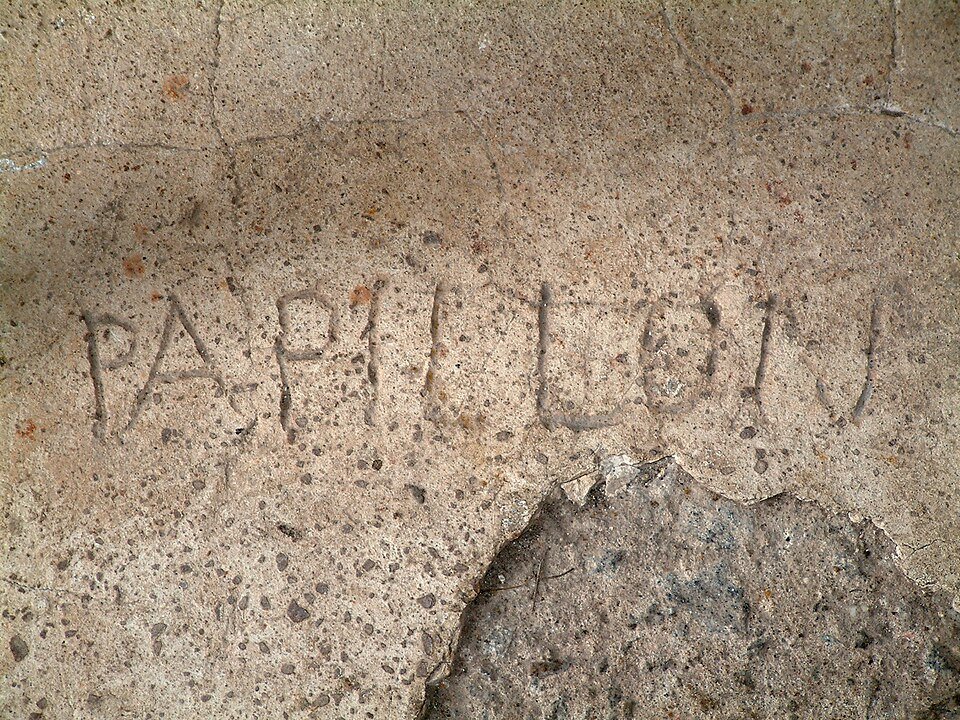
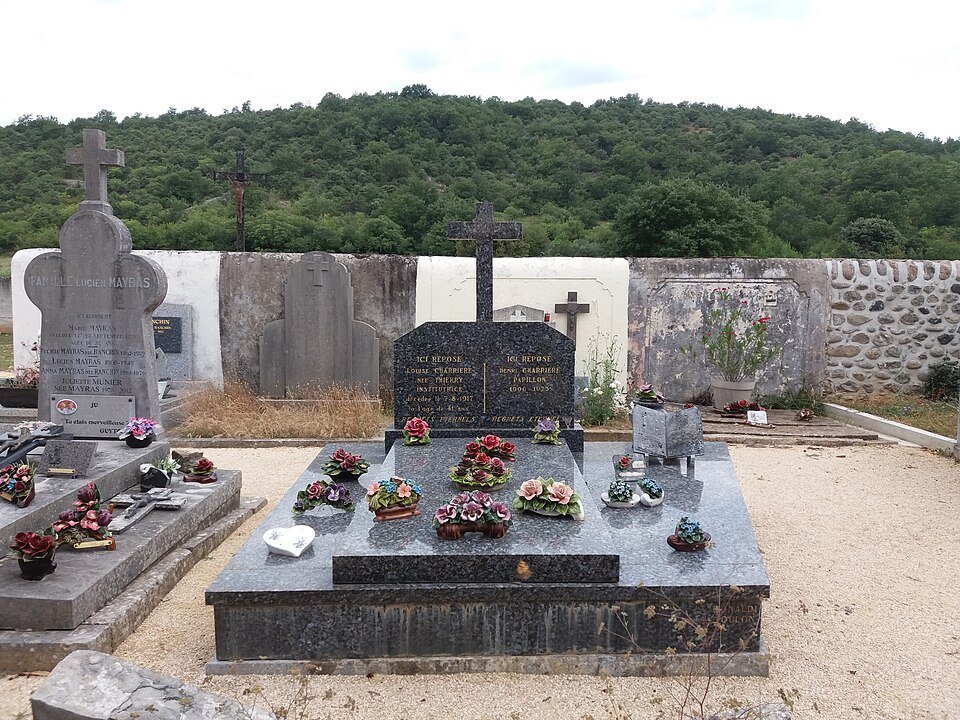
Henri Charrière became one of the most famous prison escapees of the twentieth century because of Papillon, the 1969 memoir that turned the French Guiana penal colony into an international adventure story. The book’s most memorable images are almost impossible to separate from the man: the butterfly tattoo, repeated breakouts, years of solitary confinement, a final leap from Devil’s Island, and a coconut-filled raft carrying him to freedom.
The archival record does not support that version of his life.
Charrière was a real French convict. He really was transported to French Guiana. He really escaped once in 1934, was recaptured, and escaped again in March 1944. The second escape permanently removed him from French penal custody and eventually allowed him to build a new life in Venezuela.
But the famous Devil’s Island escape was not his.
Historian Michel Pierre’s comparison of Charrière’s narrative with penal records shows that several of the memoir’s best-known episodes were invented, rearranged, or borrowed from other convicts. Charrière was not recorded as making the grave-hidden raft attempt he described. The asylum escape he narrated happened when he was somewhere else. The spectacular coconut-sack departure from Devil’s Island is incompatible with his documented prison history. His actual final escape began from the lightly guarded Cascades camp on the mainland in March 1944.
That leaves a story that is less cinematic but historically more interesting: two documented escapes, a memoir that transformed them into a legend, and a penal system whose collective memory Charrière made into his own autobiography.
At a Glance
- Convicted: 27 October 1931, Paris
- Sentence: hard labor for life
- Transported to French Guiana: departed Saint-Martin-de-Ré on 29 September 1933; arrived Saint-Laurent-du-Maroni on 14 October
- Convict number: 51,367
- First documented escape: 5 September 1934
- Outcome of first escape: reached the Caribbean/Colombia but was returned to French custody
- Final documented escape: night of 18–19 March 1944
- Documented point of departure in 1944: Camp des Cascades on the French Guiana mainland
- Durable outcome: left French penal custody permanently and later established himself in Venezuela
- Famous Devil’s Island coconut-raft escape: not supported by the archival record
- Papillon published: 1969
- 1973 film: transformed the memoir’s fictionalized ending into one of the best-known prison-escape scenes in popular culture
From Paris to the Bagne
Charrière’s penal history began with a murder case, not an escape.
According to Michel Pierre’s reconstruction from judicial and penal records, Charrière was accused of killing Roger Legrand in Paris in March 1930. The case went to the Seine assize court in 1931. Charrière denied responsibility, but on 27 October he was convicted and sentenced to hard labor for life.
His later memoir presented the conviction as the great injustice from which everything else followed. The surviving record does not establish a later exoneration; Charrière continued to deny responsibility. For the escape history, the important point is simpler: the sentence placed Charrière within the French transportation system, under which men convicted in metropolitan France could be sent to the penal colony in French Guiana.
He became convict number 51,367.
On 29 September 1933, Charrière left the citadel of Saint-Martin-de-Ré aboard La Martinière. He reached Saint-Laurent-du-Maroni on 14 October. Penal records cited by Pierre give 821 prisoners in the transport population represented by that voyage’s transported and relegated convicts, not the much larger figure Charrière later supplied in Papillon.
That discrepancy is an early warning about the memoir. Charrière was not simply writing from memory with occasional small errors. He repeatedly reshaped scale, chronology, violence, and setting in ways that made his experience more dramatic.
The First Documented Escape
Charrière’s first genuine escape occurred on 5 September 1934.
This date matters because it sharply contradicts the memoir’s chronology. Papillon presents an escape only a few dozen days after arrival. The record places it 326 days after Charrière landed at Saint-Laurent-du-Maroni—more than ten months later.
He was then working around the colonial hospital. The hospital was part of the penal infrastructure but did not function like a maximum-security cell block. Pierre’s reconstruction indicates that Charrière did escape from the hospital environment, but in circumstances considerably less violent than the scene he later wrote.
The memoir describes an assault on guards during the breakout. Pierre points out that the subsequent penal judgment does not fit such an attack. Had Charrière and his companions committed the degree of violence described in the book, the special maritime tribunal would have been expected to impose a substantially more severe punishment.
The escape itself, however, is not in doubt.
Charrière got away from French custody and traveled through the Caribbean before ending up in Colombia. The exact route and adventure sequence in Papillon should not be accepted wholesale because later investigators found that the book incorporates other men’s experiences. The secure historical conclusion is narrower: he escaped, remained outside French custody for a period, was arrested in Colombia, and was eventually returned.
His first escape therefore succeeded as a breakout but failed as a durable escape from the French penal system.
Punishment and Saint-Joseph
After his return, Charrière faced the special penal court and punishment within the Guiana system.
One part of Papillon that rests on genuine institutional history is the existence of severe cellular punishment on Île Saint-Joseph. The Îles du Salut contained several different penal sites, and Saint-Joseph was especially associated with reclusion and punishment for recidivist escapees.
Modern CNES historical material describes Saint-Joseph as dominated by the reclusion building and notes that silence was imposed there. Charrière did spend time in the reclusion system after his first escape.
What the archive does not support is treating every later island episode in the memoir as autobiographical fact.
That distinction becomes essential because Papillon gradually collapses the geography of the French Guiana penal colony into one mythic place: “Devil’s Island.” In reality, Saint-Laurent-du-Maroni on the mainland, Île Royale, Île Saint-Joseph, Île du Diable, hospitals, work camps, agricultural sites, and other penal facilities served different functions.
Charrière was part of that wider system. The archival challenge is determining which experiences were actually his.
The Raft Hidden in a Grave
One of the memoir’s escape attempts involves a raft prepared on Île Royale and concealed beneath freshly disturbed earth associated with a grave. Michel Pierre found no supporting prosecution in Charrière’s file.
That absence is significant because the alleged conduct would have involved not merely attempted escape but desecration or misuse of a burial site. Within the intensely documented disciplinary system, such an episode should have generated a record.
Pierre’s conclusion is that this supposed attempt is not credible as Charrière’s own history.
The episode illustrates a recurring pattern in Papillon. Charrière drew on the culture of the penal colony—the real obsession with escape, actual rafts, actual fugitives, repeated stories told among prisoners—and transformed that collective material into a first-person adventure.
The penal world was real. The individual ownership of every adventure was not.
The Asylum Escape That Happened Without Him
An even clearer contradiction concerns the memoir’s escape from an asylum.
Charrière really did spend time connected with the penal psychiatric system. Pierre’s archival chronology places him at the asylum on Île Saint-Joseph from August 1939 to June 1940.
But the dramatic asylum escape narrated in Papillon closely resembles a real escape that occurred during the night of 7–8 February 1939. At that moment Charrière was not there.
The records place him at Saint-Laurent-du-Maroni awaiting judgment before the special maritime tribunal. Pierre therefore concluded that Charrière merged a real incident involving other prisoners into his own life story.
The same pattern appears repeatedly in later criticism of the book. Journalists and historians identified stories resembling episodes from the lives of other convicts, including René Belbenoît, Charles Brunier, Marius Jacob, and others associated with French penal history.
Not every parallel proves direct copying. Prison stories circulated orally, memoirs were published, and men could hear the same event retold many times. But the accumulation of contradictions makes Papillon unusable as a literal chronological record without external verification.
The Devil’s Island Escape
The most famous scene is also the least defensible as Charrière’s history.
In the book, Charrière escapes Devil’s Island by studying the sea, timing the waves, and using sacks filled with coconuts as flotation. The image became central to the 1973 film starring Steve McQueen.
Archival reconstruction places Charrière somewhere else.
Pierre states that the Devil’s Island coconut-raft escape is imaginary as an episode in Charrière’s life. The terrain and institutional record do not match the story, and Charrière’s documented final departure occurred from a mainland camp.
This is more than a correction of one cinematic embellishment.
“Papillon escaped from Devil’s Island” has become one of the standard summaries of the case. Historically, it combines a real man, a real penal archipelago, real traditions of attempted sea escape, and a fictionalized final scene.
The name Devil’s Island itself adds to the confusion. The entire French Guiana penal system is often called “Devil’s Island” in English-language popular culture, even though Île du Diable was only one island within a much larger network of penal establishments.
A reader can therefore encounter the statement that Charrière “escaped Devil’s Island” when the writer means “escaped the French Guiana penal colony.” That broad shorthand is still misleading here because the memoir and film specifically place him on the island.
The documented escape should be named for where it actually began.
Camp des Cascades
By the early 1940s, Charrière had been moved through several assignments. Pierre’s archival reconstruction eventually places him as a senior infirmary worker at a camp for Indochinese prisoners known as the Camp des Cascades.
This was on the French Guiana mainland.
The conditions of custody were different from the spectacular fortress imagined by later readers. Pierre emphasizes that the site and period were comparatively weakly supervised. That does not mean Charrière was free. He remained a convicted man within the penal system and leaving was still an escape.
But the opportunity was much more ordinary than a cliff jump into the Atlantic.
The archival record gives the decisive date: 19 March 1944. During the night of 18–19 March, Charrière left the Cascades camp by boat with other convicts.
Pierre’s article refers to Charrière departing with three other condemned men, while several later summaries say four companions. The record securely supports that Charrière escaped as part of a small group; the exact companion count remains unresolved without direct inspection of the underlying escape file.
This was the escape that mattered. He never returned to French penal custody.
What Happened After the 1944 Escape
The post-escape chronology is less tidy than the ending of the film.
Charrière did not leap from a prison island and emerge immediately as a free man. His movement through northern South America involved further danger, detention, and uncertainty. Later biographical traditions place him in British Guiana and Venezuela, where he was detained before eventually obtaining the ability to live freely.
The central outcome is secure: he established himself in Venezuela and built a civilian life there.
Contemporary reporting from 1969 found him returning from Caracas as the newly famous author of Papillon. French reporting still described him in relation to his old sentence and restrictions, which is another reminder that physical escape, legal rehabilitation, and public reinvention were separate processes.
By the time Papillon appeared, the man who had escaped a mainland forest camp had become internationally known as the survivor of Devil’s Island.
Why the Myth Worked
The power of Papillon did not come from documentary precision. It came from combining real brutality, real penal geography, real escape culture, and a forceful first-person narrator into a single life story.
When the book appeared in 1969, contemporary reviewers were fascinated by its immediacy. The public encountered Charrière not as a historian of the bagne but as the man who claimed to have lived every extraordinary episode himself.
The timing helped. The French Guiana penal system had become a symbol of institutional cruelty. Earlier writers and former convicts had already established a literature of the bagne. René Belbenoît’s accounts of escape and penal life were published before Papillon. Albert Londres had made the system infamous through journalism decades earlier.
Charrière arrived late to the tradition and became its most successful storyteller.
His book sold on a scale that dwarfed most earlier convict memoirs. The film adaptation then converted the book’s version of history into visual memory. Steve McQueen’s Papillon became more famous than the archival Henri Charrière.
The false version of the escape is historically significant in its own right because it has shaped how millions of people understand the French Guiana penal colony.
The 1969 Counter-Investigation
Doubts appeared almost immediately.
French reporting and later research describe a 1969 inquiry into Charrière’s story. A former penal employee produced a lengthy report for the Ministry of Justice after checking claims against the record. Later journalists quoted its conclusion that Charrière had credited himself with invented adventures or experiences belonging to others.
The wording was devastating: the report suggested that the memoir would need to be reduced dramatically to approach literal truth.
Gérard de Villiers then published Papillon épinglé in 1970, attacking inconsistencies in the story. Georges Ménager also investigated Charrière’s claims.
These counter-investigations had their own polemical tone, and later sensational claims—especially the idea that one single former convict was “the real Papillon”—should be treated cautiously. Charles Brunier, for example, claimed late in life that Charrière had appropriated his experiences. The existence of overlapping stories is plausible; the idea that all of Papillon can simply be reassigned to Brunier is not established.
Michel Pierre’s later archival method is stronger because it does not require identifying one hidden “true Papillon.” It asks a more manageable question: which episodes in Charrière’s book match Charrière’s penal file?
For several famous scenes, the answer is that they do not.
Two Real Escapes
Once the mythology is stripped away, Charrière still belongs in escape history.
He escaped from the Saint-Laurent penal system on 5 September 1934. That flight took him outside French custody before Colombia returned him.
He escaped again from Camp des Cascades during the night of 18–19 March 1944. That departure permanently ended his confinement under the French Guiana penal administration.
Those are substantial events.
The first shows that Charrière was genuinely willing to risk flight and suffer the consequences of recapture. The second shows that, after roughly a decade more within the penal system, he found a weaker point in custody and used it successfully.
Neither needs a coconut raft.
The actual escapes also fit a broader history of the bagne better than the legend does. French Guiana contained sites with radically different security conditions. Escapes occurred from hospitals, labor details, river routes, work camps, settlements, and islands. The main obstacles were not always walls. Geography, money, boats, disease, distance, police cooperation across borders, and the risk of recapture mattered as much as physical barriers.
Charrière’s documented story belongs to that history.
Was He Innocent?
Papillon presents Charrière as an innocent man condemned for a murder he did not commit.
Charrière maintained his innocence, and the claim became morally essential to the book: every escape could then be framed as resistance to a wrongful conviction.
The surviving evidence does not establish that his conviction was later overturned on factual grounds. Charrière’s innocence claim therefore remains separate from the documented fact of his conviction.
That restraint matters because later retellings often say he was “wrongfully convicted” as if a later court exonerated him.
He was convicted. He denied the murder. His memoir made innocence part of his public identity.
Those are the secure statements.
What “Papillon” Really Preserves
The book is not worthless because it is unreliable as autobiography.
It preserves something different: the mythology and oral culture of the French Guiana penal system.
Charrière had lived within that system for years. He knew prisoners who attempted escape. He knew what men feared, exaggerated, admired, and repeated in barracks and hospitals. He understood the symbolic geography of Saint-Laurent, the islands, solitary confinement, boats, jungle, sea, and frontier.
He converted that collective world into a single heroic narrator.
That is why some invented episodes can still contain authentic features of penal life. A story may be false as “this happened to Henri Charrière” while reflecting something another convict actually experienced, something prisoners believed, or something structurally possible within the penal colony.
The historical task is therefore not to throw away Papillon. It is to change how it is used.
As a source for Charrière’s exact biography, it requires constant verification.
As evidence of how the bagne was remembered and sold to the twentieth-century public, it is indispensable.
The Escape That History Should Remember
If the case is reduced to the film ending, Papillon becomes a man who conquered Devil’s Island with coconuts and courage.
If it is reduced to the counter-investigations, he becomes only a liar.
Neither version is sufficient.
Henri Charrière was a convicted man who spent years in the French Guiana penal system. He did escape in 1934, was recaptured, and was punished. He later escaped again in March 1944 from a mainland work camp and did not return to French custody.
He then transformed those two real escapes into one of the most successful adventure autobiographies ever published.
That transformation is part of the history.
The most famous Papillon escape never happened as he described it. The real final escape was less spectacular, better documented, and successful enough that Charrière lived to rewrite it.
Evidence diagram
Papillon on the page vs. Charrière in the record
Two documented Charrière escapes: 1934 and 1944. The Devil’s Island coconut raft is myth as his escape.
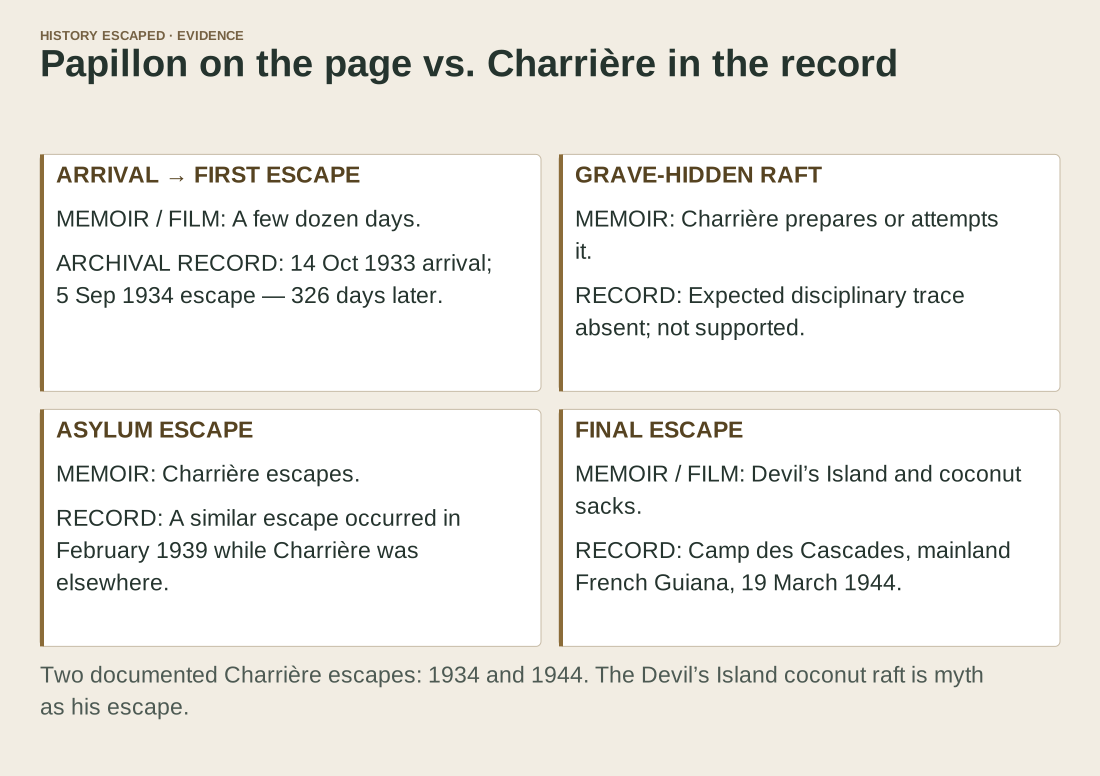
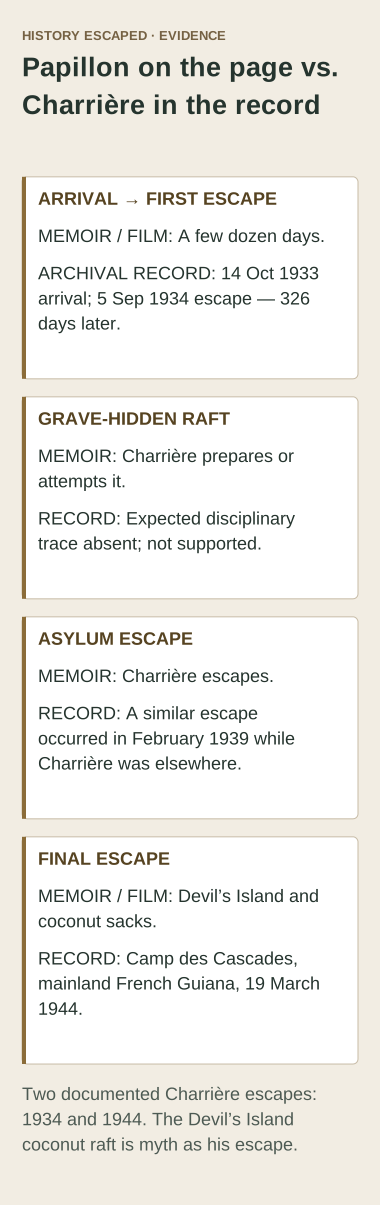
Two documented Charrière escapes: 1934 and 1944. The Devil’s Island coconut raft is myth as his escape.
Problem → response
Escape was a sequence of problems
Each response solved a practical obstacle while often creating the next one.
- 01→
Obstacle
French Guiana geography and cross-border recapture
Escaping an individual penal site did not guarantee freedom; fugitives still faced rivers, sea travel, disease, lack of money, and arrest by neighboring authorities.
Response
Charrière's 1934 flight reached Colombia but ended when he was returned to French custody.
- 02→
Obstacle
Penal surveillance and reclusion after recapture
Repeat escapees could face prosecution and harsh cellular punishment within the Îles du Salut system.
Response
Charrière survived reclusion and later received assignments with less direct physical security, eventually escaping from Camp des Cascades.
- 03→
Obstacle
Myth replacing documented geography
The success of Papillon and its film adaptation caused the larger French Guiana penal system to be compressed into the image of Devil's Island.
Response
The archival reconstruction distinguishes Saint-Laurent, Saint-Joseph, the mainland Cascades camp, and Île du Diable instead of treating them as interchangeable.
The final accounting
Outcome
Documented escapes
The 1934 and March 1944 escapes are supported by the archival reconstruction.
Durable escapes from French penal custody
The 1944 escape permanently ended Charrière's confinement under the French Guiana penal administration.
Documented Devil's Island coconut-raft escapes by Charrière
The famous memoir/film episode is not supported by Charrière's penal record.
Selected chronology
Selected chronology
Convicted in Paris
The Seine assize court sentences Charrière to hard labor for life for the killing of Roger Legrand; Charrière maintains his innocence.
Departs Saint-Martin-de-Ré
Charrière leaves metropolitan France aboard La Martinière for the French Guiana penal colony.
Arrives at Saint-Laurent-du-Maroni
He enters the transportation system as convict number 51,367.
First documented escape
Charrière escapes from the Saint-Laurent hospital-linked assignment.
Returned to French custody
After arrest in Colombia, Charrière is returned to the French penal system and punished.
Real asylum escape occurs without Charrière
Other prisoners escape from the asylum system during a period when Charrière's record places him at Saint-Laurent awaiting trial, undermining the memoir's attribution of a similar escape to himself.
Charrière actually serves in the asylum system
His real asylum-related confinement occurs later than the escape episode claimed in the memoir.
Final documented escape
Charrière leaves the Camp des Cascades on the mainland with other convicts and never returns to French penal custody.
Papillon published
Charrière's autobiographical adventure becomes a publishing phenomenon and makes the fictionalized Devil's Island version internationally famous.
Film adaptation expands the legend
The Steve McQueen film adaptation popularizes the coconut-raft Devil's Island ending even though the archival record places Charrière's actual final escape on the mainland.
Evidence discipline
What the record supports
Status labels distinguish secure conclusions from uncertainty and rejected claims. Color is never the only signal.
MYTH
Charrière escaped only a few weeks after arriving in French Guiana.
He arrived on 14 October 1933 and his first documented escape was 5 September 1934, 326 days later.
Sources: SRC-001DISPUTED
Charrière's first escape involved the violent assault on guards exactly as Papillon describes.
The escape is documented, but Michel Pierre notes that the later penal sentence is inconsistent with the degree of violence claimed in the memoir.
Sources: SRC-001MYTH
Charrière personally attempted the grave-hidden raft escape described in Papillon.
No expected prosecution for the alleged conduct appears in his penal file, and the episode is not supported by the archival record.
Sources: SRC-001MYTH
Charrière personally carried out the asylum escape narrated in Papillon.
A real asylum escape occurred in February 1939 when Charrière's record places him elsewhere; his own asylum confinement occurred later.
Sources: SRC-001MYTH
Charrière's final escape was from Devil's Island on a raft made from coconut-filled sacks.
Archival reconstruction places his final escape on 19 March 1944 from Camp des Cascades on the French Guiana mainland.
Sources: SRC-001, SRC-005, SRC-007MYTH
Papillon is reliable as a literal autobiography of Charrière's penal years.
Archival research and contemporary counter-investigations identify numerous invented, displaced, or appropriated episodes. The work is best treated as a heavily fictionalized autobiographical narrative.
Sources: SRC-001, SRC-005, SRC-006, SRC-007DISPUTED
Charles Brunier has been proven to be the single true source of the Papillon story.
Brunier claimed that Charrière borrowed his experiences, and parallels exist, but Papillon also resembles episodes from several other convicts' lives. No single replacement biography explains the entire book.
Sources: SRC-006UNKNOWN
Charrière was later proven innocent of the murder conviction that sent him to French Guiana.
Charrière consistently maintained his innocence, but the sources used here do not establish a later factual exoneration of the 1931 murder conviction.
Sources: SRC-001, SRC-003