
For a few minutes on 8 July 1910, Vinayak Damodar Savarkar was no longer aboard the ship carrying him to India.
He had gone through a porthole, entered the water at Marseille, reached the French quay and started running. The escape did not last.
A French maritime gendarmerie brigadier chased him across the port and caught him after roughly 500 metres. Men from the ship arrived to help. Savarkar was taken back aboard the Morea, which sailed from Marseille the next day.
The entire episode may have occupied only minutes. Its consequences lasted much longer.
Because Savarkar had reached French territory before being returned to British custody, his recapture became a dispute between France and Great Britain and ultimately an international arbitration at The Hague. The result is one of those rare escape attempts for which the official legal record preserves not only the outcome, but a concise reconstruction of what happened on the ground.
A prisoner being sent to India
Savarkar had been living among Indian anti-colonial activists in Britain and France when British authorities moved to prosecute him.
He returned from Paris to London on 13 March 1910 and was arrested at Victoria Station. Proceedings followed under the Fugitive Offenders Act, the law the authorities used to send him to India. The allegations against him included offences connected with revolutionary activity and abetment of murder.
The political and legal background was complicated, but the practical situation by the summer was simple. Savarkar was going to be transported by sea under guard. On 1 July he left Britain aboard the Morea, a Peninsular and Oriental Steam Navigation Company liner bound toward India. He was not travelling anonymously.
British police had already alerted the French.
Marseille was not a surprise to the authorities
One of the most persistent dramatic additions to the story is that a mechanical breakdown unexpectedly forced the Morea into Marseille and gave Savarkar a chance nobody had anticipated. The official diplomatic record does not support that version. On 29 June—before the ship sailed—the Commissioner of the Metropolitan Police in London informed the French security authorities that Savarkar was being sent to India and would be aboard the Morea when it touched Marseille on 7 or 8 July.
French officials were also warned that Indian revolutionaries on the Continent might try to help him escape. The French Ministry of the Interior passed the warning to the prefect of Bouches-du-Rhône and requested precautions. The Morea arrived at Marseille on 7 July. A French police commissioner came aboard and placed himself at the disposal of the ship's commander regarding the watch to be kept.
The possibility of an escape was therefore not merely imaginable. It had been discussed between the two governments before the ship reached France.

The opening
The attempt came the next morning.
The 1911 arbitral award places the escape between 6 and 7 a.m. on 8 July.
Later detailed accounts identify the opening Savarkar used as a porthole in a shipboard lavatory. The official award is less specific about the compartment, but it confirms the decisive fact: Savarkar got through a porthole of the Morea.
That distinction matters.
The exact dimensions and preparation surrounding the opening have become part of the legend. A frequently repeated measurement describes a porthole only about twelve inches across. That number comes through later biographical traditions rather than the arbitral award and should not be treated as an independently verified ship measurement.
The documented sequence does not need it. Savarkar got out.

Into the water
The French brigadier who later described the incident said he saw the fugitive, almost naked, emerge from a porthole, throw himself into the sea and swim to the quay. That is the strongest available official description of the physical escape. It was not a miles-long swim across open water.
The Morea was in port. Savarkar's objective was the French quay.
He reached it. At that instant the escape changed categories. A prisoner who had been confined aboard a British ship was now physically on French territory. Savarkar began to run.
The alarm moves ashore
People from the Morea reacted immediately. According to the later arbitration findings, men from the ship rushed over the bridge toward the shore, shouting and gesturing. People on the quay also began calling for the fugitive to be stopped. A French maritime gendarmerie brigadier joined the pursuit.
The important fact is that the French officer did not later claim to understand the international political problem unfolding in front of him. He said he did not know who the fugitive was. He believed the man might be a member of the ship's crew who had committed an offence aboard the vessel. The brigadier ran after him.
After about 500 metres, he caught Savarkar.
Who actually arrested him?
This point became central to the later legal dispute. It is easy to summarize the incident as "British police chased Savarkar onto French soil and seized him." The official record is more precise. The French brigadier made the arrest.
The arbitral tribunal found that one member of the ship's crew and two Indian policemen came up afterward. Their intervention was described as auxiliary to the brigadier's action.
The French officer had Savarkar by the arm and retained his hold as the group took the prisoner back toward the ship. The award also records that the brigadier did not know English.
That language problem helps explain why later stories about exactly what Savarkar supposedly demanded on shore need caution. Claims that he formally asked for political asylum, demanded a magistrate, or delivered particular words may derive from later narratives. The official case establishes the international dispute created by his presence on French soil; it does not preserve reliable dialogue from Savarkar at the moment of arrest.
Back aboard the Morea
Savarkar went back with the French brigadier and the men assisting him. The tribunal later estimated that the entire incident had taken no more than a few minutes. That is what makes the attempt so unusual. It was simultaneously a real physical escape and an almost immediate failure.
Savarkar had defeated the immediate shipboard confinement. He had passed through the porthole, entered the harbour, reached land and run hundreds of metres.
He had not achieved durable freedom. By the time the legal implications were understood, he was back aboard the ship. The Morea left Marseille on 9 July with Savarkar still in custody.
France objects
The affair did not disappear with the ship. The central question was no longer whether Savarkar had escaped. Everyone agreed that he had. The dispute concerned what happened after he reached France.
French authorities argued that the handover raised questions of sovereignty and international law. France eventually demanded that Britain restore Savarkar to French custody.
Britain refused. In October 1910 the two governments signed an agreement submitting one question to arbitration: whether international law required the British government to restore Savarkar to the French government. The case went to a five-member arbitral tribunal constituted from members of the Permanent Court of Arbitration at The Hague. That institution is sometimes confused in later retellings with the International Court of Justice.
It was not the ICJ. The International Court of Justice did not exist in 1910.
What the Hague tribunal actually decided
The tribunal met in February 1911 and issued its award on 24 February. The result is often simplified in opposite directions. One version says the recapture was completely lawful. Another says the international court declared the arrest illegal and Britain simply kept Savarkar anyway.
Neither formulation captures the award. The tribunal acknowledged that an irregularity had occurred in Savarkar's arrest and delivery to the British police.
But it also concluded that there had been no fraud or force used by the British authorities to obtain possession of a person who had taken refuge in French territory. It considered the officials involved to have acted in good faith.
Most importantly, it found no rule of international law that, in those circumstances, required Britain to return Savarkar to France because of the French official's mistake. Britain therefore did not have to restore him. That narrow distinction is the legal heart of the case.
The escape follows him into court
Savarkar was meanwhile taken to India for prosecution. The Marseille episode immediately became part of his legal strategy. In proceedings before the Bombay High Court in October 1910, the defence sought to argue that irregularities in his rearrest in France undermined the court's jurisdiction over him. The court rejected that position.
For purposes of the jurisdiction question, it held that even if his arrest abroad had been illegal, that did not prevent an Indian court from trying him once he was before it under the relevant process. The physical escape had failed within minutes. The jurisdictional argument based on the escape failed as well. Yet the affair had already become something larger than a prisoner's unsuccessful dash.
What later retellings get wrong
Several elements of the Marseille story are securely documented. Savarkar escaped through a porthole. He entered the water. He swam to the quay.
He ran on French territory. A French gendarme pursued and arrested him after about 500 metres. He was returned to the Morea. Other famous details need qualification.
The Marseille stop was not an unforeseen accident. British authorities told French authorities in advance that the Morea would touch Marseille on 7 or 8 July. This was not a long-distance ocean swim. The official record describes a short port escape from ship to quay followed by a foot pursuit. The French officer, not the British escorts, made the initial arrest on shore. Men from the ship assisted afterward.
A formal request for political asylum is not securely documented in the arbitral award. The event unquestionably raised sovereignty and asylum-related questions, but exact dialogue should not be invented. The Hague proceeding was not the International Court of Justice. It was arbitration through the Permanent Court of Arbitration. The tribunal did not simply bless the arrest as regular. It recognized an irregularity while holding that Britain had no obligation to return Savarkar to France.
Those corrections make the event more historically useful. The story is not only about a man fitting through a porthole. It is about what happened when a shipboard escape crossed an international boundary.
Why the attempt failed
Savarkar solved the first problem. He got out of the ship. He solved the second. He reached land.
The plan collapsed at the third: surviving the first minutes on shore.
The alarm from the Morea followed him immediately. The French officer who encountered the chase did not know Savarkar's identity and interpreted the scene as an ordinary pursuit from a ship. There was no pause in which the escapee's legal status could be sorted out before the gendarme acted.
Once the brigadier had him in custody, the same misunderstanding carried Savarkar back toward the vessel. The physical weakness in the security system was the porthole. The operational weakness in the escape was the absence of time.
A few minutes, an international case
Many failed escapes disappear into the records because the prisoner never gets far enough to change anything. Savarkar got far enough to change the legal question. He did not merely reach a deck, a dock ladder or the water beside the ship. He reached France.
That transformed a brief chase through Marseille into a dispute between two governments over sovereignty, custody and the consequences of an irregular handover. Savarkar did not remain free. But the few minutes between the Morea and his recapture produced a case that still appears in histories of international arbitration more than a century later.
Escape reconstruction
How the escape unfolded
An evidence-aware sequence of the principal stages.
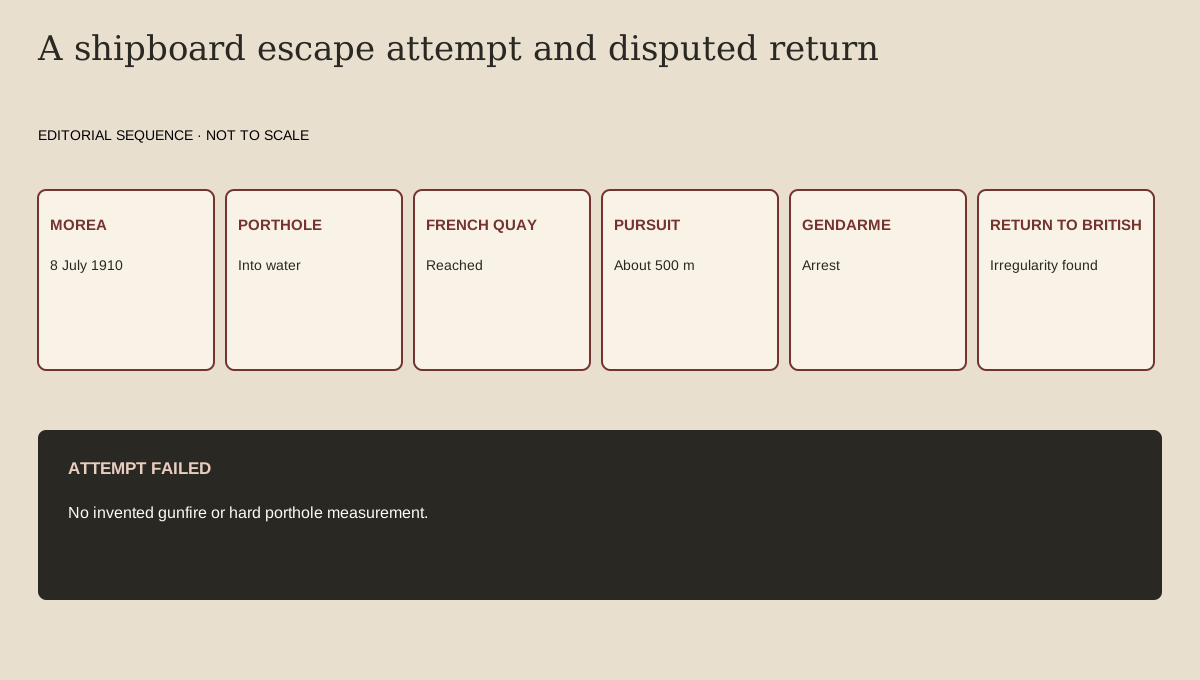
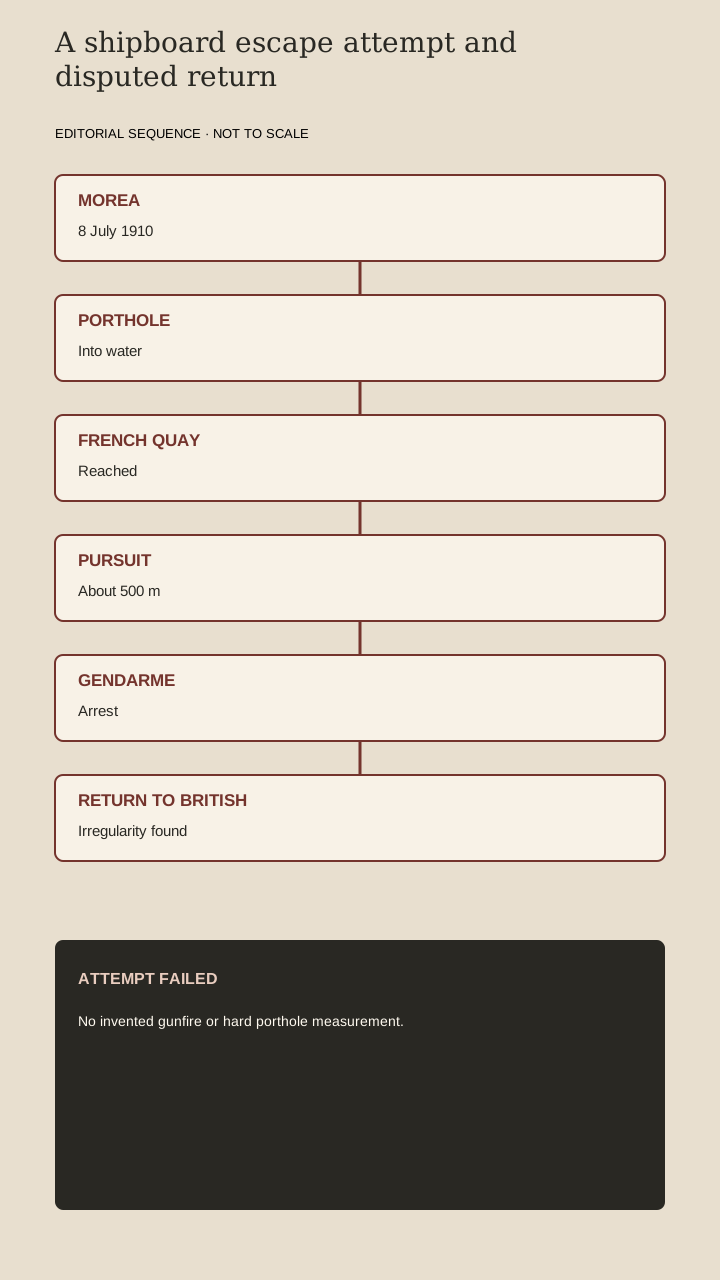
Simplified editorial reconstruction; not to scale. See adjacent text for evidence qualifications and unresolved details.
Problem → response
Escape was a sequence of problems
Each response solved a practical obstacle while often creating the next one.
- 01→
Obstacle
Constant shipboard custody
Savarkar was being transported under police guard and could not simply leave the vessel through normal passenger routes.
Response
He used access to a shipboard porthole as an exit outside the ordinary guarded route.
- 02→
Obstacle
Water between vessel and quay
Escaping the ship still required reaching French territory across the harbour water.
Response
Savarkar entered the sea and swam to the quay.
- 03→
Obstacle
Immediate alarm from the ship
Men from the Morea quickly recognized the escape and rushed ashore shouting and gesturing.
Response
Savarkar ran from the quay in an attempt to create distance before the pursuers or local police could stop him.
- 04→
Obstacle
French police intervention
A French maritime gendarme encountered the pursuit without understanding Savarkar's identity or the international legal context.
Response
Savarkar was unable to avoid the officer; the brigadier caught him after roughly 500 metres and returned him toward the ship.
The final accounting
Outcome
Shipboard custody breached
Savarkar successfully left the Morea and reached the French quay.
Long-term escape
He was recaptured within minutes and returned to the Morea.
International arbitration
The recapture produced a formal France–Great Britain arbitration decided at The Hague in February 1911.
Evidence discipline
What the record supports
Status labels distinguish secure conclusions from uncertainty and rejected claims. Color is never the only signal.
DOCUMENTED
Savarkar escaped through a porthole, swam to the Marseille quay and began running on French territory.
The 1911 arbitral award records this sequence and incorporates the French brigadier's statement describing what he saw.
Sources: SRC-001, SRC-002DOCUMENTED
The French maritime gendarmerie brigadier, rather than the British escorts, made the initial arrest on the quay.
The tribunal found that the brigadier caught Savarkar after a pursuit of about 500 metres and that men from the ship assisted only after the arrest.
Sources: SRC-001MYTH
Savarkar spent a long period swimming through open sea before reaching France.
The official reconstruction describes a port escape from the Morea to the quay followed by a foot pursuit. It does not support later claims of hours or miles in the water.
Sources: SRC-001MYTH
An unexpected mechanical breakdown alone forced the Morea to make an unplanned Marseille stop.
British police informed French authorities on 29 June that the Morea would touch Marseille on 7 or 8 July, proving the call was anticipated before the vessel sailed.
Sources: SRC-001LATER CLAIM
Savarkar formally requested political asylum from the arresting gendarme in clearly documented words.
Later accounts describe an asylum request, but the arbitral award does not preserve such dialogue. The legal dispute over French territory and restitution is documented; the exact words spoken are not.
Sources: SRC-001, SRC-008, SRC-009MYTH
The international tribunal ruled Savarkar's recapture entirely lawful.
The tribunal expressly acknowledged an irregularity in the arrest and delivery while holding that international law did not require Britain to restore him to France.
Sources: SRC-001, SRC-002MYTH
Savarkar's case was decided by the International Court of Justice.
The dispute was handled by an arbitral tribunal constituted through the Permanent Court of Arbitration decades before the International Court of Justice existed.
Sources: SRC-001, SRC-002, SRC-011Selected chronology
Selected chronology
Arrested in London
Savarkar returned from Paris and was arrested at Victoria Station under proceedings that led to his transfer to India.
French authorities warned
The Metropolitan Police informed French security authorities that Savarkar would be aboard the Morea when it touched Marseille on 7 or 8 July.
Morea departs Britain
Savarkar was placed aboard the P&O liner Morea for transport to India under police escort.
Arrival at Marseille
The Morea arrived at Marseille, where a French police commissioner made contact with the British officer responsible for Savarkar.
Escape and recapture
Savarkar exited through a porthole, swam to the quay and ran before a French gendarme arrested him after roughly 500 metres.
Morea leaves Marseille
The vessel departed Marseille with Savarkar again in custody.
France and Britain submit dispute to arbitration
The two governments signed an agreement asking an arbitral tribunal whether Britain was required by international law to restore Savarkar to France.
Hague award
The tribunal acknowledged an irregularity in the arrest and handover but decided that Britain was not required to restore Savarkar to France.