
On the evening of 11 September 1863, the prisoners of Cockatoo Island were counted. Two men were missing.
One was Frederick Britten, a prisoner with a history of escape attempts. The other was Frederick Ward, a skilled horseman who had already spent years in the island penal establishment and who would soon become far better known by another name: Captain Thunderbolt.
They had not yet escaped Sydney Harbour. That is the first detail most short versions of the story lose.
Ward and Britten appear to have slipped away from their work station and hidden somewhere on Cockatoo Island while prison authorities searched for them. For roughly two days, their problem was not how to cross the water. It was how to remain undiscovered on a prison island small enough for guards to know that two men had vanished.
Then, during the night of 13–14 September, they made the second move. They went into the water.
By the next morning, clothing and Britten's irons had been found near the northern shoreline. The prisoners were gone.
The most famous version says Ward's partner, Mary Ann Bugg, had secretly helped him—perhaps bringing a file to the island and waiting on shore with a horse. It is a good story. The evidence points elsewhere.
Back to Cockatoo Island
Frederick Ward had already known freedom once.
In 1856, he was convicted in a horse-stealing case and sentenced to ten years' hard labour. Cockatoo Island, sitting in Sydney Harbour, became his prison.
The island had been used as a penal establishment since 1839. Prisoners worked in quarrying, construction and dockyard-related labour. The water around the island formed an obvious outer barrier: even if a man could get away from his work gang or barracks, he still had to cross open harbour to reach the mainland.
Ward behaved well enough during his first period of imprisonment to earn conditional release in 1860. His freedom came with rules.
He was required to report for muster. After becoming involved with Mary Ann Bugg and travelling to the Dungog district around the birth of their child, he failed to meet the required reporting conditions. His ticket-of-leave was cancelled. A further horse case made his position worse, and he was returned to Cockatoo Island.
By 1863, he faced years more confinement. He was not the only prisoner thinking about escape.
Frederick Britten
Ward's companion was Frederick Britten, whose surname appears in the historical record in several forms, including Brittain and Britton.
Britten had arrived on Cockatoo Island in February 1863 after conviction in a mail-robbery case. Unlike Ward, he was under sentence to spend part of his term in irons. He had already demonstrated a willingness to escape custody. Archival research records earlier attempts to break away and, in July 1863, an attempt involving other prisoners to break out of a ward. Days later, Britten was caught tampering with his irons.
Two months after that, he and Ward were working near one another. What happened next is reconstructed from the records left by the prison system.

Missing at muster
On 11 September, Ward and Britten disappeared from their work station. When the evening muster was called, they were absent.
Many later biographies simply call 11 September the day they escaped from Cockatoo Island. That is understandable: it was the day the prison lost control of them.
But it was probably not the night they entered the harbour. Archival-based research of Cockatoo Island correspondence and establishment records indicates that the men concealed themselves somewhere on the island for approximately two days. That choice makes sense.
An immediate swim would have taken them into the water while guards were at the height of the alarm. Hiding changed the problem. If Ward and Britten could remain unseen while the island was searched, they could wait for the first response to lose some of its intensity before attempting the exposed crossing to the mainland.
There is no securely documented hiding place. No historian should invent one. The island's quarries, work areas, buildings and industrial landscape offered possibilities, but the evidence only allows the safer conclusion: the men were missing on the island and were not immediately found.

The water barrier
By the night of 13–14 September, hiding was no longer enough. Cockatoo Island itself was still a prison. The escapees had to cross the harbour. Later stories often decorate the swim with cinematic details: sharks circling, secret tools, a waiting horse, a perfectly arranged rescue on the far shore.
The surviving evidence is less complete—and more interesting because of it. On the morning of 14 September, some of the men's clothing and Britten's irons were reportedly discovered near the northern shore of Cockatoo Island. That evidence points toward a departure from the north side.
The State Library of New South Wales identifies the northern peninsula of Woolwich as the likely destination. Other retellings have said Balmain, but the archival reconstruction favors Woolwich.
"Likely" matters. No surviving record places Ward's feet on a particular patch of shoreline at a particular minute. What can be said with confidence is that Ward and Britten got off the island by swimming to the mainland. The harbour—the prison's natural wall—failed.
The irons tell part of the story
The discovery of Britten's irons is especially useful because it helps separate the documented escape from the legend that later grew around it. Britten had been sentenced to wear irons. Ward had not. That distinction matters because one of the best-known versions of the escape says Mary Ann Bugg brought a file to Cockatoo Island so Ward could cut himself free from his chains.
The archival record does not fit that story. Ward did not need a file to remove irons he was not wearing.
Britten, however, did have irons to deal with, and his irons were reportedly found at the shore after the escape. Exactly how he removed them is not established securely enough to describe a specific tool or technique as fact.
The evidence lets us say what was left behind. It does not let us manufacture the missing mechanics.
The Mary Ann Bugg legend
Mary Ann Bugg is an important figure in Ward's life, and later in his years on the run she clearly played a substantial role in his survival. But that does not mean she engineered the Cockatoo Island escape.
Popular accounts have given her several dramatic roles. In some she swims to the island and secretly leaves a file. In others she waits on the mainland with a horse. Some versions combine both.
Modern scholarship is much more cautious.
The Australian Dictionary of Biography states that some historians have attributed the escape to Mary Ann but that there is little evidence supporting the claim. Archival-based research goes further, pointing to evidence that she was working at Dungog during Ward's second imprisonment and remained there until he rejoined her after escaping.
That does not diminish her historical importance. It improves it.
Mary Ann does not need a fictionalized prison-break role to be significant. She later travelled with Ward, helped him survive in the bush, gathered information and supplies, and raised children while the authorities pursued him.
The Cockatoo Island story is strongest when her documented life is separated from later folklore.
Reaching the mainland was not the end
Swimming away from Cockatoo Island solved only the first problem. Ward and Britten were now escaped prisoners near Sydney. They had to get away from the search area, find food and clothing, and move into country where capture became more difficult. They headed north.
By late October, the pair had reached the New England district. On 27 October 1863, near Split Rock south of Uralla, they were encountered by police while apparently preparing to intercept the mail.
Shots were exchanged.
Ward was hit through the back of his left knee but escaped. The scar from that wound would become important years later when authorities identified his body.
Ward and Britten remained at large and eventually separated. Ward then moved into the phase of his life that transformed the escaped prisoner into a legend.
Becoming "Captain Thunderbolt"
Calling this case "Captain Thunderbolt's escape" is convenient, but historically it looks backward. The man who vanished from Cockatoo Island was Frederick Ward. The name Captain Thunderbolt became associated with him afterward.
A famous story links the name to a December 1863 toll-bar robbery near Maitland. According to the legend, a startled tollkeeper compared Ward's arrival to a thunderbolt, and Ward adopted the word as his name.
The State Library of New South Wales correctly treats the neat origin story as mythology rather than securely documented dialogue. What is clear is that by the end of 1863 Ward was operating under the identity that would define the remaining years of his life. His escape from Cockatoo Island was the hinge. Before September, he was a prisoner.
After September, he was a fugitive who would remain beyond permanent police control for nearly seven years.
Why the escape worked
The most important feature of Ward and Britten's plan was not the swim. It was the delay before the swim. If the archival reconstruction is correct, the two men separated the escape into stages. First they disappeared from the normal control system of work and muster.
Then they hid. Only after the initial search failed to recover them did they attempt the most exposed part of the escape: crossing the water.
That sequence exploited a weakness common to island prisons. Water is an excellent perimeter only if authorities can prevent prisoners from choosing the time and place of crossing it.
Ward and Britten did not have to make the harbour safe. They only had to make the timing better.
Their second advantage was physical endurance. Reaching the mainland by swimming was not a symbolic act. It was the only way to turn concealment on the island into actual freedom.
Their third advantage came after landing. They did not remain in Sydney. They moved north into regions where Ward's knowledge of horses and the bush became far more useful than it had been inside a penal establishment.
The prison had contained him on an island. Once he reached the mainland, the scale of the chase changed completely.
What later versions get wrong
The basic escape is secure: Ward and Britten vanished from Cockatoo Island custody and swam to the mainland. The details require more care. 11 September is best treated as the beginning of the escape, not necessarily the night of the swim. Archival reconstruction places their disappearance from muster on the 11th and the water crossing on the night of 13–14 September.
Mary Ann Bugg should not be credited as a proven participant. The file, horse and shoreline-rescue stories are later traditions unsupported by strong contemporary evidence. Ward was not chained in irons at the time. Britten was the prisoner under an irons sentence. Woolwich is probable, not certain. Evidence from the northern shoreline supports that direction, while some institutional retellings use Balmain.
Ward was not yet securely "Captain Thunderbolt" when he left the island. The famous alias belongs to the bushranging career that followed. These corrections do not make the escape less dramatic. They reveal the real mechanism: disappearance, concealment, patience, an uncertain night swim and then rapid movement away from Sydney.
From island prisoner to fugitive
Cockatoo Island was supposed to make geography part of the sentence. Walls and guards controlled the prisoner. The harbour controlled everything beyond them.
Ward and Britten defeated the first system by vanishing from their work routine. They defeated the second by waiting until they could risk the water.
When the prison searched the northern shoreline on the morning of 14 September, it found evidence of departure. It did not find the men. Within weeks Frederick Ward was in northern New South Wales. Within months he was becoming Captain Thunderbolt.
And he would never return to Cockatoo Island.
Escape reconstruction
How the escape unfolded
An evidence-aware sequence of the principal stages.
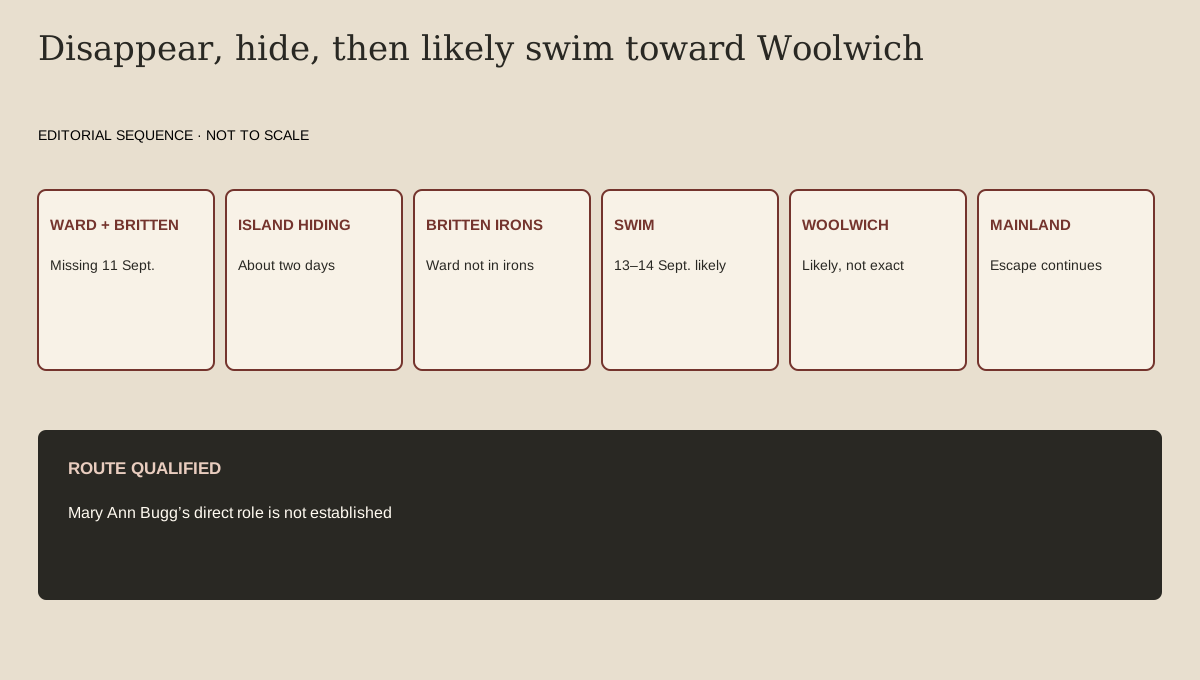
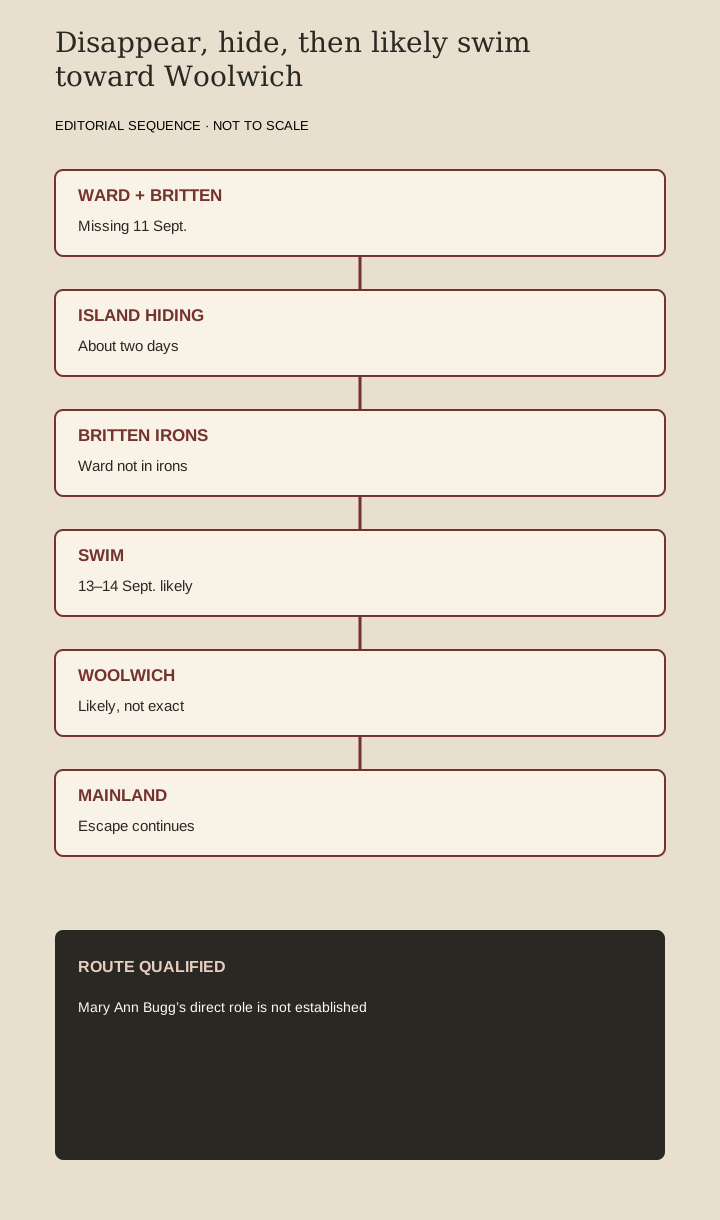
Simplified editorial reconstruction; not to scale. See adjacent text for evidence qualifications and unresolved details.
Problem → response
Escape was a sequence of problems
Each response solved a practical obstacle while often creating the next one.
- 01→
Obstacle
Evening muster and immediate search
Once Ward and Britten were found missing, authorities knew two prisoners were loose somewhere on or beyond the island.
Response
The men appear to have remained concealed on Cockatoo Island rather than attempting an immediate crossing during the first alarm.
- 02→
Obstacle
Sydney Harbour
Water separated the penal establishment from the mainland and exposed any swimmer outside the physical cover of the island.
Response
Ward and Britten eventually swam from the island, apparently from the northern side toward the mainland.
- 03→
Obstacle
Britten's irons
Britten was under sentence to wear irons, creating a physical impediment to a water escape.
Response
His irons were reportedly found near the northern shoreline after the escape, but the exact method used to remove them is not securely documented.
- 04→
Obstacle
Recapture near Sydney
Reaching shore still left the fugitives close to the colony's principal city and the prison from which they had escaped.
Response
They moved north and were in the New England district by late October.
The final accounting
Outcome
Successful escapees
Ward and Britten both escaped Cockatoo Island and reached the mainland.
Ward's period at large
Ward remained beyond permanent recapture until his death in May 1870.
Evidence discipline
What the record supports
Status labels distinguish secure conclusions from uncertainty and rejected claims. Color is never the only signal.
DOCUMENTED
Ward and Frederick Britten escaped Cockatoo Island together in September 1863.
The paired escape is supported by the Australian Dictionary of Biography, State Library of New South Wales, Sydney Harbour Trust, Heritage NSW, and archival-based research.
Sources: SRC-001, SRC-002, SRC-004, SRC-005, SRC-007DISPUTED
11 September 1863 was the night Ward and Britten swam from the island.
Many institutional summaries use 11 September as the escape date, while archival-based reconstruction indicates this was the date they absconded from work and that the swim most likely occurred during the night of 13–14 September.
Sources: SRC-001, SRC-004, SRC-005WELL-SUPPORTED
The pair most likely swam toward Woolwich.
The State Library describes Woolwich as the presumed destination, and archival reconstruction points to the northern shoreline as the departure area. A precise landing site remains unknown.
Sources: SRC-001, SRC-005MYTH
Mary Ann Bugg brought Ward a file and directly enabled the Cockatoo Island escape.
The Australian Dictionary of Biography says there is little evidence for her participation. Archival-based research places her working at Dungog and notes that Ward was not sentenced to wear irons at the time.
Sources: SRC-003, SRC-004, SRC-006MYTH
Ward needed to remove his own prison irons before swimming away.
Archival-based research indicates Ward was not under an irons sentence; Britten was. Britten's irons were reportedly found at the shoreline.
Sources: SRC-005, SRC-006DISPUTED
Balmain is the securely documented landing point.
The Dictionary of Sydney repeats a Balmain version, while the State Library and archival reconstruction favor a northward swim toward Woolwich. The exact landing point is not established.
Sources: SRC-001, SRC-008UNKNOWN
Ward was already securely known as Captain Thunderbolt at the moment of the Cockatoo Island escape.
The alias is strongly associated with his later 1863 bushranging career, while the neat toll-bar naming story is treated by institutional sources as legend.
Sources: SRC-001, SRC-002, SRC-004Selected chronology
Selected chronology
Ward receives a ten-year sentence
Ward was sentenced to ten years' hard labour in connection with stolen horses and was imprisoned on Cockatoo Island.
Conditional release
Ward received a ticket-of-leave and left Cockatoo Island under reporting conditions.
Returned to Cockatoo Island
After his ticket-of-leave was revoked and a further horse case followed, Ward was returned to imprisonment.
Ward and Britten disappear
The two prisoners absconded from their work station and were found missing at muster.
Concealed on the island
Archival reconstruction indicates Ward and Britten remained hidden on Cockatoo Island for roughly two days.
Swim from Cockatoo Island
The pair appear to have left from the northern shoreline and swum toward the mainland, most likely in the direction of Woolwich.
Encounter near Split Rock
Ward and Britten were confronted by police near what is now Thunderbolt's Rock; Ward was wounded in the back of the left knee but escaped.
The Thunderbolt identity emerges
Ward's later bushranging career became associated with the name Captain Thunderbolt; the exact origin story of the nickname is partly legendary.
Ward's life on the run ends
Ward was killed after a confrontation with police near Uralla, almost seven years after the Cockatoo Island escape.