
Air France Flight 139 left Tel Aviv for Paris on 27 June 1976 with a scheduled stop in Athens. Shortly after it departed Athens, four newly boarded passengers seized the aircraft. Two were Palestinians associated with the Popular Front for the Liberation of Palestine–External Operations; two were German members of the Revolutionary Cells. The hijackers forced the crew first toward Benghazi and then to Entebbe in Uganda. Seven days later, 102 hostages left Entebbe aboard Israeli military transports.
The distance between those two events contains far more than a famous commando raid. It includes a hostage selection, two major releases, an execution deadline, French and Israeli diplomatic efforts, pressure from hostage families, questioning of released passengers, uncertainty about Ugandan involvement, a long-range rescue plan that initially seemed almost impossible, and an international argument over whether saving hostages could justify armed action inside another state.
At a Glance
- Flight: Air France Flight 139
- Hijacked: 27 June 1976
- Original route: Tel Aviv → Athens → Paris
- Forced route: Athens → Benghazi → Entebbe
- Original hijackers: 4
- Additional hostage-takers at Entebbe: 3
- Hostage-takers present by the raid: 7
- People aboard: best-supported current count is 248 passengers + 12 crew = 260
- Hostages remaining before the raid: 106
- Hostage away from Entebbe: Dora Bloch, hospitalized in Kampala
- Hostages physically at Entebbe when the rescue began: 105
- Hostages extracted: 102
- Hostages killed during the raid: 3
- Hostage murdered afterward: Dora Bloch
- Israeli military fatalities: 1 — Lt. Col. Yonatan Netanyahu
- Hostage-takers killed: 7
- Ugandan military fatalities: dozens; 45 is commonly cited but not treated here as uncontested
- Main transports: 4 C-130 Hercules
- Operation: night of 3–4 July 1976
- Original codename: Operation Thunderbolt
- Later name: Operation Yonatan / Jonathan
The crisis began after Athens
Flight 139 had originated in Tel Aviv and stopped in Athens before continuing toward Paris. Four hijackers boarded during that stop and took control after takeoff. Their identities matter because simplified retrospective pages sometimes misidentify the German pair. Wilfried Böse and Brigitte Kuhlmann belonged to the West German Revolutionary Cells, while the Palestinian pair were linked to the PFLP's external-operations network.
The aircraft was an Air France Airbus, making France central to the diplomatic response even though a large share of the passengers were Israeli. The hijackers diverted the aircraft first to Benghazi, where it remained for hours, and then south to Uganda.
Entebbe transformed the problem. The crisis was no longer a moving aircraft with an uncertain destination. It became a fixed hostage site inside a state whose authorities were willing to support the captors.
Uganda was not a neutral landing ground
President Idi Amin's Uganda had once maintained close military and economic relations with Israel, but that relationship had broken down before 1976. By the time Flight 139 arrived, Amin publicly aligned himself with the Palestinian cause.
At Entebbe, three additional hostage-takers joined the original four. Ugandan soldiers guarded the airport and helped create the secure environment in which the hostages were detained.
This became central to the later legal argument. Israel did not describe the mission as an ordinary incursion into the territory of a neutral state honestly trying to free the passengers. Israeli officials argued that Uganda had become complicit in the detention.
Uganda and many African governments rejected that justification and emphasized that the raid still violated Ugandan sovereignty. Both parts of that dispute belong in the history.
The hostage count is harder than it first appears
Current Knesset material describes 260 passengers and crew aboard Flight 139. The familiar breakdown is 248 passengers and 12 Air France crew members.
An IDF French-language retrospective instead gives 228 passengers plus 12 crew. Because the Knesset's current archival project, another IDF aircrew retrospective and multiple independent reconstructions support 248 passengers, the lower figure is best treated as an institutional inconsistency rather than a controlling alternative. The later numbers are more important to the rescue itself.
After the large releases, 106 people remained within the hostage crisis. The usual reconstruction is 94 passengers plus the twelve-member Air France crew.
One of those 106, Dora Bloch, was moved to a hospital in Kampala before the raid. That left 105 physically at Entebbe when the rescue began.
Three died during the rescue. The strongest extraction count is therefore 102.
The hostage selection needs careful wording
The separation at Entebbe became one of the most powerful memories of the crisis. Israeli and Jewish passengers were separated from the larger group, an act with unmistakable antisemitic resonance given that two hijackers were German. Yet the exact criterion is not described identically by every source.
Israeli institutional histories often say Jewish and Israeli hostages were separated. Some eyewitness-based accounts emphasize Israeli nationality and note exceptions involving non-Israeli Jews and other non-Israelis who remained.
The available evidence preserves the antisemitic significance of the selection without establishing one perfectly documented rule applied to every individual. The retained passenger group was overwhelmingly Israeli and Jewish. The Air France crew remained as well.
The Air France crew did not simply leave
When most non-Israeli passengers were released, Captain Michel Bacos and the Air France crew remained with those still being held. Bacos became one of the best-known non-Israeli figures in the crisis because he treated the crew's responsibility as continuing while passengers remained captive. That decision also matters to the count.
The final hostage group was not simply “the Israelis.” It included the twelve-member Air France crew and other non-Israeli passengers who remained. A label such as “106 Israeli hostages” is therefore inaccurate.
The demand was international
The captors demanded the release of prisoners held not only in Israel but in several other countries. Contemporary and later accounts commonly describe a list of fifty-three Palestinian and allied prisoners, with the largest group held in Israel.
This made negotiation multinational. France had the airline and crew. Israel held many of the requested prisoners and had the largest number of citizens at risk.
Uganda controlled the territory. Other governments held people named in the demands.
Amin presented himself publicly as a mediator while simultaneously enabling the hostage site. The crisis was international before any Israeli military aircraft left for Uganda.
The first Israeli answer was not simply “no negotiations”
Entebbe later became associated with the idea that Israel defeated hostage-taking by refusing to negotiate. The declassified decision record complicates that national myth.
Israeli officials initially resisted the demands and searched for alternatives. As the deadline approached and hostage families increased pressure, the government became willing to negotiate.
That willingness bought time. The captors extended their deadline to 4 July and released additional non-Israeli hostages. Military planning and diplomacy then continued in parallel.
The eventual raid was not proof that no negotiation occurred. It became possible partly because negotiation extended the clock long enough for a credible rescue option to mature.
Released hostages became an intelligence source
The large releases changed the military problem as much as the diplomatic one. People who had spent days in the old terminal could be questioned about the number and appearance of the captors, the rooms being used, Ugandan soldiers, hostage conditions and the physical arrangement of the building. Israeli archival material from the crisis shows senior officials discussing information obtained from released passengers.
The value of those debriefings is easy to underestimate. Entebbe lay thousands of kilometers from Israel, and planners could not repeatedly observe the interior of the terminal. People who had just left it provided unusually current information.
Selected chronology
Selected chronology
Flight 139 hijacked
Four hijackers take control after the Athens stop.
Benghazi stop
The aircraft lands in Libya before continuing to Uganda.
Arrival at Entebbe
Hostages are moved to the old terminal; three additional hostage-takers and Ugandan forces reinforce the site.
Hostages separated
The retained group becomes overwhelmingly Israeli/Jewish; exact sorting criterion varies by account.
First major release
Non-Israeli hostages are released and later debriefed.
Deadline extended
Negotiations produce more time and another large release.
Military option becomes concrete
Dan Shomron presents the developing rescue concept to senior leaders.
Dora Bloch hospitalized
Bloch is moved to Mulago Hospital in Kampala.
Cabinet authorizes rescue
Israel approves the military operation after feasibility and intelligence improve.
C-130 force lands
Four Hercules transports bring the rescue force to Entebbe.
Old terminal assaulted
The hostage-takers are killed; three hostages and Yonatan Netanyahu die during the operation.
102 hostages extracted
The force leaves Uganda and uses Nairobi for refueling and medical support.
Dora Bloch murdered
Bloch disappears from hospital and is later established to have been murdered by Ugandan authorities.
Security Council debate
Uganda and the OAU condemn the raid; Israel defends it as an exceptional hostage rescue. No resolution conclusively settles legality.
The terminal itself was unusually knowable
Another advantage came from Entebbe's construction history. Israeli companies and personnel had been involved in Ugandan infrastructure during the earlier period of close Israel-Uganda relations.
Official Israeli military histories say planners were able to obtain or reconstruct useful information about the old terminal from that earlier connection. This did not make the intelligence perfect. Buildings change.
Furniture moves. Guards alter positions. Hostages can be relocated.
But planners were not forced to imagine an unknown building from scratch. They could rehearse against a meaningful representation of the actual problem.
Distance was the first military obstacle
Entebbe lay roughly 3,600 to 4,000 kilometers from Israel depending on route and measuring point. That distance eliminated many otherwise plausible rescue ideas. A helicopter force could not simply fly from Israel, reach Uganda and return.
Fighters could not extract more than one hundred civilians. A rescue force also needed vehicles, medical capability, reserve troops and enough fuel to leave. The operation therefore became an airlift and logistics problem before it became an assault problem.
The Hercules made the concept possible
The Israeli Air Force built the main rescue force around four C-130 Hercules transports. The C-130 could carry troops, vehicles and hostages over long distances and use a normal runway without the infrastructure required by a large civilian airliner. Israeli accounts also describe Boeing 707 support aircraft serving command and medical functions.
The exact support-aircraft positioning varies in simplified retellings, but the central architecture is clear. The Hercules force would carry the people and equipment needed to open the hostage site, protect the transports and evacuate the civilians. The plan depended on solving the return trip as well as the arrival.
Kenya was the logistical hinge
Nairobi provided the refueling and medical bridge that made the extraction far more practical. This was politically sensitive. Kenya shared the region with Uganda and risked retaliation from Amin's government if its cooperation became known.
For Israel, however, the value was enormous. The rescue aircraft did not need to preserve enough fuel for an uncompromised direct round trip while also carrying a large force and, on the return, more than one hundred rescued civilians.
The route home could pass through Nairobi, where fuel and medical support were available. The tactical drama at Entebbe has often overshadowed this diplomatic-logistical achievement.
Material evidence
Tools of Escape
The objects used in an escape reveal how a plan worked under constraint.
- 01Reduced uncertainty at a remote site.
Released-hostage debriefings
Released passengers supplied recent information about the terminal and captors.
- 02Allowed meaningful rehearsal against a known building.
Airport construction knowledge and plans
Earlier Israeli involvement in Ugandan infrastructure helped reconstruct the old terminal.
- 03Made long-range insertion and evacuation possible.
C-130 Hercules transports
Four transports carried troops, vehicles and extraction capacity.
- 04Intended to delay recognition during the initial approach.
Vehicle deception
A black Mercedes and accompanying vehicles resembled a Ugandan official convoy.
- 05Solved a central long-range extraction problem.
Kenyan refueling and medical access
Nairobi provided fuel and medical support after the force left Uganda.
The cabinet still had to choose
A workable plan did not automatically become an authorized operation. Rabin's government had to decide whether the intelligence was reliable enough, whether the rescuers could arrive before the hostages were killed, whether Uganda would resist and whether the aircraft could get everyone out. Hostage families were demanding action and, in many cases, acceptance of the prisoner-release demands rather than a military gamble with their relatives' lives.
The political pressure was real. So was the fear that conceding might encourage future hostage-taking. The cabinet ultimately authorized the raid on 3 July only after planners had produced an option senior leaders believed had a realistic chance of success.
The plan was broader than one commando team
The most famous element was Sayeret Matkal, assigned to reach the old terminal and free the hostages. But the operation required more than an assault element. Other forces had to protect the transport aircraft, control important parts of the airfield, respond to Ugandan military resistance, support evacuation and reduce the danger that Ugandan combat aircraft could pursue the departing C-130s.
The operation therefore consisted of several coordinated tasks around one central objective. The hostages were the purpose. The airfield was the environment that had to be controlled long enough to get them out.
The black Mercedes was a limited deception
The best-known operational detail is the black Mercedes carried to Uganda with other vehicles. The lead force intended to resemble a familiar Ugandan presidential convoy during its movement toward the old terminal. Popular retellings sometimes make the trick sound almost magical, as though the Israeli force simply drove past everyone disguised as Idi Amin.
That is too neat. The deception was useful during the initial movement, but it did not preserve complete surprise all the way to the hostages.
An encounter with Ugandan guards broke the intended stealth, forcing the rescuers to accelerate into the assault. The Mercedes belonged to the opening phase of the plan, not the whole explanation for success.
The final approach became a firefight
Once surprise deteriorated, the lead force moved rapidly toward the old terminal. The exact shot-by-shot sequence has been argued over for decades, especially because later accounts differ over who fired first at particular points and who caused individual casualties. A historical reconstruction does not need to reproduce those micro-tactics to explain the result.
The key fact is that the rescue force entered the terminal while hostage-takers and Ugandan soldiers were armed and capable of returning fire. That compressed the central danger into a very small space. The rescuers had to distinguish civilians from captors while the hostages themselves were reacting to sudden gunfire and shouted instructions.
Three hostages died during the rescue
Jean-Jacques Maimoni, Pasco Cohen and Ida Borochovitch were killed during the operation. Their deaths are often reduced to a footnote beneath the number rescued. They should not be.
The operation succeeded on an extraordinary scale, but it did not rescue everyone alive at the terminal. The precise circumstances of the three deaths are also less tidy than some popular accounts suggest.
Later reconstructions differ over which shots came from Israeli soldiers and which from hostage-takers or crossfire. For this page, the strongest treatment is to name the victims, acknowledge that they died during the rescue and avoid forcing a definitive micro-sequence where the evidence remains disputed.
Problem → response
Escape was a sequence of problems
Each response solved a practical obstacle while often creating the next one.
- 01→
Obstacle
Distance
Entebbe lay roughly 3,600–4,000 km from Israel.
Response
Use long-range transports, support aircraft and Kenyan refueling.
- 02→
Obstacle
Uncertain intelligence
Israel initially lacked reliable detail about the hostage site.
Response
Debrief released hostages, study plans and rehearse.
- 03→
Obstacle
Execution deadline
Captors threatened hostage killings.
Response
Negotiate and gain deadline extensions while planning continues.
- 04→
Obstacle
Captors plus Ugandan military
The hostage site existed inside an armed Ugandan environment.
Response
Divide responsibilities between hostage rescue, airfield protection and extraction.
- 05→
Obstacle
Loss of full surprise
The convoy deception did not carry the force unseen all the way to the terminal.
Response
Accelerate into the assault.
- 06→
Obstacle
Dora Bloch outside Entebbe
Bloch had been moved to a Kampala hospital.
Response
No direct rescue was possible within the airport operation.
- 07→
Obstacle
Sovereignty consequences
The raid used force on Ugandan territory without consent.
Response
Israel invoked exceptional rescue necessity and Ugandan complicity; Uganda and OAU rejected that justification.
Yonatan Netanyahu was the only Israeli military fatality
Lt. Col. Yonatan Netanyahu commanded the Sayeret Matkal assault element.
He was shot during the operation and died of his wounds. At least five other Israeli soldiers were wounded in the IDF's retrospective account. Netanyahu's death had an enormous effect on the memory of the mission.
The operation was later renamed Operation Yonatan in his honor, and his personal story became inseparable from the national mythology surrounding Entebbe. That memorial prominence should not obscure the wider chain of command. Dan Shomron directed the overall operation, while multiple Air Force and ground-force commanders were responsible for distinct components.
All seven hostage-takers at Entebbe were killed
The original four hijackers had been reinforced by three additional militants after the aircraft reached Uganda. All seven were killed during the rescue operation. This is one of the firmer combatant counts.
The Ugandan military casualty figure is less secure. Many histories repeat forty-five Ugandan soldiers killed.
Some contemporary and institutional summaries instead use broader wording such as “dozens.” Because archival reconciliation of Ugandan losses is weaker than the Israeli and hostage casualty record, forty-five should be treated as a conventional estimate rather than an uncontested exact total.
Ugandan aircraft were destroyed
Israeli forces also destroyed Ugandan military aircraft on the ground. The purpose was to reduce the possibility that Ugandan fighters could pursue heavily loaded transports as they departed. Later accounts differ over the exact number destroyed.
The commonly repeated number is eleven, while some sources give larger totals. The exact figure adds little to understanding the rescue mechanism, so the page should explain the reason for the action without pretending the aircraft count is perfectly settled.
Documentary reconstruction
Hostage crisis, rescue and extraction
A case-local editorial visual separates the documented sequence from uncertainty without implying exact modern geography or operational detail.
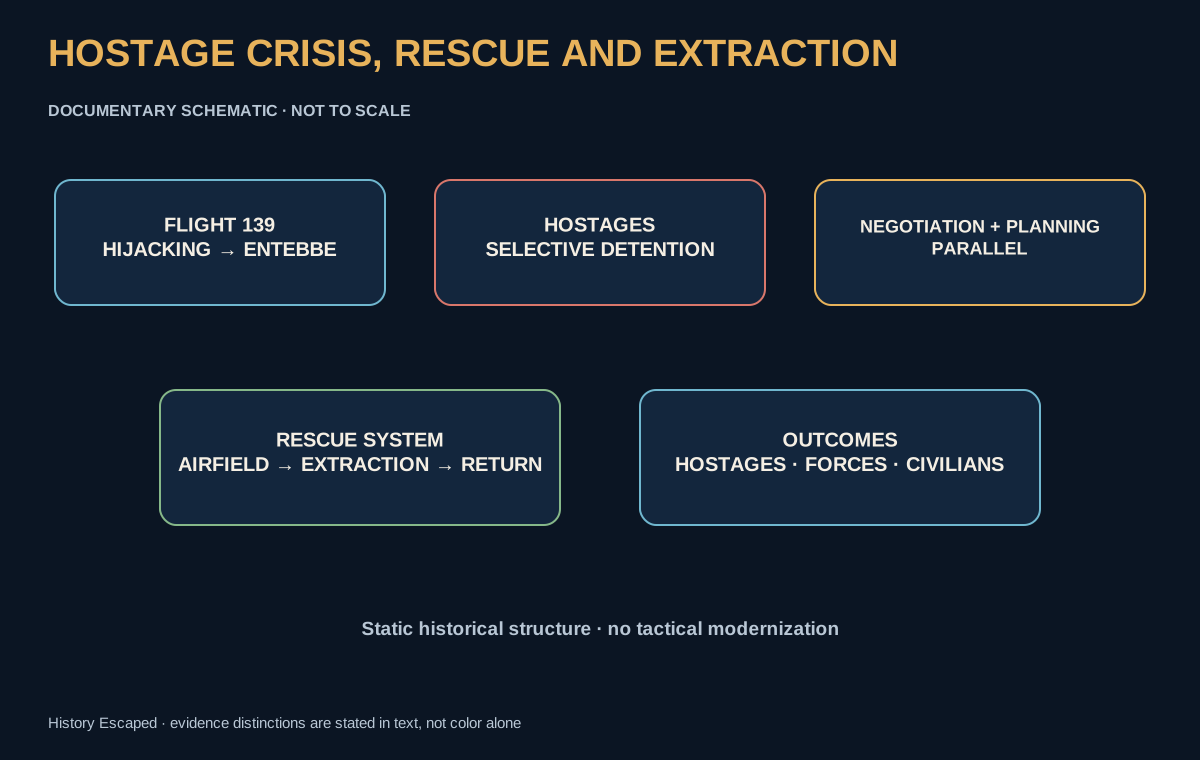

Simplified editorial reconstruction based on the cited historical record; not to scale. Uncertainty is stated directly in the visual and adjacent text.
The hostages had to move through an active battle
Once the terminal was under Israeli control, the operation changed from assault to extraction. The hostages still had to move to the transport aircraft while Israeli forces were facing Ugandan fire around the airport. This phase matters because a rescue is not complete when the captors are dead.
More than one hundred civilians had to cross open space, board aircraft and leave a hostile country. The extraction force also had wounded hostages and wounded soldiers to manage. The operation succeeded because enough of the airfield remained under Israeli control for that movement to happen.
Dora Bloch was not at the terminal
The arithmetic of 106 hostages and 102 rescued becomes clear only when Dora Bloch is separated from the terminal count. Bloch, an elderly British-Israeli passenger, suffered a medical emergency and was taken to Mulago Hospital in Kampala before the raid. She was still alive in Ugandan medical custody when the Israeli force attacked Entebbe.
The commandos could not rescue someone who was no longer at the airport. After the raid, British diplomats tried to determine her status. She disappeared from the hospital.
Evidence that emerged later showed she had been murdered by Ugandan authorities. Her remains were recovered after Amin's fall in 1979.
The correct extraction count is 102
Some Israeli commemorative pages use 103 rescued hostages. That number has become embedded in the public memory of Entebbe. The more coherent outcome count is:
106 people remained in the continuing hostage crisis. 1 — Dora Bloch — was in Kampala hospital. 105 were physically at the Entebbe hostage site.
3 died during the raid. 102 were evacuated.
This sequence also matches widely used modern accounts and the 2026 reporting on newly released Israeli archival records. A reconstruction page should prefer the count that makes every individual outcome intelligible.
The fourth hostage death occurred after the raid
The three deaths at the terminal and the murder of Dora Bloch belong in different categories. Maimoni, Cohen and Borochovitch died during the rescue operation itself. Bloch died later in the custody of Ugandan authorities.
Combining them into “four hostages killed in the raid” erases an important distinction. Her murder was an act of post-raid state violence, not a casualty of the firefight at Entebbe. It also intensified the diplomatic rupture between Uganda and the United Kingdom.
How long did the operation last?
An IDF retrospective by navigator Avi Mor states that the Israeli aircraft left Entebbe fifty-eight minutes after arrival. Other summaries describe the operation as lasting under ninety minutes. The difference is largely definitional.
One account may measure from the first landing to final departure; another may include a wider operational window. The safest presentation is therefore not to advertise a single stopwatch figure as though every source measures the same phase. The important point is that a mission requiring a flight of thousands of kilometers depended on a very short period on the ground.
Nairobi completed the extraction
The rescued hostages and Israeli forces did not simply fly from Entebbe straight to a celebration in Israel. Nairobi was a critical intermediate stop. There, the aircraft could refuel and wounded people could receive medical care.
This makes clear that Operation Entebbe was more than a tactical raid. Political access to Kenya, air-force planning, fuel calculations, medical arrangements and secrecy were all part of the rescue mechanism. The old terminal was only the most visible piece.
The final accounting
Outcome
Hostages in crisis before raid
Dora Bloch was hospitalized away from the terminal.
Hostages extracted
The strongest outcome count.
Hostages killed during raid
Jean-Jacques Maimoni, Pasco Cohen, Ida Borochovitch.
Hostage murdered afterward
Dora Bloch.
Israeli military killed
Yonatan Netanyahu.
Hostage-takers killed
All seven present at Entebbe.
Ugandan military killed
Dozens; 45 is conventional but not treated as exact.
The immediate hostage crisis ended on 4 July
On the morning of 4 July, the rescued hostages reached Israel. For families waiting there, the central fact was simple: people who had been held thousands of kilometers away were suddenly home. The operation had an enormous psychological effect in Israel.
It came only four years after the Munich Olympic hostage catastrophe, where a West German rescue attempt ended with all nine remaining Israeli hostages killed. Entebbe seemed to demonstrate that distance did not necessarily place hostages beyond the reach of a carefully planned rescue. That perception became part of the operation's mythology almost immediately.
Rabin warned against mythology
The 2026 release of Israeli records is valuable because it preserves a more restrained tone inside the decision-making system than later celebration sometimes suggests. Rabin recognized the operation as an extraordinary achievement. He also warned that one successful rescue did not solve the broader problem of international terrorism.
That distinction matters. Entebbe became a model studied by militaries and security agencies around the world, but no responsible historical lesson is simply “repeat Entebbe.” The mission depended on unusually favorable conditions: specific intelligence, a known airport, suitable aircraft, an extended deadline, third-country logistical access, a concentrated hostage site and a government willing to accept exceptional risk.
Uganda called the raid aggression
For Uganda, the rescue was an armed Israeli incursion that killed Ugandan personnel and damaged military assets on Ugandan territory. Amin's government demanded international condemnation. The Organization of African Unity also treated the raid as a violation of sovereignty and territorial integrity.
That position cannot be dismissed merely because Uganda supported the hostage-takers. International law normally begins with a strong prohibition on one state using force inside another. The dispute was whether the extraordinary hostage danger and Ugandan complicity could create an exception.
Israel framed the raid as rescue where the host state was complicit
Israel argued that Uganda was not functioning as a neutral sovereign protecting civilians. Ugandan soldiers were helping guard the hostages. Additional hostage-takers had joined the operation on Ugandan territory.
Amin repeatedly appeared during the crisis while civilians remained under armed threat. From the Israeli perspective, asking Uganda for protection was meaningless because the Ugandan state was part of the danger. Israel therefore presented the raid as an exceptional measure necessary to save lives.
Evidence discipline
What the record supports
Status labels distinguish secure conclusions from uncertainty and rejected claims. Color is never the only signal.
MYTH
Israel categorically refused to negotiate.
Declassified records show negotiations and military planning in parallel.
Sources: SRC-003, SRC-006, SRC-014DISPUTED
Every Jew was retained solely because of religion and every non-Jew released.
The retained group was overwhelmingly Israeli/Jewish, but eyewitness and institutional accounts vary over the exact sorting criterion.
Sources: SRC-004, SRC-005, SRC-008, SRC-018MYTH
The Air France crew was forced to remain.
The crew remained with the passengers and was rescued with them.
Sources: SRC-004, SRC-007, SRC-018MYTH
Exactly 103 hostages were extracted.
Some retrospective pages use 103, but the 106 → 1 hospital → 3 raid deaths → 102 extraction sequence is the most coherent reconstruction.
Sources: SRC-001, SRC-003, SRC-013, SRC-018MYTH
Dora Bloch died during the raid.
She was in a Kampala hospital and was murdered afterward by Ugandan authorities.
Sources: SRC-011, SRC-017MYTH
The three raid hostage deaths have one completely settled shot-by-shot explanation.
Later accounts differ over the source of particular fatal fire; the victims and timing are secure, the micro-sequence is not.
Sources: SRC-015, SRC-016MYTH
The Mercedes deception preserved surprise all the way to the hostages.
It supported the initial approach, but surprise broke down before the terminal.
Sources: SRC-001, SRC-002DISPUTED
Exactly 45 Ugandan soldiers were killed.
Forty-five is the conventional estimate; official summaries often say dozens.
Sources: SRC-013, SRC-019, SRC-021MYTH
Entebbe created a universally accepted legal right to use force abroad to rescue nationals.
The raid became a major precedent in argument, but its legality remained contested.
Sources: SRC-012, SRC-019, SRC-021MYTH
The UN Security Council formally condemned Israel.
The Council debated competing approaches but adopted no resolution conclusively settling the issue.
Sources: SRC-012, SRC-022MYTH
The operation was originally called Operation Yonatan.
It was conducted as Operation Thunderbolt and renamed Operation Yonatan afterward.
Sources: SRC-002, SRC-015The Security Council did not settle the law
The United Nations Security Council met to consider the complaint. The debate exposed several competing principles:
- protection of civilians from international terrorism;
- prohibition of aircraft hijacking and hostage-taking;
- Uganda's sovereignty and territorial integrity;
- Israel's asserted right to protect endangered nationals;
- accusations that Uganda had collaborated with the captors.
The Council considered competing draft approaches but did not adopt a resolution conclusively condemning or endorsing the raid. That outcome is sometimes misremembered as legal approval. It was not.
Nor was it a formal condemnation. The international-law status of forcible rescue of nationals abroad remained contested.
Entebbe became a precedent in argument, not a universal license
Later lawyers and governments repeatedly cited Entebbe when debating the use of force to rescue nationals overseas. Supporters saw it as a powerful example of necessity: civilians faced imminent death, the territorial government was complicit, the force was directed toward rescue and the operation ended quickly. Critics emphasized that allowing states to decide unilaterally when another government had “failed” could weaken the broader prohibition on force.
That disagreement matters more than a simple label of legal or illegal. The legal aftermath should therefore be treated as a contested precedent rather than a judicial verdict.
The broader Arab-Israeli conflict should not swallow the hostage story
The captors' goals were connected to Palestinian militancy and the Arab-Israeli conflict. The prisoners they sought to free included Palestinians and allied militants. Israel's security doctrine had been shaped by years of attacks against Israeli and Jewish civilian targets.
Those facts are necessary. But the Entebbe case does not require a complete history of the Israeli-Palestinian conflict.
The immediate event was a specific hostage crisis involving an Air France aircraft, Ugandan state support, Palestinian and German militants, released passengers, detained Israeli/Jewish hostages, French diplomacy, Israeli decision-making and a military extraction. Keeping the scale controlled makes the case more accurate.
The rescue was not just Sayeret Matkal
Popular culture naturally concentrates on the commandos who entered the terminal. The aircrews were equally necessary. So were planners who reconstructed the airport.
So were intelligence officers who debriefed released hostages. So were Kenyan officials who enabled the logistical bridge. So were medics, airfield-security forces and transport crews.
The operation succeeded because these systems met at the same moment. A flagship reconstruction should show those dependencies rather than reducing Entebbe to a short gun battle.
The hostages were not one anonymous mass
The casualty count also needs to resist triumphal compression. Jean-Jacques Maimoni was nineteen. Pasco Cohen and Ida Borochovitch also died at Entebbe.
Dora Bloch survived the hijacking, selection and days of detention, only to be murdered after she was removed for medical treatment. Their deaths do not erase the success of rescuing 102 people.
The success does not erase their deaths. A serious page can hold both facts at once.
Why the operation remains exceptional
Many hostage sites cannot be reached by a long-range transport force. Many governments do not permit a neighboring state to provide fuel. Many captors disperse hostages.
Many buildings are unknown. Many deadlines are too short. Many target countries have air-defense environments that make a transport landing implausible.
Entebbe worked because an extraordinary set of political, geographic, technical and intelligence conditions aligned. The raid's fame can make those conditions look inevitable in retrospect. They were not.
Why this belongs in History Escaped
Operation Entebbe is a rescue-extraction rather than an escape initiated by the captives. The hostages could not simply walk out of the old terminal or cross a nearby friendly border. Their confinement was protected by armed hostage-takers and by the security apparatus of the state in which they were held.
The escape mechanism therefore had to be imported from outside. Aircraft brought the rescuers thousands of kilometers into Uganda. A short period of control at the airport created a corridor from the terminal to the transports.
Kenyan access made the return route sustainable. The rescued hostages moved from captivity to aircraft to another country in less time than the rescue force had spent flying to reach them. That is the central reconstruction.
The assault mattered because it opened the door. The extraction system is what carried 102 people through it. ---