
On the evening of 19 April 1943, 1,631 Jewish men, women, and children were locked into Transport XX at the Dossin Barracks in Mechelen and sent toward Auschwitz-Birkenau.
Later that night, three young resisters stopped the train with a false red signal. Under fire, they managed to open one freight wagon, and 17 people escaped through that door. The much larger number usually associated with the Twentieth Convoy came afterward, when Jewish prisoners in other wagons forced openings themselves and jumped during stops or while the train was moving. That distinction is essential to understanding what happened.
At a Glance
- Date: 19 April 1943
- Departure: Dossin Barracks, Mechelen
- Destination: Auschwitz-Birkenau
- Deportees at departure: 1,631
- Outside attackers: Youra Livchitz, Robert Maistriau, Jean Franklemon
- Directly freed during the stop: 17
- Current CegeSoma gross escape figure: 236
- Successful escapes: 120 in the current narrative; 122 in Kazerne Dossin's current person-level database
The Deportation System Behind the Train
Dossin Barracks in Mechelen served as the main German transit camp for Jewish deportations from occupied Belgium. From there, transports carried thousands of people east, most of them to Auschwitz-Birkenau.
Transport XX belonged to that system. By spring 1943, German authorities had reason to fear escapes. People had already jumped from earlier deportation trains, and increasing numbers of Jews were hiding rather than complying with German orders.
The twentieth transport was therefore secured more heavily than many of its predecessors. CegeSoma's recent reconstruction notes additional German soldiers and Flemish SS personnel, the use of freight wagons rather than the earlier third-class passenger coaches, and a late-evening departure. The route itself was unusually long, passing through Tongeren rather than following the more familiar route through Liège. The purpose was unchanged: deportation into the Nazi system of persecution and mass murder.
An Idea the Larger Resistance Considered Too Dangerous
By early 1943, information about the deadly fate awaiting Jewish deportees was spreading more widely.
Within the Comité de Défense des Juifs, the idea of attacking a deportation transport was discussed. Larger resistance organizations considered the action too dangerous.
Three young men decided to proceed anyway: Youra Livchitz, Robert Maistriau, and Jean Franklemon. A fourth man, Richard Altenhoff, supplied the only firearm available to them but did not go to the railway line.
Their equipment was limited. They carried pincers and a storm lantern whose light had been covered with red paper so that it could imitate a railway danger signal. This was not a large armed commando operation.
Selected chronology
Selected chronology
Transport XX departs Mechelen
The train leaves with 1,631 Jewish deportees in freight wagons.
False red signal stops the train
The railway accident report places the stop near the Hambosch block signal.
Seventeen escape at the intervention
Maistriau opens one wagon and 17 people leave.
Additional prisoners escape
People in other wagons force openings and jump later along the route.
Transport reaches Auschwitz-Birkenau
The remaining deportees arrive and undergo selection.
Livchitz is executed
After arrest, escape from custody, recapture, and imprisonment, Livchitz is executed.
Where the Train Actually Stopped
The attack has long been associated with Boortmeerbeek, where a memorial commemorates the event.
Recent railway research complicates that geography. In 2023, researchers found a special accident report in Belgian railway archives. CegeSoma says its location sketch places the false red signal near the warning signal for block 26 Hambosch, between Wespelaar-Tildonk and Hambosch.
That is several kilometres from the modern Boortmeerbeek memorial. Boortmeerbeek remains central to the public memory of the attack, but the monument should not be treated as a surveyed marker of the exact stopping point.
The Stop
Transport XX left Mechelen at about 10:40 p.m. The railway report places the stop at roughly 11:46 p.m.
The attackers immediately met a problem. Armed German guards were positioned near the front of the transport, where the three men had not expected them in such strength. Gunfire began.
Franklemon later said that he encountered a German guard and had to withdraw before opening a wagon. Maistriau reached a freight car and used his pincers on the door.
He got it open, and 17 people came out. He tried to reach another wagon, but firing forced him away.
Seventeen, Not Two Hundred
Those 17 are the people directly freed by the outside resistance intervention.
That number is stable across the strongest sources. What happened next is where simplified versions often become misleading. They jump from “17 people escaped the opened wagon” to a final figure above 200 and make it sound as though the three attackers personally released everyone. They did not.
Their intervention stopped the train and opened one door. The next phase belonged largely to the deportees themselves.
The Train Starts Again
The interruption lasted about twenty minutes according to the railway report.
The German escort ordered the train onward. The Belgian locomotive crew initially moved slowly before the train resumed its eastward journey. Inside the wagons, preparations for escape were already under way.
CegeSoma's reconstruction says Jewish partisans had been concentrated in one wagon with help from Eva Fastag, a prisoner-secretary at Dossin who manipulated the transport list. Tools had also been brought secretly onto the train.
As the journey continued, prisoners forced doors and wooden barriers. People began getting out.
Problem → response
Escape was a sequence of problems
Each response solved a practical obstacle while often creating the next one.
- 01→
Obstacle
Reinforced deportation security
Transport XX used locked freight wagons and additional armed guards.
Response
The outside group created a false stop while prisoners inside relied on concealed tools and forced openings.
- 02→
Obstacle
Armed escort fire
German escorts fired during the attack and later at people leaving the train.
Response
The attackers withdrew after opening one wagon; later deportees made individual escape attempts despite the danger.
- 03→
Obstacle
Locked freight wagons
Freight wagons made escape more difficult than earlier passenger coaches.
Response
Maistriau used pincers externally; prisoners forced doors and wooden barriers from inside.
Escape from Inside the Train
The later escapes did not form one coordinated mass exit at a single point. They happened along the route.
Some people jumped when the train slowed or stopped. Others risked jumping while it was moving. German guards fired at people leaving the wagons. Survivor testimony shows how individual these decisions could be.
Régine Krochmal later described forcing the wooden bars in her wagon and escaping while the train was stopped. Markus Wiesenfeld testified that a crowbar from Dossin was used to create an exit. Simon Gronowski was eleven years old.
Documentary reconstruction
Intervention, self-rescue and the conflicting totals
A case-local editorial visual separates the documented sequence from uncertainty without implying exact modern geography or operational detail.
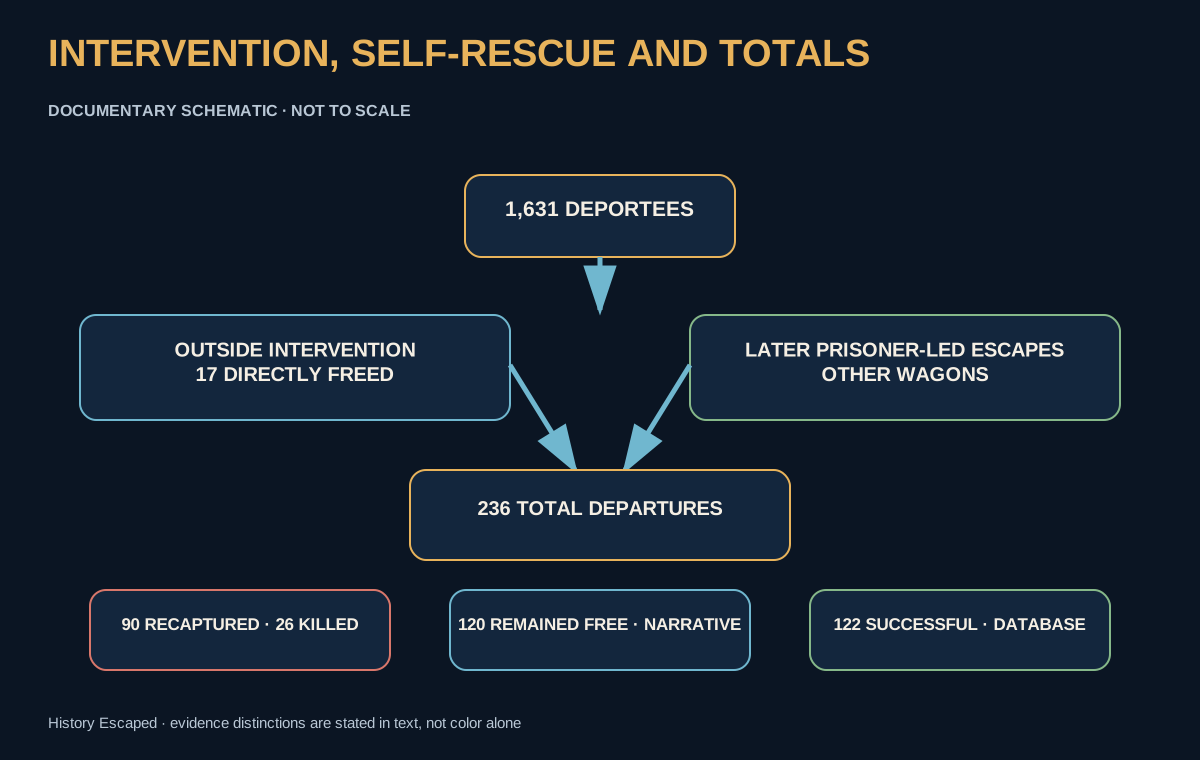
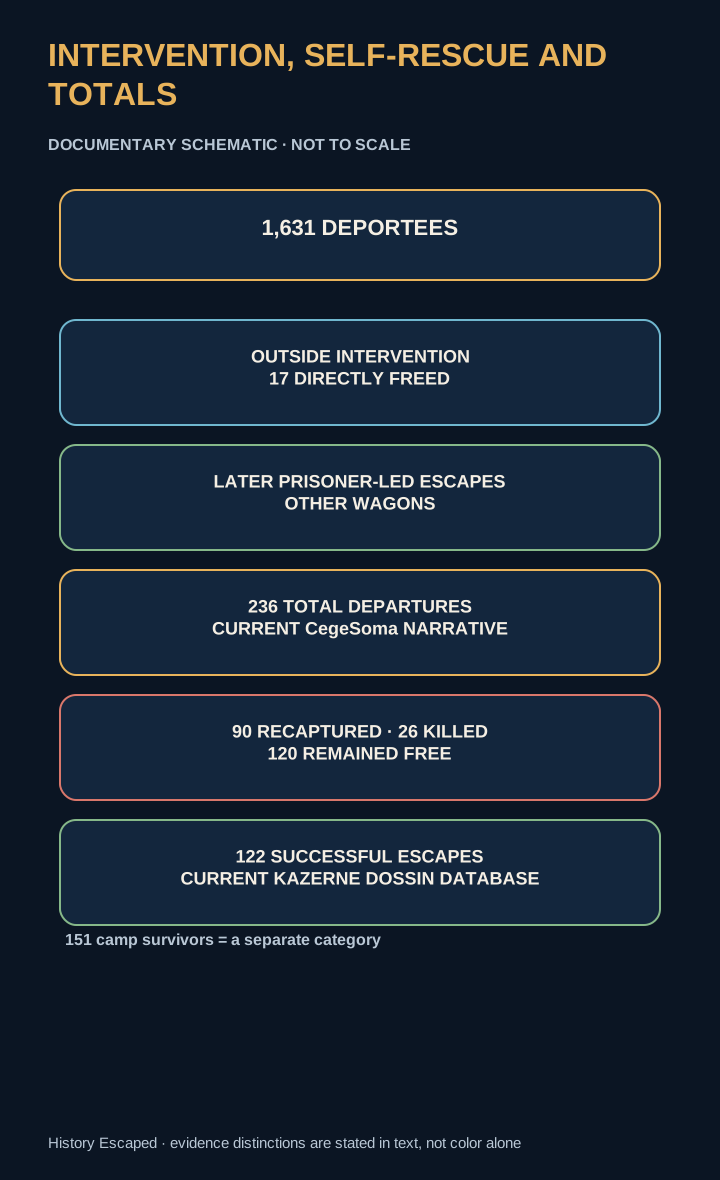
Simplified editorial reconstruction based on the cited historical record; not to scale. Uncertainty is stated directly in the visual and adjacent text.
Simon Gronowski
Simon had been arrested with his mother, Chana, and sister Ita in March 1943.
He and his mother were placed on Transport XX. During the journey, people in Simon's wagon created a way out. His mother helped him onto the running board. At the right moment, she let him go.
Simon jumped, survived the fall, and was helped by people in the area. He eventually returned to Brussels and was reunited with his father.
His mother did not jump. She remained aboard and was murdered after deportation. Simon's sister Ita was also murdered at Auschwitz-Birkenau. One child's successful escape did not become a family rescue.
How Many People Got Out?
This is the point where the modern numbers become difficult. The current CegeSoma reconstruction says 236 people escaped or otherwise got out of the train in all.
That figure includes the 17 who left the wagon opened during the attack and the much larger group who escaped later. The same reconstruction gives the outcomes as:
- 90 recaptured
- 26 killed
- 120 remaining free
CegeSoma's current biography of Livchitz repeats the same figures and attributes them to Kazerne Dossin research. Those numbers are internally straightforward: 236 minus 90 minus 26 equals 120. But they are not the only current institutional count.
The final accounting
Outcome
Directly freed during stop
Escaped through the wagon opened by Maistriau.
Total departures in current CegeSoma narrative
Includes direct and later prisoner-led escapes.
Recaptured in current narrative
Ninety are listed as recaptured.
Killed during escape attempts in current narrative
CegeSoma gives 26 killed; older institutional summaries differ.
Successful escape classification
CegeSoma's current narrative gives 120 remaining free; Kazerne Dossin's current person-level database lists 122 successful escapes.
Concentration-camp survivors
Kazerne Dossin lists 151 concentration-camp survivors for Transport XX as a separate category.
Why Kazerne Dossin Now Says 122
Kazerne Dossin's current online Transport XX database lists:
- 1,631 deportees at departure
- 122 successful escapes
- 1,392 deportees on arrival
- 151 concentration-camp survivors
The public database does not explain why the successful-escape field is 122 while the recent CegeSoma narrative still says 120 remained free.
The difference is only two people, but that is precisely why it should not be hidden. It may reflect revised identification or person-level outcome classification, but without an explicit published reconciliation from Kazerne Dossin that remains an inference.
For this case, both figures should remain visible: 120 is the final-free total in the current CegeSoma narrative. 122 is the successful-escape count in Kazerne Dossin's current person-level database.
Where the Number 231 Comes From
Another figure appears frequently: 231.
The Auschwitz-Birkenau State Museum used that number in a 2012 summary, giving 90 captured, 26 killed, and 115 escaping. The United States Holocaust Memorial Museum also describes 231 attempted escapes, though its summary gives a different figure for those shot.
These older institutional summaries demonstrate that the Transport XX numbers have been revised and defined differently over time. They should not override the newer Belgian research, but they should not be erased either. The safest hierarchy is simple:
17 direct rescues — secure.
236 total departures from the train — current CegeSoma reconstruction.
120 vs. 122 successful escapes — unresolved current-source difference.
Evidence discipline
What the record supports
Status labels distinguish secure conclusions from uncertainty and rejected claims. Color is never the only signal.
MYTH
The three attackers directly freed more than 200 people.
They opened one wagon and directly freed 17. Most later escapes were initiated by prisoners inside the train.
Sources: SRC-002, SRC-003, SRC-005MYTH
Exactly 236 people permanently escaped and survived.
236 is a gross departure/escape-attempt figure in the current CegeSoma narrative, not a survivor total.
Sources: SRC-002, SRC-003DISPUTED
The final successful-escape count is unquestionably 120.
CegeSoma's current narrative gives 120 remaining free, while Kazerne Dossin's current person-level database lists 122 successful escapes.
Sources: SRC-001, SRC-003MYTH
The attack happened exactly at the current Boortmeerbeek memorial.
The 2023 railway reconstruction places the stop several kilometres away near block 26 Hambosch.
Sources: SRC-002MYTH
Jean Franklemon opened a wagon.
The current reconstruction says Franklemon withdrew after encountering a guard; Maistriau opened the successful wagon.
Sources: SRC-002MYTH
The operation was a large armed resistance raid.
Three young men acted with one firearm, pincers, and a red-covered lantern after larger resistance groups judged the action too dangerous.
Sources: SRC-002, SRC-003MYTH
The 151 concentration-camp survivors can simply be added to 120 or 122 train escapees to get a total survivor count.
These are separate database categories with possible person-level overlap through later arrests and deportations; the public transport summary does not support simple addition.
Sources: SRC-001The Train Reaches Auschwitz
Escape was not the fate of most people aboard. Transport XX continued east and reached Auschwitz on 22 April 1943.
The Auschwitz-Birkenau State Museum states that 531 people were registered in the camp after arrival and selection. The remainder were murdered shortly afterward in the gas chambers. Kazerne Dossin's present database lists 151 concentration-camp survivors for Transport XX.
That figure is a different category from people who successfully escaped the train. It should not simply be added to 120 or 122 to create a supposed total survivor number. A person who escaped one transport could later be arrested and deported again, and the public summary does not establish that the categories are mutually exclusive.
What Happened to the Three Attackers
The intervention also had consequences for the men who stopped the train.
Jean Franklemon was arrested. Robert Maistriau stayed underground longer but was arrested in March 1944. Both were deported and survived the war.
Livchitz was arrested in May 1943, escaped custody after wounding a guard, and was captured again in June. He was imprisoned at Breendonk and executed on 17 February 1944.
Richard Altenhoff, who had supplied the firearm but did not participate at the railway line, was arrested and executed in 1943. The rescue did not end when the train began moving again.
Why the Twentieth Convoy Matters
The action is often described as unique because it was the only deportation train carrying Jews toward a killing center that was deliberately stopped by an outside resistance group in this way. That distinction is important, but it can overshadow what happened inside the train.
The three attackers created a breach and directly saved 17 people. Jewish prisoners then widened the history of the event through their own preparation, tools, decisions, and risks. More people got out later than during the original stop.
The story is therefore not simply about three men rescuing passive prisoners. It is about outside intervention intersecting with self-rescue from within a genocidal deportation.
The final numbers resist a triumphant ending. Some escaped. Some were recaptured. Some were killed. Most of the people who remained aboard reached Auschwitz, where the transport entered the machinery of mass murder.
That is the full historical meaning of Transport XX. ---