
Operation Barras began as the final answer to a hostage crisis that had already lasted more than two weeks. On 25 August 2000, a British Army patrol operating in Sierra Leone encountered the West Side Boys, an armed faction with roots in the country’s fractured military politics. Eleven soldiers of the Royal Irish Regiment and their Sierra Leone Army liaison officer were taken captive.
Negotiations secured the release of five British soldiers. Seven military captives remained: six Royal Irish soldiers and the Sierra Leonean liaison officer. As threats increased and British commanders feared that the prisoners might be moved or killed, the government authorized a rescue.
On 10 September, British forces struck the two West Side Boys positions at Gberi Bana and Magbeni. The seven remaining military hostages were recovered alive. Civilian prisoners were also freed. One British rescuer, Bombardier Bradley Tinnion, was killed and twelve British personnel were wounded.
The operation is frequently remembered as a spectacular special-forces success. That description is incomplete. Barras makes more historical sense as the last phase of a crisis involving a patrol error, coercive captivity, negotiation, intelligence from the prisoners themselves, a contested armed group, civilian captives, and a government decision that the danger of waiting had become greater than the danger of attacking.
At a Glance
What: British military hostage-rescue operation during the Sierra Leone Civil War.
Capture: 25 August 2000.
Initially held: 11 Royal Irish Regiment soldiers and 1 Sierra Leone Army liaison officer.
Released by negotiation: 5 British soldiers on 30 August.
Rescued by Operation Barras: 6 British soldiers and the Sierra Leonean liaison officer on 10 September.
Sites: Gberi Bana, where the military hostages were held, and Magbeni, the related West Side Boys position across Rokel Creek.
British casualties: 1 killed and 12 wounded.
Evidence problem: Later institutional sources contain errors or conflicting figures for the negotiated-release date, number of British hostages rescued, civilian captives freed, and West Side Boys killed.
Britain in Sierra Leone
Sierra Leone’s civil war began in 1991 and produced a shifting landscape of rebel forces, army factions, militias, peacekeepers, and changing alliances. A 1999 peace agreement had not ended the fighting. In May 2000, after the Revolutionary United Front seized hundreds of United Nations peacekeepers and threatened Freetown, Britain intervened.
The initial British deployment, Operation Palliser, was publicly framed around evacuation and securing access through Lungi airport. It soon became more consequential. British troops helped stabilize the situation around Freetown, supported the rebuilding and training of Sierra Leonean government forces, and strengthened a UN mission that had appeared close to collapse.
The West Side Boys occupied a different place in the conflict from the RUF. Sierra Leone’s Truth and Reconciliation Commission linked them to elements of the Sierra Leone Army and the Armed Forces Revolutionary Council. Later academic research likewise describes the group as an army splinter whose members and commanders navigated changing political and military alliances.
That matters because much contemporary British coverage portrayed the West Side Boys simply as unpredictable criminals or drugged bandits. Their abuses were real, but reducing them to caricature obscures why an armed faction with military experience could capture a British patrol and bargain with the government over its prisoners.
The Patrol That Did Not Return
On 25 August, a Royal Irish Regiment patrol led by Major Alan Marshall was traveling in the area around Masiaka. Eleven British soldiers were accompanied by a Sierra Leone Army liaison officer. The patrol diverted from its authorized movement to make contact with the West Side Boys at Magbeni.
A later Ministry of Defence inquiry concluded that the diversion was an error of professional judgment. That finding clarified an issue disputed in early reporting, when the circumstances of the patrol’s movement were still being reconstructed.
The error did not make the subsequent detention legitimate. The West Side Boys surrounded and disarmed the patrol, seized its vehicles, and took the soldiers captive. The prisoners were moved to Gberi Bana on the opposite side of Rokel Creek from Magbeni.
Accounts from the captives and negotiators describe an increasingly coercive situation. The soldiers experienced beatings, threats, mock executions, and uncertainty about whether their captors would continue bargaining. The Sierra Leonean liaison officer, Lieutenant Musa Bangura, was reportedly subjected to especially severe mistreatment.
Negotiating for Twelve
Britain did not move immediately to an armed rescue. Lieutenant Colonel Simon Fordham led negotiations with the captors, with specialist police hostage negotiators also involved. The immediate goals were to establish that the prisoners were alive, reduce tension, and secure releases without an assault.
Fordham later recalled one proof-of-life meeting in which a captive covertly handed him a sketch of Gberi Bana showing features useful to those planning for a possible rescue. The episode is important, but its source is a retrospective oral-history interview. It confirms the role of the prisoners in improving British understanding of the site without justifying a detailed tactical reconstruction.
The negotiations did produce a result. Contemporary reporting on 30 August records the release of five of the eleven British soldiers. The Sierra Leonean liaison officer remained captive with the six Royal Irish soldiers who had not been released.
This date is worth fixing because later sources drift. A House of Commons Library research paper published in 2008 gives 3 September. Other later accounts give 31 August. Contemporary Sierra Leone reporting and international journalism place the release on 30 August, making that the stronger date.
The hostage arithmetic was now straightforward: twelve military personnel had been seized; five British soldiers had been released; seven remained.
Why the Government Chose Rescue
Negotiation continued, but the apparent risk to the remaining captives increased. British officials later cited threats, mock executions, erratic demands, and concern that the prisoners could be moved away from a site the rescuers had been studying.
The government therefore faced a familiar hostage-rescue problem. An assault could kill the people it was intended to save, but waiting could also make rescue impossible. Once ministers and commanders judged the second risk to be growing, the balance shifted toward action.
The plan involved two connected sites with different purposes. At Gberi Bana, the overriding objective was the recovery of the remaining military captives. At Magbeni, British troops acted against the West Side Boys position across the creek so that fighters there could not reinforce the hostage site, while also recovering the Royal Irish vehicles and releasing other prisoners.
There is extensive published material about aircraft, weapons, force composition, approach routes, and the sequencing of the assault. Those details matter to military history, but they are not necessary to understand why the captives got free. The historical reconstruction can remain accurate at a higher level: British forces attacked both positions nearly simultaneously, isolated the hostage site from reinforcement, reached the prisoners, and extracted them.
Seven Military Captives Rescued
The operation took place on the morning of 10 September 2000. At Gberi Bana, the six remaining Royal Irish soldiers and Lieutenant Musa Bangura were recovered alive.
That means seven military captives were rescued, not five. The distinction is important because even the National Army Museum’s otherwise valuable Operation Barras page contains a summary line saying five British soldiers were rescued. Its fuller chronology, contemporary reporting, parliamentary material, and specialist scholarship establish the correct sequence: eleven British soldiers captured, five British soldiers released earlier, six British soldiers rescued during Barras, plus the Sierra Leonean liaison officer.
The operation also freed Sierra Leonean civilian prisoners. Here the count is less secure. Contemporary UNAMSIL reporting cited fifteen civilians rescued. The National Army Museum later described around twenty. Those figures may reflect different counting points or groups, and neither should be silently converted into a more precise total.
British losses were serious despite the successful extraction. Bombardier Bradley Tinnion, serving with 22 SAS, was killed during the operation. Twelve other British personnel were wounded.
The West Side Boys suffered much heavier losses, but the exact fatality figure varies. Same-day Sierra Leone reporting gave twenty-four dead, including women among the group’s fighters, while a later House of Commons Library synthesis gave twenty-five. Eighteen members were reported captured, including the faction commander Foday Kallay.
Contemporary Sierra Leone reporting additionally stated that one Sierra Leonean captive or civilian was killed in the crossfire. Because later summaries do not consistently reproduce that casualty, it should remain identified as a contemporary reported death rather than disappearing from the account or being folded into another denominator.
After Gberi Bana and Magbeni
Operation Barras sharply reduced the West Side Boys’ ability to act as an independent armed force. Captured members were turned over to Sierra Leonean authorities, and additional fighters surrendered in the aftermath. The group ceased to present the same threat it had before the hostage crisis.
The political effect was wider. The successful rescue reinforced the perception that British forces in Sierra Leone could act decisively and that armed groups could not assume British personnel would be bargained away indefinitely. In Britain, Barras became one of the most celebrated episodes of the intervention.
It is easy to let that reputation expand into a larger claim: that Operation Barras ended the Sierra Leone Civil War. It did not. The war’s end emerged from a much broader combination of Sierra Leonean political and military developments, UN operations, disarmament, regional pressures, and sustained British support. Andrew Dorman’s study of the intervention places the hostage rescue as one important episode within that larger campaign, not as a solitary war-ending event.
The operation did, however, solve the crisis it was designed to solve. Seven remaining military captives came out alive. A dangerous armed faction was badly weakened. Civilian prisoners were released. The British military recovered from the political and operational embarrassment of losing a patrol, but at the cost of one rescuer’s life and multiple wounded.
What the Record Supports
Operation Barras is unusually well documented for a modern rescue, but abundance of material does not eliminate contradictions. Some conflicts arise because contemporary accounts were written before casualty and prisoner totals settled. Others come from later retellings that compress the seventeen-day crisis into the assault itself.
The most secure sequence is simple. Twelve military personnel were captured on 25 August. Five British soldiers were released through negotiation on 30 August. Six British soldiers and one Sierra Leonean liaison officer remained at Gberi Bana. On 10 September, British forces attacked Gberi Bana and Magbeni, rescued all seven remaining military captives, freed Sierra Leonean civilian prisoners, and recovered the seized British vehicles.
The broad outcome is equally secure: one British rescuer was killed, twelve British personnel were wounded, the West Side Boys suffered severe losses, and their commander Foday Kallay was captured. The precise number of West Side Boys killed and civilian prisoners freed should remain qualified.
That evidence-led version is less cinematic than many later accounts, but it gives the rescue its proper scale. Operation Barras was not simply a raid. It was the end of a hostage crisis in which negotiation succeeded partially, failed to secure the final releases, and was followed by armed extraction when the remaining prisoners appeared to be in increasing danger.
Evidence discipline
What the record supports
Status labels distinguish secure conclusions from uncertainty and rejected claims. Color is never the only signal.
WELL-SUPPORTED
Twelve military personnel were captured on 25 August 2000.
Contemporary and later institutional sources agree on eleven Royal Irish soldiers plus one Sierra Leone Army liaison officer.
Sources: SRC-001, SRC-003, SRC-006DOCUMENTED
Five British soldiers were released by negotiation on 30 August 2000.
Contemporary Sierra Leone reporting and international journalism date the release to 30 August. Later sources giving 31 August or 3 September reflect date drift.
Sources: SRC-003, SRC-005, SRC-002MYTH
Only five British soldiers were rescued during Operation Barras.
Five British soldiers had already been released. Six British soldiers remained and were rescued on 10 September together with the Sierra Leonean liaison officer. A National Army Museum summary line saying five British were rescued conflicts with its own chronology and contemporary reporting.
Sources: SRC-001, SRC-004, SRC-005, SRC-006MYTH
The West Side Boys were simply an RUF unit.
Sierra Leone’s Truth and Reconciliation Commission and peer-reviewed scholarship place the group largely in Sierra Leone Army / AFRC networks, with changing alignments during the war.
Sources: SRC-008, SRC-009DISPUTED
Exactly twenty-five West Side Boys were killed during Barras.
Same-day Sierra Leone reporting gave twenty-four West Side Boys killed, while later British parliamentary synthesis gave twenty-five. The difference should remain visible.
Sources: SRC-002, SRC-004DISPUTED
The exact number of Sierra Leonean civilian prisoners freed is known.
Contemporary UNAMSIL reporting cited fifteen rescued civilians, while the National Army Museum later gives around twenty. The accounts may use different denominators or phases.
Sources: SRC-001, SRC-004MYTH
Operation Barras by itself ended the Sierra Leone Civil War.
The rescue weakened the West Side Boys and reinforced the wider British intervention, but the eventual end of the war depended on a larger political, military, UN, and disarmament process.
Sources: SRC-007, SRC-008, SRC-009Documentary reconstruction
Twelve captured, five released, seven rescued
A case-local editorial visual separates the secure historical sequence from uncertainty without exposing reusable modern operational detail.
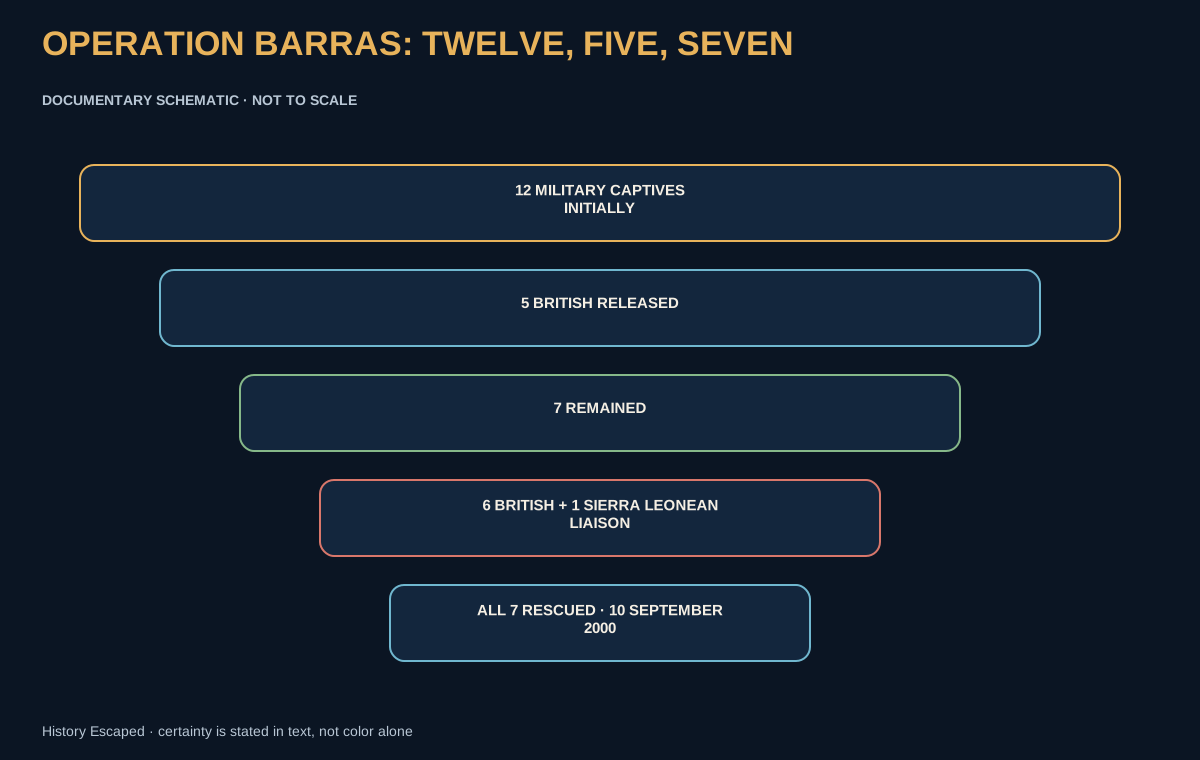
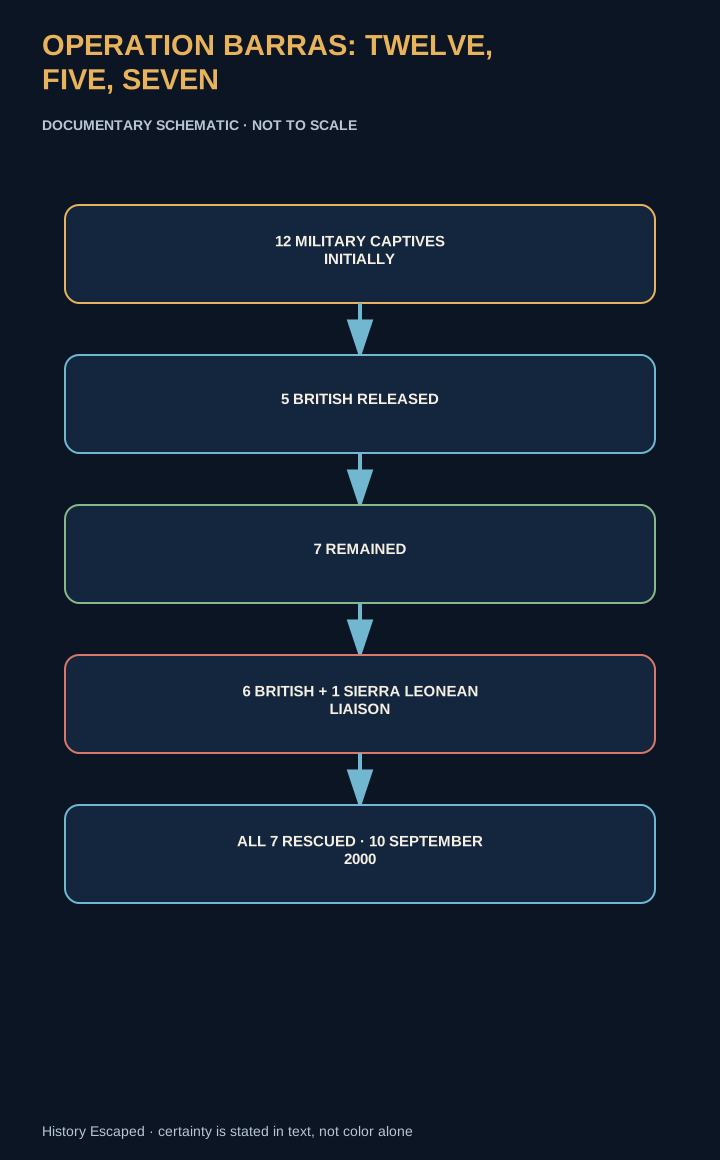
Simplified evidence-led editorial reconstruction based on the cited record; not to scale. Uncertainty is stated directly in the visual and adjacent text.
