
On the night of 19 April 1954, Evdokia Petrov crossed the tarmac at Sydney’s Mascot Airport between two Soviet couriers while a crowd surged around her.
The photographs became some of the most famous images of Australia’s Cold War. In them, Evdokia appears distressed, one arm gripped by each escort as police and protesters struggle around the group. She lost a shoe. Her handbag was damaged. People in the crowd shouted that she would be killed if she returned to the Soviet Union.
The image looks like a rescue in progress. Evdokia’s own account says it was not.
At a Glance
- Vladimir Petrov’s decision: 3 April 1954
- Public announcement: 13 April 1954
- Mascot Airport confrontation: 19 April 1954
- Evdokia Petrov’s decision to remain: 20 April 1954, Darwin
- Formal asylum application/grant: 21 April 1954
- Classification: Successful asylum/defection after attempted repatriation, enabled by Australian intervention
- Central correction: Vladimir and Evdokia made separate decisions
- Key evidence: Evdokia’s signed statement says she did not ask the Sydney crowd to rescue her
Two Soviet Intelligence Officers
Vladimir and Evdokia Petrov arrived in Australia in 1951 as members of the Soviet diplomatic mission in Canberra. Both also worked for Soviet state security and intelligence. Vladimir served under diplomatic cover and handled intelligence communications and operational tasks. Evdokia was an experienced cipher specialist with deep knowledge of Soviet communications and intelligence practice.
The couple’s position deteriorated after Joseph Stalin’s death in 1953 and the arrest and execution of Lavrentiy Beria, with whom their security-service careers were politically associated. Their embassy standing also weakened, and recall to Moscow began to look dangerous. The two Petrovs did not respond to that danger in the same way.
Vladimir Defects Without Evdokia
ASIO had been cultivating Vladimir through the Polish-born doctor Michael Bialoguski and later through senior intelligence officers including Ron Richards and Charles Spry. On 3 April 1954, Vladimir formally sought Australian protection and entered the ASIO defection operation. National Archives and National Museum chronologies treat that date as his defection, although some biographical accounts distinguish the asylum request on the 3rd from his final physical removal into protection the following day.
The important point is not the one-day archival variation. Vladimir did not tell Evdokia.
She was left inside the Soviet mission to discover that her husband had vanished and that Australian authorities were claiming he had defected. The Soviet Embassy instead said Vladimir had been kidnapped.
The Announcement Changes Everything
Prime Minister Robert Menzies announced Vladimir Petrov’s defection in Parliament on 13 April. He also established a Royal Commission on Espionage to investigate the intelligence material Petrov had brought out of the embassy.
The timing was explosive. Parliament was about to rise before a federal election scheduled for 29 May, and the Petrov documents touched Australian political and public-service circles.
For Evdokia, however, the immediate consequence was more personal. She remained under Soviet control.
Selected chronology
Selected chronology
Vladimir Petrov defects
Vladimir seeks Australian protection through ASIO without informing Evdokia.
Evdokia under supervision
In her later statement Evdokia says she had been under watch from 6 April while living within the Soviet Embassy system.
Menzies announces Vladimir’s defection
Prime Minister Robert Menzies announces the case publicly and establishes a Royal Commission on Espionage.
Mascot Airport confrontation
Evdokia is escorted toward an outbound aircraft through a disorderly anti-communist demonstration in Sydney.
Darwin intervention and decision
Police disarm the Soviet couriers, Evdokia is separated from them, speaks with Vladimir and chooses to remain in Australia.
Political asylum formalized
The Australian Dictionary of Biography records Evdokia applying for and being granted political asylum.
Royal Commission opens
The Royal Commission on Espionage begins hearings in Canberra.
Federal election
The Liberal–Country Party Coalition retains government with a seven-seat House majority despite Labor’s stronger national vote.
Royal Commission final report
The Royal Commission reports after extensive hearings and accepts the Petrov documents as genuine.
Australian citizenship
Vladimir and Evdokia Petrov are granted Australian citizenship and continue living under protected identities.
Inside the Embassy
After Vladimir’s disappearance, Evdokia was moved into the Soviet Embassy and closely watched. Her later statement said she had been under supervision from 6 April. The Australian Dictionary of Biography describes her as effectively a prisoner inside the embassy during the two weeks between Vladimir’s defection and her attempted return to the Soviet Union.
She was also being given the Soviet version of events: that Vladimir had been abducted. This matters because it explains why the choice facing Evdokia cannot be reconstructed as a simple decision between husband and Soviet state. She did not know whether Vladimir was free, dead, coerced or lying. She also knew that her own relatives remained in the Soviet Union.
Moscow Sends Couriers
Two diplomatic couriers arrived from Moscow to escort Evdokia home. The Soviet side treated her departure as a recall. In Australia, anti-communist activists and refugees from Eastern Europe increasingly described it as forced repatriation.
The image of what might happen to the wife of a defector if she returned to the USSR was frightening enough to mobilize a crowd. On 19 April, Evdokia was driven from Canberra to Sydney for an international flight that would take her out of Australia. News of the departure had spread. People were waiting at Mascot.
What Happened at Mascot
Evdokia reached the airport at about nine o’clock that night. In the statement she signed three days later, she described arriving with Soviet Embassy personnel and the two couriers. She said that as soon as the group left the car, people began shouting warnings not to return to Russia.
The crowd did more than shout. People grabbed at Evdokia’s belt and clothing. Her handbag was broken, two buttons came off her suit and she lost a shoe. She remembered being terrified.
The couriers held her arms tightly as they pushed through. That moment produced the photograph that came to symbolize the affair. But the photograph does not tell us what Evdokia wanted.
Her Own Statement
Evdokia’s signed account is unusually clear about what she did not do. She denied appealing to the crowd for help. She said she had not asked anyone at Mascot to rescue her. She also said that if Australian officials had asked at that moment whether she wanted to remain, she would have been unable to answer.
Most importantly, she did not describe the couriers’ grip on her arms simply as an assault. She wrote that she believed they were trying to protect her from the crowd until she reached the aircraft.
That evidence overturns one of the easiest readings of the iconic photograph. Yet her statement contains a second, equally important line of thought. She said she had been unhappy inside the embassy, had been under watch for days, and hoped that she might be rescued later. Evdokia was frightened of the crowd and uncertain about returning to the Soviet Union at the same time.
The Plane Leaves Sydney
The protesters failed to keep her in Australia. Evdokia and the Soviet couriers boarded the aircraft, and it departed Sydney.
Public anger intensified almost immediately. Telegrams reached the Menzies government describing the airport scene as a forced removal and demanding intervention before the aircraft left Australian territory.
The next scheduled refuelling stop was Darwin. That gave the Australian government one more opportunity.
The Darwin Intervention
ASIO director-general Charles Spry arranged for Australian authorities in Darwin to approach Evdokia. When the aircraft landed on the morning of 20 April, police and officials separated her from the Soviet couriers. The couriers were disarmed.
That action was itself forceful. The Australian state had now interrupted the Soviet escort and created a space in which Evdokia could answer outside the immediate presence of the men taking her home.
She was offered the choice to remain in Australia. For the first time since Vladimir’s disappearance, the decision was directly hers.
Documentary reconstruction
Two asylum decisions in parallel
A case-local editorial visual separates the documented sequence from uncertainty without implying exact modern geography or operational detail.
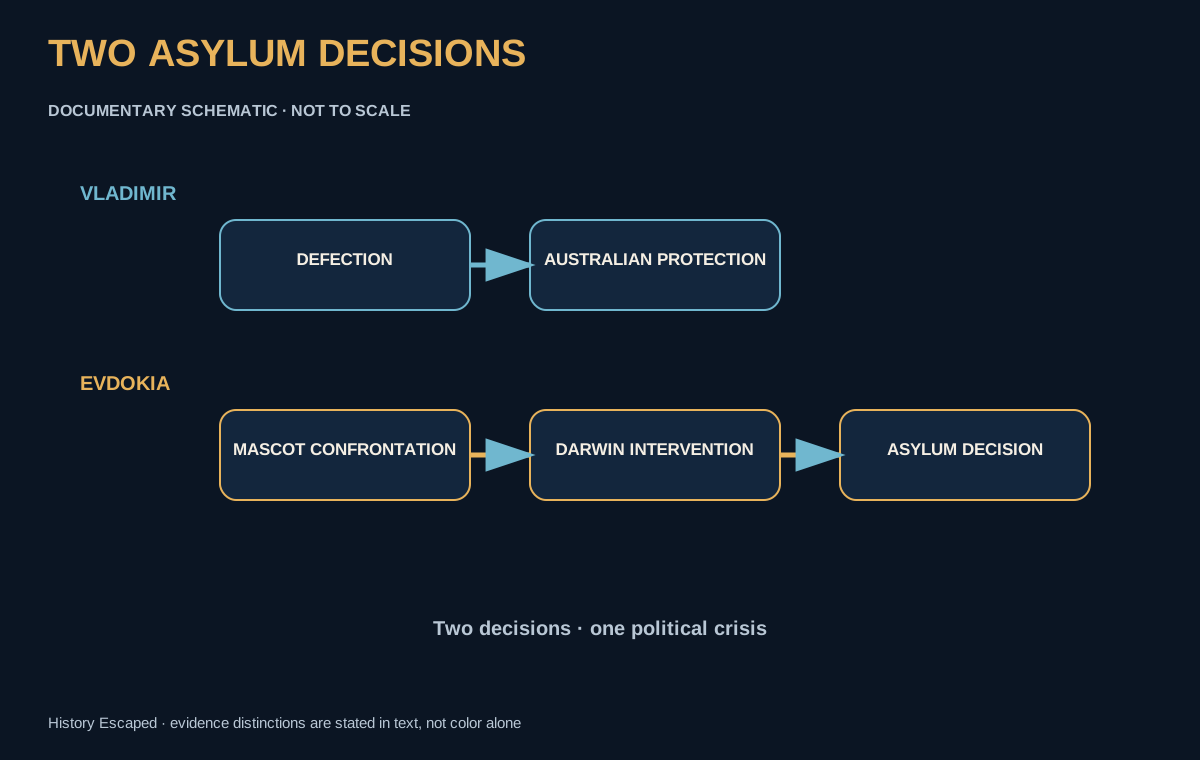
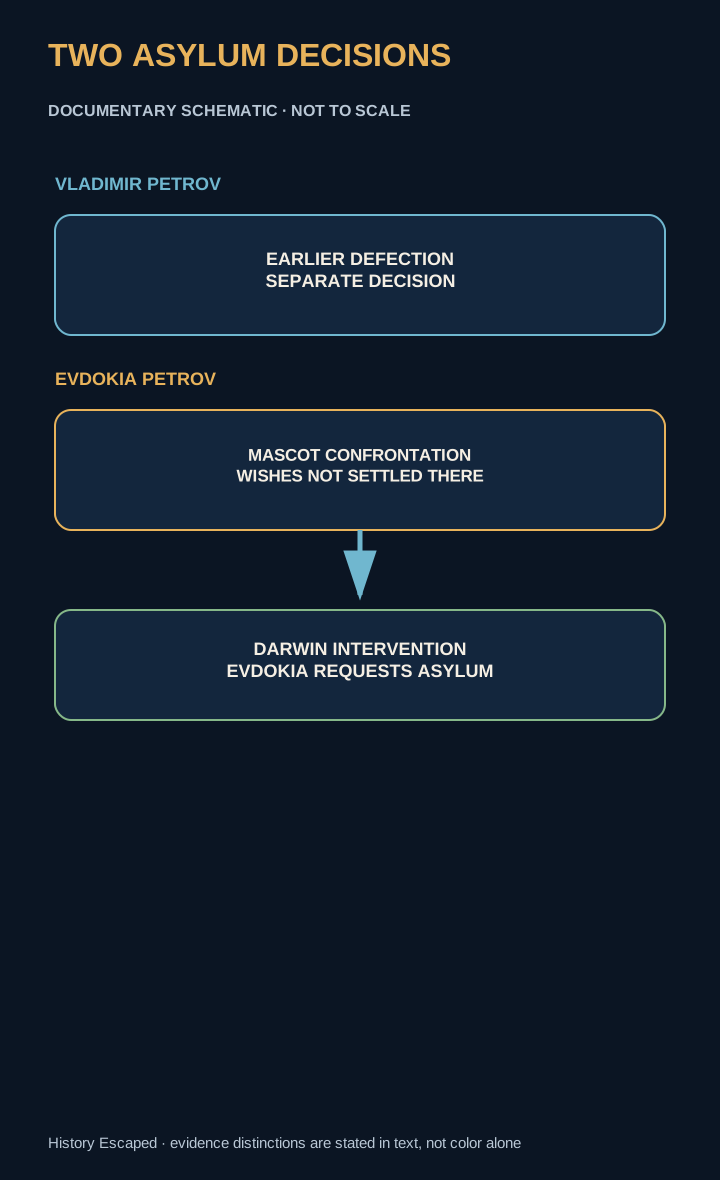
Simplified editorial reconstruction based on the cited historical record; not to scale. Uncertainty is stated directly in the visual and adjacent text.
The Phone Call
Evdokia still hesitated. Australian officials arranged a telephone conversation between husband and wife. The deeper problem was her family in the Soviet Union.
If she stayed, relatives could suffer because of her defection. The Australian Dictionary of Biography emphasizes how heavily that fear affected her and records that she delayed until very near the aircraft’s departure time.
Then she decided. Evdokia would remain in Australia. The aircraft continued without her.
April 20 and April 21
Public histories usually date Evdokia’s defection to 20 April 1954, because that was when she told Australian officials in Darwin that she would stay. The formal immigration chronology extended into the next day. The Australian Dictionary of Biography records that on 21 April she applied for and was granted political asylum. National Archives holdings preserve government correspondence and files relating to asylum for both Petrovs. The distinction is useful: April 20 marks Evdokia’s decision; April 21 formalized it.
Not One Defection
The phrase “the Petrovs defected” is convenient and historically misleading. Vladimir decided first, secretly and without his wife’s agreement. His move exposed Evdokia to Soviet scrutiny and recall.
Evdokia then faced a separate sequence of pressure. At Mascot, the Australian crowd tried to make the decision for her and frightened her in the process. Soviet officials intended to take her home. At Darwin, Australian police forcibly interrupted that escort.
Only after those competing pressures were separated did Evdokia state that she wanted to remain. The two defections should therefore be narrated as connected events, not a single couple’s plan.
Reunion Did Not Erase the Cost
Vladimir and Evdokia were reunited under Australian protection. That did not turn the episode into a simple romantic reunion.
Their marriage had already been damaged by Vladimir’s decision to leave her uninformed. Evdokia continued to fear for relatives in the Soviet Union. Later biographical evidence also describes serious strain between the couple while they were living under ASIO protection.
At the same time, Evdokia was not merely valuable because she was Vladimir’s wife. Her own intelligence experience mattered. She had specialist knowledge of Soviet cipher work and communications, and Western intelligence services considered the combined information supplied by the Petrovs highly significant.
The Royal Commission
The political machinery was already moving before Evdokia made her decision. Menzies had announced Vladimir’s defection and the creation of a Royal Commission on Espionage on 13 April. The commission opened on 17 May 1954.
Over the following months it sat for 126 days, examined 119 witnesses and received more than 500 exhibits. The documents Vladimir had carried out of the Soviet Embassy became known as the Petrov Papers. The proceedings widened a spy case into a national political conflict.
Evidence discipline
What the record supports
Status labels distinguish secure conclusions from uncertainty and rejected claims. Color is never the only signal.
MYTH
Vladimir and Evdokia Petrov made one joint defection plan.
Vladimir defected without informing Evdokia. Her asylum decision occurred separately in Darwin more than two weeks later.
Sources: SRC-002, SRC-003, SRC-004, SRC-005MYTH
Evdokia asked the crowd at Mascot Airport to rescue her.
Her signed statement of 22 April says she did not ask for help or rescue and was terrified of the crowd.
Sources: SRC-001DISPUTED
The Mascot photographs prove that the Soviet couriers were dragging Evdokia against her expressed wishes.
The couriers held her tightly, but Evdokia’s own statement says she believed they were trying to protect her from the crowd. She was simultaneously unhappy under Soviet supervision and hoped she might be rescued later.
Sources: SRC-001, SRC-007, SRC-011MYTH
Evdokia had already decided to defect before the aircraft left Sydney.
She later wrote that at Mascot she could not have answered whether she wanted to stay. The decisive choice occurred in Darwin.
Sources: SRC-001, SRC-004, SRC-007DOCUMENTED
Australian intervention in Darwin created the setting for Evdokia to make a separate decision.
Police disarmed the Soviet couriers and separated Evdokia from them; officials then offered her the opportunity to remain and arranged communication with Vladimir.
Sources: SRC-002, SRC-003, SRC-004, SRC-006, SRC-008MYTH
Evdokia’s motives can be reduced to wanting to reunite with Vladimir.
Sources emphasize competing fears, especially possible consequences for her family in the Soviet Union, as well as uncertainty about Vladimir’s fate and her own treatment at the embassy.
Sources: SRC-001, SRC-003, SRC-004DISPUTED
The Petrov Affair by itself determined the 1954 federal election result.
It was a major campaign issue immediately before the election, but no evidence can isolate it as the sole determinant of the result.
Sources: SRC-009, SRC-010MYTH
The Petrov Affair alone caused the 1955 Australian Labor Party split.
It intensified existing conflicts over communism, Evatt’s leadership and anti-communist organization, but the split had multiple causes.
Sources: SRC-009, SRC-010The Election Question
Australia voted on 29 May 1954. The Liberal–Country Party Coalition retained government with a seven-seat majority in the House of Representatives even though Labor received more votes nationally. The Petrov Affair had dominated headlines immediately before the campaign.
That has made it tempting to say that Petrov “won the election for Menzies.” The historical record does not permit that certainty.
The affair clearly changed the political atmosphere and gave the government a powerful security issue. But an election has many causes, and historians cannot rerun 1954 without the defections. The more defensible conclusion is that Petrov became a major factor in the campaign and in the political crisis that followed.
Evatt, the Commission and the Labor Split
Opposition leader H. V. Evatt came to believe that the Petrov Affair had been manipulated by Menzies, ASIO and anti-communist political forces to damage Labor.
Some of Evatt’s staff had been named in material examined by the Royal Commission. Evatt challenged the authenticity of the documents and eventually appeared before the commission. The commissioners later withdrew his permission to participate in the way he had been doing, arguing that he was pursuing his own political interests.
The episode deepened divisions already developing inside Labor over communism, Catholic anti-communist organization and Evatt’s leadership. Those tensions culminated in the 1955 Labor split and the emergence of the Democratic Labor Party. The Petrov Affair did not create every cause of the split, but it accelerated and intensified them.
Diplomatic Consequences
The defections also damaged relations between Australia and the Soviet Union. The Soviet government withdrew its embassy from Canberra, and Australian diplomats were expelled from Moscow.
For ASIO, the case was a major institutional success. The intelligence supplied by the Petrovs was shared within the Western security community and contributed to understanding of Soviet personnel, methods and espionage networks.
For Evdokia, the public political meaning was larger than the choice she had made on the ground in Darwin. She had become a Cold War symbol.
The Photograph and the Decision
The Mascot photograph survives because it compresses the Cold War into one frame: Soviet couriers, an apparently distressed woman, Australian police, anti-communist protesters and a waiting aircraft. But the frame is too narrow.
It cannot show that Vladimir had made his decision without Evdokia. It cannot show the fear she felt inside the embassy. It cannot show that she was frightened of the people trying to save her. It cannot show her worry about family in Russia.
And it cannot show Darwin. The most important part of Evdokia Petrov’s story happened after the famous photograph—when the plane stopped, the escorts were separated from her, she spoke to her husband, and she finally made a decision of her own.
