
The Gran Sasso Raid: How German Forces Rescued Mussolini in 1943
On September 12, 1943, German gliders descended beside a hotel more than two kilometres above sea level in Italy’s Gran Sasso mountains. Inside was Benito Mussolini, the fascist dictator deposed and arrested seven weeks earlier. Within a short time, German troops had him outside the hotel and aboard a light aircraft.
The raid became inseparable from one name: Otto Skorzeny. The surviving operational picture is more complicated. Major Harald-Otto Mors planned and coordinated a two-pronged operation, Georg von Berlepsch led the airborne paratrooper force, Skorzeny participated in the glider assault and extraction, and Nazi propaganda transformed the man standing beside Mussolini into the raid’s dominant legend.
At a Glance
Date: September 12, 1943
German codename: Unternehmen Eiche / Operation Oak
Captive: Benito Mussolini, deposed fascist dictator
Location: Hotel Campo Imperatore, Gran Sasso, Italy
Altitude: Approximately 2,100–2,130 metres
Senior airborne authority: General Kurt Student
Operational planner / commander: Major Harald-Otto Mors
Airborne paratrooper commander: Georg Freiherr von Berlepsch
SS participant / later propaganda face: Otto Skorzeny
Air assault: DFS 230 gliders
Ground objective: Lower cable-car station
Extraction aircraft: Fieseler Fi 156 Storch
Outcome: Mussolini removed from Italian custody and transferred into German control
Classification: Successful political rescue / extraction
The Dictator Becomes a Prisoner
By July 1943, Fascist Italy was in military and political crisis. Allied forces had landed in Sicily, years of war had exhausted the country, and support for Benito Mussolini was collapsing even inside the institutions that had sustained his dictatorship.
During the night of July 24–25, the Fascist Grand Council voted for a motion that stripped away the basis of Mussolini’s authority. On July 25, King Victor Emmanuel III dismissed him.
Mussolini left his audience with the king under arrest. Marshal Pietro Badoglio replaced him as prime minister.
The change did not immediately end the war or German influence in Italy. It did, however, create a problem Adolf Hitler wanted reversed: the Axis partner he had dealt with for years was now being held by the Italian state.
Why Mussolini Was Hidden
Italian authorities expected Germany to look for him. They moved Mussolini repeatedly: - out of Rome; - to the island of Ponza; - to La Maddalena off Sardinia; - then to the Gran Sasso massif in central Italy. The transfers were not random.
A fixed location could be discovered. An island could be watched. A city prison could be attacked from surrounding roads. Campo Imperatore offered something different.
A Hotel Above the Cable Car
Hotel Campo Imperatore stood high on the Gran Sasso plateau, more than 2,100 metres above sea level. The most practical access route came up from the valley by cable car. That geography appeared to favor the guards.
A prisoner could be isolated from sympathetic crowds, from ordinary road traffic and from easy German reconnaissance. The lower cable-car station created a natural choke point.
But the same system created a structural vulnerability. The hotel and the valley station could be attacked as separate targets. If the Germans seized the lower station while airborne troops landed beside the hotel, the guards on the plateau could be cut off before reinforcements arrived. That became the core of Operation Oak.
Finding Gran Sasso
German intelligence spent weeks trying to identify Mussolini’s location. By late August, German officers had fixed on Hotel Campo Imperatore.
Later legend often turns that intelligence search into an Otto Skorzeny detective story. Modern research points to a broader German intelligence effort involving military, SS and security-police personnel.
The important fact is secure even where the individual credit is messy: the Italian attempt to keep Mussolini’s location secret had failed.
Hitler, Student and Mors
Hitler demanded a rescue. General Kurt Student, one of Germany’s senior airborne commanders, became responsible for preparing airborne options. The strongest corrective histories then place Major Harald-Otto Mors at the center of operational planning and coordination. Mors did not design a raid in which one small commando team would do everything.
He split the problem. One force would control the mountain from below. Another would strike the hotel from above.
The Ground Force
Mors’s ground component moved toward the lower cable-car station near Assergi. Its role was not glamorous enough to dominate the newsreels, but it was essential. Control the station and the Germans could: - prevent or delay Italian forces from travelling up; - control the cableway; - isolate the plateau; - and connect the hotel assault to a secure base below. The lower station therefore belonged to the rescue mechanism as much as the gliders.
Selected chronology
Selected chronology
Allied invasion of Sicily
Operation Husky accelerates the military and political crisis of Mussolini's fascist regime.
Mussolini dismissed and arrested
King Victor Emmanuel III removes Mussolini and has him taken into custody; Pietro Badoglio becomes prime minister.
Secret detention transfers
Italian authorities move Mussolini through multiple sites, including Ponza and La Maddalena, to prevent German recovery.
Campo Imperatore identified
German intelligence efforts identify Hotel Campo Imperatore as Mussolini's detention site.
Italy signs armistice
The Badoglio government secretly signs the armistice with the Allies.
Armistice announced
Public announcement triggers political and military collapse as German forces move to occupy and disarm former Italian allies.
Operation Oak
Mors's ground force seizes the lower cable-car station while Berlepsch's glider force lands beside the hotel. Mussolini is secured and extracted by Storch.
Mussolini announces renewed fascist rule
From German-controlled territory, Mussolini broadcasts the political program that precedes the formal establishment of the RSI.
Italian Social Republic established
The German-dependent fascist state takes formal shape with Mussolini as its leader.
The Airborne Force
The second force would arrive directly on the plateau in DFS 230 assault gliders. Oberleutnant Georg Freiherr von Berlepsch commanded the Fallschirmjäger company assigned to the airborne assault. Otto Skorzeny and SS personnel were attached to the glider group. That distinction matters.
The troops who physically landed beside the hotel were not simply “Skorzeny’s SS commandos.” German paratroopers formed the core airborne assault force.
Ten Gliders or Twelve?
Even a famous operation can resist one clean number. Official Italian Carabinieri history describes twelve gliders taking off from Pratica di Mare. Other modern reconstructions commonly count ten in the assault or landing group. The difference probably reflects which stage is being counted.
The safest description is:
roughly a dozen DFS 230 gliders were committed to the airborne phase, with about ten commonly counted at the target.
A precise number is less important than the tactical idea. The gliders put troops almost directly beside Mussolini before the plateau guard could organize a defense.
An Italian General in a German Glider
The Germans also brought General Fernando Soleti. He was not a volunteer member of the rescue party. German forces compelled him to accompany them.
His value was psychological and political. An Italian guard seeing German troops arrive beside a recognizable senior Italian official had another reason to hesitate before opening fire. That calculation became even more important because the Italian chain of command was already disintegrating.

Material evidence
Tools of Escape
The objects used in an escape reveal how a plan worked under constraint.
- 01Essential
DFS 230 assault gliders
Gliders enabled the airborne force to land extremely close to Hotel Campo Imperatore without requiring a conventional airfield.
- 02Essential
Ground control of cable-car station
Mors's ground force isolated the plateau and prevented the cableway from becoming an easy Italian reinforcement route.
- 03High
Fernando Soleti
The coerced presence of a senior Italian official added hesitation among guards confronted by the German airborne force.
- 04Essential
Surprise and command collapse
The raid exploited the unstable Italian command environment after the September 8 armistice announcement and changing orders to Mussolini's guards.
- 05Essential
Fieseler Fi 156 Storch
The short-takeoff-and-landing aircraft provided the final physical extraction from the restricted mountain plateau.
- 06High
Propaganda photography
Wartime photographers documented the operation and enabled Nazi media to associate Skorzeny closely with Mussolini and the rescue.
September 8 Changes Everything
Italy had secretly signed an armistice with the Allies on September 3. The agreement was publicly announced on September 8. The result was chaos.
German forces began disarming Italian units and occupying much of the country. The king and Badoglio government left Rome. Italian commands received incomplete, contradictory or rapidly changing instructions.
The guards at Campo Imperatore were not operating inside the stable state structure that had placed Mussolini there two weeks earlier. They were an isolated detachment trying to interpret orders while the alliance around them collapsed.
Were the Guards Ordered to Shoot Mussolini?
At different points, Italian security authorities issued severe instructions intended to prevent Mussolini from being freed. The order history did not remain stable.
Italian police and Carabinieri sources preserve a confusing sequence of reversals as the armistice crisis unfolded. By September 12, the message reaching the Gran Sasso command emphasized maximum prudence and avoiding an extreme armed clash.
Later members of the guard force understood this as an instruction not to resist a German rescue at any cost. That context is a stronger explanation for what happened than the usual claim that the Italians simply lost their nerve.
The Gliders Descend
On September 12, the airborne force left Pratica di Mare. Towed gliders approached Gran Sasso, released and descended toward the plateau. The terrain was not a prepared runway. It was a high, uneven landing area near the hotel.
Some gliders were damaged in landing. Enough arrived close enough to the building that surprise was preserved. The Bundesarchiv photographs taken that day make the physical result visible: gliders scattered on the plateau with Hotel Campo Imperatore rising behind them.
The Fight Below
While cameras recorded the dramatic landing above, Mors’s ground column approached the lower cable-car station. Here the raid was not bloodless. Official Carabinieri history identifies two Italian security personnel killed during the operation. Pasqualino Vitocco, a forestry guard, was shot after recognizing the German movement and attempting to raise the alarm.
Giovanni Natale, a Carabiniere, resisted the German force and was killed.
They are the critical correction to one of the raid’s most repeated claims.
Problem → response
Escape was a sequence of problems
Each response solved a practical obstacle while often creating the next one.
- 01→
Obstacle
Secret prisoner location
Italian authorities moved Mussolini repeatedly to prevent German intelligence from identifying a fixed target.
Response
German intelligence and security services eventually identified Campo Imperatore by late August.
- 02→
Obstacle
Mountain isolation
The high Gran Sasso plateau was difficult to approach by ordinary ground assault.
Response
Mors split the operation between the valley cable-car station and a direct glider landing beside the hotel.
- 03→
Obstacle
Italian guard force
A substantial Italian security detachment guarded Mussolini and could have turned the hotel into a firefight.
Response
German surprise, Soleti's presence, seizure of the lower station and final Italian orders emphasizing prudence reduced organized resistance.
- 04→
Obstacle
Rough landing terrain
Campo Imperatore lacked a conventional runway for a large airborne assault.
Response
DFS 230 gliders landed directly on the uneven plateau, accepting aircraft damage in exchange for proximity to the hotel.
- 05→
Obstacle
Extraction from the plateau
Securing Mussolini did not by itself remove him from a mountain position cut off from ordinary transport.
Response
A Fieseler Fi 156 Storch landed near the hotel and carried him to Pratica di Mare.
- 06→
Obstacle
Political usefulness after extraction
The old Fascist state had collapsed and Germany needed more than Mussolini's physical recovery to turn the raid into a political gain.
Response
Hitler pressured Mussolini to resume leadership in a new German-dependent fascist regime in occupied Italy.
“Not a Shot Was Fired”
The capture of Mussolini at the hotel was largely accomplished without an exchange of fire. That does not mean Operation Oak as a whole occurred without shooting or deaths. Vitocco and Natale died in the ground phase. The accurate sentence is:
The hotel assault was largely bloodless; the wider operation was not.
That distinction preserves both the speed of the plateau seizure and the actual human cost below.
The Hotel Does Not Become a Battlefield
On the plateau, the arriving Germans moved rapidly toward the hotel. The Italian guards did not organize a sustained defense. They faced several disadvantages at once: - gliders landing immediately beside their position; - isolation from the valley; - German forces controlling the lower access; - a senior Italian official arriving with the attackers; - and final instructions emphasizing prudence rather than a suicidal defense. Mussolini was found and secured before the situation could turn into a prolonged siege.
Where Was Skorzeny?
At the hotel. This is why correcting his legend should never become an effort to remove him from the operation. Skorzeny participated in the airborne assault. He reached Mussolini.
He appeared beside him in the photographs. He accompanied him during the flight off the mountain. All of that happened. What is less defensible is using those facts to conclude that Skorzeny alone conceived, commanded and executed the entire raid.
Documentary reconstruction
Command and the two-pronged operation
A case-local visual focused on the spatial, mechanical or evidentiary relationship established by the surviving record.
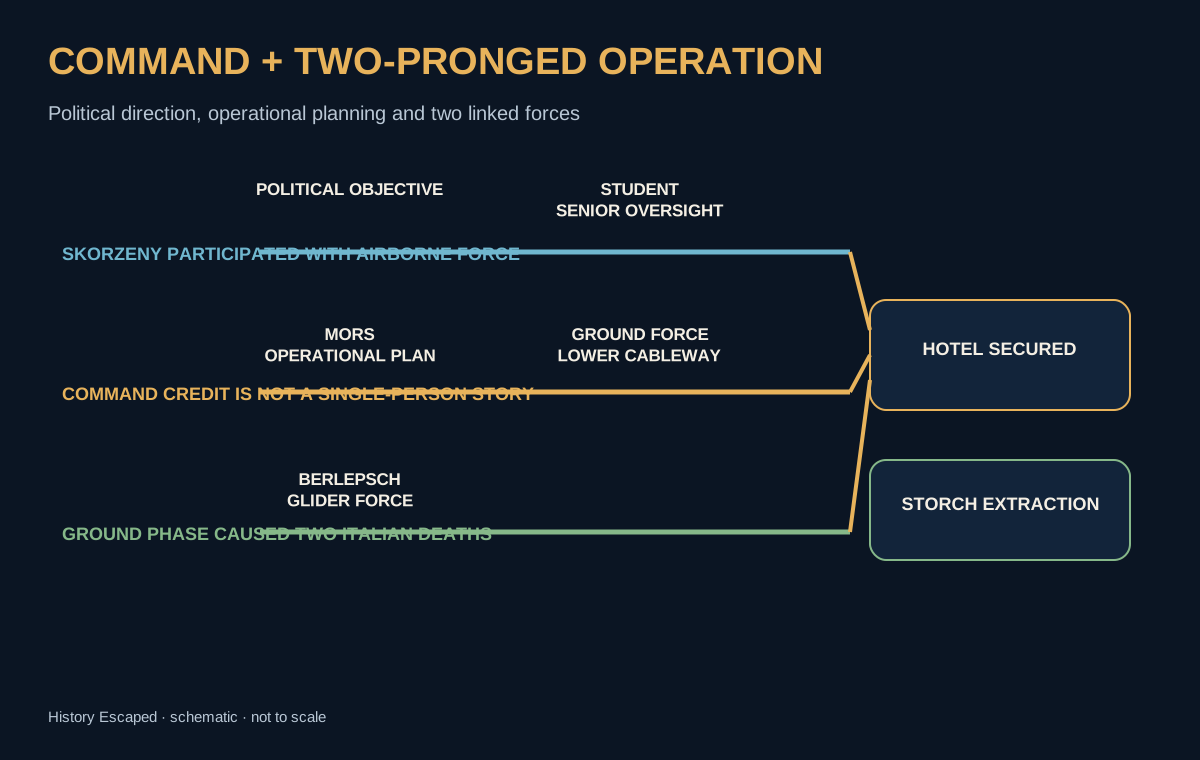
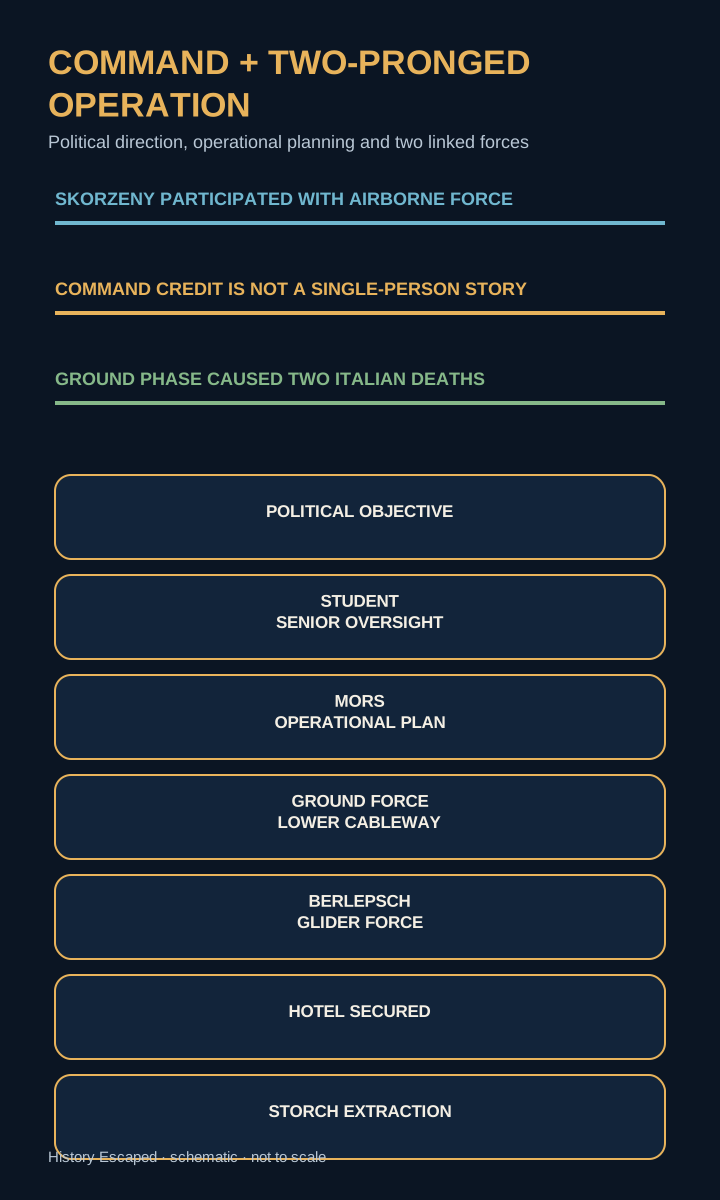
Simplified editorial reconstruction based on the cited historical record; not to scale. Uncertainty is stated directly in the visual and adjacent text.
Where Was Mors?
Mors had been directing the operation from the ground side. His force secured the lower cable-car station. After the assault succeeded, he reached the plateau. Bundesarchiv photographs show him at Gran Sasso with Berlepsch and other participants.
Those photographs are important because popular image memory tends to crop the operation around Mussolini and Skorzeny. The archive preserves a wider cast.
Where Was Berlepsch?
Berlepsch led the airborne Fallschirmjäger company. That operational role is visible in German archival captions and Italian historical reconstructions. His relative obscurity today is itself evidence of how propaganda can reorganize memory. An officer can command the troops carrying out the assault and still disappear behind the participant whom newspapers and newsreels place next to the rescued political figure.
Why Skorzeny Won the Story
The raid was a propaganda opportunity before the dust had settled. German military photographers were present. The images were excellent.
Mussolini emerged from the hotel beside German troops. Skorzeny was repeatedly near him. When Mussolini boarded the evacuation aircraft, Skorzeny went too.
A public story needs fewer names than an operation order. Nazi propaganda supplied one.
Skorzeny rescued Mussolini.
The Archive Is Not Neutral Either
The photographs are unusually strong evidence. Their captions require source criticism. The German Federal Archives preserves many of the images through wartime propaganda-company collections and warns that original descriptions may be biased, incomplete or incorrect. That is why image and text evidence must be separated.
A photograph can securely show: - Mors and Berlepsch together; - gliders near the hotel; - Mussolini beside Skorzeny; - the Storch on the plateau. It cannot, by itself, prove who designed the plan.
The final accounting
Outcome
Benito Mussolini
Successfully extracted from Italian custody and transferred into German control.
Italian security fatalities
Pasqualino Vitocco and Giovanni Natale were killed in the ground/cable-car phase, according to official Carabinieri history.
The Storch Arrives
The next problem was getting Mussolini off Gran Sasso. A Fieseler Fi 156 Storch landed near the hotel. The aircraft was famous for short takeoff and landing performance, making it suitable for a confined, rough landing area that could not accommodate an ordinary transport aircraft. Its pilot is commonly identified as Heinrich Gerlach.
Mussolini climbed aboard. So did Skorzeny.
The Flight Off the Mountain
The Storch successfully left the plateau. It carried Mussolini to Pratica di Mare. From there, larger aircraft carried him onward through German-controlled Europe, including Vienna, and into Germany. The geographic extraction was complete.
The political phase began immediately.
Mussolini Was Not Returning to the Old Italy
The Italy Mussolini had ruled before July no longer existed. The country was divided. The royal government had broken with Germany. German troops occupied the north and center.
Allied forces were advancing from the south. Mussolini was not being returned to Rome to resume his former dictatorship over a unified kingdom. Hitler had another use for him.
Evidence discipline
What the record supports
Status labels distinguish secure conclusions from uncertainty and rejected claims. Color is never the only signal.
MYTH
Otto Skorzeny single-handedly planned and commanded Operation Oak.
Strong corrective scholarship and official Italian history credit Harald Mors with operational planning/coordination and Georg von Berlepsch with leading the airborne paratrooper company under Kurt Student's senior authority. Skorzeny participated but did not constitute the entire command structure.
Sources: SRC-003, SRC-005, SRC-008MYTH
Skorzeny was not actually present at Gran Sasso.
He participated in the glider assault, was photographed with Mussolini and accompanied him in the Storch extraction aircraft.
Sources: SRC-006, SRC-009, SRC-014WELL-SUPPORTED
Harald Mors was the principal operational planner/commander of Operation Oak.
Italian Carabinieri history and Swiss National Museum scholarship give Mors the central operational role, although some modern sources still describe Skorzeny as the raid's leader.
Sources: SRC-003, SRC-005, SRC-006DOCUMENTED
Georg von Berlepsch commanded the airborne Fallschirmjäger assault company.
Official Italian history and Bundesarchiv captioning identify Berlepsch as commander of the paratrooper company used in the assault.
Sources: SRC-003, SRC-008DISPUTED
Exactly twelve DFS 230 gliders landed at the hotel.
Official Carabinieri history says twelve gliders departed Pratica di Mare, while other modern histories commonly count ten in the assault/landing phase.
Sources: SRC-003, SRC-005MYTH
General Fernando Soleti voluntarily joined the rescue party.
German forces compelled the Italian general to accompany the airborne assault as a means of discouraging Italian resistance.
Sources: SRC-003, SRC-004MYTH
Italian guards at Campo Imperatore were under one clear, unchanged order to fight to the death.
Italian police and Carabinieri sources document changing orders during the armistice crisis; final guidance on September 12 stressed maximum prudence and avoidance of an extreme armed clash.
Sources: SRC-002, SRC-003, SRC-004MYTH
Operation Oak was completely bloodless and no shots were fired.
The hotel seizure was largely bloodless, but official Carabinieri history records two deaths during the ground/cable-car phase: Pasqualino Vitocco and Giovanni Natale.
Sources: SRC-003DOCUMENTED
A Fieseler Fi 156 Storch extracted Mussolini from the plateau.
German archival photographs and modern histories document the aircraft at Campo Imperatore and Mussolini's departure in it.
Sources: SRC-006, SRC-009, SRC-014WELL-SUPPORTED
Nazi propaganda substantially amplified Skorzeny's public credit for the raid.
Contemporary propaganda photography centered Skorzeny beside Mussolini, and later Skorzeny accounts helped sustain a simplified narrative that eclipsed Mors and Berlepsch.
Sources: SRC-005, SRC-006, SRC-013, SRC-014MYTH
Mussolini returned after the raid as the independent ruler of all Italy.
He became head of the Italian Social Republic in German-occupied territory; Treccani characterizes the state as politically and militarily subordinate to Germany.
Sources: SRC-001, SRC-011Pressure to Return
Treccani’s biographical account describes Mussolini as regarding himself as politically finished after his removal. Hitler pressed him to resume leadership. Mussolini agreed. On September 18, he broadcast a declaration announcing the restoration of fascist political authority in German-held Italy.
Within days, the new Italian Social Republic took formal shape.
The Italian Social Republic
The Italian Social Republic was commonly called the Republic of Salò. It operated in territory dependent on German military power. Mussolini stood again at the head of a fascist government, but his position was radically weaker than before July. Treccani describes the RSI as politically and militarily subordinated to Germany.
That dependence is the political meaning of Operation Oak. The Germans did not merely retrieve a famous ally. They recovered a political symbol who could be installed at the head of a regime serving occupation strategy.
What Followed
The German occupation and the RSI period became one of the most violent phases of modern Italian history. Italy descended into civil war alongside the Allied campaign. German and fascist forces conducted brutal anti-partisan repression. Italian Jews faced arrest and deportation under German occupation, with fascist collaboration.
Operation Oak did not cause every act that followed. It did help put Mussolini back into a position from which he could lead the fascist state operating inside that system. That is why the raid deserves sensitive rather than celebratory presentation.
The Myth of the Perfect Rescue
Several versions of the story are too neat.
Skorzeny planned everything
No. The strongest operational reconstruction gives the central planning and coordinating role to Mors under Student, with Berlepsch leading the airborne paratroopers.
Skorzeny did nothing
Also no. He participated in the glider assault and extraction and was physically present with Mussolini.
No one fired a shot
No. The hotel seizure was largely bloodless, but Vitocco and Natale were killed in the ground phase.
The guards were simply cowards
No useful evidence supports that caricature. Their command structure had collapsed, orders had changed, Soleti arrived with the Germans, and the final instruction emphasized prudence.
Exactly ten—or exactly twelve—gliders attacked
The source record varies depending on the counting stage. Use roughly ten to twelve with explanation.
Evidence, Myth and What the Sources Support
Was Mussolini still Italy’s lawful dictator when Germany rescued him?
MYTH
King Victor Emmanuel III had dismissed Mussolini on July 25, 1943, and the Italian government was holding him in custody.
Was Mussolini kept at Gran Sasso specifically because the location was difficult to reach?
DOCUMENTED
The high plateau and cable-car access made Campo Imperatore a deliberately isolated detention site after earlier transfers intended to conceal Mussolini from the Germans.
Did Otto Skorzeny single-handedly plan and command Operation Oak?
MYTH
Skorzeny participated in the glider assault and extraction, but strong modern and official-source reconstruction credits Harald Mors with operational planning/coordination and Georg von Berlepsch with leading the airborne paratrooper force under Kurt Student’s senior authority.
Was Skorzeny merely a fictional propaganda figure who was not at Gran Sasso?
MYTH
He was physically present, took part in the airborne assault, appeared with Mussolini and flew off the plateau with him.
Was Harald Mors the operational commander?
WELL-SUPPORTED
Italian Carabinieri history and modern Swiss National Museum research identify Mors as the principal operational planner/commander, although some other modern narratives still use “leader” for Skorzeny.
Did Georg von Berlepsch lead the airborne Fallschirmjäger force?
DOCUMENTED
German archival captions and Italian official history identify Berlepsch as commander of the paratrooper company used in the airborne assault.
Were exactly twelve gliders used?
DISPUTED
Official Carabinieri history describes twelve departing Pratica di Mare; other histories commonly count ten in the assault/landing phase. The difference likely reflects counting at different stages.
Did the Germans bring an Italian general with them?
DOCUMENTED
General Fernando Soleti was compelled to accompany the airborne force, in part to discourage Italian guards from opening fire.
Were the Italian guards under clear orders to fight to the death?
MYTH
Orders concerning Mussolini changed repeatedly during the collapse following the armistice. By September 12, the instruction reaching the guard command emphasized maximum prudence and avoiding an extreme armed clash.
Was Operation Oak completely bloodless?
MYTH
The hotel seizure was largely bloodless, but official Carabinieri history records the deaths of Pasqualino Vitocco and Giovanni Natale during the German ground operation near the cable-car approach.
Did the Storch carry Mussolini away from Gran Sasso?
DOCUMENTED
Bundesarchiv photographic evidence and multiple histories document the Fieseler Fi 156 Storch extraction.
Did the rescue restore Mussolini to his former independent dictatorship over all Italy?
MYTH
Germany installed him as leader of the Italian Social Republic in German-occupied territory. The new regime was politically and militarily dependent on Nazi Germany.
Why the Operation Worked
Mussolini’s prison was geographically isolated. Mors turned that isolation against the defenders. The lower cable-car station could be seized from the valley. The hotel could be struck directly from the air.
The Italian command system was collapsing after the armistice. The guards received changing instructions and final guidance emphasizing prudence. Soleti’s forced presence added hesitation. Gliders placed German troops almost on top of the objective.
The Storch solved the final extraction problem. Then propaganda solved a different problem:
how to turn a multi-unit German operation into a simple political victory story.
The raid worked operationally because several organizations solved different pieces of the same problem. The Skorzeny legend worked because history was photographed from the plateau.