
Late on Sunday afternoon, 4 May 1947, explosions opened a section of the wall around Acre Central Prison. British authorities reported that an armed Jewish force, some of its members wearing British military uniforms, had entered the city as blasts struck near the old Turkish baths adjoining the citadel. Inside, imprisoned members of the Irgun and Lehi moved toward the breach while barriers were blown and guards tried to respond.
The operation had a tightly defined objective: extract selected members of the two Jewish underground organizations from a heavily guarded British Mandate prison. Once the wall opened, however, the event became larger than the plan. Arab inmates also poured through the breach, British troops and police engaged the attackers and fleeing vehicles, and the first official counts changed as recaptures continued over the following days.
At a Glance
- Date: 4 May 1947
- Place: Acre Central Prison, Mandatory Palestine
- External force: Irgun
- Prisoner groups selected for extraction: Irgun and Lehi
- Operation commander: Dov Cohen, known as Shimshon
- Selected prisoners freed from the prison: 41 in the current Israeli museum account
- Breakdown: 30 Irgun, 11 Lehi
- Selected prisoners who ultimately escaped: 27 in the later Israeli/Irgun reconstruction
- Selected escapees recaptured: 8
- Selected released prisoners killed: 6
- External attackers killed: 3
- External attackers captured: 5
- Arab inmates escaping: disputed; contemporary British and later Irgun counts do not agree
- British personnel: several wounded in the official May 7 account; no British death is listed there
- Political setting: Jewish insurgency against British rule during the UN special session on Palestine
- Outcome: a successful prison breach and partial extraction, followed by deaths, recaptures, trials, executions, and continued manhunts
A prison with several political histories
Acre's prison occupied an Ottoman citadel built over earlier Crusader remains. Under the British Mandate it became the principal prison in northern Palestine, and by the 1930s and 1940s its cells had accumulated more than one political meaning.
For Palestinians, Acre already carried the memory of Mandate imprisonment and execution. British authorities had jailed activists there during periods of Palestinian opposition to British rule, including the 1936–39 Arab Revolt, and three Palestinians connected to the 1929 al-Buraq disturbances were hanged at Acre in June 1930. Palestinian memory therefore did not begin with the Irgun raid of 1947.
Jewish underground organizations developed a different memory of the prison. Members of Haganah, Irgun—also known by the Hebrew acronym Etzel—and Lehi were confined there at different times. The present Israeli Museum of Underground Prisoners, operated within the state's defense-heritage system, presents the site primarily through that history and commemorates men executed by the British and those who took part in the 1947 breakout.
Those overlapping memories matter because even the language used for the raid is contested. British officials called the Irgun and Lehi terrorists. Israeli commemorative institutions describe their members as underground or resistance fighters. A neutral reconstruction can describe the Irgun as a Revisionist Zionist underground and paramilitary organization conducting an armed insurgency against British rule, while preserving the labels used by historical actors when those labels themselves are relevant.
The Mandate was already in crisis
The Acre operation came during the final, increasingly violent period of British rule in Palestine. After the Second World War, the dispute over Jewish immigration, the future of the Mandate, Zionist statehood, Arab Palestinian political claims, and British security policy intensified sharply.
The British Army's National Army Museum estimates that around 100,000 British troops were deployed in Palestine by 1947. Curfews, searches, arrests, bombings, kidnappings, illegal immigration, intercommunal tensions, and attacks on British targets created a security environment in which the army and Palestine Police were continually responding to insurgent action.
Irgun had already carried out major attacks against British targets, most notoriously the July 1946 bombing of the King David Hotel, in which more than ninety people were killed. Lehi conducted its own campaign. The Haganah's relationship to those organizations and to direct attacks on the British changed over time, and it should not be treated as interchangeable with Irgun policy.
By February 1947, Britain had concluded that the political deadlock could not be resolved through the London Conference. The government announced that it would refer the Palestine question to the United Nations.
That chronology is important. The UN General Assembly's first special session on Palestine opened on 28 April, six days before the Acre Prison break. The raid could influence perceptions of Britain's ability to maintain control, but it did not cause Britain to turn to the UN.
Executions sharpened the immediate atmosphere
On 16 April 1947, less than three weeks before the raid, the British authorities hanged four Irgun members at Acre: Dov Gruner, Yechiel Dresner, Mordechai Alkahi, and Eliezer Kashani. Their executions became central to Irgun memory and to the organization's confrontation with British authority.
The prison therefore held practical and symbolic importance. Freeing imprisoned underground members would recover experienced personnel, challenge the security system, and demonstrate that even a citadel prison could be penetrated. The cost of failure, however, included not only recapture but the possibility of death sentences for attackers taken with weapons.
Why an outside breach was necessary
The prison's physical setting made a simple escape difficult. The massive citadel, its walls, controlled interior spaces, armed guards, and the surrounding old city created several layers that had to be overcome.
Later Irgun accounts say an Arab inmate who worked near an oil-storage area noticed that voices from outside could be heard through the southern wall. The information reached Eitan Livni, the senior Irgun prisoner, and from him the underground command outside. Reconnaissance then focused on the section adjoining the old Turkish baths.
That account comes through Irgun's own historical tradition, so its fine detail should not be confused with an independent British operational record. The broad conclusion is supported more widely: the attackers targeted the side beside the Turkish baths rather than the prison's principal entrance, and the British government later confirmed that the main explosions occurred in that area.
The wall was only the outer layer. Selected prisoners still needed to get from their cells and corridors to the breach. The plan therefore depended on coordination between the external assault and prisoners who had prepared to force internal gates at the same time.
Forty-one places
Irgun's leadership did not plan to empty the entire prison. Later accounts say the underground selected forty-one Irgun and Lehi inmates because the organization could support only a limited number of fugitives with vehicles, contacts, clothing, and hiding places after the break.
Thirty were Irgun prisoners and eleven were Lehi prisoners. Livni was given responsibility for choosing the Irgun contingent, while Lehi selected its own group.
The number is one of the first places where later summaries become confusing. The current Museum of Underground Prisoners says forty-one prisoners were freed, but also says only twenty-seven ultimately escaped. Both statements can be true because they describe different stages of the same operation.
Forty-one is the selected group that got out of the prison. Later Israeli and Irgun reconstructions divide their subsequent fate into twenty-seven who got clear, eight who were recaptured, and six who were killed during the withdrawal.
Preparing both sides of the wall
Later Irgun narratives describe explosives, fuses, and detonators being smuggled into the prison in containers brought during visits. The story includes explosives hidden beneath food and components concealed in an oil container. These details fit the wider operational requirement: the prisoners needed their own means of opening internal barriers once the outside force created a breach.
Outside, the assault unit assembled British-style military clothing and vehicles. Dov Cohen, known in the organization as Shimshon, commanded the operation. Amichai Paglin was among the senior planners.
The British account provides independent confirmation of the disguise at the moment of attack. On 7 May the government told the House of Lords that armed Jews, some wearing British military uniforms, had arrived in British military transport at about 4:30 p.m.
That convergence is valuable. Irgun's later account supplies much of the operational sequence; the British statement confirms several of its central visible features without sharing the Irgun's political framing.
The breach beside the baths
The outside team approached through the old-city area beside the Turkish baths. Later Irgun accounts describe men dressed as Royal Engineers and presenting themselves as workers dealing with telephone lines. Charges were carried into position near the prison wall.
The British statement records four principal explosions in the vicinity of the baths and says that one wall surrounding the exercise ground was breached. At the same time, firing and explosions were reported elsewhere in Acre.
Inside the prison, the selected escapees moved toward the opening. Later Irgun accounts describe internal gates being blown, a fire used to obstruct the guards' route, and grenades thrown toward guard positions.
The British account also says grenades were thrown into what it called the criminal-lunatic section, wounding inmates, and that automatic fire was directed at the prison from multiple points. This is one reason the operation should not be retold only as a clean engineering problem. The breach unfolded amid armed violence affecting people beyond the intended extraction group.
A planned extraction becomes a wider prison break
Once the wall opened, Arab as well as Jewish prisoners escaped through it. The British government described both groups moving out during the exercise period.
The Arab prisoners were not part of Irgun's selected extraction plan. Their movement transformed a limited rescue operation into a mass prison break and made the immediate counting problem far more complicated.
Later Irgun accounts sometimes characterize the Arab prisoners collectively as criminals. The contemporary British statement simply calls them Arab prisoners and separately mentions a criminal-lunatic section. Acre had also been used for political detention during the Mandate. The available event record does not justify assigning every Arab inmate who escaped to a single legal or political category.
This is more than a wording issue. It reflects the uneven archival visibility of the prison population. The names, affiliations, assigned vehicles, and later careers of many Irgun participants are well documented in Israeli commemorative sources. The Arab inmates who went through the same breach are far less individually visible in the commonly used English-language accounts.
Why the Arab escape count does not settle cleanly
The figure 214 is often repeated as the number of Arab prisoners who escaped. The contemporary British record is more complicated.
On 7 May, the British government told Parliament that the latest report from 6 May listed 214 Arab prisoners still at liberty. It also said twelve Arab prisoners had already been recaptured, one of them dead and two injured.
That is not the same thing as saying exactly 214 had originally escaped. It is a snapshot of the manhunt two days after the breach.
A later Irgun reconstruction gives 182 Arab prisoners escaping. The two figures cannot be reconciled simply by choosing the larger or the later one. They may reflect provisional reporting, different definitions, and different understandings of who had actually cleared the prison before being caught.
The most defensible conclusion is that a very large number of Arab inmates—well beyond the Irgun's forty-one-person extraction group—escaped during the breach, while the exact total remains disputed.
The withdrawal was the operation's weakest stage

Blowing the wall did not guarantee that the selected prisoners would remain free. The external plan had to move people through Acre and away from the British response before the security forces could close roads.
Blocking parties placed mines on approaches and attempted to delay military traffic. British officials later confirmed that roads near Acre had been mined and reported six soldiers wounded when a military truck struck one of them.
Getaway vehicles carried escapees and attackers away from the prison. At this point, the operation's outcomes diverged sharply.
One group ran into British forces outside the city. Dov Cohen was killed in the fighting. Other Irgun members and escapees were killed, wounded, or captured.
Later Irgun accounts also describe blocking squads failing to withdraw at the right moment. Avshalom Haviv, Meir Nakar, Yaakov Weiss, Amnon Michaelov, and Nahman Zitterbaum were among the five attackers captured after the operation.
The remaining successful escapees reached the underground's concealment network.
Twenty-seven is the long-term extraction count
The present Israeli museum summarizes the designated Jewish underground prisoners this way: forty-one freed, twenty-seven successfully escaped, eight recaptured, and six killed. It also records three members of the outside attacking force killed and five captured.
Later Irgun history gives the twenty-seven successful escapees as twenty Irgun members and seven Lehi members.
This is why the familiar sentence “twenty-seven prisoners were freed” is misleading. It collapses the breach and the withdrawal into one number.
The distinction is operationally useful. The wall breach succeeded for forty-one selected prisoners. The entire extraction succeeded for twenty-seven of them.
Casualty totals are harder than they look
Role-specific Israeli museum figures are relatively clear for the planned underground operation: six released prisoners and three attackers killed.
Contemporary reporting, however, produced higher overall death totals because newspapers and officials were counting additional people and updating information at different times. British reporting also recorded dead and injured among recaptured Jewish and Arab prisoners.
The British House of Lords statement gives detailed British injuries: six soldiers wounded by a road mine, one police officer slightly injured, and one British constable seriously wounded in the leg. It does not list a British fatality during the raid.
Some later summaries say a British soldier was killed. That claim should remain qualified unless a stronger contemporary record is found, because the detailed government statement issued three days after the attack does not support it.
A single “total dead” number therefore risks combining different categories and provisional reports. The role-specific numbers are more reliable than a flattened overall casualty figure.
British and Israeli sources tell different kinds of truth
The May 7 parliamentary statement is immediate, administrative, and written from the perspective of the government under attack. Its title calls the event a “terrorist attack.” It is especially useful for timing, visible tactics, British casualties, recapture figures, and the status of the manhunt.
The Israeli Museum of Underground Prisoners has a different purpose. It is a commemorative institution presenting the Jewish underground struggle as part of the history leading to Israeli independence. It is especially useful for the identities of participants, the selected escape group, and the later reconstruction of which designated prisoners were killed, captured, or successfully hidden.
The Irgun narrative associated with Yehuda Lapidot provides the most detailed operational sequence, including internal preparation, vehicles, blocking parties, and the withdrawal. It is indispensable but openly rooted in the organization whose operation it describes.
A neutral account needs all three kinds of evidence. Agreement between them is strong evidence. Disagreement is not something to erase; it identifies the questions where memory, political framing, and counting practices still matter.
The Peres Etkes story
In 2020, a new claim attracted attention. Relatives of Peres Etkes, an engineer and British civil servant who had worked on major infrastructure in Mandatory Palestine, said he had secretly supplied plans of the prison to the Jewish underground.
His great-nephew told the Guardian that Etkes had described the episode to relatives during a visit to New York in the 1950s. The family story would explain how planners obtained unusually detailed knowledge of the site.
The evidentiary limitation is substantial. Etkes's surviving memoir ends before the Acre Prison break, and the selected contemporary documents do not record the alleged handover.
The Israel Antiquities Authority's Mandatory archive contains multiple plans of Acre Central Prison and an archival item specifically identified as the breach in the prison wall after the May 1947 attack. Those records prove that detailed plans existed within the Mandatory administrative archive; they do not prove who gave what to the Irgun.
The Etkes story is therefore best treated as a later family claim: plausible, potentially important, but not independently established.
The breakout did not send Palestine to the UN
Later celebratory accounts sometimes connect the raid too directly to the creation of the United Nations Special Committee on Palestine. The chronology does not allow that claim.
Britain had announced in February that it would refer the Palestine question to the United Nations. The General Assembly's special session opened on 28 April. The Acre breakout occurred on 4 May. UNSCOP was formally established on 15 May.
The operation may still have mattered politically. A successful breach of a major prison during an insurgency could reinforce a perception that British authority was becoming increasingly difficult and expensive to sustain. Contemporary politicians and journalists did discuss British prestige.
But influence is different from initiation. The UN process was already underway.
The raid also did not have one agreed political meaning
For Irgun, the operation was a demonstration that British security could be penetrated and that imprisoned underground members could be recovered. In Israeli memory it became one of the organization's most celebrated operations.
For British officials, it was part of a campaign of armed insurgency that included bombings, shootings, kidnappings, and attacks on security forces. The language of contemporary parliamentary statements reflects that view.
For Palestinian historical memory, Acre prison belongs to a longer history of British repression, detention, and execution that predated the Jewish insurgency. The hundreds of Arab inmates caught up in the May 1947 breach are rarely given the same individual attention as the Irgun and Lehi prisoners in later popular accounts.
These perspectives are not interchangeable, but neither can be removed from the history without distorting the prison's place in Mandatory Palestine.
The captured attackers faced military court
The five Irgun attackers captured after the operation were tried by a British military court beginning later in May.
Three—Avshalom Haviv, Meir Nakar, and Yaakov Weiss—were sentenced to death. The other two defendants received prison terms rather than death sentences.
The three condemned men were returned to Acre Prison, the same institution they had helped attack, and were hanged there on 29 July 1947. Their executions became the next link in a cycle of reprisal.
The Sergeants affair followed
Before the executions, the Irgun kidnapped two British Army sergeants, Clifford Martin and Mervyn Paice, and threatened to kill them if Haviv, Nakar, and Weiss were hanged. The British authorities nevertheless carried out the executions.
On 31 July, the sergeants' bodies were found hanging near Netanya. British parliamentary reporting identified the killings as an Irgun reprisal and described the episode as sharply increasing tension in Palestine.
The deaths generated outrage in Britain and anti-Jewish violence in several British cities. They also became part of later arguments about whether capital punishment and reprisals strengthened or weakened Britain's position.
The Acre breakout therefore cannot be isolated entirely from its aftermath. A raid intended to free prisoners led, through the capture and execution of attackers, into another escalation.
Did Acre hasten British withdrawal?
The broad proposition is plausible; the stronger causal claims are much harder to prove.
The raid plainly demonstrated that a major British prison could be breached by a coordinated underground operation. It imposed additional security costs, produced politically damaging images and reports, and became part of the wider insurgency confronting British authorities.
Yet Britain's strategic problem in Palestine was already much larger than Acre. The government had referred the issue to the UN before the raid. Immigration policy, communal conflict, military costs, domestic politics, international pressure, and repeated attacks all shaped the decision-making environment.
Acre should therefore be described as one significant episode in the erosion of British control and prestige, not as the single event that made withdrawal inevitable.
What actually escaped?
The answer depends on what is being counted.
Forty-one selected Irgun and Lehi prisoners got through the prison breakout in the current Israeli museum reconstruction. Twenty-seven of those ultimately reached safety within the underground's hiding system. Eight were recaptured and six were killed.
At the same time, a much larger secondary escape of Arab inmates took place through the same breach. British and later Irgun counts disagree substantially, and the early official figures were still changing as the search continued.
That makes Acre an unusual case. The operation was designed as a selective political extraction, but the breach created a general prison escape whose scale exceeded the planners' original objective.
The wall was opened deliberately for forty-one selected underground prisoners. The opening did not remain theirs alone.
Documentary reconstruction
Barriers, breach, cordon, and escape outcomes
A case-local visual focused on the historical question that the surviving evidence can answer.
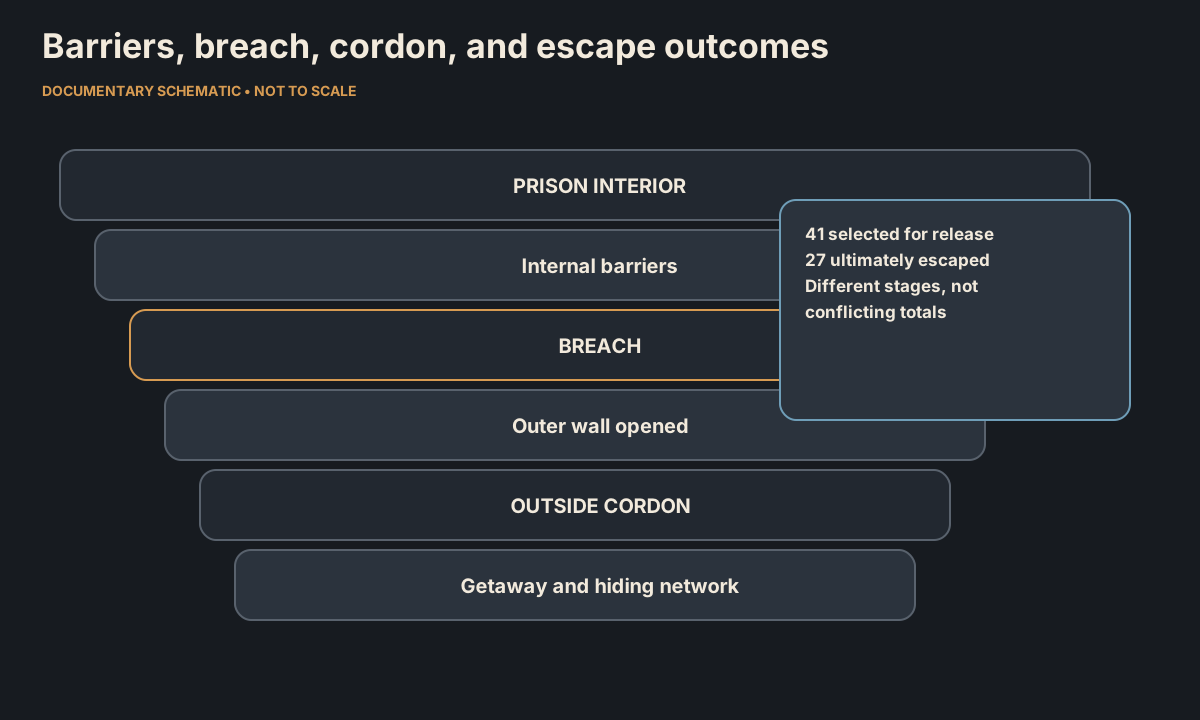
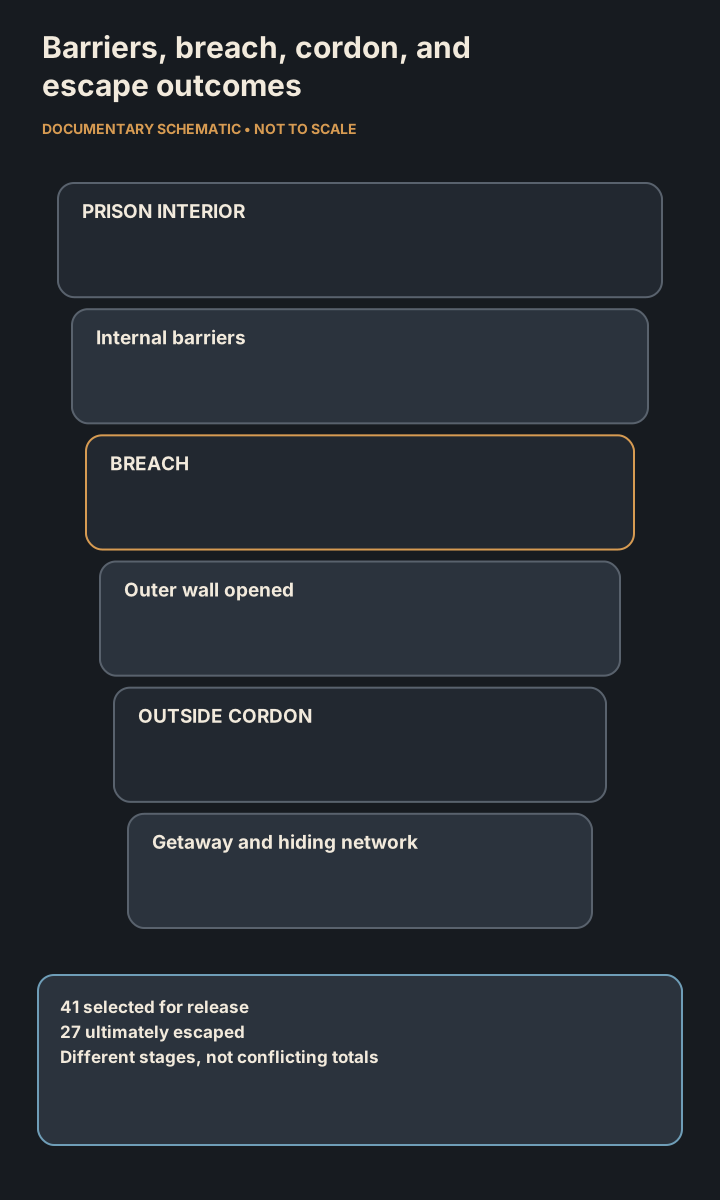
Simplified documentary reconstruction; not to scale. Evidence qualifications are written directly into the visual and explained in the adjacent text.
Evidence discipline
What the record supports
Status labels distinguish secure conclusions from uncertainty and rejected claims. Color is never the only signal.
MYTH
Exactly 27 Irgun and Lehi prisoners were freed from Acre Prison.
The current Israeli museum says forty-one selected prisoners were freed from the prison. The figure twenty-seven refers to those who ultimately completed the escape in the later Israeli/Irgun reconstruction after six were killed and eight recaptured.
Sources: SRC-001, SRC-004DISPUTED
Exactly 214 Arab prisoners escaped.
A British report dated May 6 listed 214 Arab prisoners still at liberty after twelve Arab prisoners had already been recaptured. A later Irgun narrative gives 182 Arab escapees. The sources are counting at different moments and may use different prisoner categories, so no single exact Arab total is secure.
Sources: SRC-002, SRC-004UNKNOWN
All Arab prisoners who escaped were ordinary criminals.
Later Irgun narratives often describe the Arab inmates collectively as criminals, while the contemporary British statement simply calls them Arab prisoners and separately refers to a criminal-lunatic section. Acre had also long held Palestinian political detainees and prisoners. The available event sources do not establish one uniform legal category for all Arab escapees.
Sources: SRC-002, SRC-012DISPUTED
A British soldier was definitely killed during the Acre breakout.
The detailed official British statement of May 7 records six soldiers wounded by a road mine, a police officer slightly injured, and a British constable seriously wounded, but no British fatality. Some later secondary summaries report one British death; the contemporary official account does not support stating that as settled.
Sources: SRC-002MYTH
The Acre breakout caused Britain to refer Palestine to the United Nations.
Britain had announced the UN referral in February 1947, and the UN General Assembly's special session opened on April 28, six days before the Acre raid. The breakout could affect perceptions of British control, but it did not initiate the UN process.
Sources: SRC-003, SRC-005, SRC-006MYTH
The breakout directly caused the creation of UNSCOP.
UNSCOP was established on May 15, after the raid, but within a special session that had already opened on April 28 at Britain's request. Claims that the raid itself created the committee confuse chronology with possible political impact.
Sources: SRC-005, SRC-006LATER CLAIM
Peres Etkes definitely supplied the Irgun with the prison plans used in the operation.
In 2020 Etkes's relatives said he had told family members in the 1950s that he supplied prison plans. His surviving memoir ends before the Acre breakout, and the selected contemporary record does not independently document the handover. The story is plausible family testimony but not a settled operational fact.
Sources: SRC-007, SRC-008MYTH
British sources and Israeli commemorative sources describe the operation in politically neutral language.
British official records routinely used 'terrorist' for Irgun and Lehi, while the present Israeli state-supported museum frames members as underground resistance fighters and emphasizes heroism and sacrifice. Those labels are evidence about political memory and official viewpoint, not neutral narrator terminology.
Sources: SRC-001, SRC-002, SRC-003MYTH
The operation was a complete tactical success.
The prison wall was breached and twenty-seven designated underground prisoners ultimately got clear in the later Israeli reconstruction, but nine Irgun/Lehi attackers or selected escapees were killed, eight selected escapees were recaptured, and five outside attackers were captured. The result was operationally significant but costly and incomplete.
Sources: SRC-001, SRC-004