
The images that fixed Operation Nimrod in British memory are unusually simple: black-clad soldiers at the windows of a London embassy, smoke pouring from the building, and hostages being hurried to safety while television cameras recorded the assault. The rescue on 5 May 1980 was real, fast, and remarkably successful. It was also the violent end of a six-day police operation in which two hostages died, five were released by negotiation, and important questions about command, casualty counts, and the deaths of several hostage-takers remained more complicated than the televised victory suggested.
The best-supported reconstruction therefore starts before the first SAS soldier entered the Iranian Embassy. Operation Nimrod became possible because police negotiators had spent days trying to avoid an assault, the government had kept a military option ready without immediately authorizing it, and the killing of a hostage changed the threshold for force. Its success is best measured by the people who emerged alive, but the operation's historical meaning also depends on what the surviving record can—and cannot—prove about the decisions made that evening.
At a Glance
- Crisis: Iranian Embassy hostage siege, London
- Dates: 30 April–5 May 1980
- Rescue operation: Operation Nimrod, 5 May 1980
- Initially held hostage: 26
- Released through negotiation: 5
- Hostages killed: 2
- Rescued alive during the assault: 19
- Hostage-takers: 6
- Hostage-takers killed: 5
- Hostage-takers captured: 1
- Assault duration: about 17 minutes
The politics that entered Princes Gate
At about 11:30 a.m. on 30 April 1980, six armed men seized the Iranian Embassy at 16 Princes Gate in South Kensington. Twenty-six people were trapped inside, including embassy personnel, visitors, journalists, and Metropolitan Police Constable Trevor Lock, who had been on diplomatic protection duty. The seizure immediately created two overlapping problems: a hostage crisis in central London and an international political dispute being played out inside a diplomatic mission.
The gunmen were Iranian Arabs whose cause centered on Khuzestan, the oil-rich southwestern province of Iran with a substantial Arab population. Modern British institutional accounts identify them with the Democratic Revolutionary Front for the Liberation of Arabistan. The contemporary British public record was less settled: when Home Secretary William Whitelaw briefed Parliament on 1 May, he said the men had described themselves as an Iranian dissident organization called the “Group of the Martyr.”
Their initial demands included the release of 91 Arabs imprisoned in Iran. As the siege developed, safe passage out of Britain became central to the negotiations. The British government would not grant that escape route, while Iranian authorities had no intention of conceding the political demands made in London.
Later research has placed the seizure inside the sharpening conflict between revolutionary Iran and Saddam Hussein's Iraq. Ben Macintyre's reconstruction argues that Iraqi intelligence backed the hostage-takers as part of a campaign against Iran before the Iran-Iraq War began later in 1980. That later evidence is important context, but it should not be projected backward as if police and ministers confronting the embassy on the first day already possessed a complete, settled account of who had sponsored the operation.
Six days of negotiation
The Metropolitan Police took operational responsibility for the siege and tried to resolve it without a forced entry. Negotiators maintained contact with the gunmen while officials sought intermediaries and considered what concessions could be offered without granting safe conduct. By the end of the crisis, police negotiation had secured the release of five hostages.
Those five releases are easy to lose in a story dominated by the SAS assault. They matter because the eventual outcome was produced by two different mechanisms. Negotiation removed five people from danger before the raid; the military rescue later brought out another nineteen alive.
The SAS was moved into position early as a contingency, but the presence of soldiers did not mean that an assault had already been ordered. John Dellow, the senior Metropolitan Police officer responsible for operations at the siege, later made the distinction explicit. Government authority first allowed the SAS to deploy and prepare; a second act of authority was required before armed troops could be committed in support of the police.
Dellow's later account also makes clear that negotiation remained the preferred course while he judged that the hostages could be protected that way. He told the military commander that he intended to continue negotiating and would seek an assault only if captives were gravely at risk. As the siege developed, Dellow described the trigger more specifically in terms of evidence that two or more hostages had been killed.
That distinction between deployment and commitment is central to understanding Operation Nimrod. The government had prepared for force without making force inevitable. The final assault followed a deterioration inside the embassy, not merely the passage of six days or impatience outside it.
The threshold for force
On 5 May, the gunmen's threats became more immediate. Shots were heard during the afternoon, and by late in the day officials were preparing for the possibility that a hostage had been killed. At about 7 p.m., the body of Abbas Lavasani, an Iranian embassy official, was pushed out of the building.
Lavasani's death transformed the decision facing police and ministers. There was now visible evidence that threats to kill hostages had been carried out, and authorities feared further killings. Whitelaw told the House of Commons the next day that he authorized commitment of the SAS at the Metropolitan Police Commissioner's request once it became clear that the hostage-takers had begun executing their threats.
Dellow's 1985 professional account describes the same transition from police control to military action, but it contains a conspicuous typographical problem. It says he committed the SAS at “7:09 a.m.” on 5 May, even though the surrounding chronology places the decisive events in the evening. Modern institutional chronologies place the transfer at roughly 7:07 p.m.; the assault itself began at about 7:23 p.m. The printed “a.m.” cannot be reconciled with the sequence and is best understood as an error in the document rather than evidence for a morning assault order.
Who ordered Operation Nimrod?
Popular memory often compresses the chain of command into a single sentence in which Prime Minister Margaret Thatcher “sent in the SAS.” She was closely interested in the crisis and later became politically identified with its outcome, but the administrative sequence was more structured. The police requested military intervention; the Home Secretary authorized the commitment of the SAS; and operational control was then transferred for the rescue.
Whitelaw was unusually explicit when Parliament praised him for the decision. He said that, under the arrangements in place, the final decision had to be taken by the Home Secretary. Thatcher's own surviving papers show that she followed events closely, received calls from Whitelaw and the Cabinet emergency machinery during 5 May, returned to Downing Street that evening, and later visited the SAS.
A letter Thatcher had sent to Iranian President Abolhassan Bani-Sadr on 1 May likewise described Whitelaw as being in charge of the situation while she herself was taking a close personal interest. That evidence does not make Thatcher peripheral: as prime minister she remained politically responsible for the government's policy, including its refusal to grant safe passage. It does, however, make the one-person-order version too crude for a historical account.
The distinction matters because Operation Nimrod was conducted as military aid to the civil power. The SAS was not acting as an independent force that had taken over a London street. Police command, ministerial authorization, military control during the rescue, and the return of the scene to police authority were separate stages of the response.
Seventeen minutes
The assault began at about 7:23 p.m. on 5 May. SAS teams entered the embassy from more than one direction while police negotiators continued to occupy the hostage-takers' attention. The details of the entry have since become part of special-forces legend, but the historical result can be explained without turning the building into a tactical manual.
The opening did not unfold perfectly. One soldier became caught during an entry from above, a window broke before intended, and fire spread in part of the building. Those complications accelerated the crisis inside as the hostage-takers realized the assault had begun.
Constable Trevor Lock, still carrying a concealed police firearm that his captors had failed to discover, confronted the gunmen's leader during the assault. Elsewhere, hostage-takers opened fire on a group of captives. Ali Akbar Samadzadeh was killed and other hostages were wounded before SAS soldiers reached the group.
The rescue then moved rapidly through the embassy. Hostages were identified, moved out of rooms, and taken from the building while the assault teams confronted the remaining gunmen. By about 7:40 p.m., roughly seventeen minutes after entry began, nineteen hostages had been brought out alive.
Five of the six hostage-takers were killed. The sixth, Fowzi Nejad, initially emerged among the hostages and was identified outside as one of the gunmen. He was taken into police custody rather than killed, preserving both an important piece of evidence and the possibility of ordinary criminal prosecution after the military phase ended.
Reconciling the hostage count
The final hostage arithmetic is secure even though contemporary descriptions of the last minutes are not perfectly aligned. Twenty-six people were initially held. Five were released during negotiation. Abbas Lavasani was killed before the assault, Ali Akbar Samadzadeh was killed during it, and nineteen people were rescued alive.
That produces a complete total: five released, two killed, nineteen rescued. The difficulty appears when sources describe how many captives were believed to be alive at the precise moment of entry.
On 6 May, Whitelaw told Parliament that all nineteen hostages “known to be alive” when the assault began had been rescued. His statement also said that the hostage-takers had killed two people. In real time, police had reason to fear that two hostages might already have been killed before the SAS entered, even though later reconstruction established that Lavasani was the only hostage killed before the assault and Samadzadeh died during it.
Dellow's later account uses a different denominator, writing that twenty of the twenty-one hostages remaining in the stronghold immediately before the assault were released, with one shot during the operation. Read literally, that wording does not map neatly onto the moment after Lavasani's body had already been expelled from the embassy. It is more useful as evidence of the overall outcome and command sequence than as a perfectly framed census at a single minute.
The apparent contradiction is therefore a warning about real-time crisis records. Officials did not possess the final post-operation casualty picture while the decision to assault was being made. The cleanest historical count comes from reconciling the entire six-day sequence rather than selecting one intermediate denominator and forcing every source to match it.
The deaths of the hostage-takers
The five deaths among the hostage-takers were investigated after the siege. Once the assault ended, police resumed control of the scene, weapons were examined, and SAS personnel were questioned. An inquest at Westminster Coroner's Court in February 1981 considered whether the deaths resulted from reasonable force.
The jury returned unanimous verdicts of justifiable homicide, the terminology then used for killings regarded as legally justified in the circumstances. A later legal analysis by W. Hays Parks, drawing on the inquest transcript, records that the jury was instructed to consider whether the force had been necessary and proportionate in preventing crime. That verdict is the strongest formal legal finding in the surviving public record used here.
It did not end every factual dispute. In 2002, a BBC documentary and accompanying reporting revived allegations concerning two hostage-takers killed in the room where many of the Iranian captives had been held. Former hostage Ahmad Dadgar said that the two men had surrendered before SAS soldiers shot them, and the report said two other Iranian witnesses supported his version.
The soldiers' position at the inquest was different: they described perceiving continuing threats, including movement toward weapons or the presence of a grenade. The later surrender account therefore cannot simply be substituted for the inquest evidence. It is a significant later claim by witnesses who said they were in the room, but the public record remains contested.
A related allegation concerns whether the assault team understood that the government wanted no surviving hostage-takers. One former SAS participant later recalled a message attributed to Thatcher and said some soldiers interpreted it as meaning there should be no “ongoing problem” after the embassy. Other participants did not share that recollection, the alleged instruction was not established in writing in the material used here, and Nejad was captured alive.
A categorical claim that the SAS entered Princes Gate under a proven blanket order to kill every hostage-taker therefore goes beyond the evidence. The controversy belongs in the history because it affected later interpretations of the raid, but uncertainty is part of the record rather than a gap to be filled with certainty.
The surviving hostage-taker
Fowzi Nejad's survival gives the end of Operation Nimrod a less cinematic but historically important coda. After being identified outside the embassy, he entered the British criminal justice system. He was later convicted of conspiracy to murder, false imprisonment, and two counts of manslaughter.
The fact that one hostage-taker survived also complicates retrospective claims about an absolute no-prisoners policy. It does not by itself disprove what individual soldiers may have believed or intended at particular moments inside a burning building. It does show that the operation as completed did not end with every captor dead and that civil legal authority resumed once the immediate threat was over.
The television victory—and what it leaves out
Operation Nimrod was one of the first special-forces assaults to become a mass television event while it was still happening. Broadcasters interrupted normal programming as cameras outside Princes Gate captured soldiers at the windows and smoke rising from the embassy. The imagery gave the public an unusually direct view of a secretive military unit and transformed the SAS into a household name.
The political effect was equally strong. Thatcher's government had refused safe conduct, the hostages had been rescued under British authority, and the raid appeared to demonstrate decisiveness after days of tension. The operation became part of the developing public image of Thatcher as a leader unwilling to yield to armed coercion.
That legacy can make the preceding police work disappear. For five days the Metropolitan Police had kept the crisis from reaching its worst possible outcome, secured five releases, and preserved options while the SAS prepared. The rescue was the final phase of a combined civil-military response, not the whole response.
The television narrative can also obscure the people who did not survive. Abbas Lavasani was killed before the troops entered. Ali Akbar Samadzadeh was killed during the assault. The operation saved nineteen captives who remained in immediate danger, but “successful” cannot mean bloodless.
How successful was Operation Nimrod?
Measured against the immediate rescue objective, Operation Nimrod was highly successful. Nineteen hostages were brought out alive in about seventeen minutes after a captive had already been murdered and the threat of further killings had become acute. None of the six hostage-takers escaped, and the surviving gunman was arrested and prosecuted.
Measured against the entire hostage crisis, the result was more mixed. Two captives were killed, others were injured, the embassy was badly damaged, and later controversy surrounded some of the lethal force used against the hostage-takers. Police negotiation had already saved five people before the SAS entered, making the final outcome a product of both patience and force.
Its broader legacy is similarly double-edged. The operation became a benchmark for British counterterrorism and a defining public moment for the SAS, while the live television images encouraged a simplified story of flawless rescue and unambiguous command. The surviving record supports admiration for the speed and effectiveness of the rescue without requiring that every later heroic detail be accepted as fact.
Operation Nimrod endures because nineteen people escaped an immediate lethal crisis. Understanding how they did so requires more than replaying the famous footage: it requires following the six days of negotiation, the legal and political chain that authorized force, the casualty arithmetic, and the disputes that remained after the smoke cleared from Princes Gate.
Evidence discipline
What the record supports
Status labels distinguish secure conclusions from uncertainty and rejected claims. Color is never the only signal.
DOCUMENTED
Six armed men seized the embassy and initially held 26 people hostage.
The six-man/26-hostage starting count is consistent across modern institutional and major later accounts; Dellow also notes that the initially reported number of attackers was later found to be six.
Sources: SRC-003, SRC-004, SRC-009DOCUMENTED
Five hostages were released through negotiation before Operation Nimrod.
Whitelaw's statement to Parliament and Dellow's later professional account independently record five progressive releases during negotiation.
Sources: SRC-001, SRC-003DOCUMENTED
Operation Nimrod rescued 19 hostages alive.
The 19 rescued figure is secure in the parliamentary and institutional record and reconciles with the full 26-hostage total when the five prior releases and two hostage deaths are counted separately.
Sources: SRC-001, SRC-004MYTH
Margaret Thatcher alone personally issued the complete operational order for the SAS assault.
Thatcher followed the crisis closely and carried prime-ministerial responsibility, but Whitelaw stated that the final ministerial decision had to be taken by the Home Secretary, while police requested assistance and transferred operational control under established military-aid procedures.
Sources: SRC-001, SRC-003, SRC-006, SRC-007LATER CLAIM
Two hostage-takers had surrendered before SAS soldiers shot them in the telex room.
Ahmad Dadgar and other witnesses later reported a surrender; the SAS testimony considered at the inquest described perceived continuing threats. The later account is historically significant but does not erase the inquest record.
Sources: SRC-008, SRC-010DISPUTED
The SAS operated under a proven blanket order to take no hostage-takers alive.
A former participant later described interpreting an unwritten Thatcher message that way, while other participants did not share the recollection, no written order has been established in the sources used here, and one hostage-taker was captured alive.
Sources: SRC-004, SRC-010MYTH
Dellow committed the SAS at 7:09 a.m. on 5 May 1980.
The 1985 printed paper gives 7:09 a.m., but its own sequence and independent institutional chronology place the transfer in the evening immediately before the assault. The a.m. notation is a documentary typo.
Sources: SRC-003, SRC-004DISPUTED
The hostage-takers were consistently identified in the contemporary British record by the later DRFLA label.
Modern accounts commonly use DRFLA, while Whitelaw told Parliament on 1 May that the men called themselves the Group of the Martyr. Naming should preserve the difference between contemporary self-description and later organizational identification.
Sources: SRC-002, SRC-004WELL-SUPPORTED
Iraqi state support lay behind the embassy seizure.
Major later research, including Ben Macintyre's reconstruction from interviews and previously unavailable material, supports Iraqi sponsorship. The exact sponsorship chain was not presented as settled public knowledge in the contemporary British record used here.
Sources: SRC-009Documentary reconstruction
Twenty-six hostages: releases, deaths and rescue
A case-local editorial visual separates the secure historical sequence from uncertainty without exposing reusable modern operational detail.
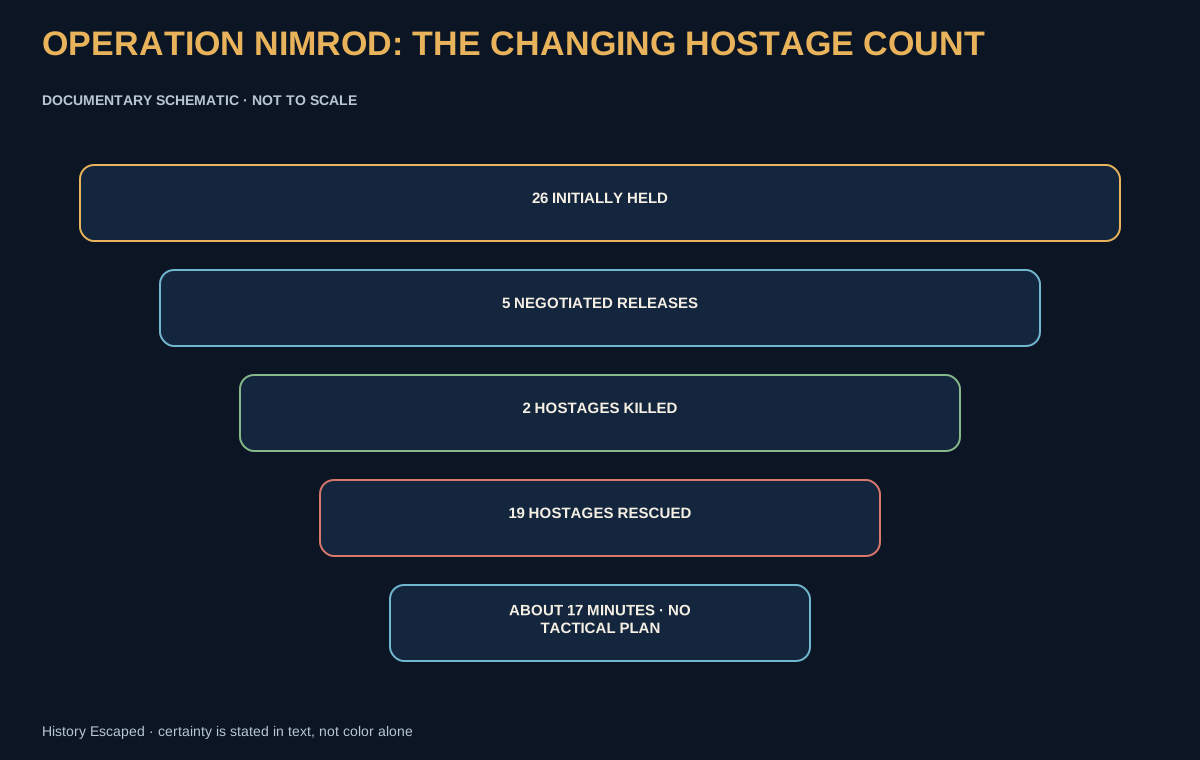
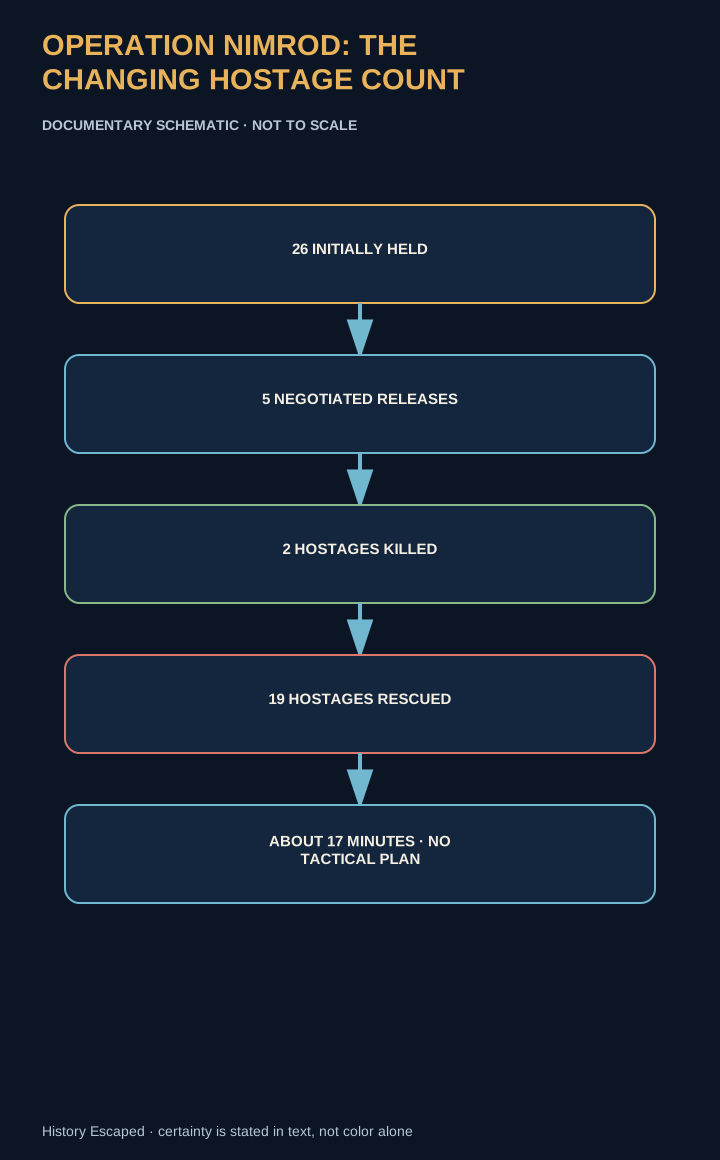
Simplified evidence-led editorial reconstruction based on the cited record; not to scale. Uncertainty is stated directly in the visual and adjacent text.

