
Kim Gu was not yet Kim Gu when he escaped from custody in Incheon. In 1898 he was Kim Chang-su, a young Korean prisoner held after killing the Japanese traveler Tsuchida Jōsuke at Chihapo two years earlier. The later statesman and independence leader would remember the breakout in extraordinary detail, but the account most readers know was written more than thirty years after the event.
The secure core is narrower and still remarkable. On 19 March 1898, Kim escaped from the Incheon magistracy prison with four other prisoners, got beyond the prison compound, and remained at large. His own memoir supplies the iron tool, money, food and drink, manipulation of prison routines, exact order of movement, confusion in the fog, and much of the early route. Institutional records and later historical reconstruction corroborate the escape and broad movement, but not every dramatic mechanism with equal certainty.
At a Glance
- Name at the time: Kim Chang-su, later known as Kim Gu
- Escape: 19 March 1898
- Place: Incheon Magistracy prison, Incheon, Korean Empire
- Escapees: Kim and four fellow prisoners
- Immediate outcome: Successful breakout and flight from Incheon
- Later destination: Southern Korea; by late 1898 Kim had entered Magoksa and become a Buddhist monk under the name Wonjong
- Central evidence problem: Kim's detailed account was written retrospectively in Baekbeom Ilji, while official and institutional sources establish a firmer but less detailed core
- Date conflict: Kim's memoir gives the ninth day of the third month of the Musul year; modern institutional chronology generally gives 19 March 1898
Why Kim Chang-su was in Incheon
Kim's imprisonment grew out of the political violence surrounding Korea's late nineteenth-century crisis. In October 1895, Queen Min, later posthumously known as Empress Myeongseong, was killed during a Japanese-backed attack on the royal palace. Anti-Japanese anger intensified as Korea confronted foreign pressure, domestic reform, armed resistance, and King Gojong's flight to the Russian legation.
On 9 March 1896, at Chihapo in Hwanghae Province, Kim killed a Japanese man named Tsuchida Jōsuke. Kim openly presented the act as revenge for the slain queen. He was arrested in June and eventually transferred to the Incheon Magistracy, where Japanese officials participated in interrogations and pressed for severe punishment.
The victim's identity has become part of Kim's later legend and requires careful wording. Kim's memoir and some commemorative retellings present Tsuchida as a Japanese military officer or agent. Other records cited by later scholarship describe him as a merchant or medicine seller. There is no secure basis for stating that Tsuchida personally took part in the queen's assassination. Kim's political motive is documented; the more specific identification of his victim is disputed.
That distinction matters because the escape can easily become an extension of a heroic national biography in which every contested detail is resolved in Kim's favor. It was, more concretely, the escape of a man imprisoned after an intentional killing committed for a declared political purpose. His later importance in the Korean independence movement does not eliminate the need to describe the original custody accurately.
A death sentence that was not carried out
The story of Kim's imprisonment is often told with a dramatic climax before the escape: a death sentence, an execution supposedly only hours away, and an imperial telephone call that stopped it at the last moment. The surviving administrative chronology is less cinematic.
According to the Academy of Korean Studies' reconstruction of the Chihapo case, a Japanese consular official pressed for execution in September 1896. On 22 October, Korea's Ministry of Justice petitioned the king to approve hanging. The king did not approve that recommendation. After further submissions, a final list approved on 22 January 1897 omitted Kim, allowing him to escape execution while remaining in custody.
Kim later remembered a much more immediate rescue from execution by royal order. Even a Korean government publication discussing Baekbeom Ilji notes internal date contradictions in the memoir's version of the episode. The broad fact that Kim was not executed is secure; the famous last-minute telephone narrative should not be treated as a verified minute-by-minute sequence.
He remained confined through 1897 and into 1898. National Institute of Korean History accounts describe him reading new works, learning about Western ideas, and teaching other prisoners. By his later account, he came to believe that continuing to wait in prison served Japanese interests and that escape was justified.
Four other prisoners
Kim did not leave alone. In Baekbeom Ilji he names four companions: Jo Deok-geun, Yang Bong-gu, Hwang Sun-yong, and Kim Baek-seok. The memoir portrays them not as political comrades assembled around a shared nationalist program but as fellow prisoners whose sentences and positions within the jail differed.
This is an important corrective to a retrospective resistance narrative. Kim's later political stature can make the breakout look like a coordinated independence operation. His own account instead describes a prison plan built from relationships inside the jail, family assistance, money, and the exploitation of ordinary institutional routines.
The memoir says Jo supplied money and that Hwang, who had a supervisory role among prisoners, was drawn into the plan. It also says Kim asked his father to bring in a triangular iron implement concealed with clothing. These details are plausible within the larger sequence, but they come primarily from Kim's recollection and should remain identified as such rather than converted into independently documented prison records.
What the breakout securely establishes
The broad mechanism involved breaching the prison structure and crossing the perimeter. Kim's memoir says he slipped beneath the floor, lifted paving material with the iron implement, dug outward, and initially emerged by himself. He then says he went back, brought the other four through the opening, helped them over the wall, and finally crossed the wall himself as an alarm spread through the compound.
His account adds an elaborate diversion. Kim says money was used to provide food and alcohol for prisoners, while an on-duty jail functionary was separately given money for opium. He remembered eighty prisoners eating and drinking that evening and described the functionary withdrawing from active supervision. Those figures and the exact manipulation of the guard routine are memoir evidence, not details that should be presented as though preserved in a surviving duty log.
The same caution applies to the physical mechanics. Later local research in Incheon has used Baekbeom Ilji, historical maps, and old photographs to reconstruct the prison and the path Kim may have taken. That work is valuable because it tests the memoir against historical geography, but its conclusions are explicitly reconstructions. A modern mapped line is not the same thing as a contemporary record of his footsteps.
What does not depend on accepting every remembered detail is that the breakout succeeded. Institutional histories date it to 19 March 1898, identify four other prisoners as leaving with Kim, and place him outside Incheon afterward. The escape was not merely an unfulfilled plan preserved in autobiography.
Beyond the wall
Kim's memoir makes the first hours after the breakout unusually vivid. He wrote that poor visibility and unfamiliarity with Incheon left him disoriented and that, instead of quickly putting the city behind him, he found himself close to the magistracy again by dawn. He then described hiding from a policeman, orienting himself by landmarks, and moving away from the port.
In 2019, an Incheon Jung-gu research project attempted to reconstruct this section using the memoir, period maps, and historical photographs. Researchers proposed a path from the former magistracy through several identifiable Incheon locations before the route turned inland. Their language remained appropriately cautious: the route was estimated from the surviving evidence.
For the broader flight, Kim's own account places him moving through Bupyeong and Siheung toward the Yanghwa crossing and Seoul. He then continued into Korea's southern provinces rather than returning directly to his family. The National Institute of Korean History and Kim Koo Museum chronology confirm the broad post-escape wandering without validating every encounter and disguise in the memoir.
The authorities' response also had consequences for his family. The Academy of Korean Studies states that Kim's father was imprisoned in his place after the breakout. Kim's own memoir gives a different duration for his father's detention than the modern encyclopedia entry, another reminder that even family episodes should not be harmonized by guesswork.
What happened to the other escapees
The later fates of the four companions are much less secure than Kim's. His memoir says he later encountered Yang Bong-gu in Mokpo. Through Yang, Kim reported hearing that Jo Deok-geun had been recaptured and severely injured in custody. Because that information reaches the reader as Kim's recollection of what another escapee told him, it is not equivalent to an independent arrest or prison record.
For Hwang Sun-yong and Kim Baek-seok, the surviving sources do not establish a reliable later outcome. Their disappearance from the surviving narrative should not be filled with invented recapture, freedom, or death stories.
This imbalance in the evidence is historically revealing. Kim became a major public figure whose papers, memoir, museums, and commemorative institutions preserved his life in detail. The men who escaped beside him did not receive comparable documentation. A reconstruction centered on evidence has to resist allowing Kim's later fame to turn uncertainty about them into certainty.
From fugitive to monk
After leaving the Seoul area, Kim traveled through the southern provinces under changing circumstances. Later in 1898 he reached Magoksa, a Buddhist temple in Gongju. Institutional histories record that he shaved his head there and took the Buddhist name Wonjong.
He did not remain permanently at the temple. The Magoksa entry in the Encyclopedia of Korean Culture places him there in 1898 and says he left for the Mount Kumgang area in the spring of 1899. Those later movements matter because they establish that the Incheon escape produced durable freedom from the 1896 imprisonment rather than a brief period at large followed by immediate recapture.
The escape also became part of the autobiographical foundation from which Kim later explained his political life. Decades afterward he would lead the Provisional Government of the Republic of Korea and become one of the best-known figures in the Korean independence movement. That later career explains why the prison episode accumulated commemorative weight, but it should not be used as evidence for details of an event that occurred before the twentieth century began.
Memory, commemoration, and the evidence
Baekbeom Ilji is unavoidable for reconstructing the Incheon escape. Kim wrote the first part in Shanghai in 1929, roughly three decades after the breakout, and the work was first published in 1947 after editorial preparation. It is both first-person testimony and retrospective autobiography.
That combination demands neither dismissal nor credulity. Kim could preserve information unavailable anywhere else: names, remembered conversations, the logic he assigned to the plan, and details of moving through the prison and city. At the same time, Korean institutional commentary acknowledges errors in dates, names, and places in the original manuscript, and the death-sentence episode demonstrates how memory could produce internal chronological problems.
The escape date itself shows the issue. The memoir identifies the chosen night as the ninth day of the third month of the Musul year. Modern institutional and local historical chronologies give 19 March 1898. Without a surviving source that conclusively resolves how the memoir's calendar expression became the modern date, it is better to retain the discrepancy than to pretend there is none. The institutional consensus makes 19 March the strongest canonical date, but not a reason to erase the memoir's wording.
The same method applies to the prison mechanics. The five-person escape, structural breach, perimeter crossing, successful flight, and broad aftermath are well supported. The iron implement, payments, opium, precise diversion, order of movement, exact wall maneuver, fog-bound detours, and conversations belong primarily to Kim's later account.
Kim Gu's Incheon escape therefore survives on two levels. One is a securely established 1898 prison breakout by Kim Chang-su and four companions. The other is the richly narrated escape that Kim himself constructed from memory decades later. Keeping those levels visible does not weaken the story; it shows how a documented escape became part of a national political biography without requiring every remembered detail to become fact.
Evidence discipline
What the record supports
Status labels distinguish secure conclusions from uncertainty and rejected claims. Color is never the only signal.
WELL-SUPPORTED
Kim Gu's Incheon prison escape occurred on 19 March 1898.
The revised Academy of Korean Studies chronology and later institutional/local historical sources use 19 March. Kim's memoir instead identifies the chosen night as the ninth day of the third month of the Musul year, so the source discrepancy is retained rather than silently harmonized.
Sources: SRC-001, SRC-003, SRC-006WELL-SUPPORTED
Kim escaped with four fellow prisoners.
Kim names Jo Deok-geun, Yang Bong-gu, Hwang Sun-yong, and Kim Baek-seok; later Korean historical reporting also describes four other prisoners escaping with him.
Sources: SRC-003, SRC-006LATER CLAIM
Kim's father smuggled a triangular iron implement into the prison for the escape.
This specific preparation is described in Baekbeom Ilji. It is useful participant testimony but was written decades after the event and is not independently established by the institutional sources used here.
Sources: SRC-003, SRC-004LATER CLAIM
Kim disabled effective supervision by giving an on-duty jail functionary money to buy opium while prisoners were fed and given alcohol.
The detailed diversion, payments, quantities, and guard behavior come from Kim's retrospective account.
Sources: SRC-003DISPUTED
Kim was saved only hours before execution by a last-minute telephone order from King Gojong.
Kim's memoir helped popularize a dramatic intervention narrative, but the Academy of Korean Studies' administrative chronology says the king did not approve the October 1896 execution recommendation and a January 1897 final list omitted Kim. Korean government commentary also notes internal date contradictions in the memoir's execution story.
Sources: SRC-001, SRC-005DISPUTED
Tsuchida Jōsuke was definitively a Japanese Army officer who participated in Queen Min's assassination.
Kim's later account and some commemorative sources identify Tsuchida as an officer or agent, while Japanese records and later scholarship cited in Korean institutional discussion describe him as a merchant or medicine seller. Kim's declared revenge motive is clearer than Tsuchida's exact status or personal connection to the assassination.
Sources: SRC-001, SRC-009DISPUTED
A modern reconstructed route through Incheon reproduces Kim's exact escape path.
Incheon researchers combined Baekbeom Ilji with period maps and photographs to estimate a route. Their work is valuable historical reconstruction, not a contemporary record of every movement.
Sources: SRC-007LATER CLAIM
Jo Deok-geun was recaptured and severely injured in custody.
Kim says Yang Bong-gu later told him that Jo had been recaptured and suffered grave injuries. No independent confirmation is established in the surviving institutional sources.
Sources: SRC-003Documentary reconstruction
Secure breakout and memoir-level mechanics
A case-local editorial visual separates the secure historical sequence from uncertainty without exposing reusable modern operational detail.
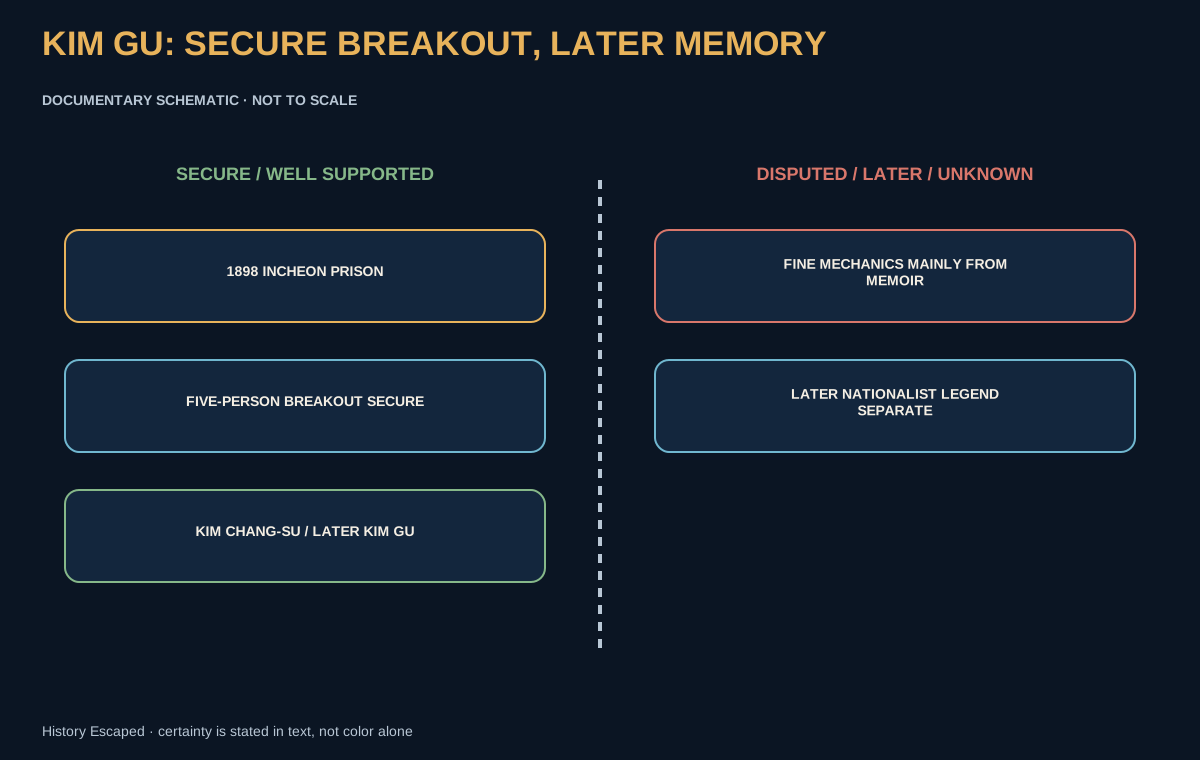
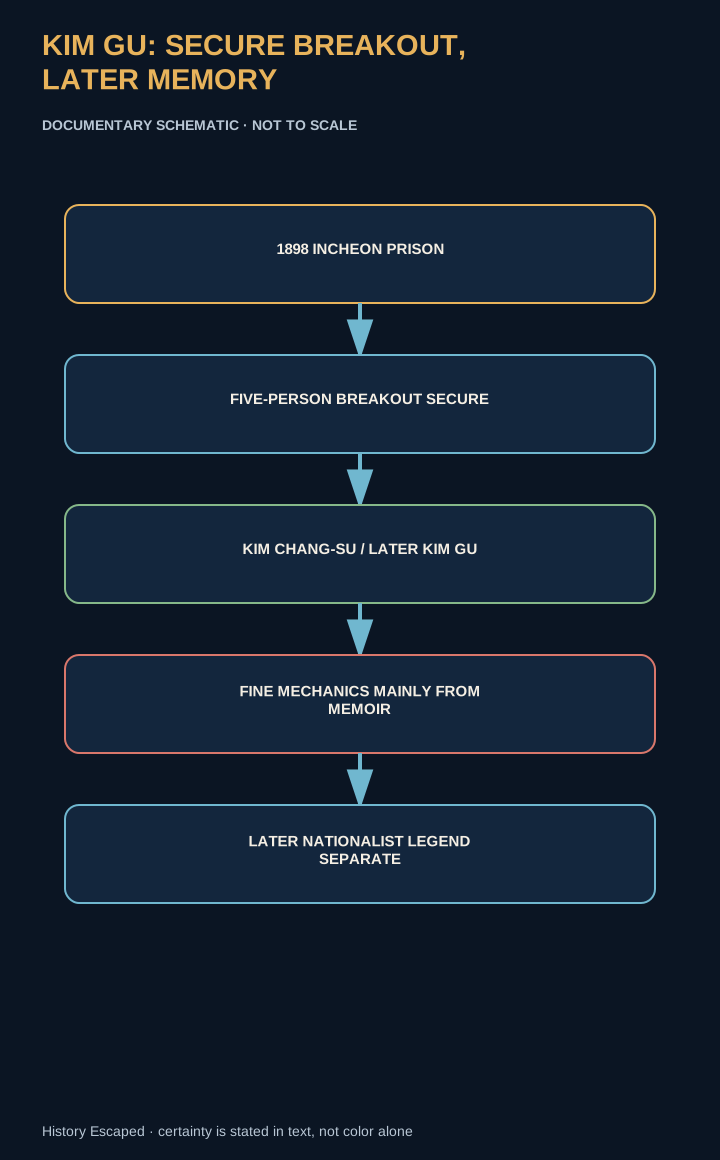
Simplified evidence-led editorial reconstruction based on the cited record; not to scale. Uncertainty is stated directly in the visual and adjacent text.