
In October 1953, five Czechoslovak men crossed into East Germany intending to reach West Berlin. They were not ordinary border fugitives. Ctirad Mašín, Josef Mašín, Milan Paumer, Václav Švéda, and Zbyněk Janata belonged to an armed anti-communist group that had already carried out raids, sabotage, and killings in Czechoslovakia. Their month-long flight became one of the most heavily pursued escape episodes of the early Cold War—and one of the most morally contested.
The broad outcome is clear. Three men reached West Berlin; two were captured in East Germany and later executed after being returned to Czechoslovakia. Less simple is the meaning attached to what happened.
Communist authorities called the group bandits and terrorists. Post-communist institutions have recognized members as participants in anti-communist resistance. Critics, including opponents of the communist dictatorship, have continued to argue that some of the group’s killings cannot be justified as resistance. The historical record supports describing an armed escape by an anti-communist resistance group without turning that description into a verdict on every act its members committed.
At a Glance
- Who fled: Ctirad Mašín, Josef Mašín, Milan Paumer, Václav Švéda, and Zbyněk Janata.
- Objective: Cross East Germany and reach the American sector of West Berlin, with surviving members intending to continue anti-communist activity from the West.
- Border crossing: Night of 3–4 October 1953 near Deutschneudorf.
- Major pursuit points: Uckro on 10 October and the Reichwalde–Waldow area on 16–17 October.
- Result: Josef Mašín, Ctirad Mašín, and Milan Paumer reached West Berlin at the end of October. Janata and Švéda were captured, transferred to Czechoslovakia, and executed in 1955.
- Evidence caution: Often-repeated claims of 20,000 or 25,000 pursuers do not represent a secure single-source headcount. East German records document very large deployments, but different records count different formations and phases.
From resistance activity to flight
The Mašín brothers were sons of Josef Mašín, a Czechoslovak army officer and prominent anti-Nazi resister executed by the Germans in 1942. After the Communist Party consolidated power in Czechoslovakia in 1948, Ctirad and Josef Mašín and a circle of associates turned toward armed opposition. Their later defenders have emphasized continuity with resistance to dictatorship; their critics have focused on the victims of the group’s raids.
Those actions matter because the 1953 escape did not begin in a vacuum. In 1951 members of the group attacked police stations to obtain weapons. During one raid, policeman Jaroslav Honzátko was incapacitated and then killed by Ctirad Mašín with a knife. In another, Josef Mašín shot policeman Oldřich Kašík.
During a 1952 payroll robbery, Josef Mašín killed accountant Josef Rošický. The group later stole explosives and carried out arson against agricultural property associated with collectivization. These facts are central to why the Mašín case remains controversial long after the communist regime itself disappeared.
Ctirad had also experienced imprisonment directly. Arrested in 1951, he was later sentenced and spent time in the Jáchymov uranium-labor system before being released in the 1953 amnesty. After his return, the group decided to leave Czechoslovakia. Their stated purpose in the West was not simply personal resettlement: they intended to join the U.S. military and prepare for what they believed might become a wider conflict with the Soviet bloc. Josef also wanted to avoid assignment to the communist-era Auxiliary Technical Battalions.
The escape party comprised five men. Besides the brothers and Paumer, it included Václav Švéda, whose family had been affected by collectivization, and Zbyněk Janata. An East German report states that the group left Prague on 3 October. The modern editorial apparatus of the Stasi Records Archive places their crossing into the German Democratic Republic during the night of 3–4 October near Deutschneudorf. West Berlin, still physically accessible years before construction of the Berlin Wall, was their target.
Uckro: the escape becomes a major manhunt
For several days the five moved north through East Germany. On 10 October, railway security at Elsterwerda alerted Uckro that five suspicious men believed to be Czechoslovak nationals had bought tickets in that direction. East German police met the train.
The resulting confrontation transformed the pursuit. A contemporary East German state-security report records that police officer Hermann Grummini was shot dead and that Helmut Strempel and Helmut Wittkewitz were wounded. The five fugitives escaped from the station area, but they no longer faced an ordinary search for border violators. Alarm measures expanded rapidly around Luckau and Lübben.
Zbyněk Janata became separated from the others. The 21 October 1953 East German report states that he was captured at 8 p.m. on 10 October. Some later accounts place the arrest on 11 October near Pelkwitz, leaving the exact date-and-place combination disputed. What is secure is that the group had become four within roughly a day of the Uckro shooting.
The scale of the response has accumulated its own legend. Later retellings often say 20,000 or 25,000 police, troops, security personnel, and Soviet soldiers were involved. Surviving East German documentation does show an extraordinary deployment: one contemporary report described about 8,000 police personnel in the first cordon and about 4,000 in a later one, while an archival editorial note cites a final Deutsche Volkspolizei report giving 5,000 police and paramilitary police, without counting every security-service or Soviet component. These figures do not describe the same denominator or moment, so no single 20,000/25,000 headcount is secure.
Reichwalde and Waldow
After Uckro, the four remaining fugitives spent days avoiding patrols and search parties. Later memoir-based accounts describe concealment in rural buildings and assistance from civilians, but the exact route is difficult to reconstruct because recollections, police records, and later retellings do not always align. The broad sequence is more secure than the precise path: the group remained in the Luckau region until the search tightened again in mid-October, then moved toward the Reichwalde–Waldow area.
On 16 October East German security forces encountered the four near Reichwalde. They escaped toward Waldow, where police formed another cordon. A 21 October state-security report says that after darkness fell the fugitives approached the police line and opened fire. It records two officers killed by the fugitives during the breakout and several additional deaths caused by fire from East German forces themselves.
Even the official record is not completely stable about those deaths. The contemporary report attributed the deaths of Herbert Hoffmann, a paramilitary lieutenant, and Heinz Sunkel to friendly fire, while later archival annotation based on a police reconstruction says Sunkel was shot by Ctirad Mašín. The same archival edition summarizes three Volkspolizei deaths attributable to the fugitives over the entire escape: Hermann Grummini, Martin Lehmann, and Heinz Sunkel. The overall three-death attribution is well supported by the modern archival reconstruction, while Sunkel’s individual attribution remains disputed because the contemporary report says otherwise.
Václav Švéda was wounded during the Waldow episode and could not continue with the others. East German records state that he was found and arrested near Waldow at about 11:45 a.m. on 17 October. That left Josef Mašín, Ctirad Mašín, and Milan Paumer still moving toward Berlin.
The pursuit was dangerous not only to the fugitives. East German documentation acknowledges deaths among police and paramilitary forces caused by their own side. The archival edition states that at least four further members of the Volkspolizei or Kasernierte Volkspolizei died from shots fired by colleagues during the wider operation. That does not diminish the killings attributed to the escapees; it shows that a large armed search generated casualties independently of direct contact with them.
Three reach West Berlin
The final stage brought the three survivors toward Berlin. Participant recollections and later reconstructions provide more detail than the contemporary East German report, but not every movement can be independently fixed on a map. Ctirad ultimately entered West Berlin separately from Josef and Paumer, and the three reunited after reaching the Western sectors. Milan Paumer had been wounded but remained mobile.
The best-supported end date is 31 October 1953. The modern editorial apparatus of the Stasi Records Archive gives that date, as does Memory of Nations. Some later English-language retellings give 2 November. The archival and Czech institutional evidence favors 31 October, while the alternate date remains part of the source history rather than a second escape event.
Once in the American sector, the three were beyond the East German manhunt. Their intention to continue the struggle from abroad did not remain rhetorical: all three later entered the U.S. Army. The escape itself, however, had split the original five permanently.
Janata and Švéda were transferred to Czechoslovakia. In a 1955 proceeding before the Czechoslovak Supreme Court, both were sentenced to death along with the Mašíns’ uncle Ctibor Novák, and they were executed on 2 May 1955. Their executions belong to the aftermath of the escape rather than to its mechanics, but they are essential to understanding what capture meant in this case.
Resistance, murder, terrorism—and the problem with a single label
The Mašín group is unusually difficult to summarize with one moral noun because different questions produce different answers. They deliberately organized armed opposition to a dictatorship and understood themselves as resistance fighters. Members of the group also killed people, including in actions in Czechoslovakia whose necessity and proportionality remain disputed. Communist authorities exploited those killings in a propaganda framework that depicted the group as criminal bandits and terrorists. That propaganda history does not make every later criticism of the killings illegitimate.
Post-communist Czech institutions have moved toward formal recognition of anti-communist resistance. Prime Minister Mirek Topolánek honored the brothers and Milan Paumer in 2008 and explicitly presented the awards as a means of opening national discussion about the “third resistance.” A 2011 law created a formal framework for recognizing participants in anti-communist opposition and resistance. In 2022 the Czech Ministry of Defence issued such certificates to Ctirad Mašín, Milan Paumer, Václav Švéda, and Zbyněk Janata; Josef Mašín was not part of that particular four-person issuance.
Official recognition did not end the argument. Historian Markéta Devátá has described the Mašín case as a central focus of Czech debate over the ethical meaning of armed anti-communist resistance, while academic work on representations of the brothers likewise emphasizes the persistence of public division. The controversy is therefore not simply “communists versus anti-communists.” It includes disagreements among people who reject the communist dictatorship but reach different conclusions about the moral boundaries of resistance.
For the escape of 1953, narrow description is more reliable than a sweeping label. Five members of an armed anti-communist group fled Czechoslovakia through East Germany toward West Berlin. Their flight triggered a massive East German manhunt and repeated armed encounters.
Two were captured; three reached the West. The route was an escape from communist-controlled territory, but it was also an armed operation by men already implicated in killings. Both parts of that history belong in the same account.
Evidence discipline
What the record supports
Status labels distinguish secure conclusions from uncertainty and rejected claims. Color is never the only signal.
WELL-SUPPORTED
The five crossed into East Germany during the night of 3–4 October 1953.
The Stasi Records Archive editorial apparatus gives the 3–4 October crossing near Deutschneudorf, consistent with Czech institutional reconstructions of the early-October departure.
Sources: SRC-001, SRC-002WELL-SUPPORTED
The three surviving fugitives reached West Berlin on 31 October 1953.
The Stasi Records Archive editorial note and Memory of Nations both give 31 October; some later retellings give 2 November.
Sources: SRC-001, SRC-002, SRC-009DISPUTED
A single force of 20,000 or 25,000 men pursued the group.
Different records give 8,000, 4,000, or 5,000 for different phases and force categories, while later accounts aggregate larger figures. The operation was unquestionably large, but the popular single total is not securely reconciled.
Sources: SRC-001, SRC-009DISPUTED
Heinz Sunkel was killed by Ctirad Mašín during the Waldow breakout.
The contemporary 21 October report attributes Sunkel’s death to East German friendly fire; a later police reconstruction cited by the archival editors attributes the shooting to Ctirad Mašín.
Sources: SRC-001DOCUMENTED
The Mašín group was formally recognized in post-communist Czech public life as part of anti-communist resistance.
The prime minister honored the brothers and Paumer in 2008; a 2011 law created a recognition framework; and the Ministry of Defence issued resistance certificates to four group members in 2022.
Sources: SRC-005, SRC-006, SRC-008Documentary reconstruction
Five participants, changing routes and separation
A case-local editorial visual separates the documented sequence from uncertainty without implying exact modern geography or operational detail.
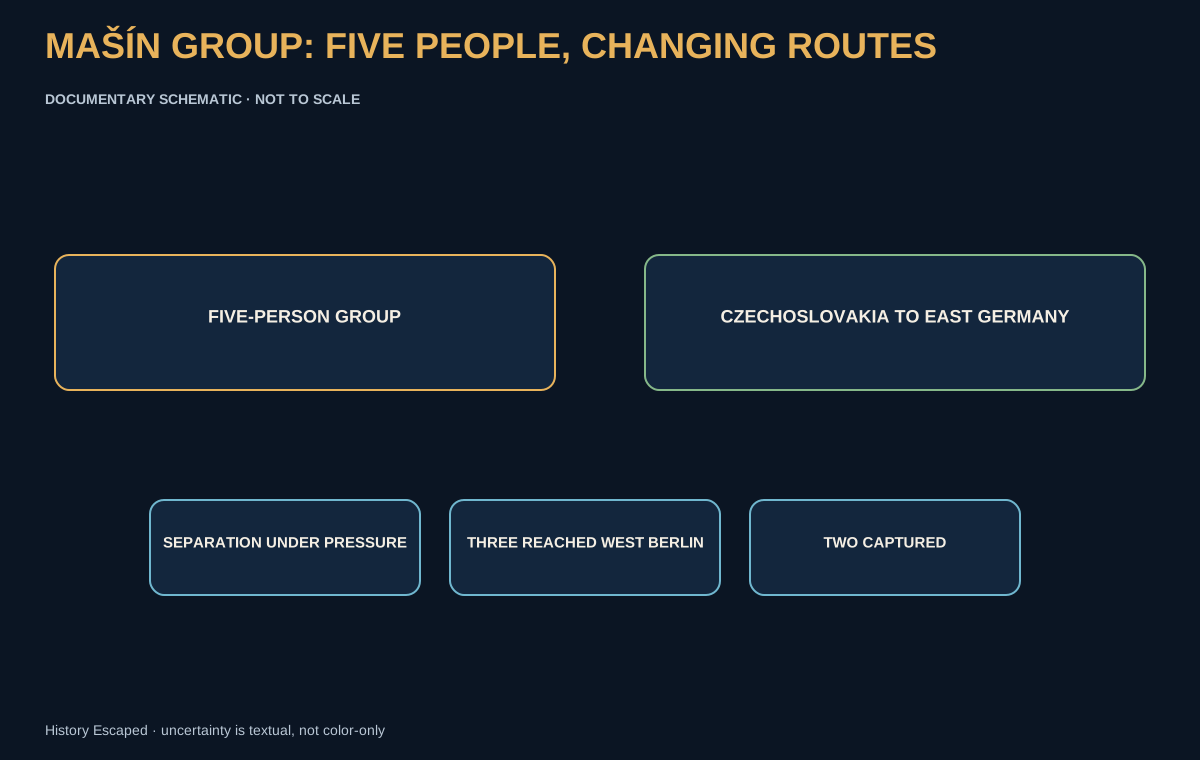
Simplified editorial reconstruction based on the cited historical record; not to scale. Uncertainty is stated directly in the visual and adjacent text.

