
Jayaprakash Narayan escaped from Hazaribagh Central Jail with five other political prisoners during Diwali in November 1942, three months after the Quit India movement had erupted across British India. The breakout did more than remove six men from colonial custody. It returned a group of experienced socialist organizers to an underground movement whose most prominent national leaders had already been imprisoned.
The broad event is secure. Narayan, Yogendra Shukla, Suraj Narayan Singh, Ramnandan Mishra, Shaligram Singh, and Gulab Chand Gupta crossed the prison perimeter and dispersed into clandestine political work.
Some of the famous details are less secure than later retellings suggest. Participant Ramnandan Mishra remembered the escape beginning around 9:30 p.m. on 8 November; Indian government and educational sources conventionally date it to 9 November. Mishra also described a rope made from six dhotis, not the “56 dhotis” frequently repeated in popular accounts.
The result is a case whose central mechanics can be reconstructed, but only if folklore is kept separate from participant testimony and later commemoration.
At a Glance
- Place: Hazaribagh Central Jail, then in Bihar Province, British India; now in Jharkhand
- Event: Diwali night, 8–9 November 1942
- Conventional commemorative date: 9 November 1942
- Escapees: six
- Names: Jayaprakash Narayan, Yogendra Shukla, Suraj Narayan Singh, Ramnandan Mishra, Shaligram Singh, and Gulab Chand Gupta
- Immediate method: improvised climb to the perimeter wall followed by a knotted cloth rope
- Participant account: Mishra said six dhotis were tied into the rope
- Aftermath: the men divided into underground networks; Narayan later helped organize clandestine resistance and the Azad Dasta in Nepal
- Narayan recaptured: September 1943, after roughly ten months underground
Prison before Quit India
Narayan had already spent years moving between political activism and colonial detention before November 1942. A leading figure in the Congress Socialist Party, he opposed Britain’s decision to involve India in the Second World War without Indian consent. He was imprisoned under wartime security laws and eventually sent to the Deoli detention camp in Rajasthan.
At Deoli, Narayan undertook a long hunger strike over detention conditions and the treatment of political prisoners. The camp was subsequently broken up and detainees were returned to their home provinces. Narayan was transferred to Hazaribagh in early 1942.
That chronology matters because some later biographies incorrectly imply that he was first arrested after the Quit India resolution of August 1942. He was already in detention when the movement began. From Hazaribagh he followed reports of the uprising and the sweeping arrests that removed Gandhi, Jawaharlal Nehru, Vallabhbhai Patel, Maulana Azad, and many provincial leaders from open political life.
The Congress Socialist Party had long argued that a more militant underground organization might become necessary if the national leadership was imprisoned. For Narayan and several fellow detainees, remaining inside Hazaribagh meant watching that moment unfold from confinement.
Six prisoners, not Narayan alone
The escape is usually remembered under Narayan’s name, but it was a six-man breakout.
Alongside him were Yogendra Shukla, an older revolutionary with extensive prison experience; Ramnandan Mishra, a Congress Socialist organizer; Suraj Narayan Singh; Shaligram Singh; and Gulab Chand Gupta, who was also known in contemporary and later sources as Gulali or Gulabi Sonar.
The aliases around Gupta are one reason participant lists sometimes look inconsistent. More problematic are retellings that add a seventh name, Shyam Barthwar, or describe Narayan as escaping with “six companions.” The strongest roster evidence supports six escapees in total: Narayan plus five others.
Government of India biographical material on Gulab Chand Gupta and Suraj Narayan Singh independently preserves the same core group. The Ministry of Culture’s own Hazaribagh overview is less reliable on this point because it includes Shyam Barthwar, illustrating why even institutional commemorative sources require cross-checking.
Other prisoners inside Hazaribagh appear to have supported the operation. Later accounts particularly credit political detainees with creating a festive distraction. What is not securely established is collusion by jail staff. Mishra explicitly maintained that the escape had been designed to work without assistance from prison employees.
Diwali as cover
The plan depended on timing.
The prison was marking Diwali, with political prisoners and staff drawn into festival activity. Later biographies describe lamps, singing, performances, and guards distracted by celebration. The basic use of Diwali as cover is consistent across participant-derived accounts, government biographies, and later historical treatments.
Mishra’s recollection supplies the most useful mechanical account. He said the group had rehearsed the climb in advance and chose a dark area of the perimeter. A table and the men’s bodies formed an improvised way to reach the upper part of the wall. A knotted cloth rope then helped the men cross.
Those facts are sufficient to understand the escape. Popular versions increasingly elaborate them with exact patrol cycles, detailed human-ladder positions, precise wall measurements, and dramatic timing. Much of that material ultimately traces back to memoir or retelling rather than independent prison records.
The wall itself is commonly described as about seventeen feet high, though some later biographies give roughly twenty feet. There is no reason to convert that difference into false precision.
Six dhotis or fifty-six?
The most memorable numerical detail is also one of the weakest.
Modern newspaper features regularly say the escapees made a rope from 56 dhotis. Some even build headlines around the number.
Mishra’s account says something different. In the version reproduced in Santosh Singh’s history of Bihar socialism, he recalled that the jail authorities had issued six dhotis, which the prisoners tied together and knotted at intervals to make a rope.
That is a major evidentiary difference. Mishra was one of the six men crossing the wall. His recollection was published after the event and is not immune from memory error, but it carries substantially more weight than an unsourced number repeated decades later.
Accordingly, six dhotis is the best-supported participant claim, while fifty-six should be treated as disputed popular tradition rather than a settled fact.
When exactly did they leave?
The calendar date has a similar, though smaller, problem.
Government of India biographies, IGNOU teaching material, district histories, and modern commemorations generally use 9 November 1942. That date has become the conventional anniversary of the Hazaribagh escape.
Mishra, however, remembered the group setting out around 9:30 p.m. on 8 November, which he identified as Diwali night. Other socialist historical material also dates the prison departure to 8 November.
The disagreement can be preserved without forcing a choice unsupported by stronger contemporary documentation. The breakout occurred on the Diwali night of 8–9 November 1942. For archive and search purposes, 9 November remains the conventional public date.
Beyond the wall
Crossing the wall did not immediately put the group beyond danger. Narayan was physically unwell and had difficulty during the first stage of movement away from Hazaribagh. Later narratives describe companions supporting or carrying him during portions of the journey.
Local government histories connect the fugitives with villages in the Hazaribagh–Chatra region before movement toward Gaya and farther political networks. The detailed route varies across later accounts, so an exact trail would overstate the evidence.
What is clear is that the six eventually divided. Suraj Narayan Singh, Yogendra Shukla, and Gulab Chand Gupta became active in North Bihar networks. Narayan and other socialist organizers moved through clandestine centers attempting to coordinate resistance across provincial boundaries.
The immediate objective was therefore not simply personal freedom. The prisoners escaped because they intended to return to political work.
Narayan underground
Narayan’s months outside custody became an important phase of the Quit India underground.
The movement of August 1942 had combined mass protest, strikes, disruption of communications, attacks on state institutions, and local attempts to create alternative authority. Gandhi had insisted on nonviolence, but underground socialist leaders debated and sometimes advocated forms of sabotage and guerrilla organization that went beyond Gandhian practice.
Narayan’s own clandestine writings survive. His 1943 letters To All Fighters for Freedom discussed organization after the first wave of the uprising and attempted to give scattered resistance a coherent political strategy. The Selected Works published by the Nehru Memorial Museum and Library preserve those texts and place them directly after the Hazaribagh period.
He also helped organize the Azad Dasta in Nepal, an underground formation intended to support resistance against colonial rule. Suraj Narayan Singh and other former Hazaribagh prisoners were involved in these networks.
The significance of the jail escape therefore lies partly in what it enabled: experienced organizers who had been isolated inside a prison re-entered a movement that colonial repression had deprived of much of its leadership.
Recapture
The British authorities mounted an extensive search for Narayan and the other fugitives. Rewards were announced for information leading to several of their arrests.
Narayan remained outside British custody for roughly ten months. In September 1943 he was arrested while traveling through Punjab. Jawaharlal Nehru, then himself imprisoned, recorded reading the news of Narayan’s arrest in his prison diary in October and noted that it had occurred nearly eleven months after the Hazaribagh escape.
Narayan was taken to Lahore Fort and later remained imprisoned until 1946.
His recapture did not erase the effect of the escape. By then he had issued underground political appeals, participated in efforts to coordinate the movement, and become publicly associated with continued resistance after the August crackdown.
The escape in memory
Independent India transformed the Hazaribagh episode into a patriotic landmark. The prison was eventually renamed the Lok Nayak Jayaprakash Narayan Central Jail, and government biographies routinely present the escape as a defining episode of Narayan’s freedom-struggle career.
That memorial status created its own distortions.
Narayan increasingly became the sole protagonist even though five men crossed with him. Numbers became more dramatic. The six-dhoti participant account became fifty-six dhotis in popular retelling. Exact wall heights and split-second patrol schedules gained confidence each time the story was repeated.
There is also a tendency to treat every person later credited with helping the escape as if his role were equally documented. Krishna Ballabh Sahay, Rambriksh Benipuri, local activists, and fellow prisoners all appear in commemorative traditions, and some certainly helped create conditions or provide support. Their precise roles, however, are not uniformly established by the same level of evidence.
The historical event does not need those additions to remain significant.
What the evidence supports
Six political prisoners escaped Hazaribagh Central Jail during Diwali in November 1942. They were Jayaprakash Narayan, Yogendra Shukla, Suraj Narayan Singh, Ramnandan Mishra, Shaligram Singh, and Gulab Chand Gupta.
They prepared in advance, used festival activity as cover, improvised a climb to the wall, and crossed with the aid of a cloth rope. Mishra said that rope was made from six dhotis.
The precise calendar date is best presented as the night of 8–9 November, with 9 November retained as the conventional commemorative date. The exact wall height, exact patrol interval, and “56 dhotis” detail are less secure.
Afterward, the men returned to underground independence activity rather than simply disappearing into private refuge. Narayan remained at large until September 1943, when British authorities arrested him in Punjab.
That is enough to explain why Hazaribagh became one of the most remembered prison escapes of the Quit India movement. Its importance came not from an increasingly embellished wall-climbing story, but from the political work the escape made possible.
Evidence discipline
What the record supports
Status labels distinguish secure conclusions from uncertainty and rejected claims. Color is never the only signal.
WELL-SUPPORTED
The Hazaribagh breakout involved six prisoners in total.
Participant testimony and multiple independent government biographies support Narayan, Yogendra Shukla, Suraj Narayan Singh, Ramnandan Mishra, Shaligram Singh, and Gulab Chand Gupta. Some derivative lists add Shyam Barthwar or describe six companions, creating an apparent seventh participant.
Sources: SRC-001, SRC-004, SRC-006DISPUTED
The escape occurred on a securely established single calendar date of 9 November 1942.
9 November is the conventional government and educational date. Ramnandan Mishra, one of the escapees, recalled beginning the escape around 9:30 p.m. on 8 November. The evidence therefore supports the Diwali night of 8–9 November.
Sources: SRC-001, SRC-002, SRC-004DISPUTED
The escape rope was made from 56 dhotis.
The number 56 is common in modern popular retellings. Mishra’s participant account says the prisoners had six dhotis and tied them together into a knotted rope.
Sources: SRC-001DISPUTED
The wall was exactly seventeen feet high.
Mishra’s transmitted account gives seventeen feet, while some later biographies use approximately twenty feet. The escape mechanism does not require an exact modernized measurement.
Sources: SRC-001, SRC-010UNKNOWN
Jail staff knowingly helped the six prisoners escape.
Later traditions credit multiple helpers, but Mishra specifically maintained that the plan was designed to work without jail-staff assistance. Other prisoners clearly participated in festival activity, but staff collusion is not established here.
Sources: SRC-001, SRC-005MYTH
Narayan escaped primarily to obtain personal freedom.
Participant and institutional histories consistently place the escape within an intention to resume underground Quit India activity. Narayan’s 1943 clandestine writings and later Azad Dasta organization confirm the political purpose of his freedom.
Sources: SRC-002, SRC-003, SRC-006Documentary reconstruction
Six escapees and the evidence conflicts
A case-local editorial visual separates the secure historical sequence from uncertainty without exposing reusable modern operational detail.
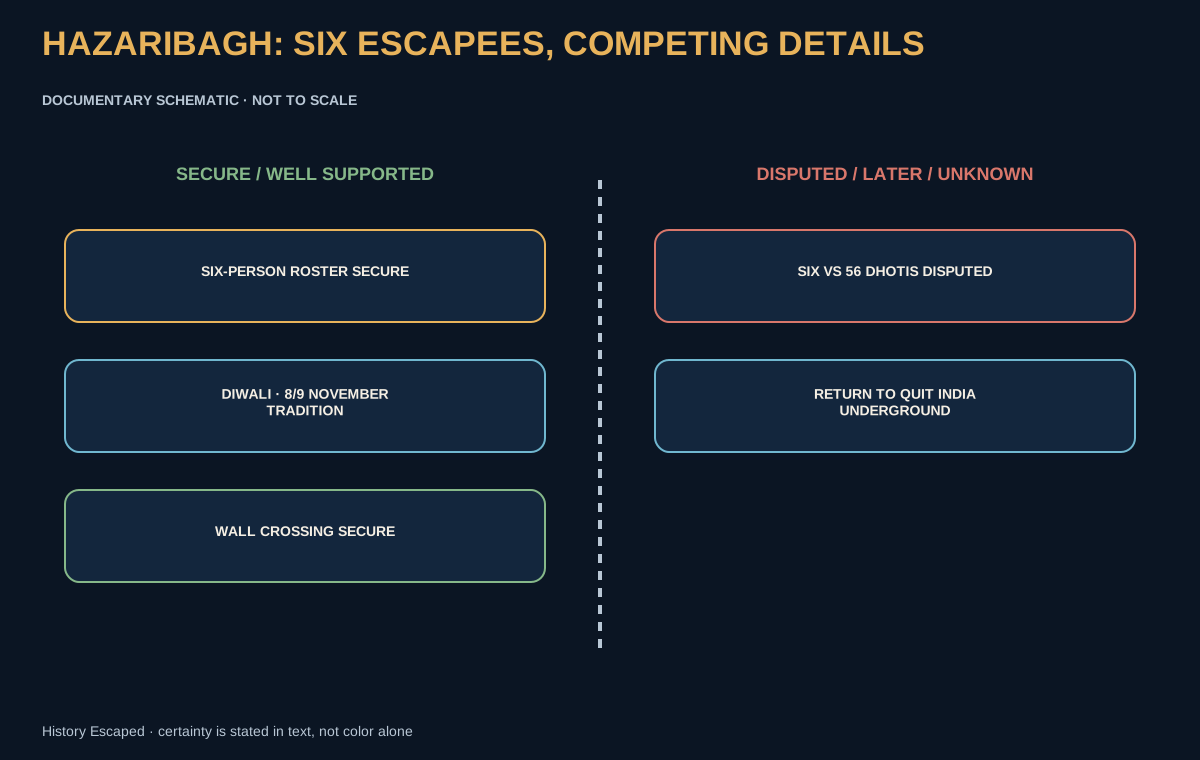
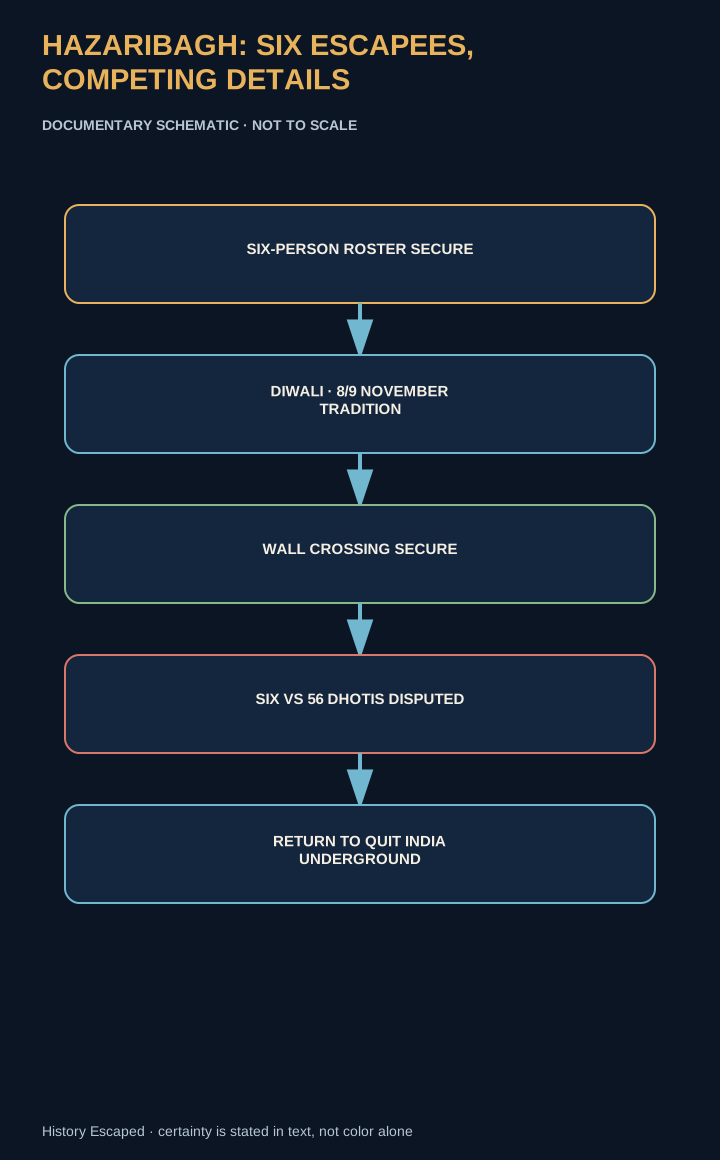
Simplified evidence-led editorial reconstruction based on the cited record; not to scale. Uncertainty is stated directly in the visual and adjacent text.