
Boris Savinkov's 1906 escape from Sevastopol is often summarized in a few dramatic words: revolutionary terrorist, death sentence, prison break. The first description is broadly accurate. The second is not. The third needs a geographic correction.
Savinkov was a leading organizer in the Socialist-Revolutionary Party's Combat Organization, which used political assassination as a revolutionary tactic. In May 1906 he came to Sevastopol under a false identity to prepare an attack on Vice Admiral Grigory Chukhnin. He was arrested after a separate Socialist-Revolutionary bombing against fortress commandant Vladimir Nepluev and was eventually identified by the police. Yet when Savinkov escaped before dawn in July, he had not been convicted or sentenced to death. His military-court proceedings had repeatedly been postponed.
Nor did the successful escape take place from the city's ordinary prison. Authorities had moved Savinkov to the main fortress guardhouse for tighter security. There, after several failed schemes, an enlisted sympathizer named Vasily Sulyatitsky used his position inside the guard system to lead Savinkov out disguised as a soldier.
At a Glance
- Escape: Night of 15–16 July 1906, Old Style — 28–29 July Gregorian
- Canonical modern date: 29 July 1906
- Place: Main fortress guardhouse, Sevastopol, Russian Empire
- Prisoner: Boris Savinkov, Socialist-Revolutionary Combat Organization leader
- Principal inside helper: Vasily Sulyatitsky
- Outside organizer: Lev Zilberberg
- Method: Insider-assisted movement through the guardhouse followed by concealment in a soldier's uniform
- Immediate outcome: Successful departure from the guardhouse and Sevastopol
- Post-escape refuge: A farm in the Kara-Koba valley outside the city
- Later route: By boat across the Black Sea to Romania
- Important correction: Savinkov faced the possibility of a capital sentence, but had not been sentenced to death before escaping
In Sevastopol to organize an assassination
Savinkov did not arrive in Sevastopol as an ordinary political dissident. By 1906 he had become one of the most experienced organizers in the Socialist-Revolutionary Combat Organization, the clandestine wing responsible for assassinations of senior imperial officials.
His own memoir says he entered the city on 12 May under the identity of a reserve officer, Dmitry Evgenievich Subbotin. His purpose was to organize an attack on Vice Admiral Grigory Chukhnin, commander of the Black Sea Fleet. Chukhnin had become a target after suppressing revolutionary activity in the fleet.
Two days later, another Socialist-Revolutionary group attacked Lieutenant General Vladimir Nepluev, commandant of the Sevastopol fortress. Savinkov consistently maintained that the operation was independent of his own mission. The Sevastopol museum's modern reconstruction likewise attributes the attempt to the local Socialist-Revolutionary fighting group rather than to Savinkov's organization.
The bombing failed to kill Nepluev. It did, however, trigger searches and arrests across the city. Savinkov, still carrying his false identity, was arrested at a hotel along with people caught in the broader investigation.
This distinction is essential. Savinkov was not an uninvolved visitor swept up solely because of his politics. He was in Sevastopol to organize a different assassination. At the same time, the specific Nepluev attack used to justify the immediate prosecution was not his operation according to the strongest surviving accounts.
A trial that had not reached a verdict
Once police established who their prisoner really was, Savinkov's situation became much more dangerous. He had been wanted for his role in revolutionary terrorism and had already helped organize attacks that killed senior imperial officials.
Near-contemporary newspaper reporting predicted that he would receive a death sentence. Savinkov himself believed execution was likely. That expectation later hardened into the repeated claim that he had already been condemned to death when he escaped.
The chronology contradicts it.
The military trial was initially set for 18 May. Proceedings were postponed over legal questions involving a younger co-defendant. A second session scheduled for 26 May also failed to produce a verdict. Savinkov remained an accused prisoner awaiting renewed military-court proceedings when he escaped in July.
The distinction is more than technical. A prisoner fleeing while facing possible execution is not the same historical situation as a condemned man breaking out after sentence. The danger to Savinkov was serious, but it should not be made more dramatic by moving a verdict backward in time.
From the city prison to the fortress guardhouse
Savinkov was initially caught within Sevastopol's larger detention system, and local revolutionaries attempted to organize his release. Authorities eventually transferred him to the main fortress guardhouse because it offered tighter control.
This is why the familiar label "Sevastopol Prison Escape" is imprecise. The successful operation did not free him directly from the ordinary city prison. It freed him from a military guardhouse inside a fortress city operating under heightened security.
Escape planning continued outside. Lev Zilberberg, another member of the Combat Organization, coordinated efforts to get Savinkov free. Inside the military system, the decisive figure became Vasily Sulyatitsky, a volunteer serviceman and Socialist-Revolutionary sympathizer.
Savinkov's memoir describes several failures before the successful night. One effort involved an attempt to manipulate access to the guardhouse. Another used sweets containing morphine in the hope that sentries would become unable to interfere; the plan failed. A later opportunity disappeared when Sulyatitsky was assigned to a position from which he could not help.
The Sevastopol museum independently summarizes the same pattern of failed escape attempts, though much of its fine detail ultimately depends on revolutionary memoir literature. Those episodes therefore establish repeated planning more securely than they establish every operational detail exactly as Savinkov remembered it.
An ally inside the guard
Sulyatitsky's value came from legitimate access. He did not have to storm the building or create an opening from outside. When assigned guardhouse duties, he could move within routines that an outsider could not.
The exact unit in which he served is unexpectedly disputed. The Sevastopol museum identifies him with the 51st Infantry Lithuanian Regiment, consistent with later regimental history. A notice reproduced in Savinkov's own memoir instead calls it the 57th Lithuanian Regiment. Because the difference does not affect the escape, the regiment number is best left unresolved rather than corrected by assumption.
On 15 July Old Style, Sulyatitsky again obtained duty at the guardhouse. The planned opportunity during an earlier watch did not develop because the officer overseeing the guard remained awake. According to Savinkov, the opening came only after three in the morning.
The memoir then becomes exceptionally detailed. It describes boots obtained from another prisoner, movement under the pretext of washing, a storage area, removal of Savinkov's moustache, and a prepared soldier's shirt, cap, belt, and ammunition pouch. Those particulars are first-person retrospective evidence, not an official guardhouse log.
The secure mechanism can be stated more simply: Sulyatitsky used his authority within the guard detail to escort Savinkov out of his cell area; Savinkov changed his appearance and put on a soldier's uniform; the two then passed through the guardhouse without Savinkov being recognized.
Walking out before dawn
This was not an escape built around a tunnel, broken wall, or mass assault. The successful phase depended on Savinkov being seen and misidentified rather than unseen.
Savinkov followed Sulyatitsky through occupied parts of the guardhouse. Soldiers were present. Officers were nearby. The disguise and Sulyatitsky's apparent authority allowed the pair to continue toward the exit.
Savinkov's memoir says the alarm followed only minutes later. That interval is memorable but cannot be independently timed from the surviving record. The important fact is that the discovery came too late to stop the immediate departure.
An announcement issued by the Socialist-Revolutionary Combat Organization soon afterward dated the escape to the night of 16 July and credited Sulyatitsky with freeing Savinkov from the main fortress guardhouse. The Sevastopol museum gives the same event as the night of 16 (29) July, explicitly pairing the Russian Empire's Julian date with the Gregorian calendar.
For modern chronology, the corresponding date is therefore 29 July 1906. The most historically transparent display retains both calendars: the escape occurred during the night of 15–16 July Old Style, equivalent to 28–29 July Gregorian.
Hidden outside Sevastopol
Leaving the guardhouse was only the first stage. Savinkov was still one of the best-known revolutionary fugitives in the empire, and Sevastopol could be searched quickly.
Outside helpers moved him away from the immediate urban search. Savinkov later identified a small group that included Sulyatitsky, Zilberberg, Fedor Bosenko, and a guide named Iosif Sepi. They traveled to the Kara-Koba valley outside Sevastopol, where Savinkov was hidden on the farm of Karl Shtalberg, a colonist sympathetic to the revolutionaries.
The Sevastopol museum independently confirms the Kara-Koba refuge and Shtalberg farm. Savinkov remembered remaining there for roughly ten days.
The concealment also gave the escape network time to arrange a route out of the Russian Empire. Remaining indefinitely in Crimea would have left Savinkov exposed to police searches and informants. The Black Sea offered a way to turn a local escape into exile.
Across the Black Sea
The final extraction used a vessel named Alexander Kovalevsky, associated with the Sevastopol Biological Station. Savinkov and his helpers departed secretly and crossed toward Romania.
His memoir places the maritime departure on 26 July Old Style. The Sevastopol museum confirms that the Alexander Kovalevsky was used to transport him to Romania. Once outside the empire, Savinkov returned to revolutionary exile and political work.
This post-escape phase has sometimes been folded into the guardhouse breakout as though it were one continuous maneuver. It is better understood as two related operations. First, Savinkov escaped military custody. Then a civilian revolutionary network concealed him and moved him beyond Russian jurisdiction.
The division also clarifies who did what. Sulyatitsky's insider position made the actual guardhouse exit possible. Zilberberg and others maintained the outside organization. Shtalberg supplied refuge. The maritime network made durable escape possible.
What the escape did not prove
Savinkov later became a gifted writer about his own revolutionary career, and the Sevastopol escape naturally became one of the most famous episodes in that story. His Memoirs of a Terrorist remains indispensable because no official record provides the same interior view of the planning.
It is also a source that requires control. Savinkov wrote the memoir in 1909, three years after the escape, and it was first published in 1917. Modern editors describe it as the most detailed personal account of the revolutionary terrorist world he inhabited, but detail is not the same as independent verification.
The Sevastopol museum itself warns readers to approach Savinkov's memoir critically. Several famous elements—the exact dialogue, the precise timing of each guard movement, the failed sedative scheme, and the claim that discovery followed within about five minutes—depend mainly on his recollection.
Other claims can be checked more securely. The fortress guardhouse rather than the ordinary prison was the site of the successful escape. Sulyatitsky assisted him. Savinkov left in soldier's clothing. Kara-Koba became his refuge. The Alexander Kovalevsky took him toward Romania.
Most importantly, the surviving chronology corrects the most dramatic later shorthand. Savinkov escaped while awaiting a military trial in which he feared capital punishment. He did not escape after a death sentence had already been handed down.
The real episode needs no invented last-minute reprieve. Before dawn on 29 July 1906 by the modern calendar, a high-profile revolutionary terrorist walked out of one of Sevastopol's most closely watched military detention sites because an ally had managed to become part of the system guarding him.
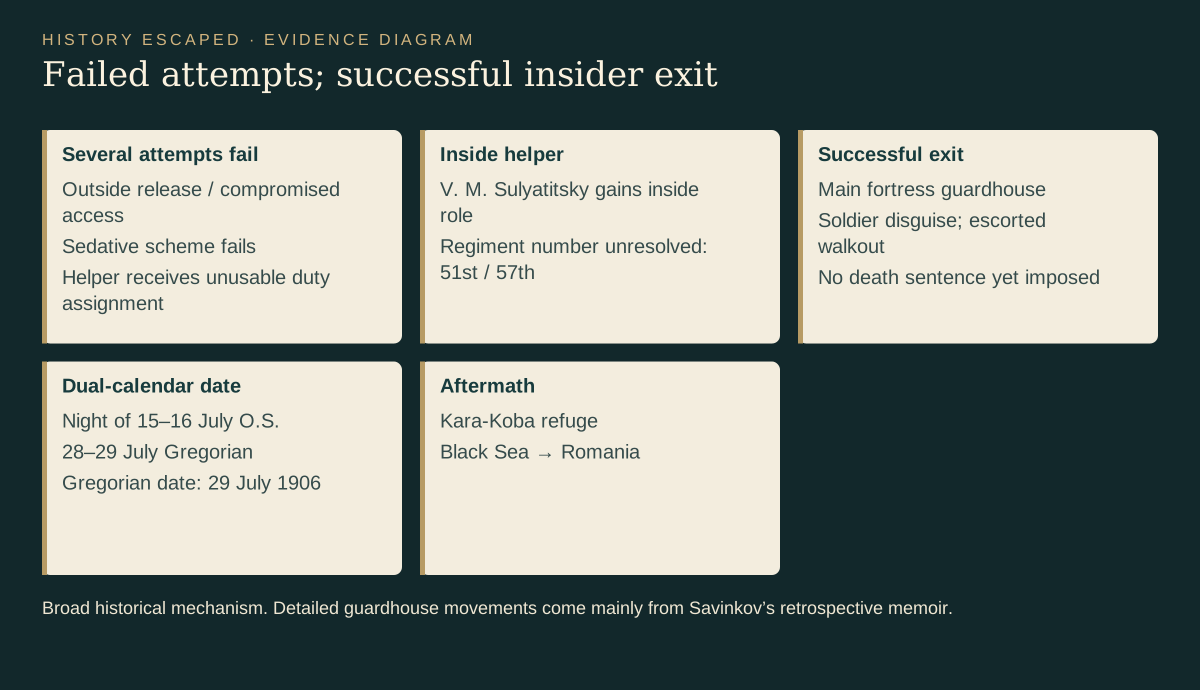
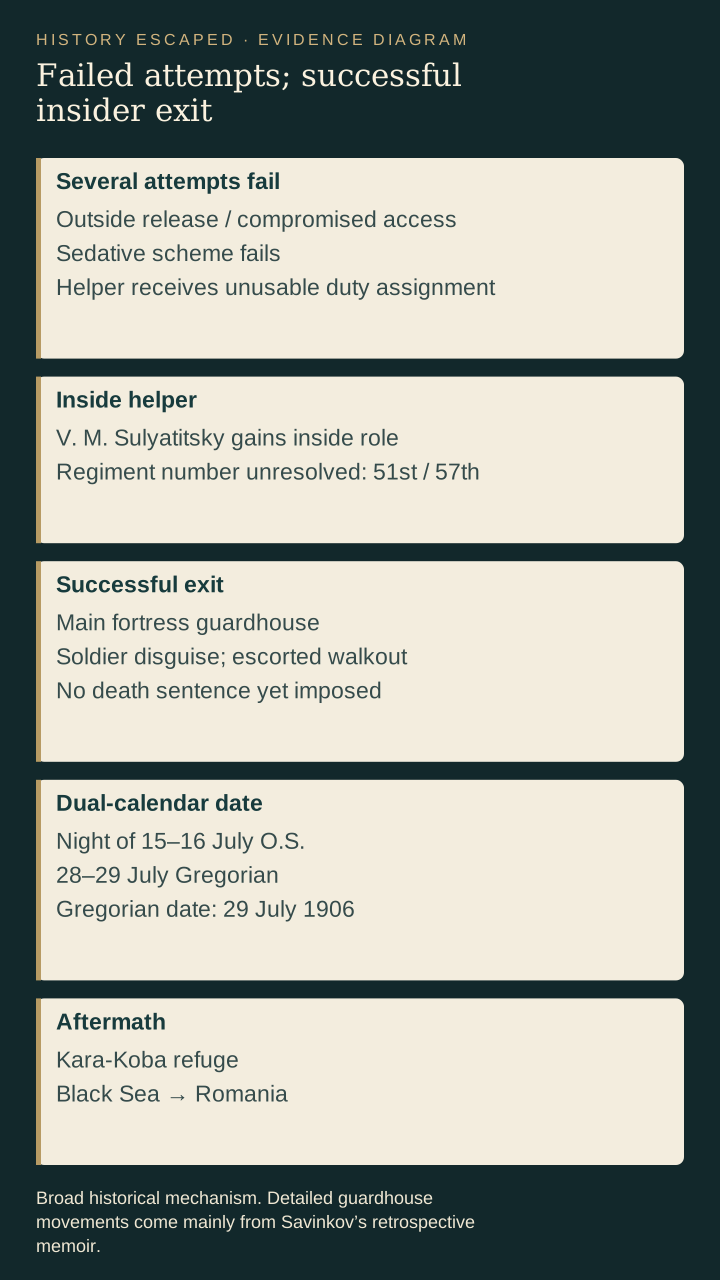
Evidence diagram
Failed attempts; successful insider exit
Broad historical mechanism. Detailed guardhouse movements come mainly from Savinkov’s retrospective memoir.
- 01
Build an inside-outside support network
Lev Zilberberg coordinated escape planning outside while Vasily Sulyatitsky sought guardhouse assignments that could give him legitimate access to Savinkov. WELL-SUPPORTED. Sources: SRC-001, SRC-002, SRC-005.
- 02
Wait through failed opportunities
Several proposed escapes failed before the successful night, including schemes involving compromised access, sedative-laced sweets, and a duty assignment that left Sulyatitsky unable to assist. LATER CLAIM. Sources: SRC-001, SRC-002.
- 03
Move Savinkov out of his cell area
During the night of 15–16 July Old Style, Sulyatitsky used his guardhouse role to escort Savinkov through an ordinary internal movement rather than forcing a physical breach. WELL-SUPPORTED. Sources: SRC-001, SRC-002.
- 04
Change appearance inside the guardhouse
Savinkov put on a prepared soldier's uniform and altered his appearance before continuing through occupied guardhouse spaces. WELL-SUPPORTED. Sources: SRC-001, SRC-002.
- 05
Walk out under the helper's authority
Savinkov followed Sulyatitsky out of the guardhouse without being recognized in time to prevent their departure. WELL-SUPPORTED. Sources: SRC-001, SRC-002, SRC-005.
- 06
Reach concealment and leave the empire
Outside helpers moved Savinkov to the Kara-Koba valley, after which the vessel Alexander Kovalevsky carried him toward Romania. WELL-SUPPORTED. Sources: SRC-001, SRC-002.
Broad historical mechanism. Detailed guardhouse movements come mainly from Savinkov’s retrospective memoir.
Problem → response
Escape was a sequence of problems
Each response solved a practical obstacle while often creating the next one.
- 01→
Obstacle
Heightened military custody
Authorities moved Savinkov to the fortress guardhouse specifically to make escape more difficult.
Response
The revolutionary network shifted from an outside release attempt toward exploiting Sulyatitsky's legitimate inside access.
- 02→
Obstacle
Repeated failed escape plans
Earlier schemes failed when proposed access, sedatives, or guard assignments did not work as expected.
Response
Sulyatitsky continued seeking a duty position that allowed him to accompany Savinkov through normal guardhouse routines.
- 03→
Obstacle
High risk of recognition
Savinkov was a nationally wanted revolutionary whose true identity had already been established.
Response
He changed his appearance and wore a soldier's uniform while moving behind Sulyatitsky.
The final accounting
Outcome
Fortress guardhouse escape
Savinkov successfully left military custody before the court proceedings reached a verdict.
Durable flight from Sevastopol
The outside network successfully concealed Savinkov beyond the immediate search area.
International escape
Savinkov was transported by boat to Romania and resumed life in revolutionary exile.
Selected chronology
Selected chronology
Savinkov enters Sevastopol under an alias
Savinkov arrives under a false reserve-officer identity to prepare an assassination attempt against Vice Admiral Grigory Chukhnin.
Nepluev bombing triggers arrests
A local Socialist-Revolutionary fighting group attempts to kill fortress commandant Vladimir Nepluev; the resulting crackdown leads to Savinkov's arrest.
First military-court session postponed
The planned trial does not reach a verdict and is postponed.
Proceedings delayed again
A second scheduled court session also fails to produce a verdict.
Fortress guardhouse escape
Sulyatitsky leads Savinkov out of the main fortress guardhouse disguised as a soldier.
Savinkov reaches outside helpers
He joins Zilberberg, Sulyatitsky, and other supporters and leaves the immediate urban search area.
Hidden in the Kara-Koba valley
Savinkov is concealed at Karl Shtalberg's farm outside Sevastopol.
Maritime departure
Savinkov's memoir places his secret departure toward Romania aboard the Alexander Kovalevsky on this date.
Evidence discipline
What the record supports
Status labels distinguish secure conclusions from uncertainty and rejected claims. Color is never the only signal.
MYTH
Savinkov had already been sentenced to death when he escaped.
Contemporary reporting and Savinkov's own chronology show that the military trial had been postponed and had not produced a verdict. He faced a serious possibility of capital punishment, but no death sentence had yet been imposed.
Sources: SRC-001, SRC-004MYTH
The successful 1906 escape took place directly from Sevastopol's ordinary city prison.
Savinkov had been transferred to the main fortress guardhouse for tighter security. The successful operation removed him from that military detention site.
Sources: SRC-002MYTH
Savinkov organized the 14 May Old Style bombing against General Nepluev.
Savinkov said the local Sevastopol Socialist-Revolutionary group carried out the attack independently, and the Sevastopol museum likewise distinguishes it from his mission to organize an attack on Admiral Chukhnin.
Sources: SRC-001, SRC-002MYTH
Savinkov was merely an innocent political prisoner with no connection to planned violence in Sevastopol.
Although he was not responsible for the Nepluev attempt, Savinkov states that he came to Sevastopol to organize the assassination of Vice Admiral Chukhnin and was already a leading Combat Organization terrorist.
Sources: SRC-001, SRC-003DISPUTED
Sulyatitsky served in the 57th Lithuanian Regiment.
A Combat Organization notice reproduced in Savinkov's memoir gives the 57th Lithuanian Regiment, while the modern Sevastopol museum identifies the 51st Infantry Lithuanian Regiment. The regiment number remains unresolved.
Sources: SRC-001, SRC-002LATER CLAIM
A morphine-laced sweets scheme was one of the failed escape attempts.
Savinkov describes the failed plan in detail, and the Sevastopol museum repeats it, but the fine mechanics appear to derive primarily from revolutionary recollection rather than an independent guardhouse record.
Sources: SRC-001, SRC-002LATER CLAIM
The escape was detected exactly five minutes after Savinkov left.
The approximate five-minute interval comes from Savinkov's memoir and is not independently timed by the stronger institutional material.
Sources: SRC-001