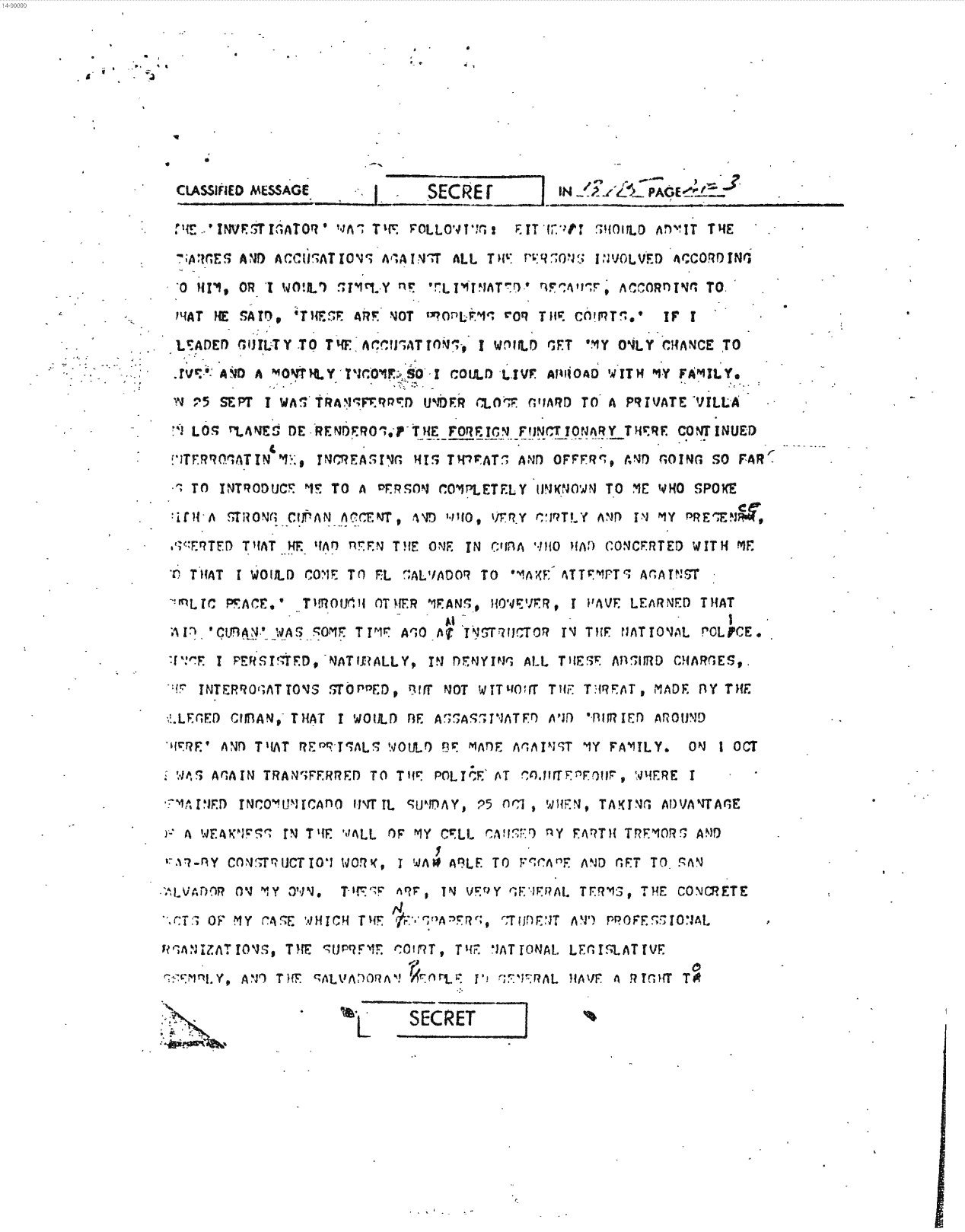
Roque Dalton escaped from Cojutepeque Prison on 25 October 1964. That date is unusually secure because it does not depend on a late biography or on Dalton’s posthumously published fiction. Five days after the escape, a classified CIA cable translated part of a letter Dalton had sent to the Salvadoran newspaper El Diario de Hoy. In the translated passage, Dalton said that he had remained incommunicado at Cojutepeque until Sunday, 25 October, when he took advantage of a weakness in the wall of his cell caused by tremors and nearby construction and escaped to San Salvador on his own.
That contemporary documentary trail collides with one of the best-known stories about Dalton: that an earthquake on 3 May 1965 suddenly knocked down his cell wall and saved him from execution. The 1965 version is chronologically impossible if the October 1964 letter and CIA cable are genuine—and there is no serious reason to doubt that they are. By the end of October 1964, U.S. intelligence was already discussing Dalton’s account of an escape that had just happened.
The case is therefore both an escape story and a source-correction story. Dalton really did escape from political imprisonment at Cojutepeque. What happened to the wall, which tools he used, and whether anyone quietly helped him remain more complicated than the later earthquake legend suggests.
A political prisoner in 1964
Dalton was already a prominent Salvadoran poet, journalist, communist activist, and political exile by the time he returned clandestinely to El Salvador in 1964. University of El Salvador research places his arrest on 4 September, after he was seized in San Salvador while socializing with friends. His family initially struggled to establish where the authorities were holding him.
The detention was not a conventional criminal sentence followed by ordinary prison procedure. Declassified U.S. records show that American intelligence took a direct interest in Dalton. A CIA cable from 30 September records an officer and a Cuban defector meeting Dalton and explicitly discusses continuing an “interrogation and recruitment effort.” The agency regarded him as valuable because of his knowledge of Cuban intelligence and the Salvadoran Communist Party.
Dalton later described the American interrogator as a CIA officer who alternated threats with offers. The declassified cables are important because they show that this part of Dalton’s story was not invented years later. U.S. intelligence really was trying to exploit his detention.
Cojutepeque
Dalton was held at the prison in Cojutepeque, east of San Salvador. The surviving evidence does not provide a trustworthy architectural plan of his cell, and the prison changed substantially over later decades. Modern photographs should not be used to reconstruct a 1964 wall, window, guard position, or escape route.
The strongest evidence instead describes the condition of the wall. In the letter translated by the CIA, Dalton said tremors and construction work in the surrounding area had created a weakness in the wall of his cell. That wording is careful. It does not say that a single earthquake demolished the wall while he waited.
It says the structure had become vulnerable. Dalton exploited that vulnerability.
25 October
The date should be frozen at 25 October 1964. The most important evidence is the 30 October CIA cable because it preserves a translation of Dalton’s own near-contemporary public account. The cable says he had been returned to Cojutepeque on 1 October and remained incommunicado until Sunday the 25th.
He then escaped through the weakened wall and reached San Salvador by himself. The CIA had no reason in that secret communication to move the date backward by more than six months. The record was produced while Dalton was still in hiding and while U.S. officials were deciding how to respond publicly to his accusations about the interrogation. That makes the later May 1965 chronology untenable.
The wall—and the tools
Dalton’s contemporaneous letter does not explain exactly how he enlarged or passed through the weak section of wall. Later testimony adds possible tools.
His son Juan José Dalton remembered seeing a small strip of steel that his father said he had torn from his prison cot and used to work at the adobe material. The family recollection also describes Dalton appearing after the escape with scratches on his face and arms from moving through rough terrain.
Another later biographical tradition mentions pieces of wood, a spoon, or similar improvised implements. These accounts are not necessarily mutually exclusive, but they are too late and too inconsistent to turn into a precise tool sequence.
The secure claim is structural: the wall was already weakened, and Dalton worked his way through it. The exact instrument belongs in the evidence ledger rather than the headline reconstruction.
Did someone help him out?
A second source conflict concerns outside assistance. Ricardo Castrorrivas, a contemporary of Dalton’s, later said he had heard that the celebrated escape story was invented and that the anthropologist and poet Pedro Geoffroy Rivas had instead used his influence to secure Dalton’s release and move him clandestinely toward Guatemala.
Castrorrivas presented that version as something he had been told, not something he personally witnessed. It therefore cannot outweigh the near-contemporary letter.
At the same time, it should not simply be discarded. Political imprisonment in El Salvador operated through personal networks, military influence, judicial pressure, and informal arrangements as well as locked cells. It is possible that someone helped before or after the physical break.
The evidence does not establish that Geoffroy Rivas arranged the escape. Nor does it establish that Dalton did everything without any assistance at any stage. The best conclusion is that the physical wall escape is documented, while the degree of outside assistance remains disputed.
The CIA-release accusation
The most politically damaging alternative theory was different. Some of Dalton’s later enemies on the Salvadoran left suspected that his surprising release from Cojutepeque proved that he had agreed to cooperate with the CIA. The accusation became especially consequential a decade later, when Dalton was accused within the Ejército Revolucionario del Pueblo of being an intelligence agent.
The declassified CIA record cuts strongly against that interpretation of the 1964 escape. The agency’s own secret cables show it trying to recruit Dalton during his detention. They also show U.S. officials reacting to his post-escape accusations and deciding how to answer the press.
Charles Lane’s reconstruction from those records notes that the San Salvador station appears to have been surprised by the escape and that the files contain no evidence that the CIA engineered it. That is not proof that every intelligence document survived or that every actor told the truth.
It is, however, much stronger evidence than the later rumor that the CIA deliberately released him as a newly recruited asset. That rumor should be classified as MYTH / unsupported allegation for the escape itself.
The 1965 earthquake legend
The 3 May 1965 earthquake story became extraordinarily durable. Biographical articles, literary studies, poetry websites, and even respected cultural summaries have repeated a version in which Dalton was awaiting execution when an earthquake struck, his prison wall collapsed, and he simply walked or ran out.
Some versions add a religious procession passing the prison at exactly the right moment and say he disappeared into the crowd. The dramatic structure is obvious: condemned poet, earthquake, fallen wall, procession, miraculous survival.
The evidence is much weaker. The NARA cable is dated 30 October 1964 and reproduces Dalton’s statement that the escape occurred on 25 October. There is no way to reconcile that contemporary chronology with an escape caused by an earthquake in May 1965.
The religious-procession detail likewise lacks comparable near-contemporary support. The later story may have grown from a real element—the wall damage caused by tremors—and transformed cumulative structural weakness into one decisive earthquake. That is a common way legends become cleaner than history.
What happened after the wall
Dalton’s own account says he reached San Salvador on his own. His posthumously published novel Pobrecito poeta que era yo turns the flight into a much more elaborate narrative of movement through darkness, rough terrain, roads, fear of pursuit, and eventual approach toward the capital.
The novel has autobiographical value, but it is literature rather than a police log. Its route details should not be mapped as exact fact.
Family testimony does support the broad picture that Dalton moved through rough terrain after leaving the prison. Juan José remembered his father appearing days later with many small cuts and saying that he had been running through the countryside.
After the escape, Dalton remained underground and eventually left El Salvador. The exact sequence by which he crossed borders is less securely documented than the fact that he had broken state custody and avoided immediate recapture.
Why the date error matters
Correcting the year does more than tidy a biography. The October 1964 escape happened while Dalton was actively being interrogated by Salvadoran authorities and U.S. intelligence. His accusations against the American interrogator were already circulating within days.
The May 1965 version disconnects the escape from that intelligence operation and makes the event look like pure natural luck. The contemporary version is more politically complicated.
Tremors and construction had weakened a wall. Dalton exploited it while under secretive political detention after weeks of interrogation. He then publicly accused a foreign intelligence officer of trying to recruit him.
Those circumstances later fed rumors that he had been compromised. Dalton’s escape therefore remained politically alive long after he was physically free.
A poet inside his own legend
Dalton helped shape the legend himself. He repeatedly turned his life into literature, mixing autobiography, political argument, humor, fear, and deliberate self-mythologizing. Pobrecito poeta que era yo is one of the clearest examples.
That does not make it useless as evidence. It means the book must be read alongside documents written for purposes other than literary effect.
The declassified CIA cables provide exactly that kind of counterweight. They show the American officers behind Dalton’s interrogation discussing recruitment in real time. They also preserve his October 1964 escape account before later biographies had converted the event into a May 1965 earthquake miracle. The result is unusually strong for a twentieth-century literary figure: the source conflict can actually be resolved at its most basic level.
What the evidence supports
Roque Dalton was arrested in early September 1964 and held as a political prisoner. Declassified CIA records show American intelligence participating in his interrogation and considering him a recruitment target.
Dalton was returned to Cojutepeque and held incommunicado. On 25 October 1964, he escaped through a weakness in his cell wall that he attributed to tremors and nearby construction.
He reached San Salvador without being immediately recaptured. Later family testimony supports the physical-wall account and adds that he used a small piece of metal from his cot, but the exact tool remains a later claim.
A rival story that Pedro Geoffroy Rivas helped arrange his release survives through hearsay and remains disputed. The theory that the CIA deliberately staged Dalton’s escape to cover his recruitment is unsupported by the declassified record and conflicts with the agency’s own contemporaneous reaction.
The famous 3 May 1965 earthquake escape is a later chronology error. Dalton’s real escape was less miraculous and more historically revealing: he exploited a damaged prison wall in October 1964 while caught inside a Cold War political and intelligence struggle that would follow his reputation for the rest of his life.
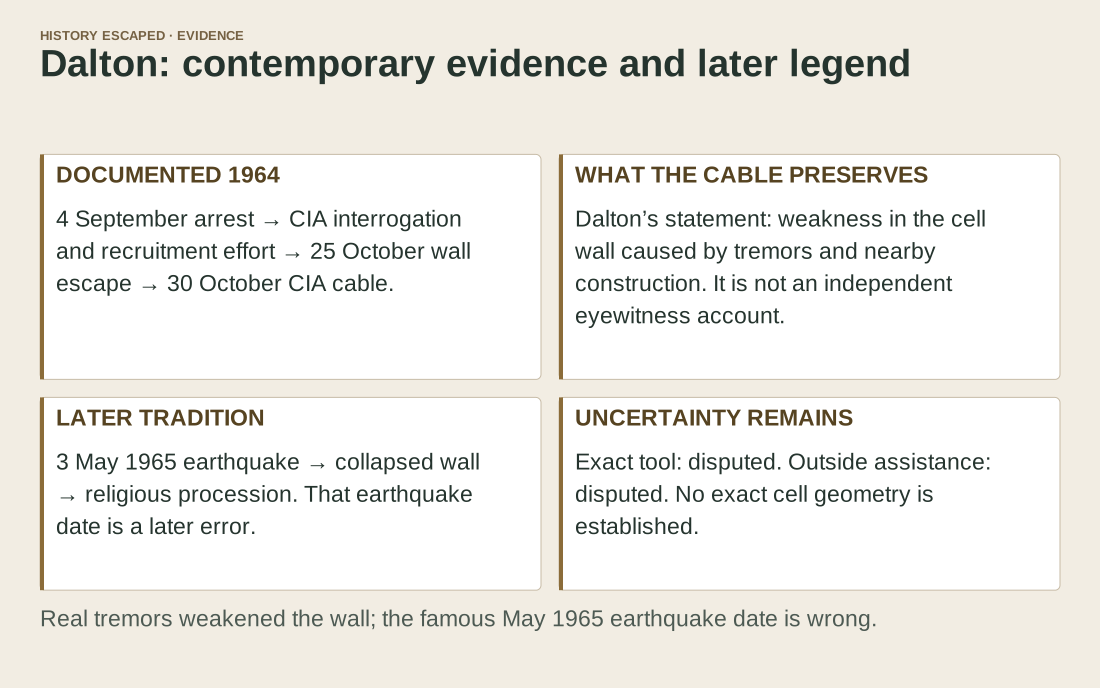
Evidence diagram
Dalton: contemporary evidence and later legend
Real tremors weakened the wall; the famous May 1965 earthquake date is wrong.
Real tremors weakened the wall; the famous May 1965 earthquake date is wrong.
Selected chronology
Selected chronology
Dalton arrested
Modern Salvadoran university research places Dalton’s arrest on 4 September during his clandestine return to El Salvador.
CIA interrogation and recruitment effort documented
A secret CIA cable records an officer and Cuban defector seeing Dalton and discusses continuing the agency’s interrogation and recruitment effort.
Returned to Cojutepeque
Dalton’s letter says he was transferred back to Cojutepeque and remained incommunicado.
Escape from Cojutepeque
Dalton escaped through a weakened section of his cell wall and made his way toward San Salvador.
CIA circulates Dalton’s account
A classified cable translated the escape passage from Dalton’s letter to El Diario de Hoy.
Later earthquake chronology emerges
Later biographies attached Dalton’s escape to the May 1965 earthquake, creating the chronology now widely repeated.
Dalton killed by ERP comrades
Dalton was killed by members of the revolutionary organization he had joined; later CIA-agent accusations became entangled with retrospective interpretations of his 1964 escape.
Evidence discipline
What the record supports
Status labels distinguish secure conclusions from uncertainty and rejected claims. Color is never the only signal.
DOCUMENTED
Dalton escaped from Cojutepeque on 25 October 1964.
A CIA cable dated 30 October 1964 translates Dalton’s own letter stating that he escaped on 25 October.
Sources: SRC-001MYTH
The 3 May 1965 earthquake caused Dalton’s prison escape.
The October 1964 CIA cable proves that Dalton had already escaped more than six months before the May 1965 earthquake.
Sources: SRC-001, SRC-007MYTH
Tremors played no role at all.
Dalton’s contemporaneous account explicitly says tremors, together with nearby construction, weakened the wall. The correction is about the date and mechanism, not the complete absence of seismic damage.
Sources: SRC-001LATER CLAIM
A specific metal strip from Dalton’s cot was the decisive escape tool.
Juan José Dalton remembered seeing such a piece of metal after the escape, but the contemporaneous letter does not identify the tool and other later accounts differ.
Sources: SRC-005DISPUTED
Pedro Geoffroy Rivas secretly arranged Dalton’s release.
Ricardo Castrorrivas repeated this as something he had heard. It is not eyewitness evidence and conflicts with Dalton’s near-contemporary wall-escape account.
Sources: SRC-003, SRC-006MYTH
The CIA staged Dalton’s escape because it had successfully recruited him.
Declassified CIA cables show an attempted recruitment and later concern over Dalton’s accusations, but no evidence that the agency engineered his escape; the internal record is more consistent with surprise than orchestration.
Sources: SRC-001, SRC-002, SRC-004LATER CLAIM
Dalton escaped by blending into a religious procession immediately outside the prison.
This colorful detail appears in later retellings but lacks comparable support in Dalton’s October 1964 account or the declassified CIA record.
Sources: SRC-007