
Chen Guangcheng had completed his prison sentence when his confinement began again. In September 2010, the blind, self-trained legal advocate returned to his home village of Dongshigu in Shandong Province with no new criminal charge pending against him. Local authorities nevertheless surrounded his household with guards, restricted his family's movement and communications, and prevented supporters, journalists, and diplomats from reaching him.
That arrangement lasted about nineteen months. In April 2012, Chen escaped the guarded home, moved through a small network of villagers and activists, reached Beijing, and entered the United States Embassy. What began as a break from extralegal confinement became an international diplomatic crisis over his safety, his family's safety, and whether he could remain in China without being returned to coercive control.
At a Glance
- Escape began: 20 April 2012
- Starting point: Dongshigu village, Yinan County, Shandong Province, China
- Immediate objective: Get beyond the local security cordon and reach trusted supporters
- Beijing: Reached with activist assistance on 22 April
- U.S. Embassy: Entered on 26 April and remained for six days
- Immediate outcome: Escaped the Shandong confinement and obtained temporary U.S. diplomatic protection
- Longer outcome: Left China with his wife and two children for the United States on 19 May 2012
- Key uncertainty: Initial reports dated the escape to 22 April; a fuller later reconstruction and Chen's memoir place the actual break on 20 April
Freedom on paper, confinement in practice
Chen had become prominent through rights advocacy rather than through a conventional legal career. He studied law independently while pursuing disability-rights cases and later investigated coercive enforcement of population-planning rules around Linyi, including reports of forced abortions and sterilizations. In 2006, authorities prosecuted him for intentional destruction of property and organizing people to disrupt traffic; the proceedings drew sustained criticism over restrictions on his defense, including the detention of a lawyer who intended to represent him.
After serving four years and three months, Chen was released in September 2010. Yet release from prison did not restore ordinary freedom of movement. Congressional and human-rights reporting described guards around his home, blocked communications, restrictions on his wife Yuan Weijing, interference with their daughter's schooling, and violence against family members and people attempting to visit them.
The legal character of this second confinement is essential to the case. The Congressional Research Service reported that Chen had no pending criminal charge and faced no lawful restriction on his movements or associations when he escaped in 2012. The Congressional-Executive Commission on China and Human Rights Watch likewise described the home confinement as extralegal or unlawful. Chinese central-government statements during the later embassy dispute did not publicly set out a legal order authorizing the Dongshigu confinement; instead, the Foreign Ministry emphasized in general terms that China was governed by law and that citizens' lawful rights were protected.
Responsibility also requires care. The physical restrictions were imposed by local authorities and security personnel in Shandong. Foreign governments and rights organizations had raised Chen's treatment with China's central leadership for years, however, and the absence of visible intervention led the Congressional Research Service to conclude that the national government at least tolerated the situation and may have supported it. The surviving public record does not reduce that relationship to a single documented command chain.
Preparing to leave
The successful escape was not a sudden dash. Chen's later memoir credits Yuan Weijing with studying the guards' habits and preparing a way for him to leave while the household maintained the appearance that he was ill and largely confined to bed. Later reconstructions add striking details about timing, noise, neighboring roofs and yards, but those mechanics come mainly from Chen, Yuan, and supporters rather than from independent observers.
That source problem matters because the first public reports were intentionally incomplete. When news of the escape broke, Human Rights Watch and the Congressional-Executive Commission on China repeated an April 22 date and accounts suggesting that Chen had made much of the journey to a rendezvous on his own. A Congressional Research Service report published a month later used interviews assembled by a Hong Kong publication to date the actual departure to April 20 and explained that early versions had obscured the identities and roles of helpers who were still at risk.
Chen's 2015 memoir also places the break on April 20. Taken together, the later near-contemporary reconstruction and the retrospective memoir make April 20 the stronger date, while April 22 remains an important part of the record because it shows how the story was initially reported under conditions of danger and incomplete disclosure.
Out of Dongshigu
On April 20, with Yuan's assistance, Chen got beyond the guarded household. The Congressional Research Service states that he suffered serious injuries to one foot during the escape; contemporary reports soon afterward confirm that he required treatment for an escape-related foot injury. The precise number of broken bones appears in the later reconstruction and should not be treated as independently established by every source.
The next phase depended on people outside the immediate household. The fuller 2012 reconstruction places Chen in nearby Xishigu village on April 21, where Liu Yuancheng sheltered him and a message reached Chen's brother, Chen Guangfu. From there, a local helper, Chen Hua, drove him out of the Linyi area toward Xintai, where the network could connect him with activists coming from farther away.
He Peirong, a Nanjing-based activist who had campaigned for Chen's freedom, met him in Xintai on April 22 and drove him to Beijing. Guo Yushan, a Beijing scholar and rights advocate, helped organize the transfer and later shelter. These roles are important because the escape was not the work of one person defeating a cordon unaided; it became a relay in which family members, villagers, and activists accepted substantial personal risk.
The detailed route inside and beyond Dongshigu is not necessary to understand the history and is not reconstructed here at street level. Accounts written after the danger to helpers became public describe concealment, transfers between trusted people, and movement by car. The historically significant mechanism was the creation of distance between Chen and the local security apparatus before officials realized how far the network had carried him.
Hiding in Beijing
Reaching Beijing did not immediately end the danger. Supporters moved Chen among protected locations while deciding what kind of help might keep him from being seized again. On April 25, one of his associates contacted the U.S. Embassy and requested assistance as Chen's injured foot worsened.
U.S. officials then made an unusually consequential decision. According to the Congressional Research Service and a State Department background briefing, Secretary of State Hillary Clinton authorized diplomats to bring Chen into the embassy on humanitarian grounds. A U.S. vehicle collected him from a rendezvous on April 26, and he entered the diplomatic compound.
Calling this simply an asylum request would distort what the participants said at the time. U.S. officials maintained that Chen did not request political asylum while he was in the embassy and initially wanted to remain in China if his family could be reunited, he could relocate to a safer environment, abuses against him could be investigated, and those who helped him would not be punished. The embassy described its protection as temporary humanitarian assistance.
Beijing's description was sharply different. On May 2, Foreign Ministry spokesman Liu Weimin said the U.S. Embassy had brought a Chinese citizen into the compound by "abnormal means," characterized the action as interference in China's internal affairs, and demanded an apology and investigation. The statement acknowledged that Chen had entered the embassy in late April and stayed six days but did not validate the U.S. account of why diplomatic protection had been necessary.
Six days behind embassy walls
Chen's presence inside the embassy turned an escape from local confinement into a negotiation between governments. Assistant Secretary of State Kurt Campbell, State Department Legal Adviser Harold Koh, Ambassador Gary Locke, and Chinese Vice Foreign Minister Cui Tiankai were among the officials involved. The talks unfolded immediately before the annual U.S.-China Strategic and Economic Dialogue, increasing the diplomatic pressure on both governments.
According to U.S. officials, the first understanding would reunite Chen with Yuan and their children, move the family away from Shandong, allow him to study law in China, investigate his allegations of abuse, and leave no remaining legal case directed at him. These undertakings were verbal. The Chinese government did not publicly confirm all of the detailed terms attributed to it by U.S. negotiators.
On May 2, Chen left the embassy with American officials and went to Chaoyang Hospital, where his family had been brought to meet him. Secretary Clinton said his embassy departure reflected his choices. Within hours, however, Chen said he no longer felt safe remaining in China after speaking with his wife and supporters and hearing more about what had happened to relatives and helpers after his escape.
The disagreement that followed was not simply over whether he had been physically forced out of the embassy. U.S. officials denied pressuring him to stay in China and said his wishes changed after he left. Chen later criticized aspects of the negotiations and the assurances he believed had been made. The secure conclusion is narrower: he initially accepted a plan centered on remaining in China, then quickly requested permission to leave the country once he reassessed the danger.
The cost to the people left behind
The escape exposed Chen's support network to retaliation. Chinese authorities detained, interrogated, restricted, or questioned a number of relatives, villagers, and activists associated with his flight. He Peirong was detained for several days; Guo Yushan was questioned; Chen's brother Chen Guangfu was taken into custody and later subjected to movement restrictions.
The most serious immediate aftermath involved Chen's nephew, Chen Kegui. After officials entered the family home following Chen Guangcheng's disappearance, Chen Kegui became involved in a violent confrontation and injured members of the security force. His subsequent prosecution became another international human-rights controversy, but it was a separate legal episode and should not be folded into the escape as though the facts and responsibility were uncontested.
This aftermath changes the meaning of the operation. Chen reached safety because other people created a chain of shelter, transport, communication, and diplomatic access, while several of those people remained within reach of the authorities afterward. The successful movement of one person therefore produced a much wider field of risk.
From escape to departure
On May 4, after Chen had asked to go abroad, China stated publicly that he could apply to study outside the country like other Chinese citizens. The United States announced that an American university had offered him a fellowship and said it expected his travel documents to be processed quickly. The new arrangement avoided a formal declaration of asylum and provided a legal route out of China.
Chen, Yuan Weijing, and their two children departed Beijing on May 19 and arrived in the United States. He subsequently studied at New York University and published a memoir of his activism, confinement, and escape.
The physical break from Dongshigu had taken place almost a month earlier. Its lasting significance lay in the chain of events it forced into the open: an extralegal system of home confinement, a civilian network willing to challenge it, an extraordinary intervention by American diplomats, and a negotiation in which both Beijing and Washington tried to prevent one man's flight from becoming a larger rupture in their relationship. The dramatic mechanics of the escape are memorable, but the strongest evidence shows that its historical importance rests just as much on the legal vacuum from which Chen escaped and the political consequences that followed.
Evidence discipline
What the record supports
Status labels distinguish secure conclusions from uncertainty and rejected claims. Color is never the only signal.
DOCUMENTED
Chen's post-prison home confinement was extralegal rather than a new court-imposed sentence or lawful house-arrest order.
CRS reported that Chen had no pending criminal charges and no legal restrictions on his movements or associations; CECC and Human Rights Watch contemporaneously described the confinement as extralegal or unlawful.
Sources: SRC-001, SRC-002, SRC-003WELL-SUPPORTED
The successful escape from Chen's home began on 20 April 2012.
Initial public reporting often said 22 April. A later CRS reconstruction, drawing on fuller interviews, dated the break to 20 April and explained that early accounts deliberately obscured helper roles; Chen's later memoir also uses 20 April.
Sources: SRC-001, SRC-002, SRC-006, SRC-007LATER CLAIM
Chen broke exactly three bones in his foot during the escape.
The CRS timeline gives three broken bones in its later reconstruction, while contemporary sources more generally confirm a significant escape-related foot injury. The exact count is not necessary to the narrative.
Sources: SRC-001, SRC-003DISPUTED
Chen formally requested political asylum while inside the U.S. Embassy.
Some public discussion described the episode in asylum terms, but U.S. officials said Chen did not ask for political asylum during his six-day embassy stay and initially expressed a preference to remain in China under safer conditions.
Sources: SRC-001, SRC-005DISPUTED
The first U.S.-China agreement guaranteed Chen's future safety in China.
U.S. officials described a detailed set of verbal understandings, but China did not publicly confirm every term. Chen changed his mind within hours of leaving the embassy after reassessing the risks to himself and his family.
Sources: SRC-001, SRC-004, SRC-005MYTH
The United States' decision to bring Chen into the embassy was accepted by China as ordinary diplomatic assistance.
China's Foreign Ministry explicitly called the method abnormal, described the act as interference in China's internal affairs, and demanded a U.S. apology and investigation.
Sources: SRC-005Documentary reconstruction
The helper relay and diplomatic outcome
A case-local editorial visual separates the secure historical sequence from uncertainty without exposing reusable modern operational detail.
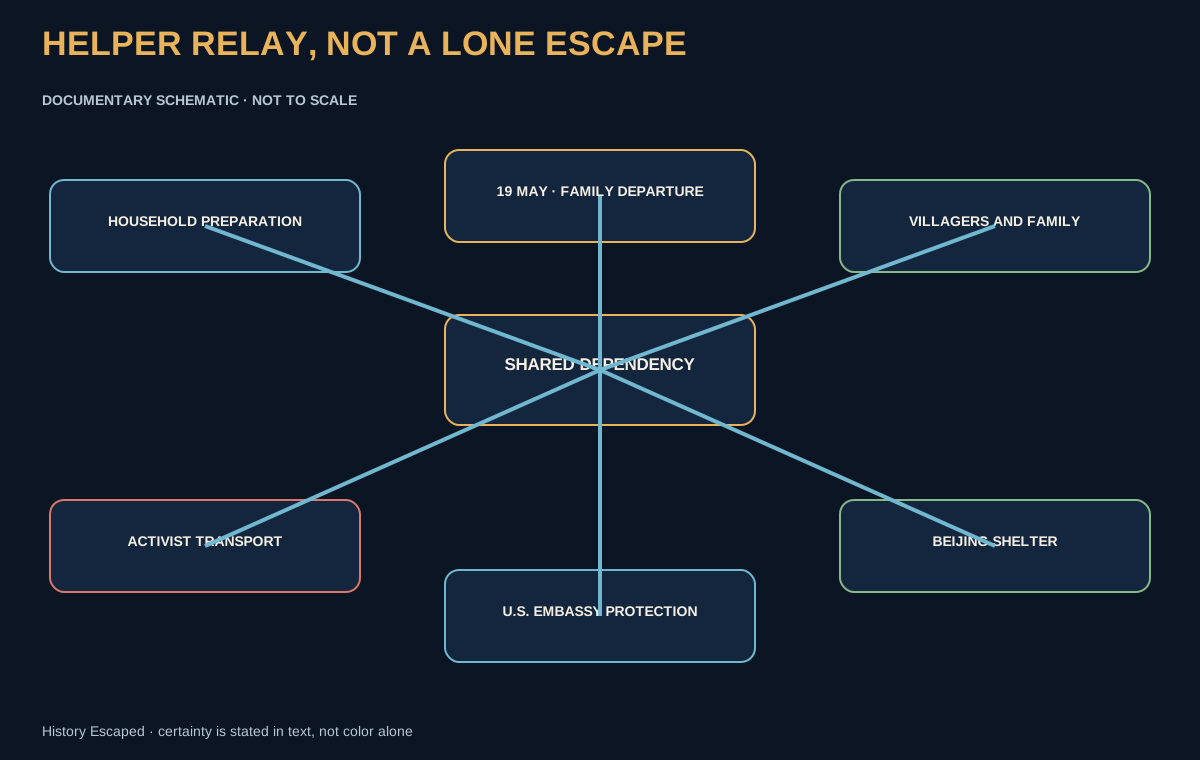
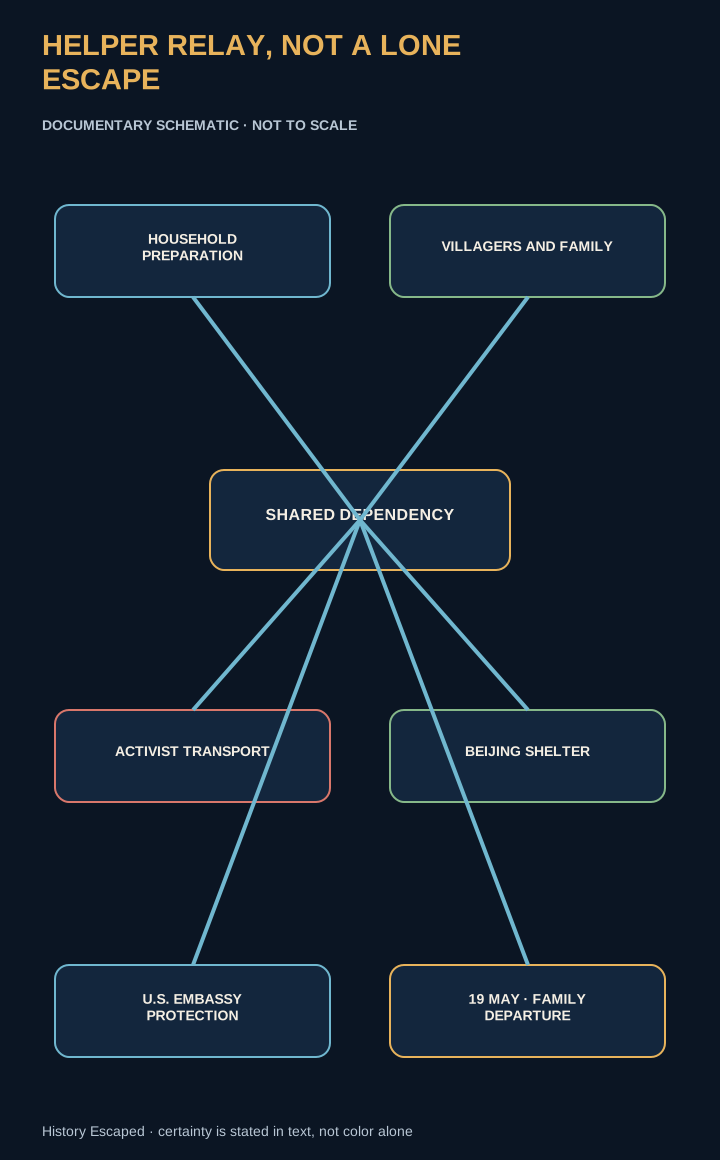
Simplified evidence-led editorial reconstruction based on the cited record; not to scale. Uncertainty is stated directly in the visual and adjacent text.