
King Gojong's flight to the Russian Legation on 11 February 1896 was neither a conventional prison break nor a ceremonial transfer. Five months earlier, Japanese agents and Korean collaborators had entered Gyeongbokgung and killed Queen Min, later posthumously titled Empress Myeongseong. Gojong remained in the same palace under intense political pressure, watched by a government whose authority depended heavily on Japanese backing.
Before dawn on February 11, that arrangement collapsed. Gojong and Crown Prince Yi Cheok left Gyeongbokgung concealed in closed chairs of the kind used by palace women and reached the Russian Legation in Jeong-dong at about seven in the morning. The physical journey was short; its political consequences lasted far longer.
At a Glance
- Flight: 11 February 1896
- Starting point: Gyeongbokgung, Hanseong
- Refuge: Russian Legation, Jeong-dong
- Royal participants: King Gojong and Crown Prince Yi Cheok
- Method: Concealment in closed palace women's chairs, supported by a wider political and diplomatic network
- Immediate outcome: Gojong reached foreign diplomatic protection and dismissed the existing cabinet
- Time at the legation: About one year; he returned to Gyeongungung on 20 February 1897
- Key source issue: The broad escape is exceptionally well documented, but exact gate choreography, troop numbers, and the division of credit among Korean and Russian planners vary across sources
A king inside his own palace
The crisis began before the escape itself. Japan's victory over Qing China in 1895 sharply increased Japanese influence in Korea, but Russia, France, and Germany then forced Japan to return the Liaodong Peninsula in the Triple Intervention. The Korean court responded by seeking greater room to maneuver among the powers.
Queen Min became closely associated with that effort. On 8 October 1895, Japanese agents and armed Korean participants entered Gyeongbokgung and killed her. The assassination transformed Gojong's security problem. He had not been formally imprisoned, but the palace in which he lived had already been penetrated by armed men who killed the queen, and the political system around him was dominated by ministers and military forces he increasingly distrusted.
A first attempt to remove him from that environment failed. On 28 November 1895, conspirators and former royal guards tried to reach the king in what became known as the Chunsaengmun Incident. The plan was exposed before Gojong could be transferred. Its failure tightened pressure around the court and provided a warning: any second attempt would have to depend on concealment rather than a visible force entering the palace.
By early 1896 the political situation had become even less stable. The government imposed the topknot-cutting decree, anti-Japanese righteous-army uprisings spread, and central troops were sent away from the capital to suppress them. That weakened the forces available to secure the palace at precisely the moment Gojong's allies were developing a second extraction plan.
Building a refuge before attempting the flight
Modern Korean institutional histories identify Yi Beom-jin, Yi Wan-yong, Yi Yun-yong, palace intermediary Uhm Sang-gung, and Russian diplomats among the people who helped prepare the move. Their roles should not be collapsed into a single mastermind. The Korean side needed a destination, foreign protection, access to the king, and a method of leaving the palace without provoking a confrontation.
Gojong was not simply carried away without his consent. The Academy of Korean Studies records that on 9 January 1896 he secretly asked for Russian help through Yi Beom-jin. A later Russian diplomatic notice to the Japanese legation described the king as having taken refuge because remaining in the palace presented serious danger to his personal safety.
The Russian side was itself more complicated than later summaries sometimes suggest. Karl Waeber remained an important Russian representative and ultimately hosted the royal court, while Alexei de Speyer had recently arrived in Seoul and played a major role in the preparations. Korean scholarship differs over how to apportion initiative between them, but the essential point is secure: Russian diplomatic personnel agreed to provide refuge and strengthened the legation's protection immediately before the transfer.
On 10 February Russian marines entered Seoul to reinforce the legation. Sources disagree over the exact number. A recent Academy of Korean Studies account gives 135, another Korean historical synthesis describes four officers and roughly one hundred sailors, while contemporary rumor recorded by Yun Chi-ho put the number in the city at two hundred. These are not interchangeable denominators, and none is necessary to explain the escape itself.
Making the chairs look ordinary
The best near-contemporary description appeared in The Korean Repository one day after the event. It reported that, for a week or more, palace women had caused closed chairs of the type they used to pass repeatedly through the palace gates. The purpose was to make their movement unremarkable to guards.
That mechanism is corroborated by other early observers. Missionary Lulu Frey likewise wrote that repeated movement of women's chairs had conditioned guards to stop examining them carefully. Yun Chi-ho learned on the day of the flight that Gojong and the crown prince had arrived in chairs belonging to palace women.
The result was a form of camouflage based on routine rather than costume. The chairs did not need to look extraordinary because the entire point was that they had become familiar. Later retellings sometimes describe Gojong himself as dressed as a court lady; the stronger evidence establishes concealment inside women's chairs, not a securely documented head-to-toe female disguise.
The morning of 11 February
Shortly before seven in the morning, Gojong and Crown Prince Yi Cheok left Gyeongbokgung. The Academy of Korean Studies' modern reconstruction places their exit through Yeongchumun, the palace's western gate, and then toward the Russian Legation in Jeong-dong.
A near-contemporary complication should remain visible. The Korean Repository said it was also reported that the king and crown prince may have used different palace gates, while their attendants slipped out separately. Because that report was explicitly framed as something being said rather than as direct observation, the exact final gate choreography is less secure than the broader transfer.
The same source estimated that about forty attendants left the palace in connection with the operation. That figure is not repeated consistently enough to use as a firm participant count. What is certain is that the escape was more than the movement of two chairs: officials, palace women, foreign diplomats, and armed protection at the destination all formed part of the operation.
At roughly seven o'clock the royal party reached the Russian compound and was admitted. Yun Chi-ho, writing the same day, recorded that the king and crown prince had arrived at about seven or earlier. The Japanese government was formally informed that Gojong had taken refuge because he believed his safety at the palace was endangered.
Escape completed, government overturned
The king's physical escape was over within hours. The political transfer of power began immediately.
Gojong received foreign representatives at the legation and appointed a new cabinet. Officials associated with the previous pro-Japanese government fled or were removed. Prime Minister Kim Hong-jip and Agriculture and Commerce Minister Jeong Byeong-ha were killed by crowds amid the collapse of the old government, and other officials escaped into Japanese protection.
The violence of that day should not be blurred into the escape mechanics. Gojong issued proclamations denouncing figures he associated with the queen's killing and the previous political order, but contemporary accounts differ over the precise relationship between royal orders, formal legal process, and the killings carried out in the streets. The secure conclusion is that the flight destroyed the existing cabinet's ability to govern and allowed Gojong to reconstitute authority from inside the Russian Legation.
A proclamation transmitted in French diplomatic records explained the king's move as refuge from a new conspiracy and summoned soldiers to protect him. Another Russian notification emphasized danger to his personal safety. These documents show how Gojong publicly justified the act: not as abdication or exile, but as temporary refuge from an unsafe palace.
Refuge was not the same as restored independence
The move sharply reduced Japan's immediate political dominance in Seoul. It did not return Korea to a position free from foreign pressure.
Russia gained extraordinary access to the king and Korean decision-making. Russian military advisers arrived, Russian and other foreign concessions expanded, and Japan and Russia negotiated directly over their respective positions in Korea. The Waeber-Komura Memorandum of May 1896 accepted the new political reality while regulating military presence.
Contemporary foreign observers noticed the contradiction. A French diplomatic dispatch from 22 February reported that Gojong remained unwilling to leave the legation because he feared that Japanese supporters would organize another attempt on his life if he returned to the palace. American diplomatic reporting later described Russia as exercising great influence even while Russian representatives publicly denied governing Korea outright.
For Gojong, the legation offered genuine personal protection. For the state, however, governing from a foreign diplomatic compound advertised Korea's vulnerability and gave Russia leverage that it had not possessed before February 11. Korean historical interpretation has therefore ranged from seeing the flight as an assertion of royal initiative against Japanese domination to criticizing it as a decision that deepened dependence on another great power.
Those interpretations are not mutually exclusive. Gojong escaped a palace whose recent history gave him strong reason to fear for his safety, and the act simultaneously shifted the balance of foreign influence rather than eliminating it.
A year in Jeong-dong
Gojong and the crown prince remained at the Russian Legation for approximately one year. The Korean Repository later calculated the stay as one year and nine days.
During that period the royal government operated from Jeong-dong while preparations were made for a safer return to a Korean palace. Gyeongungung, later known as Deoksugung, was repaired and expanded. Russian military instructors helped train Korean troops intended in part to provide royal security.
Pressure to leave the foreign compound also grew. Officials, reformers, and members of the emerging Independence Club argued that continued residence in a foreign legation damaged the country's sovereignty and prestige. Russian representatives themselves did not insist that Gojong remain indefinitely.
On 20 February 1897, Gojong left the Russian Legation and moved into Gyeongungung. Later that year he proclaimed the Korean Empire and assumed the title of emperor. That later state-building project should not be treated as a simple consequence of one escape, but the change of royal residence created the political setting in which Gojong attempted to reconstruct monarchical authority.
What the sources actually establish
Few nineteenth-century escape cases have such a dense collection of near-contemporary observers. Yun Chi-ho wrote about the transfer on the day it happened. The Korean Repository published a detailed account the next day. Japanese, Russian, French, and American diplomatic records documented the move almost immediately, while Korean government proclamations recorded the new political order.
That evidence makes the main sequence unusually secure: Gojong and Crown Prince Yi Cheok deliberately sought Russian protection; palace women's chairs were central to the concealment; the departure occurred early on 11 February 1896; and the royal party reached the Russian Legation at about seven in the morning.
The remaining uncertainties belong around the edges. Sources differ over the exact number of Russian troops, whether the two royals passed through the same gate, how many attendants left with them, and which planner deserves the greatest share of credit. Later patriotic or anti-Russian interpretations also tend to turn a collective political operation into either Gojong's lone masterstroke or a Russian abduction.
Neither extreme fits the record. The flight was a deliberate royal escape made possible by Korean palace insiders, political allies, and Russian diplomatic protection. It freed Gojong from one dangerous political environment while placing him inside another system of great-power influence. That tension is what made the escape consequential.
Evidence discipline
What the record supports
Status labels distinguish secure conclusions from uncertainty and rejected claims. Color is never the only signal.
DOCUMENTED
Gojong and Crown Prince Yi Cheok deliberately took refuge at the Russian Legation on 11 February 1896.
Contemporary Korean, Japanese, Russian-linked, and foreign diplomatic sources all record the move, and Russian notification explicitly described the king as seeking refuge because he feared for his safety.
Sources: SRC-003, SRC-004, SRC-005, SRC-006WELL-SUPPORTED
Closed women's chairs were central to concealing the king and crown prince.
The Korean Repository reported the mechanism one day later, Yun Chi-ho recorded it the same day, and modern Korean institutional histories repeat the same core account.
Sources: SRC-001, SRC-003, SRC-004DISPUTED
Gojong and the crown prince certainly left through exactly the same palace gate.
Modern Korean reconstruction identifies Yeongchumun as the escape gate, while The Korean Repository reported that the two royals may have used different gates. The broader movement out of Gyeongbokgung is secure; the final gate choreography is less certain.
Sources: SRC-001, SRC-003DISPUTED
Exactly 135 Russian marines were the relevant force supporting the operation.
One modern institutional account gives 135, another synthesis describes four officers and about one hundred sailors, and contemporary Seoul rumor recorded a higher number. The differences reflect both source quality and changing denominators.
Sources: SRC-001, SRC-004, SRC-007MYTH
The Russians abducted Gojong against his will.
Strong Korean and diplomatic evidence shows that Gojong and his allies actively sought Russian protection before the transfer. Russian officials exploited the political opportunity, but the king was not an unwilling captive in the initial move.
Sources: SRC-001, SRC-005, SRC-007MYTH
The flight restored Korea to freedom from foreign influence.
Japan's immediate dominance declined, but Russian influence increased sharply and foreign powers continued competing for political and economic concessions.
Sources: SRC-001, SRC-006, SRC-007Documentary reconstruction
From palace danger to diplomatic protection
A case-local editorial visual clarifies the evidence structure without adding false precision or reusable operational detail.
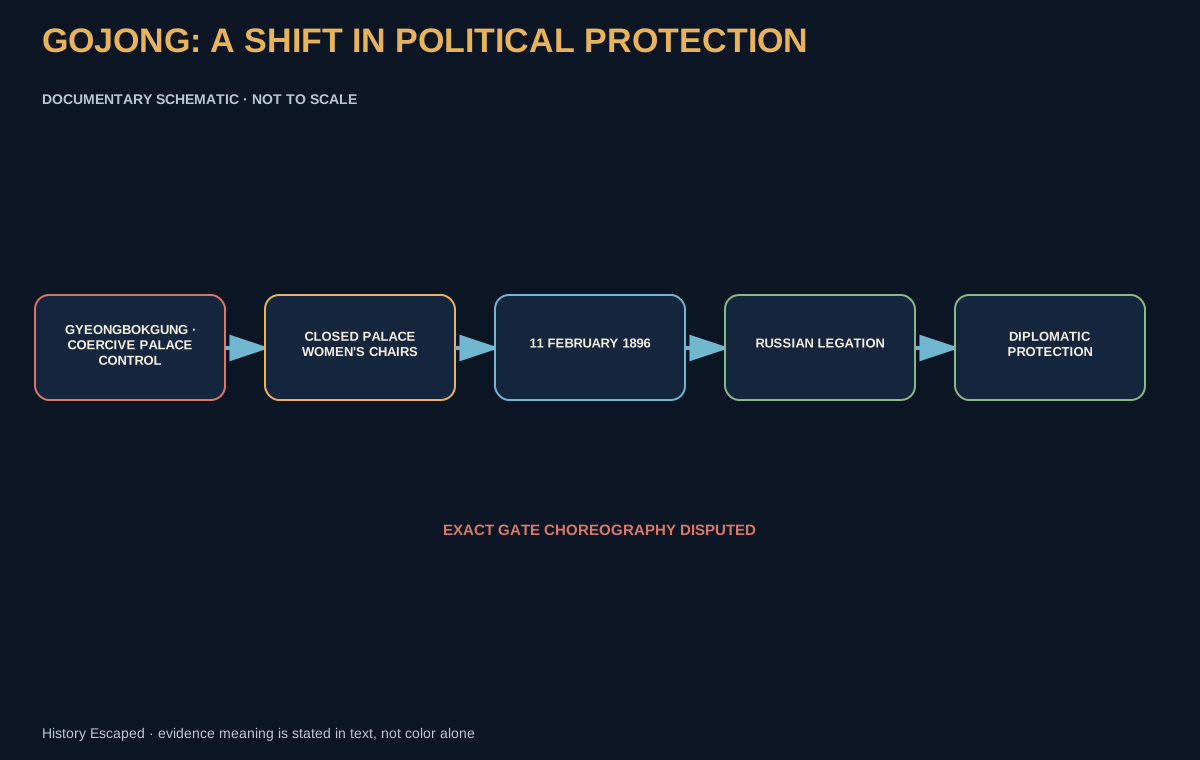
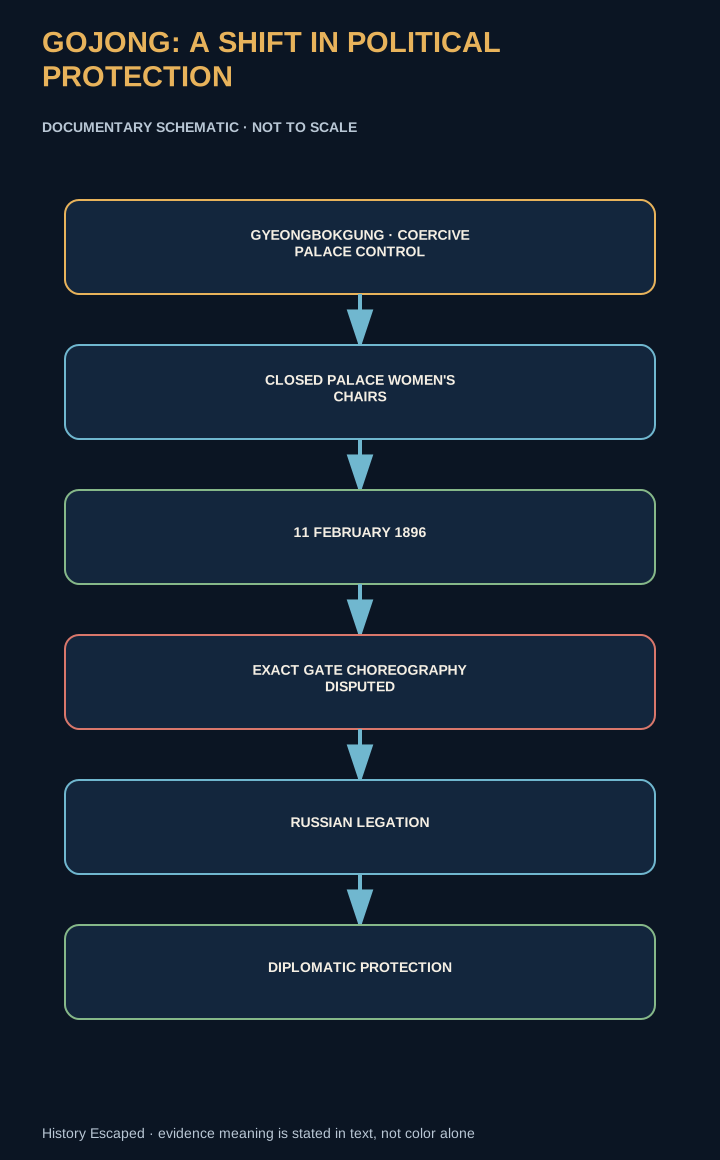
Simplified evidence-led editorial reconstruction based on the cited record; not to scale. Uncertainty is stated directly in the visual and adjacent text.
