
How John Dillinger Escaped Crown Point Jail in 1934
On the morning of March 3, 1934, John Dillinger did not need a working firearm to begin his escape from the Lake County Jail in Crown Point, Indiana. He needed the men guarding him to believe, for a few moments, that he had one.
Shortly after 9 a.m., Dillinger used an imitation pistol to gain control of a jail employee and obtain keys. The bluff widened. More jail personnel were drawn in, disarmed, and locked behind the same doors they had been guarding. Dillinger then reached real weapons—contemporary reports say two machine guns—and left the jail with another prisoner, Herbert Youngblood. When the men could not immediately get a vehicle running at the jail garage, they moved to a nearby garage, took Sheriff Lillian Holley’s Ford, and drove away with a deputy and a mechanic forced along with them. The two men were released near Peotone, Illinois.
That last part of the escape changed the case. Dillinger had crossed a state line in a stolen automobile. Under the National Motor Vehicle Theft Act, better known as the Dyer Act, he had now committed a federal crime. A jailbreak that humiliated Lake County had also created the legal opening for a national federal manhunt.
The escape became famous for one object: the fake pistol. The basic story—that an imitation gun helped Dillinger turn the jail against its own guards—is strongly supported. The familiar claim that he personally whittled a wooden pistol from a washboard, however, is not as simple as legend makes it sound. Contemporary and later records disagree about how the weapon was made, where it came from, and whether someone inside the jail deliberately helped him.
Crown Point is therefore more interesting than the one-line version. It was not simply “Dillinger escaped with a wooden gun.” It was an escape built on a chain of human decisions: where to hold him, how closely to supervise prisoners, when to enter a common area, who controlled the keys, where weapons were stored, and how quickly a bluff could become armed control.
Why Dillinger Was in Crown Point
By early 1934, Dillinger was already one of the most notorious criminals in the Midwest. He had been paroled from an Indiana prison in 1933, joined a network of experienced robbers, and became associated with a series of bank robberies, arsenal raids, jail breaks, and gunfights. His fame was growing at the same time that American law enforcement was struggling with criminals who could move rapidly across county and state boundaries.
In January 1934, the First National Bank of East Chicago was robbed and police officer William O’Malley was killed during the violence surrounding the getaway. Dillinger was accused of O’Malley’s murder. He denied involvement in the East Chicago episode in at least one contemporary local report, and the charge was never resolved by a trial because he escaped before the case could be heard. For the Crown Point story, the historically careful formulation is therefore straightforward: Dillinger was being held to face a murder charge, not serving a conviction for O’Malley’s death.
Dillinger and several associates were captured in Tucson, Arizona, in late January. Indiana officials won custody of him and returned him to Crown Point. Local reporting described a heavily guarded arrival. The jail’s reputation mattered: authorities treated the facility as strong enough to contain a prisoner whose associates had already demonstrated an ability to break men out of custody.
That confidence was not irrational in the abstract. The sheriff’s house and jail had been enlarged in 1926, and later FBI history described the addition as a relatively modern facility believed to be extremely difficult to escape. But the building’s physical strength addressed only one kind of problem. A secure wall does not compensate for weak procedure on the inside.
The “Escape-Proof” Problem
The most important precondition of the escape was not the fake pistol. It was the decision to keep Dillinger at Crown Point under a system that gave him opportunities to observe routines and encounter staff.
After the escape, the Lake County grand jury spread responsibility widely. Its reported findings criticized the decision to keep Dillinger in the county jail rather than return him to a state institution, the absence of experienced guards, lax compliance with jail rules, and the conduct of individual employees. The grand jury’s language was severe: it concluded that neglect and cowardice among jail employees were primary causes of the breakout and also alleged collusion by two employees.
Those findings came after the embarrassment had become a national story, and the accusation of collusion remained contested. But the broader point is difficult to avoid. Crown Point did not fail because Dillinger physically defeated its bars. It failed because he obtained control over the people, keys, and weapons that made the bars meaningful.
That distinction explains why the imitation pistol mattered.
A Fake Gun Only Had to Work Once
Contemporary local reporting places Dillinger with other prisoners in a common exercise area on the morning of March 3. Turnkey Sam Cahoon entered. Dillinger produced an imitation pistol and used it to compel Cahoon to surrender control, including access to keys.
The weapon did not need to survive inspection. It only needed to create enough fear and uncertainty that the first person complied.
Once that happened, the escape changed character. Dillinger could use captured authority—keys, commands, and the appearance of armed control—to bring additional jail personnel into vulnerable positions. Deputy Ernest Blunk was drawn into the sequence and was compelled to summon warden Lew Baker. Men who entered to deal with the emergency could themselves be disarmed or confined.
Later accounts differ on the exact number of guards or employees Dillinger trapped. That number should not be treated as settled. The operational fact is more important: he repeatedly converted new arrivals from potential resistance into additional prisoners.
The jail’s doors then worked for him. According to contemporary reporting, Dillinger and Youngblood moved through the facility while locking doors behind them, slowing any immediate pursuit. The security system had not ceased functioning; its control had changed hands.
Material evidence
Tools of Escape
The objects used in an escape reveal how a plan worked under constraint.
- 01Critical initiating deception
Imitation pistol
A nonfunctional pistol used to create the initial belief that Dillinger was armed. The balance of evidence supports wood, but its maker and route into Dillinger's hands remain disputed.
- 02Critical control mechanism
Jail keys
Keys obtained from jail personnel allowed Dillinger to convert the first successful bluff into control over doors and staff movement.
- 03Critical escalation from bluff to real armed control
Two machine guns
Real firearms taken from the jail after the initial deception removed the need for the imitation pistol to withstand further scrutiny.
- 04Critical getaway tool and jurisdictional turning point
Sheriff Lillian Holley's Ford
The getaway vehicle carried Dillinger and Youngblood into Illinois. Its interstate transportation as a stolen car created the federal Dyer Act offense.
From Imitation Weapon to Real Firepower
The imitation pistol was a bridge, not the final means of escape.
After taking control inside the jail, Dillinger reached the jail office and obtained real firearms. Contemporary local accounts and later FBI histories agree that he took two machine guns. Later retellings identify them as Thompson submachine guns. The distinction is crucial to understanding the sequence: once Dillinger possessed genuine automatic weapons, the question of whether the first pistol could have fooled anyone at close range no longer mattered.
This is why the Crown Point escape is often misunderstood when reduced to a novelty story about a wooden gun. The fake weapon did not magically defeat an entire jail. It initiated a takeover that gave Dillinger access to the jail’s own keys and firepower.
Herbert Youngblood joined him. Youngblood was being held on a murder charge. The Lake County grand-jury summary later listed his help as one of the factors contributing to Dillinger’s escape. The available evidence does not require assigning him the same planning role as Dillinger, but he was not merely a bystander once the break was underway: he left the jail with Dillinger and shared the flight from Crown Point.
Escape sequence
From imitation threat to federal case
The sequence shows how an imitation weapon produced initial compliance, which then yielded keys, real firearms and an interstate getaway.
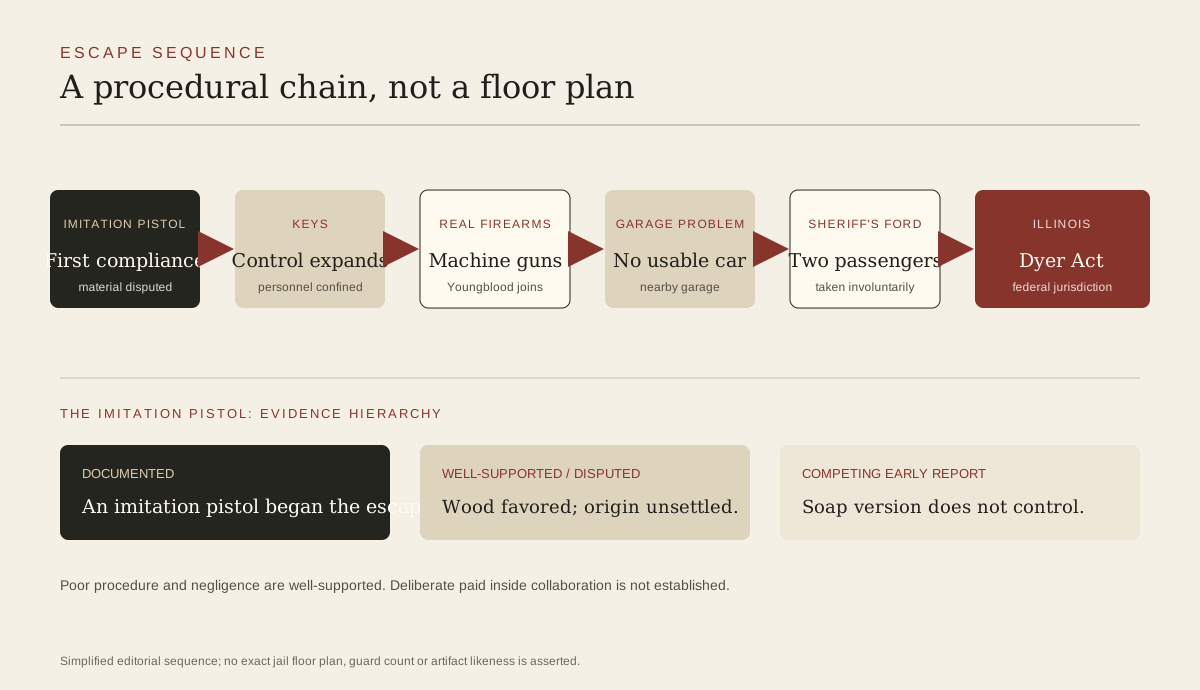
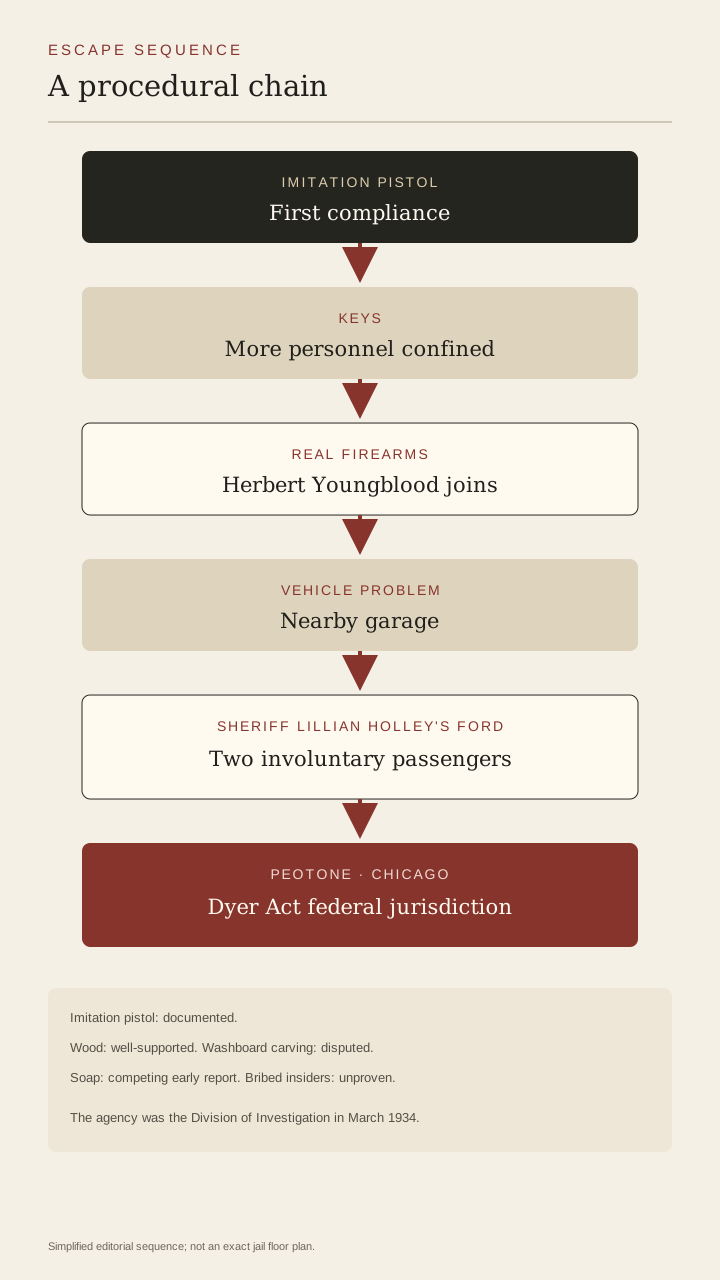
- 01
Imitation pistol
An imitation weapon initiated the escape; wood is well-supported, but manufacture and provenance remain disputed.
- 02
Keys and firearms
Compliance led to keys, confinement of personnel and seizure of real machine guns.
- 03
Herbert Youngblood
Youngblood escaped with Dillinger and must remain part of the account.
- 04
Vehicle problem
The jail garage did not provide an immediately usable vehicle.
- 05
Interstate flight
The sheriff's Ford crossed into Illinois, creating the Dyer Act federal jurisdictional hook.
Simplified editorial sequence; no exact jail floor plan, guard count or artifact likeness is asserted.
The Garage Problem
Getting outside the secure portion of the jail was not the same as getting away from Crown Point.
Contemporary local reporting says Dillinger and Youngblood first went toward the jail garage but could not get a car there started. They then moved by a rear route to a nearby city garage north of the courthouse and jail. A mechanic was forced to start the sheriff’s automobile. Deputy Ernest Blunk and the mechanic were taken along as involuntary passengers.
The precise identity of the mechanic is a minor source problem. Contemporary local reporting and later accounts give differing names or spellings. Because his identity is not necessary to reconstruct the escape, the uncertainty should not be hidden behind false precision.
The important sequence is clear. A transportation problem appeared; Dillinger solved it by moving to another garage, compelling assistance, and taking a vehicle that belonged to Sheriff Lillian Holley.
The choice of car had consequences no one at the jail could reverse.
Problem → response
Escape was a sequence of problems
Each response solved a practical obstacle while often creating the next one.
- 01→
Obstacle
Secure jail doors and confinement
The jail's physical security was intended to prevent direct breakout from the cell block.
Response
Dillinger targeted the human control system instead, obtaining keys and using staff to open or surrender control of secure spaces.
- 02→
Obstacle
Multiple jail personnel
Additional guards or employees could have ended the escape if they responded from a position of strength.
Response
The initial bluff was extended by summoning or confronting additional personnel and confining them before they could organize resistance.
- 03→
Obstacle
Imitation weapon could not sustain close scrutiny
The first pistol was not a functional firearm and could only create a temporary advantage.
Response
Dillinger used the temporary advantage to reach and seize real machine guns.
- 04→
Obstacle
No immediately usable jail-garage vehicle
Contemporary reporting says the escapees were unable to start cars in the jail garage.
Response
They moved to a nearby city garage and compelled a mechanic to start the sheriff's Ford.
The Ford That Federalized the Manhunt
Dillinger and Youngblood drove out of Crown Point with Blunk and the mechanic. The two involuntary passengers were released near Peotone, Illinois. The sheriff’s car was later found abandoned in Chicago.
To a reader accustomed to modern federal law enforcement, it may seem obvious that the federal government would pursue one of the country’s most famous fugitives. In early 1934, that was not automatic.
Before the Crown Point escape, Dillinger’s crimes had largely been matters for state and local authorities. Federal investigators could assist in identification and coordination, but their jurisdiction was defined by federal statutes. The stolen sheriff’s car changed that. The Dyer Act made interstate transportation of a stolen motor vehicle a federal offense. By driving the vehicle from Indiana into Illinois, Dillinger placed himself squarely within a federal criminal case.
A federal complaint followed, then an indictment. The Justice Department’s Division of Investigation became directly involved in the nationwide hunt. Calling the agency the “FBI” is convenient shorthand today, but technically anachronistic for March 1934: it did not officially receive the Federal Bureau of Investigation name until July 1, 1935.
The legal geography of the escape is therefore as important as the physical geography. A few dozen miles of driving transformed the jurisdictional landscape.
What Was the Fake Pistol Actually Made Of?
Here the story becomes less tidy.
A March 8 Lowell Tribune account said the pistol was wooden, carved from a piece of washboard with a razor blade and blackened to resemble a gun. The Lake County grand-jury findings reported in April were even more important: the grand jury specifically concluded that Dillinger had used a wooden gun to intimidate guards before obtaining a real weapon.
Later FBI historical accounts also describe a piece of wood shaped like a firearm. Indiana’s state archives summarizes the event by saying Dillinger was alleged to have used a wooden pistol.
Yet a federal record preserves a competing version. The FBI’s description of a March 3 telegram sent by Chicago Special Agent in Charge Melvin Purvis to Director J. Edgar Hoover says the escape involved a gun carved from soap. That does not make “soap” the best-supported answer. It does show that conflicting descriptions were circulating immediately.
There is another conflict inside the wooden-gun story itself. The traditional version says Dillinger made the weapon in the jail. A later account based on interviews with his attorney, Louis Piquett, says Dillinger did not make it there at all. According to that account, investigator Arthur O’Leary obtained a wooden gun from a woodworker and arranged for it to reach Dillinger. The Mob Museum, which holds a wooden pistol it identifies as the escape weapon, presents this later provenance and notes that some markings on the object were added after the escape.
The responsible conclusion is narrower than either legend.
The use of an imitation pistol is documented, and the balance of evidence strongly favors a wooden weapon. Exactly who made it, where it was made, and how it entered Dillinger’s possession remain disputed.
That conclusion is less cinematic than “he carved a gun from a washboard in his cell,” but it is better history.

Was the Escape an Inside Job?
The same caution applies to the question of corruption.
In the first days after the escape, Indiana investigators examined whether Dillinger had received help. One state investigator quoted in contemporary local coverage said he had found no evidence of collusion but considerable evidence of negligence. That alone makes it unsafe to present bribery as an established fact.
The investigation did not end there. A Lake County grand jury later indicted Sam Cahoon and Ernest Blunk on accusations connected to aiding the escape. Its reported findings explicitly included “collusion” by the two men among the factors responsible. That was a formal accusation, but an indictment is not a conviction.
Later accounts go further. The Piquett-derived narrative says money was paid and that Blunk’s apparent submission was part of a deliberate arrangement. The Mob Museum reports that Blunk was acquitted for lack of evidence. These later claims may help explain why the escape unfolded so smoothly, but they cannot be promoted to documented fact simply because they make the sequence easier to understand.
The strongest publication position is therefore:
- Negligent and lax procedure: well supported.
- Formal contemporary suspicion of collusion: documented.
- Deliberate bribery and a prearranged inside job: disputed and dependent heavily on later testimony.
The escape does not need a proven conspiracy to be historically significant. The documented procedural failures are enough to explain why a bluff could cascade into a complete loss of control.
Evidence discipline
What the record supports
Status labels distinguish secure conclusions from uncertainty and rejected claims. Color is never the only signal.
DOCUMENTED
Dillinger used an imitation pistol to initiate the Crown Point escape.
Contemporary local reporting, the county grand-jury summary, Indiana archival material, and FBI histories agree on the use of a fake or imitation pistol.
Sources: SRC-003, SRC-004, SRC-005WELL-SUPPORTED
The imitation pistol was wooden.
A contemporary grand-jury summary specifically states that Dillinger used a wooden gun before obtaining a real gun; several independent accounts agree. A federal image-page description preserves a competing soap version, so the material should not be described as absolutely beyond dispute.
Sources: SRC-002, SRC-004, SRC-005, SRC-003DISPUTED
Dillinger personally carved the pistol from a washboard inside the jail.
Contemporary local reporting gives the washboard-and-razor story. A later Piquett-derived account says investigator Arthur O’Leary procured an externally made wooden gun and had it delivered. The evidence preserves both versions without establishing either as certain.
Sources: SRC-005, SRC-010MYTH
The escape pistol was made of soap.
The FBI's description of the March 3 Purvis telegram uses the soap version, showing that it circulated very early. The cumulative evidence—especially the county grand-jury finding—more strongly supports wood. Retain the soap report as evidence of early confusion, not the controlling conclusion.
Sources: SRC-002, SRC-005DISPUTED
Jail employees deliberately collaborated with Dillinger in exchange for money.
A state investigator initially reported negligence without evidence of collusion. The grand jury later alleged collusion and indicted Cahoon and Blunk. Later Piquett-derived accounts allege payments and staged assistance. An indictment and later testimony do not establish a completed bribery conspiracy as historical fact.
Sources: SRC-005, SRC-010LATER CLAIM
A particular wooden pistol now in the Mob Museum is conclusively the exact Crown Point escape weapon.
The museum identifies its artifact as Dillinger's escape gun and provides a provenance narrative. That is important material evidence, but the chain depends substantially on later accounts and should not be described as independently conclusive.
Sources: SRC-010DOCUMENTED
Crossing from Indiana into Illinois in the stolen sheriff's car brought Dillinger within federal Dyer Act jurisdiction.
FBI and National Archives accounts independently identify the interstate stolen-car offense as the federal jurisdictional turning point.
Sources: SRC-001, SRC-003, SRC-007, SRC-017UNKNOWN
The escape occurred at one precisely established minute and a precisely established number of guards were captured.
Contemporary accounts place the escape around 9:15 or 9:30 a.m., and later summaries vary on the number of jail personnel subdued. The public article therefore uses 'shortly after 9 a.m.' and avoids an exact guard count.
Sources: SRC-005, SRC-006, SRC-003Crown Point’s Reckoning
The escape embarrassed Lake County almost immediately.
The jail had been publicly treated as capable of holding Dillinger. Photographs showing officials in an apparently relaxed pose with him before the escape intensified the backlash. Indiana’s state archives records widespread public outrage and a gubernatorial investigation focused on the apparent friendliness and laxity of local officials. Governor Paul V. McNutt received demands for action but emphasized that state law did not give him direct power to remove a county sheriff or prosecutor.
The Lake County grand jury’s later findings made the institutional failure explicit. Responsibility extended beyond the moment when Dillinger showed the fake pistol. The grand jury criticized where he was housed, the experience of the guard force, compliance with procedures, and the conduct of named employees.
That is one reason the story endured. Crown Point was not remembered only because a famous outlaw got away. It became a case study in how confidence in physical security can collapse when routine practices are weak.
What Happened to Herbert Youngblood
Youngblood’s freedom lasted less than two weeks.
On March 16, 1934, officers in Port Huron, Michigan, confronted him after receiving information about a man who had boasted of participating in a jailbreak. A gunfight followed. Contemporary Associated Press reporting said Youngblood was struck multiple times and died later that day. Several officers were also wounded.
Reports immediately tried to use Youngblood’s final statements to locate Dillinger, producing claims that Dillinger had recently been nearby. Those claims were uncertain and changed as the story developed. They are not necessary to the Crown Point reconstruction.
What is certain is that the two escapees had sharply different remaining timelines. Youngblood was dead by March 16. Dillinger remained at large for months.

The Escape’s Final Consequence
Dillinger’s Crown Point escape succeeded in its immediate objective: he got out of jail and avoided the murder trial awaiting him there.
Strategically, however, the escape created a new vulnerability. The stolen-car trip into Illinois gave federal investigators jurisdiction. During the months that followed, Dillinger became one of the principal targets of the Division of Investigation. The pursuit included failed raids, gunfire, informants, and an expanding federal campaign against the era’s highly mobile armed criminals.
On July 22, 1934, federal agents confronted Dillinger outside the Biograph Theater in Chicago. He was shot and killed while attempting to evade arrest.
The Crown Point escape therefore sits at an unusual turning point. It was simultaneously a spectacular local security failure and the act that brought Dillinger into a federal case. The escape widened his freedom in the short term and narrowed it in the long term.
Why Crown Point Still Matters
The wooden-gun legend survives because it compresses the escape into a perfect image: a feared criminal walks out of an “escape-proof” jail with a weapon that cannot fire. The evidence shows something more instructive.
Dillinger’s advantage was not that a piece of wood could defeat steel. It was that uncertainty could defeat procedure. A fake pistol created the first moment of compliance. Compliance yielded keys. Keys created access. Access led to real weapons. Real weapons enabled movement through the rest of the jail. A stolen car solved the final transportation problem—and then, by crossing a state line, created the federal crime that reshaped the manhunt.
The best reconstruction is therefore not a story about one clever prop. It is a sequence of security failures and adaptations.
And the most famous detail remains partly unresolved. The evidence strongly favors a wooden pistol, but the neatest version of its origin cannot be proved. In a case that became legend almost immediately, preserving that uncertainty is not a weakness in the story. It is part of the story.
Selected chronology
Custody, escape and manhunt
East Chicago bank robbery and O'Malley's death
Officer William O'Malley was killed during violence surrounding the First National Bank of East Chicago robbery. Dillinger was later brought to Crown Point to face a murder charge connected with the killing; the charge was never tried because he escaped.
Dillinger arrives at Crown Point
After capture in Arizona and extradition to Indiana, Dillinger reached Crown Point under heavy guard and was placed in the Lake County Jail.
Crown Point jailbreak
Dillinger used an imitation pistol to initiate a takeover of jail personnel, obtained real weapons, and escaped with Herbert Youngblood in Sheriff Holley's car.
Interstate car theft creates federal jurisdiction
Transportation of the stolen sheriff's automobile from Indiana into Illinois violated the Dyer Act and opened a direct federal case against Dillinger.
Herbert Youngblood dies in Port Huron
Youngblood died after a gunfight with officers in Port Huron, Michigan, less than two weeks after the Crown Point escape.
Dillinger killed in Chicago
Federal agents confronted Dillinger outside the Biograph Theater in Chicago and shot him as he attempted to evade arrest.