
George Blake’s Wormwood Scrubs Escape: How a Soviet Spy Got Over the Wall in 1966
At 7 p.m. on Saturday, 22 October 1966, officers at Wormwood Scrubs discovered that George Blake was missing.
The first official account, delivered to Parliament two days later, was remarkably short. Blake had escaped from his prison wing through a landing window. One of its bars had been broken. He had then crossed the outside wall using a ladder supplied from beyond the prison.
That description captured the physical escape, but not the larger operation.
Blake was one of Britain's most consequential convicted spies. A former officer of the Secret Intelligence Service, he had admitted passing secret information to the Soviet Union and was serving a 42-year sentence. Yet the people who helped him escape were not a Soviet commando team. The evidence points instead to an improvised network built from relationships formed inside Wormwood Scrubs: Irish former prisoner Sean Bourke, and anti-nuclear activists Michael Randle and Pat Pottle, with Randle's wife Anne later helping with the journey out of Britain.
The wall was only the first problem. After Blake got over it, the escape became an eight-week effort to hide an injured fugitive, keep him ahead of a national search, conceal him inside a camper van, move him through Western Europe and deliver him close enough to the East German border system that Soviet assistance could take over. The prison break itself took minutes.
Making it permanent took nearly two months.
The prisoner Britain could not afford to lose
By the time Blake entered Wormwood Scrubs, his case had already become an extraordinary Cold War security failure.
He had served in Britain's Secret Intelligence Service and, according to the later House of Lords account of his case, became an agent for the Soviet Union in 1951. Over the following years he disclosed valuable secret information obtained through his work.
On 3 May 1961 he pleaded guilty to five charges under the Official Secrets Act. The combined sentence was 42 years.
That figure became part of the Blake legend. A popular explanation later claimed that he had received one year for each agent supposedly lost because of his betrayal. The surviving legal record does not establish that formula. When the House of Lords summarized the case decades later, it said the sentence reflected the extreme gravity of the harm caused by his disclosures.
Whatever the arithmetic behind it, 42 years meant that a man then in his late thirties faced the possibility of spending most of the rest of his life in prison.
The sentence mattered to the escape because it changed how some of Blake's fellow prisoners saw him. Michael Randle and Pat Pottle, jailed for anti-nuclear protest, later said they did not support Blake's espionage but regarded the length of his punishment as excessive. Sean Bourke, another prisoner, formed a different sort of friendship with him.
Those relationships eventually created something prison architecture alone could not contain: help on the other side of the wall.
A security risk who was no longer on the escape list
The official story of Blake's custody makes the escape more striking.
He had been at Wormwood Scrubs since his 1961 conviction. He was initially treated as an escape risk, but in October 1961 he was removed from the formal escape list. Special restrictions remained. His visits, for example, were to be held within hearing of a prison officer.
Wormwood Scrubs was not the same thing as the maximum-security accommodation being developed elsewhere in the prison system. That distinction became politically explosive after the escape.
Blake was a long-sentence prisoner whose successful flight would carry obvious intelligence and diplomatic consequences. Yet he remained in a prison that had already suffered other escapes. In June 1966, only months before Blake disappeared, prisoners got out of Wormwood Scrubs and security weaknesses became a subject of concern.
Later that year the Mountbatten inquiry would conclude, in substance, that the basic problem preceded the details of the ladder or window: Wormwood Scrubs was a poor place to hold a prisoner of Blake's importance once he was determined to escape. The decisive weakness was not simply that one bar could be broken. It was that an unusually valuable fugitive had been left inside a system with several layers that could be defeated one after another.
Sean Bourke and the plan from outside
Sean Bourke had known Blake inside Wormwood Scrubs.
After gaining greater freedom outside the prison, Bourke became the central external figure in the breakout plan. Michael Randle later recalled Bourke approaching him in 1966 and revealing that an escape was already being prepared.
Randle and Pottle's role was initially supportive. They helped obtain money and equipment. Bourke was the man positioned to turn Blake's plan into something that could physically cross the prison boundary.
Later accounts describe Bourke establishing radio contact with Blake using a small set smuggled into the prison. That detail comes from participant and retrospective accounts rather than the first official statement, so it should be treated as well supported rather than as the best-documented part of the operation.
The essential arrangement is much firmer. Blake would get out of his wing. Bourke would provide the means to get over the perimeter. The object that joined those two problems together was a rope ladder.
A rope ladder stiffened with knitting needles
The most memorable object in the escape sounds almost too convenient for a spy story: knitting needles. But the detail is not simply a later embellishment.
Contemporary reporting described a rope ladder left hanging on the wall after the escape, with 20 rungs incorporating steel knitting needles. The later British government history likewise describes Blake scaling the wall on a ladder made using knitting needles.
The evidence does not support the idea that a bundle of loose needles somehow became a ladder by itself. The ladder was made of rope, with the needles used to create or reinforce the rigid portions of the rungs.
That made the design practical for an outside helper.
A solid wooden ladder large enough for a prison wall would be difficult to carry, conceal and deploy unnoticed. A rope ladder could be transported in a compact form and thrown or positioned over the wall. The knitting needles provided stiffness where the climber needed footholds.
It was an improvised answer to a very specific obstacle. First Blake had to reach the wall. Then the ladder had to turn a vertical security barrier into something climbable.

Saturday night: window, yard, wall
The strongest evidence for the physical sequence comes from the statement Home Secretary Roy Jenkins made to the House of Commons on 24 October, when the escape was only two days old. Blake had gone through a landing window. One of its bars had been broken. He then escaped over the outer wall with a ladder that appeared to have been supplied from outside.
Later retellings add more detail. Some place the breakout during a prison film showing. Some describe Blake descending from the window by way of part of the building before running across the grounds. Those details are plausible and recur in later accounts, but they should not be mistaken for facts established with the same strength as the window and ladder.
The central sequence requires no embellishment. Blake got through the secured window. He crossed the prison grounds. Bourke's ladder gave him a route over the perimeter.
Then the escape nearly produced its first serious failure.
Blake came down badly on the outside and injured his wrist. Michael Randle, who helped obtain medical treatment shortly afterward, remembered it as a broken wrist.
For a fugitive about to become the subject of a national manhunt, the timing could hardly have been worse.
The escape did not end outside the wall
It is easy to tell the George Blake story as though reaching the pavement outside Wormwood Scrubs completed the job. In practical terms, it only began the harder phase.
Blake could not use his own name. Police knew his appearance. Ports and borders posed obvious risks. The Soviet Union was far away, and travelling there meant crossing states in which the British authorities could search for him.
Even the first hiding place created problems. Randle later recalled that accommodation intended as a secure refuge was less private than expected. Blake's wrist needed treatment. The helpers then spent days finding people willing to hide one of Britain's most wanted men.
For the next several weeks, the network moved Blake through safe houses. That pause was important.
An immediate dash for a port would have placed him in the path of the most intense phase of the search. Hiding bought time, but it also created a growing logistical burden. Every additional host meant another person who might expose the operation. Blake had to eat, sleep and recover without creating a pattern that police could trace.
A simple breakout had become a clandestine transport problem.
Building the camper-van escape
The solution was designed to look ordinary.
A camper van would travel as though it carried a family on a holiday trip. Inside it, a concealed compartment would carry Blake.
Michael Randle later said that a friend helped construct the hiding place. Randle's wife Anne agreed to travel. Their two young children came with them.
That last detail was not incidental to the appearance of the journey. A couple travelling in a camper van with small children looked very different from two political activists driving an empty vehicle toward the Iron Curtain.
According to Randle, they left on 17 December 1966. Blake had now spent about eight weeks outside prison without being found. He was hidden in the van as the family left Britain and travelled across Belgium and West Germany toward the transit routes connecting West Germany with Berlin. The design of the second escape was almost the opposite of the first.
At Wormwood Scrubs, success depended on a conspicuous physical act performed quickly: get through a window and climb a prison wall. Across Europe, success depended on looking so ordinary that nobody had reason to inspect closely.
Escape sequence
Out of prison, then out of Britain
The wall crossing and the later continental journey were distinct operations separated by weeks in hiding.
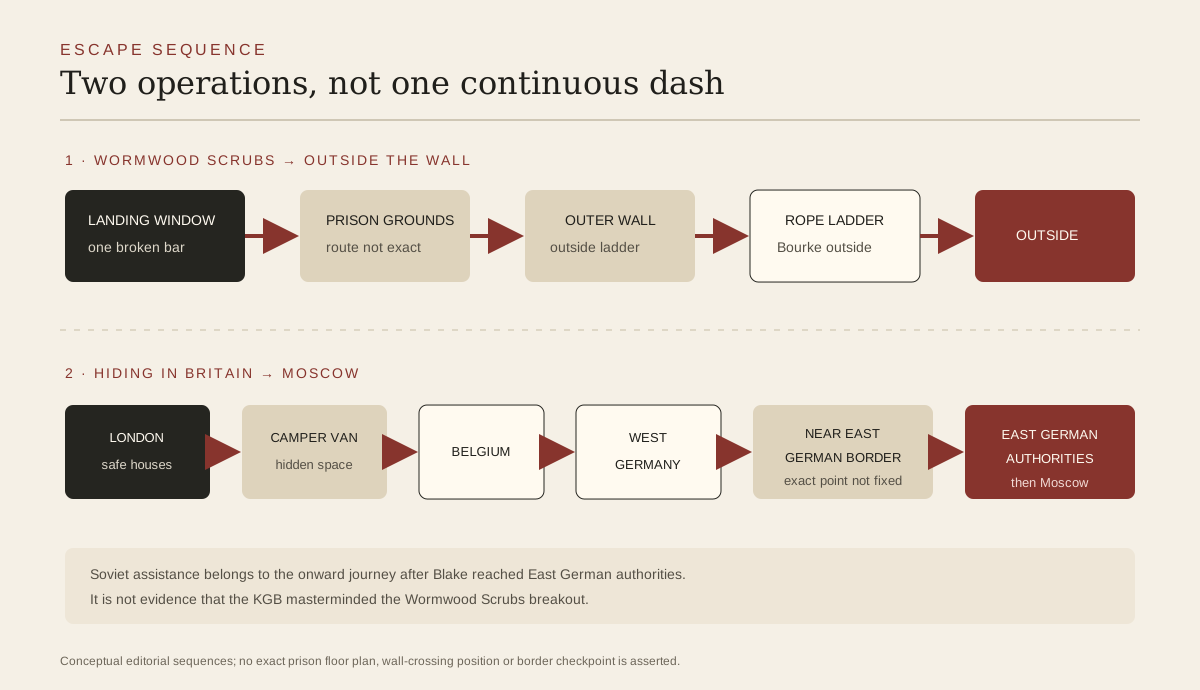
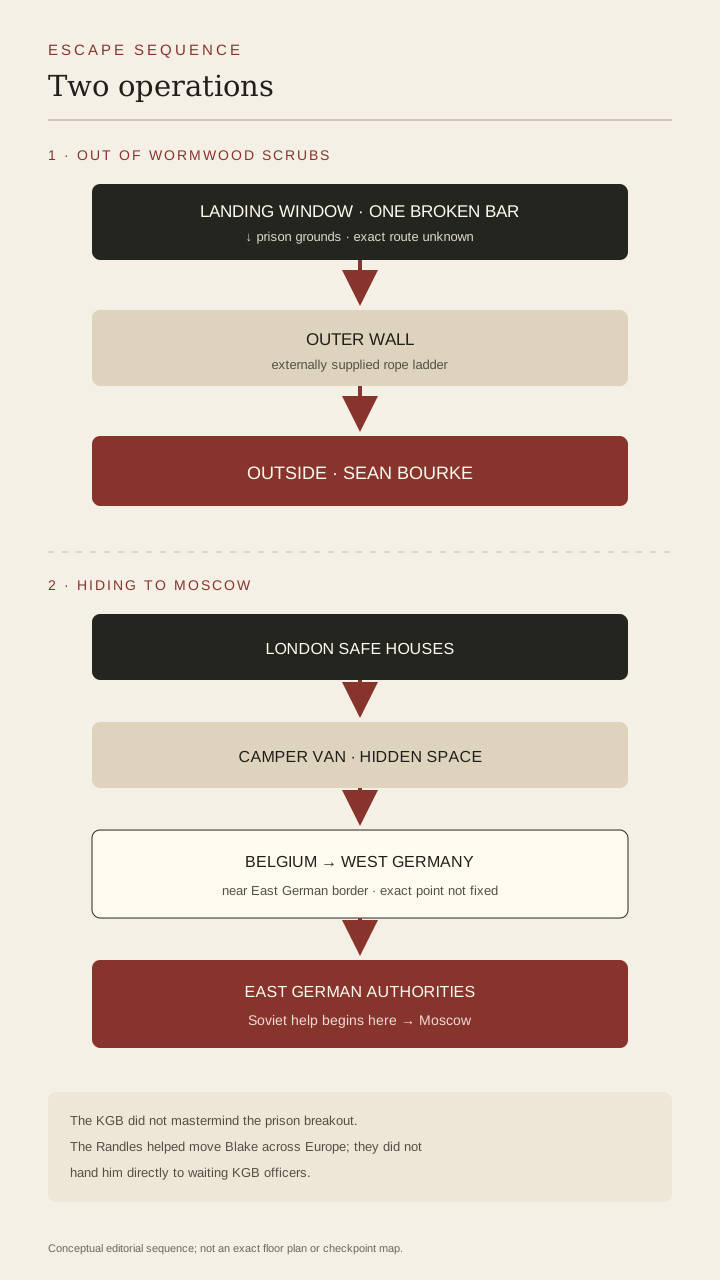
- 01
Landing window
Blake left through a landing window with one broken bar.
- 02
Wall
Sean Bourke supplied a rope ladder from outside.
- 03
Hiding
Blake remained concealed in Britain for about eight weeks.
- 04
Camper van
Michael and Anne Randle moved him through western Europe in a concealed compartment.
- 05
East German authorities
Soviet assistance belongs to the onward stage after this point, not to the prison breakout.
Conceptual editorial sequences; no exact prison floor plan, wall-crossing position or border checkpoint is asserted.
Where the KGB actually entered the story
Blake had spied for the Soviet Union, so British officials initially assumed that his escape must have been a Soviet operation. It was an understandable suspicion. It was also too simple.
The later evidence points to Bourke, Randle, Pottle and other sympathizers as the people who organized the escape from prison and the subsequent hiding operation. At the 1991 trial of Randle and Pottle, Blake himself denied that they had been acting in contact with Soviet authorities.
Michael Randle was particularly careful about what happened at the end of the camper-van journey.
A later newspaper account had said that the Randles handed Blake directly to KGB officers in East Berlin. Randle publicly corrected it. He said that he and Anne left Blake near an East German checkpoint on the route to West Berlin and then drove onward. Blake walked to the checkpoint himself without normal identification. Only after East German authorities had him did his Soviet controller arrive and arrange the next stage.
That distinction changes the shape of the story. The KGB did not need to get Blake out of Wormwood Scrubs. It did not need to hide him for eight weeks in Britain. It did not need to smuggle him through British and Western European controls.
The civilian network did those things. Soviet help became decisive once Blake had managed to place himself on the other side of the Cold War frontier.
The prison escape becomes a national inquiry
Blake's disappearance created a political crisis almost immediately. The issue was bigger than embarrassment over one missing prisoner.
How had a man convicted of exceptionally damaging espionage been left in a prison from which outside assistance could reach him? Why had he been removed from the escape list? Why had earlier escapes from the same institution not produced sufficient change? And why was a prisoner with obvious security value not in the strongest available accommodation?
On 24 October, the same day the Home Secretary made his first detailed statement to Parliament, Earl Mountbatten was appointed to investigate prison escapes and security. The terms of reference explicitly singled out Blake's case.
The inquiry's later judgment was severe. The prison, as then built and administered, had offered little chance of holding Blake once he seriously decided to go. He had also been given too much time to make good his escape before an effective search could catch up with him.
The inquiry therefore reframed the episode. The rope ladder was ingenious. The institutional failure was larger.
The helpers reveal themselves
For years, the full civilian network was not publicly settled.
Sean Bourke eventually returned to Ireland and openly acknowledged his role. British authorities sought his return, but Irish litigation over extradition treated the alleged assistance to Blake as connected with a political offence, blocking the requested surrender on that basis.
Randle and Pottle remained free in Britain.
Eventually they chose to tell their own story publicly in The Blake Escape: How We Freed George Blake — and Why. Publication made their involvement impossible to ignore.
They were prosecuted at the Old Bailey in 1991.
The unusual feature of the trial was that the central historical fact was not really in doubt. Randle and Pottle admitted helping Blake. Their argument was about why they had done it and whether they should be convicted decades later.
The judge did not accept the legal defence they tried to advance. The jury nevertheless acquitted them. The verdict produced another ending to a story already full of unlikely ones: two men publicly acknowledged helping one of Britain's most famous convicted spies escape, stood trial a quarter of a century later, and walked out of court not guilty.
Evidence discipline
What the record supports
Status labels distinguish secure conclusions from uncertainty and rejected claims. Color is never the only signal.
DOCUMENTED
Blake escaped the prison wing through a landing window and crossed the outside wall with a ladder supplied from outside.
Home Secretary Roy Jenkins gave this account to Parliament two days after the escape, while the investigation was still active.
Sources: SRC-001WELL-SUPPORTED
The rope ladder's rungs were reinforced with knitting needles.
The detail appears in contemporary reporting and in the later official-history account. Some retellings simplify this to a 'ladder made from knitting needles'; the more precise wording is that knitting needles reinforced or formed the rigid parts of the rope-ladder rungs.
Sources: SRC-002, SRC-007MYTH
The KGB masterminded Blake's physical escape from Wormwood Scrubs.
British officials initially suspected Soviet or Eastern Bloc involvement, but the later evidence instead points to Blake, Bourke and sympathetic former inmates. Michael Randle explicitly denied direct or indirect KGB contact during the escape operation. Soviet help is well supported only after Blake reached East German authorities.
Sources: SRC-002, SRC-009, SRC-010MYTH
Randle and his family personally handed Blake over to KGB officers.
Randle later corrected this version: he said the family left Blake within sight of an East German checkpoint and drove onward to West Berlin. Blake approached the checkpoint himself; his Soviet controller arrived later.
Sources: SRC-009LATER CLAIM
Blake's 42-year sentence was deliberately calculated as one year for each British agent whose death he caused.
The 'one year per agent' explanation has been repeated in later journalism and was described as a contemporary rumour. The House of Lords' later legal account states instead that the 42-year sentence reflected the extreme gravity of the harm caused by his betrayal. The exact one-year-per-agent formula should not be presented as documented fact.
Sources: SRC-006, SRC-010WELL-SUPPORTED
Blake broke his wrist coming down from the prison wall.
Michael Randle, who helped obtain medical treatment immediately after the escape, described the injury as a broken wrist. Some later summaries use the broader term 'broken arm'.
Sources: SRC-008UNKNOWN
The exact internal path Blake took from his landing window to the perimeter wall is fully established.
The immediate official record confirms the window and wall but not every movement between them. Later narratives add details such as use of a porch or the timing of a film show; those should not be converted into precise spatial fact without stronger primary corroboration.
Sources: SRC-001, SRC-007The myth of the perfect spy operation
George Blake's escape is often remembered as though its brilliance came from secret-service resources. The historical record points in the opposite direction. The plan succeeded because ordinary materials and personal relationships repeatedly solved limited problems. A broken window opened the way out of the wing.
A rope ladder crossed the wall. Knitting needles stiffened the rungs. A former prisoner waited outside. Friends found rooms.
A doctor treated an injury. A hidden compartment turned a camper van into a means of crossing borders. A family journey provided cover. Only after those stages did the Soviet state become the decisive protector.
None of that makes Blake's espionage admirable, and the escape should not be used to blur the damage for which he was convicted. But as an escape reconstruction, it explains why the case remains so useful. The most secure-looking barrier in the story was the prison wall. The real vulnerability was the chain of assumptions surrounding it.
Blake needed every link in that chain to fail. In October 1966, enough of them did.
Selected chronology
Breakout, concealment and onward flight
Blake pleads guilty
Blake pleaded guilty to five charges of unlawfully communicating secret information and received a total sentence of 42 years.
Removed from the escape list
Blake was taken off the prison escape list, although special restrictions on matters such as visits remained.
Earlier Wormwood Scrubs escape exposes weaknesses
Other prisoners escaped from Wormwood Scrubs months before Blake, intensifying concern over prison security and prompting proposed improvements.
George Blake escapes
Blake left his wing through a landing window and crossed the outer wall using a ladder supplied from outside.
Mountbatten inquiry appointed
The Home Secretary appointed Earl Mountbatten to investigate recent prison escapes, with particular reference to Blake, and recommend security improvements.
Blake leaves Britain
According to Michael Randle's account, he and Anne Randle departed with their children and Blake concealed in a camper van, beginning the journey across continental Europe.
Blake reaches the Soviet bloc
Blake was left near an East German checkpoint; Soviet assistance then took him onward to Moscow.
Mountbatten report published
The inquiry into prison escapes and security reported, criticizing the arrangements that had allowed a prisoner of Blake's importance to remain at Wormwood Scrubs.
Randle and Pottle acquitted
After admitting their role in assisting Blake, Michael Randle and Pat Pottle were found not guilty at the Old Bailey.