
Escape from Pretoria: How Three Political Prisoners Walked Out in 1979
On 11 December 1979, Tim Jenkin, Stephen Lee, and Alex Moumbaris escaped Pretoria Local Prison without scaling its perimeter wall or tunneling beneath it. They went through the prison.
Their route depended on copies of prison keys, many fashioned from wood; a device that allowed a locked cell door to be opened from the wrong side; months of clandestine tests; help from political prisoners who would remain behind; and knowledge of how the prison operated after ordinary movement had stopped for the night. Near the end, the plan almost failed anyway. The key they expected to open the final door did not work.
The escape became famous again after the 2020 film Escape from Pretoria, but the historical operation was more patient—and in some respects more remarkable—than its compressed screen version. It evolved over roughly seventeen months from a simple question into an almost complete study of the prison's weaknesses: could prisoners reproduce the means by which their captors moved through the building?
Prisoners of apartheid
Jenkin and Lee had carried out underground propaganda work for the banned African National Congress and related organizations. Security police arrested them in Cape Town in the early hours of 2 March 1978 after surveillance of their activities. They were eventually prosecuted under apartheid security legislation. On 15 June 1978, Jenkin received a twelve-year sentence and Lee eight years.
Pretoria Local was part of a larger Pretoria prison complex and was one of the institutions used to hold white political prisoners. South Africa's prisons reflected apartheid's racial system: black political prisoners were generally confined elsewhere, including Robben Island and other prisons.
Alex Moumbaris had already been imprisoned for years. He had been convicted under the Terrorism Act in connection with ANC activity and sentenced in 1973 to twelve years at Pretoria Local.
Jenkin and Lee arrived with escape already in mind. Lee had even made an unsuccessful attempt to get away while they were still in pre-trial custody. A copy of Henri Charrière's Papillon, given to Lee by his father, reinforced the idea that an escape required preparation not merely for getting out of confinement but for surviving afterward. They smuggled money into prison for that purpose.
But there was no ready-made escape route waiting to be discovered. There were doors.
The first key changed the problem
Jenkin began by studying the lock on his cell grille. He did not possess the warders' keys or precise measurements. He watched them.
His first experiments eventually produced something that appeared implausible even to some of the other prisoners: a working wooden key. Wood was available in the prison workshop, could be shaped inconspicuously, could operate quietly, and could be altered as experiments revealed mistakes. The first success proved that the locks were not an absolute barrier.
That did not mean the escape was solved. Each newly accessible part of the prison exposed another problem.
The outer arrangement of the cells presented one of them. A prisoner could reach through an opening but could not simply stand outside his own cell and turn a key. Jenkin devised a method in which the key was held and turned remotely using a broomstick arranged as a crank. Goldberg later remembered the coordination required to insert and operate it from inside the cell.
The escape project therefore grew in stages. Keys had to be produced or improvised for additional barriers. Those keys then had to be tested without revealing that prisoners were moving through supposedly secure parts of the building at night.
The men were no longer merely planning to escape. They were rehearsing pieces of the escape while still prisoners.
Material evidence
Tools of Escape
The objects used in an escape reveal how a plan worked under constraint.
- 01Core enabling technology of the escape.
Handmade wooden keys
Duplicate keys developed from observation, experimentation and repeated testing against prison locks.
- 02Solved the problem of operating a lock that could not be conventionally reached from inside.
Broomstick crank
An improvised extension that enabled a key to be manipulated from inside the cell arrangement.
- 03Allowed keys and associated devices to be adjusted.
Files and small workshop tools
Workshop tools were used during iterative construction and refinement of escape equipment.
- 04Converted a near-failure at the last barrier into a successful exit.
Chisel
Used against the wooden frame of the final front door after the intended key failed.
- 05Reduced immediate detection after departure.
Civilian clothing and bed dummies
Civilian clothing aided the transition outside while dummies delayed discovery until morning.
Learning the prison from the inside
By 1979 Jenkin and his collaborators were carrying out what they called stages of testing. They penetrated progressively farther toward the prison entrance, learning which doors used related locks, which needed different keys, where they could conceal themselves, and when the night warder could safely be drawn away.
One particularly difficult barrier was what Jenkin called door six, near the night warder's office. Goldberg had an improvised flexible key made from wire that helped solve the problem, and the escapees eventually incorporated a working solution into the route.
Another problem was human rather than mechanical.
Sergeant Vermeulen, the regular night warder, occupied the part of the prison through which they needed to pass. Goldberg cultivated long conversations with him and learned details about routines and security. Electrical faults were familiar enough that a tripped switch could provide a plausible reason to call him away.
The prisoners also prepared a hiding place in a film-equipment cupboard beneath the stairs. Its size mattered. A plan that at one stage had contemplated a much larger group eventually contracted to three actual escapees. Goldberg and other political prisoners remained involved in discussions and assistance, but internal disagreements, physical considerations, security concerns, and the constraints of the route narrowed the final party to Jenkin, Lee, and Moumbaris.
That history matters because the final escape was not the accomplishment of three men operating in complete isolation. Prisoners who stayed behind concealed equipment, advised the escapees, tolerated the risks, helped with technical problems, and facilitated the diversion.
But only three would go through the doors.
Problem → response
Escape was a sequence of problems
Each response solved a practical obstacle while often creating the next one.
- 01→
Obstacle
Locked cells
The cell arrangement prevented prisoners from simply operating the necessary locks from the accessible side.
Response
Jenkin combined copied keys with a remote broomstick-crank mechanism.
- 02→
Obstacle
Multiple unknown locks
The escapees did not initially possess measurements or working keys for the succession of barriers toward the front entrance.
Response
They observed warders' keys, fabricated copies and tested the route incrementally.
- 03→
Obstacle
Night warder
Sergeant Vermeulen occupied the administrative area through which the escape route passed.
Response
Goldberg and the escapees exploited familiar electrical faults and Vermeulen's routine to draw him away while the trio hid.
- 04→
Obstacle
Restricted hiding space
A film-equipment cupboard used during the plan could conceal only a small number of people.
Response
The final escape party was reduced to Jenkin, Lee and Moumbaris.
- 05→
Obstacle
Final front-door lock
The keys carried for the final door did not work, and attempts to manipulate the lock failed.
Response
Moumbaris forced the wooden doorframe with a chisel.
- 06→
Obstacle
Post-escape manhunt
The escape triggered an extensive search and created a second problem: leaving South Africa.
Response
The men used separate movements and clandestine assistance to reach neighboring states and ANC networks.
Why they stopped waiting
Plans for broader outside assistance repeatedly ran into delays. Goldberg had established a coded communication channel through Baruch Hirson in London and, through him, ANC contacts including Joe Slovo. At one stage the prisoners contemplated a waiting getaway vehicle.
Eventually Jenkin, Lee, and Moumbaris decided not to depend on it.
By late 1979, the prison's security environment was changing. Construction and guard arrangements threatened to make the route harder. Their stored money and escape clothing created their own problems. Another political prisoner, John Matthews, was approaching his scheduled release, and an escape immediately afterward might expose him to suspicion.
The planning had begun in July 1978. By November 1979, according to Jenkin's account, it had lasted almost seventeen months.
During the weekend of 8–9 December, the three decided they would make their first attempt on Tuesday, 11 December and try successive days if circumstances prevented them from going that night. Tuesday proved sufficient.
The night of the escape
Before moving, the three changed into civilian clothing and prepared the equipment they needed. Their prison beds were arranged so that dummy forms would delay discovery until morning. They wore gloves, helping them avoid leaving fingerprints along a route they intended to conceal by locking doors behind them.
The first part of the escape reproduced actions they had practiced.
They freed themselves from their cells and passed the early barriers leading from the political-prisoner section. They manipulated the electrical system and concealed themselves in the film cupboard. After receiving the agreed signal, Goldberg called Vermeulen about the failed lights, drawing the warder into the expected response.
The three could then move.
The route described in Jenkin's memoir is important because modern versions frequently compress it into the phrase “nine wooden keys.” His own operational sequence instead numbers successive barriers all the way to door ten, the front door. Not every one of those doors was opened by an individually handmade wooden key: one was electrically released, keys could serve more than one lock, and Jenkin's broader tally elsewhere counts additional locked barriers beyond the numbered route.
After the diversion, Moumbaris moved to operate the control that released an electrically controlled door farther down the route. Jenkin opened and, where possible, secured doors behind them. One of the later locks could be opened with a key already developed for another part of the prison.
Then they reached the front.
Escape sequence
The route through Pretoria Local Prison
The surviving accounts are best explained as a sequence of barriers, not as a falsely precise floor plan.
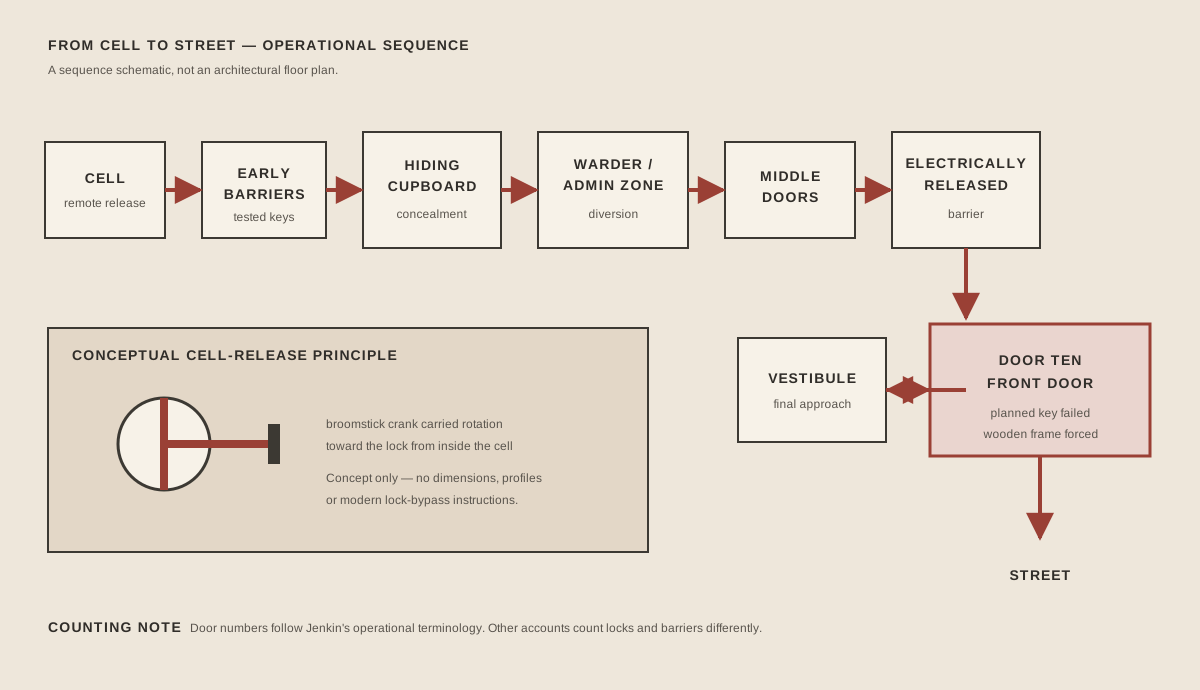
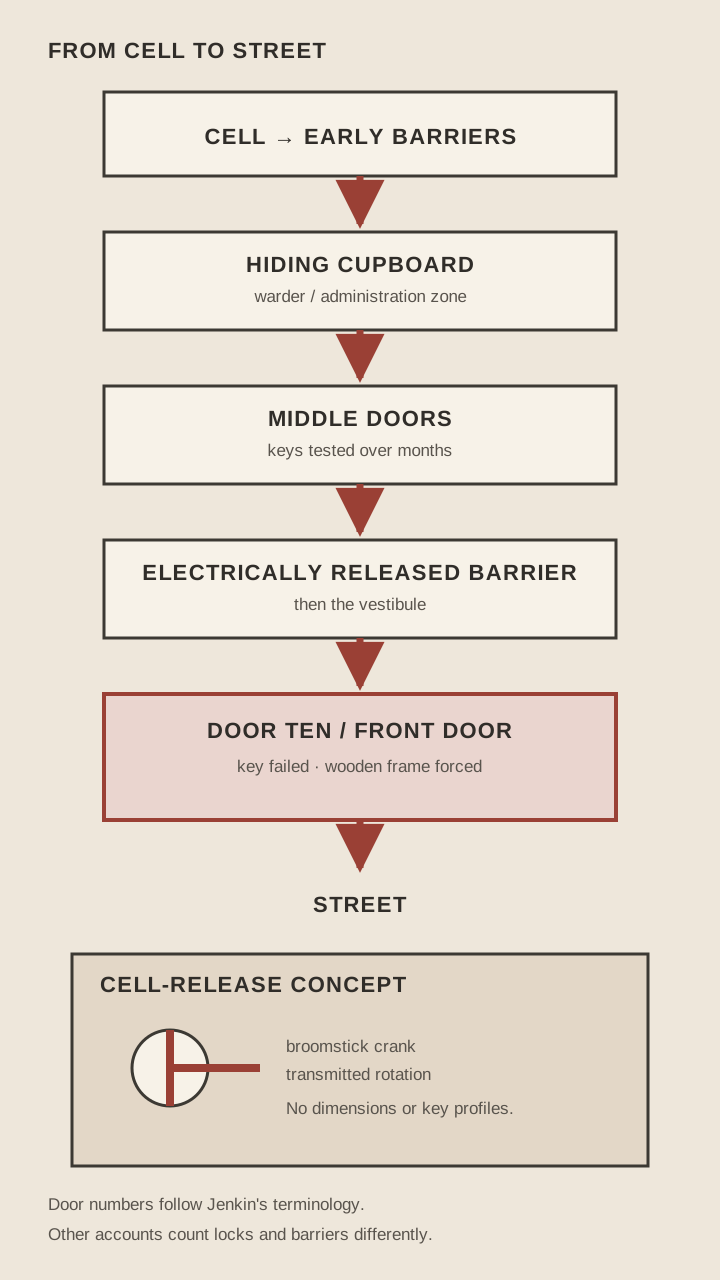
- 01
Cells and early barriers
Improvised keys opened successive barriers after months of concealed preparation and testing.
- 02
Hiding cupboard
The route used a concealed waiting point while the men coordinated movement through the prison.
- 03
Warder and administration zone
The escape depended on timing and passage through occupied institutional space.
- 04
Middle barriers
The numbered operational sequence included mechanically and electrically controlled points.
- 05
Door Ten
The planned front-door key failed; Alex Moumbaris forced the wooden doorframe with a chisel.
- 06
Street
Jenkin, Lee and Moumbaris left the prison and began separate post-prison routes.
Simplified editorial reconstruction; not to scale. Door numbers follow Jenkin's operational terminology. Other accounts count locks and barriers differently.
The one door they had never opened
The final door was different.
The escapees had previously penetrated almost this far during their clandestine testing, but they had not completed a real opening of the prison's front door. Now the small keys they had brought for it failed. Attempts to manipulate its ordinary lock also failed.
The safest response, from one perspective, was retreat.
Jenkin argued that they could potentially return to the political section, conceal what they had done, develop a working key, and try again. Until then, much of the route had been left in a condition designed to conceal the fact that prisoners had traversed it.
Moumbaris refused to abandon the attempt. He used a chisel on the wooden doorframe.
Once physical damage had been done, the option of quietly returning to their cells largely disappeared. The three forced the locking point sufficiently to open the front door.
The most carefully engineered part of the escape therefore ended with improvisation. Not because the previous planning had failed as a whole, but because planning had carried them to the one barrier they had never fully proved. Then the three political prisoners stepped into Pretoria.
Getting out was only the first escape
They were not immediately missed.
Inside the prison, the dummies remained in Jenkin's and Lee's beds. Goldberg later remembered the following morning's unlock, when an officer initially believed the prisoners were still lying down before recognizing that the forms beneath the bedding were not men. Only then did the scale of the breach become apparent.
A major search followed.
The three escapees, meanwhile, did not remain together for the entire journey out of South Africa. Goldberg later recorded that Jenkin and Moumbaris crossed into Swaziland, now Eswatini, within roughly twenty-four hours, then continued into Mozambique. Lee stayed hidden in Johannesburg and was subsequently moved across the border through a separate network.
Jenkin's memoir describes a much longer journey after the prison doors: through Swaziland and Mozambique and onward through the network of southern African states and ANC contacts that eventually returned the men to political work in exile. At the time, public disclosure of those networks carried obvious risks.
On 2 January 1980, O. R. Tambo presented Moumbaris, Lee, and Jenkin together at an ANC press conference in Lusaka.
The escape was no longer rumor. They were out.
The warder accused of helping them
The apartheid authorities confronted an embarrassing question: how could three political prisoners have passed through so much of a supposedly secure prison? Sergeant Vermeulen became one answer.
Goldberg later wrote that security police arrested the warder and extracted a confession alleging that he had intentionally helped the escape in return for a R200 payment. He was convicted. He appealed and was found not guilty. Lee, already outside South Africa, supplied a sworn statement asserting that Vermeulen had not been involved in the plot.
This point deserves more attention than it normally receives.
Vermeulen was central to the escape's mechanics—but as an unwitting part of the environment the prisoners had learned to manipulate. His schedule, habits, conversations, and responses to electrical faults were predictable enough to build into the plan.
That is very different from being a paid accomplice. The stronger evidence rejects the bribery story.
So how many doors were there?
Search for the story today and one account will say nine doors, another ten, another fourteen. The contradiction is less dramatic than it appears.
Jenkin's escape narrative gives the main route a numerical sequence culminating in door ten, the prison's front door. Some institutional and publisher summaries refer to handmade keys opening nine doors. The original book's broader descriptions count additional locked doors or barriers encountered during the complete movement from confinement toward the street.
The safest historical wording is therefore not:
They escaped through exactly nine doors.
Nor:
They escaped through exactly fourteen identical locked doors.
It is:
Their numbered escape route culminated at door ten, using a collection of handmade and improvised keys plus an electrically released barrier; Jenkin's broader accounting includes additional locked barriers, which explains the larger totals found in retellings.
The distinction sounds small. For a reconstruction, it is crucial.
What the film changed
The 2020 film helped introduce the escape to an enormous new audience. Daniel Radcliffe played Jenkin and Daniel Webber played Lee. Alex Moumbaris was represented under the fictionalized name Leonard Fontaine.
Jenkin participated in the production and regarded portions of it as accurate, but he also described it as necessarily abbreviated. Director Francis Annan has openly acknowledged altering incidents for dramatic purposes; a tense scene involving a key component disguised as another object, for example, was adapted from a different real prison incident rather than reproduced literally.
The film is therefore useful as an introduction, not as the controlling historical source. The documented escape needs less embellishment than the screenplay gives it.
Its real achievement was cumulative: staring at keys long enough to reproduce them; discovering that wood could operate prison locks; devising a way to turn a key from inside a cell; testing one barrier after another without triggering an alarm; learning how to exploit ordinary routines; accepting that a large escape party had become impossible; and reaching the front door after more than a year of preparation.
Then, when all of that precision met a lock that would not open, the three men made the decision the plan had not solved for them. They forced the door and kept going.
Evidence discipline
What the record supports
Status labels distinguish secure conclusions from uncertainty and rejected claims. Color is never the only signal.
DISPUTED
The escape involved exactly nine, ten or fourteen locked doors.
Sources use different counting conventions. Jenkin's operational numbering culminates at door ten, while some summaries count nine key-opened doors and broader descriptions count additional locked barriers. The differences should not be collapsed into a single unexplained number.
Sources: SRC-001, SRC-004, SRC-008, SRC-011, SRC-012MYTH
Stephen Lee received a twelve-year sentence alongside Tim Jenkin.
Denis Goldberg's later memoir states that both men received twelve years, but stronger corroborating evidence gives Jenkin twelve years and Lee eight.
Sources: SRC-002, SRC-004, SRC-005, SRC-008MYTH
Sergeant Vermeulen knowingly helped the escapees in exchange for money.
A confession alleging payment was obtained after threats. Vermeulen was ultimately found not guilty on appeal, and Stephen Lee supplied a sworn statement denying Vermeulen's involvement.
Sources: SRC-001, SRC-002MYTH
All three escapees followed the same route out of South Africa.
The three left the prison together, but Goldberg states that Jenkin and Moumbaris crossed into Swaziland while Lee remained hidden in Johannesburg and was moved out separately.
Sources: SRC-001, SRC-002MYTH
The 2020 film reproduces the prison escape exactly as it happened.
Jenkin described the film as an abbreviated dramatization, and its director has acknowledged altering specific incidents. Alex Moumbaris is also renamed Leonard Fontaine.
Sources: SRC-008, SRC-014Selected chronology
Imprisonment, preparation and escape
Jenkin and Lee arrested
Security police arrest Tim Jenkin and Stephen Lee in Cape Town after surveillance of their underground political activity.
Jenkin and Lee sentenced
Jenkin receives twelve years and Lee eight years before imprisonment in Pretoria.
Escape planning begins
The prison escape project develops from observation and initial key-making experiments.
Route testing expands
Keys and procedures are tested through progressively deeper stages toward the prison entrance.
Escape from Pretoria Local Prison
Jenkin, Lee and Moumbaris leave their cells, use the prepared route and force the final front door when its lock defeats their keys.
Escape discovered
Prison officials discover dummy forms in the escapees' beds and launch the search.
Escapees presented in Lusaka
O. R. Tambo introduces Moumbaris, Lee and Jenkin together at an ANC press conference.