
The 1962 Alcatraz Escape: How Three Men Got Off the Rock—and Disappeared
On the morning of June 12, 1962, guards at Alcatraz discovered something the prison had been designed to prevent. Three men were missing.
Frank Morris was gone. So were the brothers John and Clarence Anglin.
Their beds did not appear empty at first. Dummy heads had been placed beneath the blankets, painted to resemble human faces and topped with real hair. The deception had apparently survived the nighttime checks long enough for the three prisoners to put Alcatraz behind them.
What investigators found behind the cells was more important than the dummies.
The escape had not depended upon one overlooked door or a momentary lapse by a guard. Morris, the Anglins, and a fourth prisoner, Allen West, had spent months creating a hidden route through the prison while simultaneously building the equipment they expected to need once they reached San Francisco Bay.
By the evening of June 11, almost every part of that system was ready. One part failed. West never made it out of his cell. The other three did.
From there the evidence follows Morris and the Anglins through the utility spaces behind their cells, upward through the prison, onto the roof, down the outside of the cellhouse, across the island, and to the northeast shoreline. Then the reliable trail ends. For more than sixty years, that boundary has defined the Alcatraz mystery. We know, in remarkable detail, how they escaped the prison.
We still do not know whether they survived the escape from the island.

The Prison Was Only the First Barrier
Alcatraz had operated as a federal penitentiary since 1934. The government deliberately used the island for prisoners considered especially difficult to manage elsewhere, including men regarded as escape risks. Security combined the cellhouse itself with the island's isolation in San Francisco Bay.
The water was part of the prison. Even someone who got out of the cellhouse still had to reach the shoreline undetected and then cross strong, cold tidal water without ordinary boating equipment. That made the 1962 plan fundamentally different from simply opening a cell. The conspirators needed a route through two prisons:
the constructed prison of concrete, steel, guards, counts, and fences; and the natural prison surrounding it.
Frank Morris arrived at Alcatraz in January 1960 after repeated trouble with the law and previous escape attempts. John Anglin arrived later that year and Clarence in early 1961. The three knew one another from previous imprisonment. They eventually occupied neighboring cells and worked with another inmate, Allen West. According to the FBI's reconstruction, planning was underway by December 1961.
Their first problem was immediate. Each man still slept behind bars.
Getting Through the Back of the Cells
At the rear of the relevant cells were ventilation openings. Beyond them lay something far more useful: a utility corridor running behind Cell Block B. If the prisoners could enlarge those openings enough to pass through, the visible bars at the front of the cells would no longer be their only exit. The challenge was doing it without creating an obvious hole.
Investigators later concluded that the group used old saw blades and crude homemade tools, including a powered drill built using a motor from a broken vacuum cleaner. Rather than simply smashing through the wall at once, the conspirators gradually weakened the material surrounding the vent openings.
Progress created another problem. An enlarged opening would expose the scheme immediately if a guard saw it.
The prisoners therefore concealed the altered sections with coverings made to look innocuous from inside the cell. The FBI found that items such as cardboard and personal belongings had been used to hide the work.
The result was a route that could remain hidden during the day and become an opening after the prisoners were locked in. Once through it, they entered a part of Alcatraz that changed the possibilities of the escape.

The Space Behind the Cells
The utility corridor was not another normal prisoner area. It provided access behind the cellblock and, more importantly, a way upward.
The conspirators climbed through the internal structure to the top of the cellblock, where they established a concealed workshop. There they could work on escape equipment away from the direct visibility of the occupied cells.
That solved the space problem. It created a security problem. A workshop was only useful while guards did not discover it.
The men therefore organized lookout duties. Investigators found a crude periscope associated with watching for approaching officers while work continued.
Inside that hidden workspace, the plot expanded beyond simply getting out of a cell. They began preparing for the Bay.
Escape reconstruction
The documented route off Alcatraz
Investigative evidence reconstructs the route from the cells to the shoreline. It does not establish what happened after the men entered San Francisco Bay.
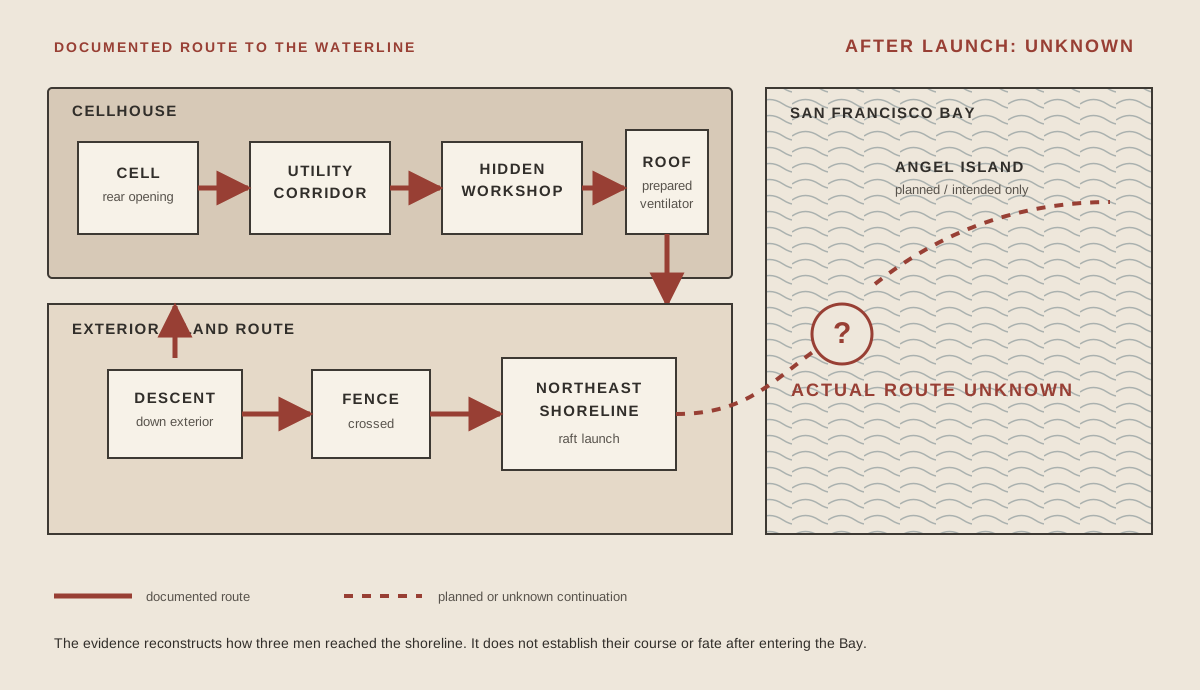
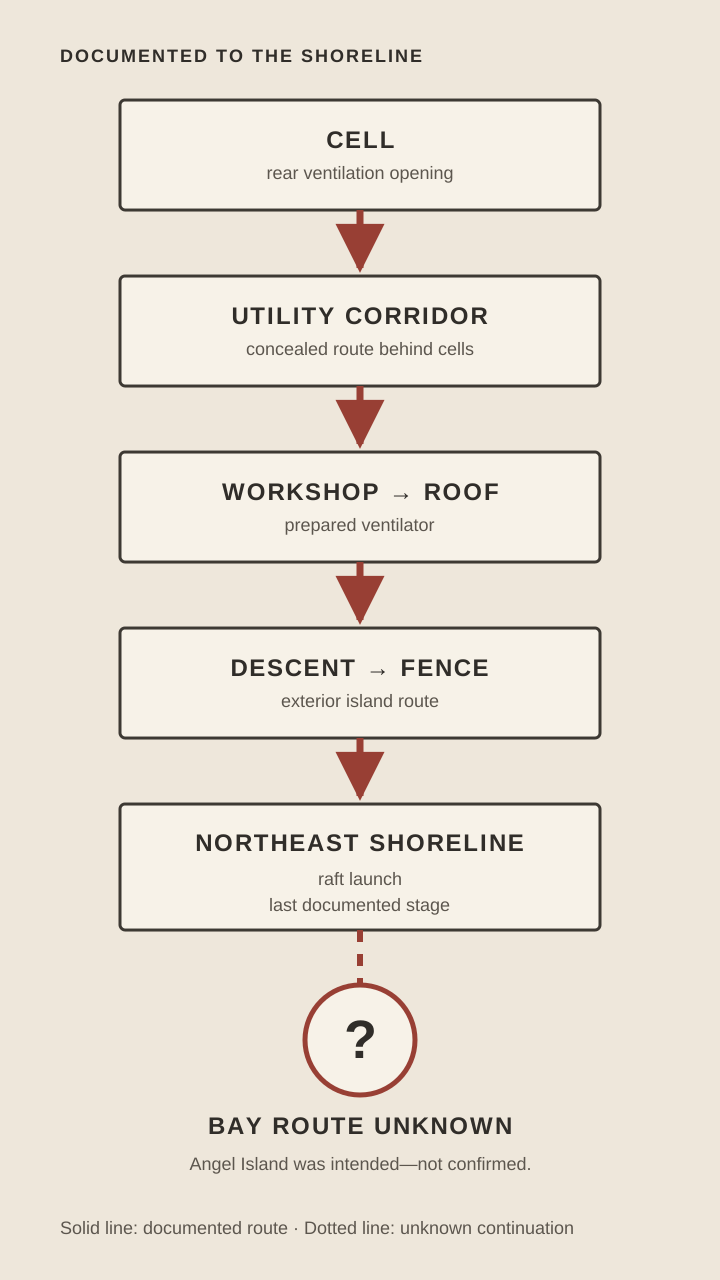
- 01
Cell
Prepared rear ventilation openings led into the utility corridor.
- 02
Utility corridor
The men climbed behind the occupied cellblock to a hidden workshop above it.
- 03
Roof route
A prepared roof ventilator provided access to the roof.
- 04
Exterior descent
They descended the exterior, crossed a fence and moved toward the island's northeast edge.
- 05
Shoreline
Evidence supports a raft launch from the northeast shoreline.
- 06
Unknown
No confirmed route continues beyond the Bay. Angel Island was an intended destination, not a documented landing.
Simplified editorial reconstruction based on investigative evidence; not to scale. The escapees' route after entering San Francisco Bay is unknown.
More Than Fifty Raincoats
A prisoner standing on the shore of Alcatraz was still not free.
The nearest land was separated from the island by cold water and powerful tidal currents. Previous Alcatraz escape attempts had already shown what the Bay could do to men who entered it without adequate support. Federal prison history records both drowned escapees and others overcome by the water.
Morris, the Anglins, and West therefore planned flotation rather than relying on an unsupported swim. The raw material came from an ordinary prison item:
raincoats.
Investigators concluded that the group accumulated more than fifty of them.
The rubberized material was cut and joined into improvised life preservers and a raft approximately six feet by fourteen feet. The seams were stitched and then sealed using heat available from the prison's steam system.
The raft created its own set of requirements. It needed propulsion. The prisoners built paddles from wood. It needed air.
Investigators determined that the conspirators converted a musical instrument into an inflation device. And all of this equipment had to remain hidden while the men continued ordinary prison life. The secret workshop above the cells provided a place to build it. They were now preparing to solve the second half of the escape before they had completed the first.

The Men Who Had to Remain in Their Beds
There was still a basic problem. Even if the men crawled out through the backs of their cells, guards continued checking the prisoners. An empty bed could expose the escape before the conspirators had even left the building. Their answer became one of the best-known artifacts in Alcatraz history.
They made dummy heads.
The surviving decoys incorporated paper or cardboard material, cement or plaster-like material, painted faces, and actual human hair collected from the prison barbershop. FBI descriptions vary slightly in how they summarize the exact composition, but the purpose is clear: each head was intended to make a sleeping figure look present during a brief nighttime inspection.
The decoys did not need to survive close examination. They only needed to postpone one. That bought the escapees time.

The Roof Was Still Sealed
Leaving the cells put the men behind Cell Block B. It did not put them outside the prison. Their route upward eventually brought them to a ceiling area roughly thirty feet above, where a ventilator blocked access to the roof. Again, the problem was not simply removing an obstacle.
It was removing it without revealing that it had been removed before the escape night. The conspirators worked the ventilator loose. Then they disguised the preparation with a false bolt fashioned from soap. With that route prepared, the escape now had a continuous sequence:
cell → utility corridor → top of cellblock → ventilator → prison roof
The island still remained beyond it.
Material evidence
Tools of Escape
The objects used in an escape reveal how a plan worked under constraint.
- 01High
Old saw blades
Cutting material used during the preparation of the cell openings.
- 02Essential
Homemade powered drill
Improvised drill incorporating the motor from a broken vacuum cleaner and used to help weaken the material around cell vents.
- 03Essential
False cell-opening covers
Temporary coverings that concealed the enlarged escape openings from routine observation.
- 04High
Lookout periscope
Improvised viewing device used to help monitor guard movement while work occurred in the hidden area.
- 05Essential
Dummy heads
Painted decoys incorporating real human hair and placed in beds to delay discovery of the escape.
- 06Essential for the water stage
Raincoat raft
Approximately 6-by-14-foot improvised flotation craft built from prison raincoats.
- 07Essential for the water stage
Raincoat life preservers
Improvised flotation devices constructed alongside the raft.
- 08High
Wooden paddles
Improvised paddles built to propel the raft.
- 09High
Improvised inflation device
A musical instrument was modified to help inflate the raft.
- 10High
Soap bolt
A fake bolt made from soap disguised prior work on the roof ventilator.
June 11: One Man Cannot Get Out
By the evening of June 11, 1962, the conspirators were ready. Morris, John Anglin, Clarence Anglin, and Allen West were supposed to leave. West could not.
His cell opening was not sufficiently ready for him to pass through in time. Whatever months of preparation had accomplished elsewhere, his individual exit failed at the decisive moment.
The other three did not wait. Morris and the Anglin brothers entered the corridor behind their cells and retrieved the equipment they had prepared. They climbed upward through the internal structure. They passed through the loosened ventilator.
They reached the roof of the cellhouse. Three of the four conspirators had now defeated the prison's interior security. They still had to get down.
Problem → response
Escape was a sequence of problems
Each response solved a practical obstacle while often creating the next one.
- 01→
Obstacle
Locked individual cells
The escapees could not pass through the normal barred fronts of their cells.
Response
They enlarged ventilation openings in the rear walls.
- 02→
Obstacle
Visibility of structural damage
An exposed opening would reveal the plan before escape night.
Response
The men concealed the enlarged sections behind temporary covers and personal items.
- 03→
Obstacle
Guard surveillance
Work on escape equipment could expose the conspiracy.
Response
They used a hidden workshop and lookout system.
- 04→
Obstacle
Nighttime bed checks
Empty beds could trigger an immediate alarm.
Response
The conspirators placed realistic dummy heads in the beds.
- 05→
Obstacle
Roof access
The vertical utility space ended beneath a secured ventilator.
Response
They loosened the ventilator in advance and concealed the alteration with a soap bolt.
- 06→
Obstacle
Exterior prison perimeter
Reaching the roof did not place the escapees outside prison security.
Response
They descended the cellhouse exterior, crossed the fence line, and moved toward the northeast shore.
- 07→
Obstacle
San Francisco Bay
Cold water, distance, and strong tidal currents separated Alcatraz from safe land.
Response
The conspirators built a raft, flotation equipment, paddles, and an inflation system.
- 08→
Obstacle
Allen West's blocked exit
West could not get through his cell opening in time on escape night.
Response
Morris and the Anglin brothers continued without him.
From the Roof to the Shore
The route from the roof required the men to descend the exterior of the cellhouse without entering a normal guarded exit. The FBI reconstruction places them moving down the bakery smokestack at the rear of the building, climbing over a fence, and working their way toward the northeast side of Alcatraz. That location mattered. It brought them to the water and provided a place from which the flotation equipment could be launched.
The men had passed through their cells, the utility structure, the roof barrier, the exterior building, and the island perimeter. At the shoreline, the engineering portion of the escape gave way to navigation. The historical certainty changes at precisely that point.

The Last Documented Stage
Investigators concluded that Morris and the Anglin brothers launched their improvised raft from the northeast shore. According to information supplied during the investigation, the intended route involved reaching Angel Island and then continuing toward Marin County. What happened to the raft itself is unknown. No witness produced a reliable account of the men landing.
No body was conclusively identified as any of the three. No later contact was authenticated strongly enough to settle the question. Instead, investigators found fragments. Within two days, a packet of personal letters protected against water was recovered.
Wooden material associated with paddles appeared. Rubber material was found. A homemade life vest washed ashore at Cronkhite Beach. A paddle similar to those manufactured for the escape was recovered near Angel Island.
Those discoveries can be read in more than one direction. Debris in the Bay could be evidence of a flotation system breaking apart. Evidence near Angel Island could also be consistent with the equipment moving toward the route the prisoners intended. Neither interpretation tells us where the men were when those objects separated from them.
Known route · unresolved fate
4conspirators prepared the escape
Left Alcatraz
Frank Morris, John Anglin, and Clarence Anglin escaped their cells, crossed the prison structure, and reached the island shoreline.
Left behind
Allen West participated in preparations but failed to leave his cell on the escape night.
Confirmed survivors after the Bay crossing
No number can be responsibly assigned because the survival of all three escapees remains unproven.
3 + 1 = 4
The Bay
The popular version of Alcatraz sometimes turns San Francisco Bay into an impossible moat. That is too simple.
Federal Bureau of Prisons history explicitly notes that people can survive swims between Alcatraz and nearby land. The decisive dangers were the water temperature, currents, distance, physical condition of the swimmer, and timing. Later in 1962, inmate John Paul Scott survived an Alcatraz swim far enough to reach rocks near Fort Point, although he required medical treatment afterward.
That establishes possibility. It does not establish what happened in June.
Decades later, researchers associated with TU Delft and Deltares modeled the Bay's currents for the night of the escape. Their simulations suggested that a raft departing during a favorable interval around late evening could plausibly have been carried toward survivable landfall, while departures at less favorable times could have been swept toward the ocean.
The crucial historical variable is missing. We do not know precisely when Morris and the Anglins launched. A model can therefore tell us that survival was possible. It cannot tell us that they survived.
Why the FBI Thought They Drowned
The FBI did not simply stop looking when the men disappeared. It pursued the case for seventeen years. Agents interviewed relatives, distributed identification information, followed possible leads, examined recovered debris, and looked for evidence that the fugitives had resurfaced in the United States or abroad. The Bureau ultimately favored the conclusion that the men had died during the crossing.
Several considerations mattered. The Bay was dangerous. No verified post-escape activity established that any of the three were alive. Investigators did not identify the expected theft of clothing and a vehicle that Allen West said formed part of the plan after landfall.
Family investigations did not establish a support network that clearly received the fugitives. And seventeen years of investigation failed to produce credible proof of survival.
On December 31, 1979, the FBI closed its active investigation and transferred responsibility to the U.S. Marshals Service.
That did not turn the conclusion into proof.
Missing and Presumed Drowned Is Not the Same as Proven Dead
Federal institutions use slightly different language for the unresolved outcome. The Bureau of Prisons lists Morris and the Anglins as missing and presumed drowned. The FBI describes their fate as a mystery and says its investigation could not establish credible evidence of survival.
The U.S. Marshals Service continues to maintain fugitive records for Frank Morris, John Anglin, and Clarence Anglin.
These positions are not actually contradictory. One concerns the most likely historical conclusion. The other concerns what can be proven. That distinction is essential.
Evidence, Myth and Unknown
Did Morris and the Anglin brothers escape from Alcatraz?
DOCUMENTED — if "Alcatraz" means the prison and island.
They escaped their cells, moved through the cellhouse, reached the roof, descended the exterior, crossed to the shoreline, and are believed by investigators to have launched their flotation equipment.
Did they reach the mainland?
UNKNOWN
No authenticated evidence establishes a mainland landing.
Did they drown?
UNKNOWN
Federal authorities came to regard drowning as the most probable explanation, and the Bureau of Prisons lists them as missing and presumed drowned. No bodies were conclusively recovered, however, so drowning remains a conclusion rather than a demonstrated fact.
Could someone survive the crossing?
YES
Other people have survived crossings from Alcatraz, and later modeling indicates that currents during parts of the escape night could have allowed a viable trajectory. That establishes feasibility, not the fate of Morris and the Anglins.
Did they dig out using nothing but spoons?
OVERSIMPLIFIED
Sharpened spoons appear prominently in later popular accounts, but the official FBI reconstruction describes a broader tool system including old saw blades, crude cutting implements, and a homemade powered drill incorporating a vacuum-cleaner motor. The escape should therefore not be reduced to "three men dug out with spoons."
Were sharks the main thing preventing escape from Alcatraz?
MYTH / MISLEADING
The Bureau of Prisons specifically notes that the major hazards were cold water, distance, and strong currents, not man-eating sharks.
Did Allen West escape too?
NO
West participated in the conspiracy and preparation but did not get through his cell opening in time on June 11. He remained at Alcatraz and subsequently helped investigators reconstruct the plan.
Evidence discipline
What the record supports
Status labels distinguish secure conclusions from uncertainty and rejected claims. Color is never the only signal.
DOCUMENTED
Frank Morris and John and Clarence Anglin successfully escaped the Alcatraz prison building and reached the island shoreline.
Physical evidence, the reconstructed route, and information supplied during the investigation establish their passage through the prison and to the launch area.
Sources: SRC-001, SRC-013UNKNOWN
The three men successfully reached the mainland and lived as fugitives.
No authenticated evidence establishes their survival or a mainland landing.
Sources: SRC-001, SRC-006, SRC-007, SRC-008UNKNOWN
All three drowned in San Francisco Bay.
The FBI favored drowning and the Bureau of Prisons lists the men as missing and presumed drowned, but their bodies were never conclusively identified.
Sources: SRC-001, SRC-003MYTH
A water crossing from Alcatraz was physically impossible.
Other people have survived crossings from Alcatraz, and modern hydrodynamic analysis demonstrates that a favorable departure time could have produced a survivable trajectory.
Sources: SRC-003, SRC-015MYTH
Man-eating sharks were the primary barrier to escaping Alcatraz.
Federal Bureau of Prisons history identifies cold water, strong currents, distance, and physical condition as the principal water hazards rather than large predatory sharks.
Sources: SRC-003MYTH
Allen West escaped with Morris and the Anglin brothers.
West participated in the plan but failed to leave his cell in time and remained at Alcatraz.
Sources: SRC-001MYTH
The escape was accomplished using only sharpened spoons.
Popular retellings emphasize spoons, but the official reconstruction identifies old saw blades, other crude tools, and a powered drill improvised from a vacuum-cleaner motor.
Sources: SRC-001MYTH
Modern current simulations prove that the men survived.
Modeling shows that survival was possible under favorable timing, but the escapees' actual launch time is unknown and the simulations cannot establish their historical fate.
Sources: SRC-015Why the Escape Worked
The three men did not discover that Alcatraz lacked security. They discovered that its security existed in layers—and prepared an answer for each one. The front of the cell was barred. They went through the back.
The opening would reveal the work. They concealed it. The space behind the cells was exposed to discovery. They moved their workshop above the cellblock and used a lookout.
Night checks could expose empty beds. They built heads that made the beds look occupied. The roof was sealed. They loosened the ventilator and disguised the missing hardware.
The island was surrounded by water. They accumulated raincoats and turned them into flotation equipment. The raft needed propulsion. They built paddles.
It needed inflation. They improvised a pump. Then a problem appeared for which months of preparation had no clean solution. Allen West could not get out.
The other three continued without him. That decision produced one of the clearest dividing lines in escape history. Everything before the northeast shoreline can be reconstructed from evidence. Everything after it becomes probability.
The remarkable fact is not that history knows too little about the Alcatraz escape. It is that we know almost exactly how three prisoners reached the edge of the island—and almost nothing about the next several hours.
Selected chronology
Preparation, escape and investigation
Planning is underway
The FBI reconstruction places the beginning of the organized plan around December 1961 after old saw blades became available.
Cells and equipment are prepared
The conspirators gradually enlarge their rear cell openings, create a hidden workshop, manufacture decoy heads, and construct flotation equipment.
The escape begins
Morris and the Anglin brothers leave their cells. Allen West cannot get through his prepared opening in time and is left behind.
Three men leave Alcatraz
The escapees reach the roof, descend the cellhouse, cross to the northeast shoreline, and launch their flotation equipment.
The escape is discovered
Guards discover three missing prisoners and dummy heads in the beds. A major search begins.
Debris is recovered
Investigators recover waterproofed personal correspondence, paddle-related material, rubber debris, and a homemade life preserver.
FBI closes its investigation
After seventeen years without proof that the men survived, the FBI closes its active case and transfers responsibility to the U.S. Marshals Service.
Original decoy heads remain evidence
The FBI creates 3D-scanned replicas for preservation and exhibition while noting that the original heads remain evidence connected with the unresolved Marshals Service investigation.