
Willie Sutton and the 1945 Eastern State Tunnel Escape: Who Really Built the Way Out?
On the morning of April 3, 1945, twelve men came up through the ground outside one of the most imposing prisons in the United States. They had not climbed Eastern State Penitentiary's wall. They had gone underneath it.
The route began in Cell 68 of Cellblock 7. From there, prisoners had cut through the cell wall, concealed the opening, descended roughly fifteen feet, driven a supported passage for about ninety-seven feet toward Fairmount Avenue, and then climbed back toward the surface beyond the prison perimeter. Eastern State Penitentiary's own historical interpretation describes timber reinforcement and electric lighting. Later archaeological work traced the buried route with ground-penetrating radar.
The most famous man to crawl through it was bank robber Willie Sutton. That fame created a historical problem.
Sutton later claimed major credit for planning the escape. Eastern State itself tells the story differently. Its current timeline says prison plaster worker Clarence Klinedinst designed and built most of the tunnel. Other later participant-derived accounts likewise portray Klinedinst, his cellmate William Russell and a smaller circle as central to the excavation.
The tunnel was real. The argument over who deserved credit is part of the history too. And for Sutton, whatever role he played in creating it, the reward lasted only minutes.
Eastern State's wall was supposed to be the answer
Eastern State had been designed to look like a fortress.
Its perimeter wall rose about thirty feet and extended below grade. By the twentieth century, however, the prison inside that wall had changed dramatically from the institution that opened in 1829. Its original regime of near-total separation had disappeared. New cellblocks, workshops and communal routines filled a complex that had been modified repeatedly for more than a century.
The wall still dominated the site. But a prison perimeter works only if every route through, over or under it can be controlled.
Eastern State had already accumulated a long history of escape attempts. The historic site now counts more than one hundred attempts over the prison's operational life, using everything from ladders and sheets to tunnels and the gatehouse itself.
Tunneling presented a particularly stubborn problem.
A wall thirty feet high was difficult to climb under observation. The same wall could be bypassed if prisoners could get beneath its foundation and reach the city outside without exposing what they were doing inside.
The hard part was not understanding the idea. It was keeping the work hidden long enough to finish it.
Clarence Klinedinst had the useful job
Clarence Klinedinst was unusually well placed to solve that problem.
Eastern State describes him as a trusted worker who repaired plaster and stone around the penitentiary. His skills gave him familiarity with masonry. More importantly, they gave him a legitimate reason to handle tools and work on walls.
Sometime in the mid-1940s, Klinedinst reached Cell 68 at the end of Cellblock 7.
According to the historic site's audio interpretation, he asked for permission to replaster his own cell. While doing that work, he began digging into the wall and concealed the developing opening behind a wooden panel.
This was the first engineering problem of the escape, and perhaps the most important. A tunnel could extend almost one hundred feet underground and still fail instantly if a guard noticed the hole in the cell wall. The entrance had to disappear when nobody was using it.

The tunnel went down before it went out
The passage could not simply run horizontally from the cell at floor level.
Eastern State's perimeter defenses extended below the visible wall. The prisoners therefore dug downward.
The historic site's current reconstruction gives the route as approximately fifteen feet down, ninety-seven feet outward toward Fairmount Avenue, and roughly fifteen feet back up to the surface.
That distinction matters because the common phrase "a ninety-seven-foot tunnel" can sound as though ninety-seven feet describes every inch travelled underground. Eastern State's modern interpretation uses ninety-seven feet for the principal outward run, with vertical shafts at both ends.
The geometry produced a clear sequence:
Cell 68 → concealed opening → descent → long horizontal passage → rise beyond the perimeter
In a diagram, it looks almost obvious. Underground, every part of it created another problem.
Tunnel cross-section
Down, beneath the wall, and up to Fairmount Avenue
The important measurement is an approximately 97-foot horizontal run between two roughly 15-foot vertical sections—not a single exact total length.
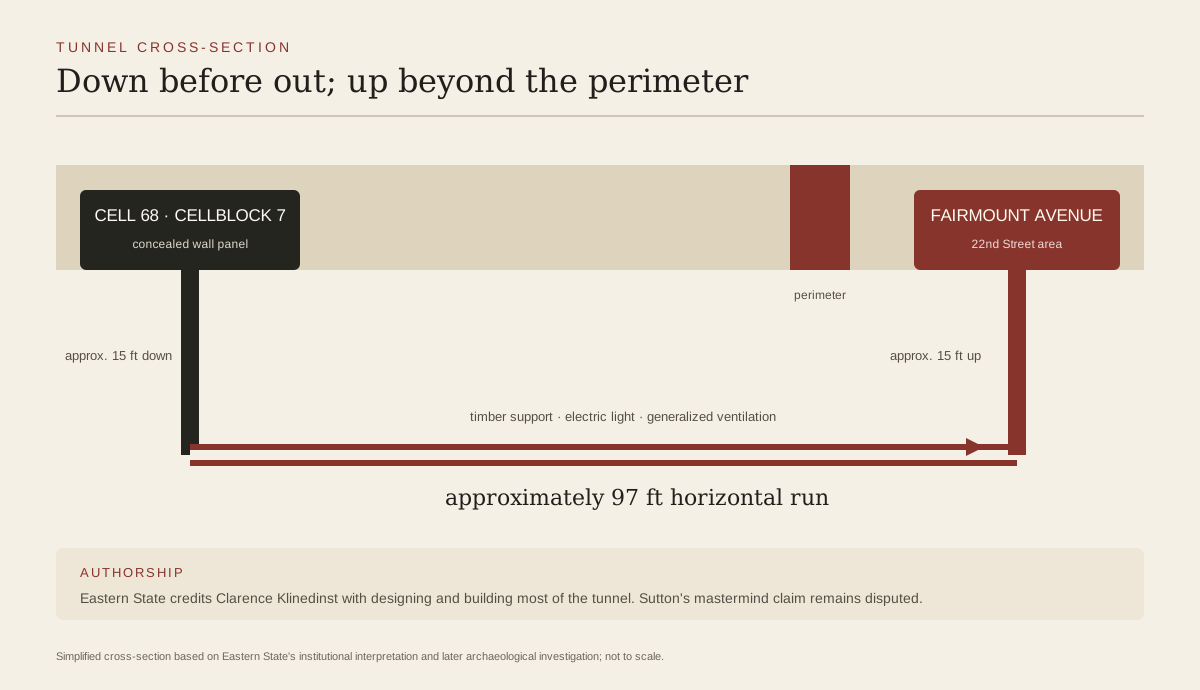
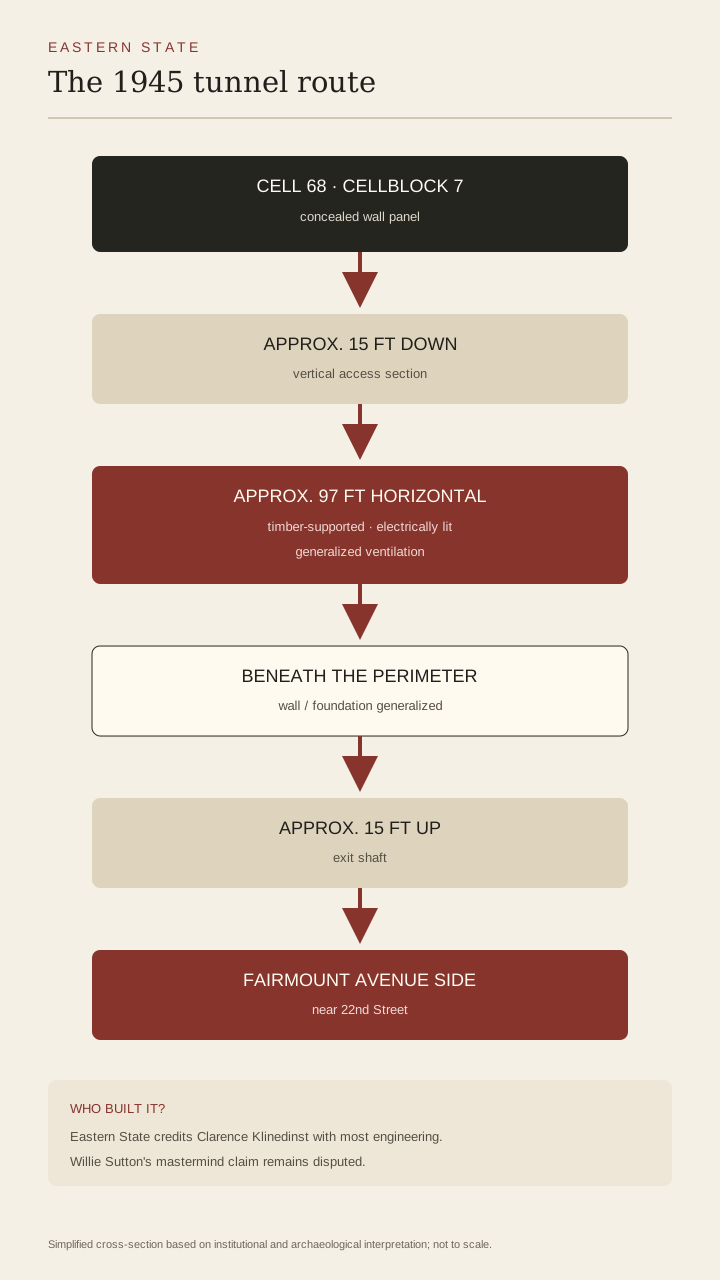
- 01
Cell 68
A concealed wall panel hid the tunnel opening at the end of Cellblock 7.
- 02
Descent
The route went approximately 15 feet down before turning outward.
- 03
Horizontal run
About 97 feet of timber-supported, electrically lit passage crossed beneath the perimeter.
- 04
Rise and exit
A second roughly 15-foot shaft reached the Fairmount Avenue / 22nd Street area.
Simplified cross-section based on Eastern State's institutional interpretation and later archaeological investigation; not to scale.

A tunnel that had to survive for months
Loose soil does not respect an escape plan.
As the passage grew, the prisoners had to keep it from collapsing. Eastern State describes the tunnel as reinforced with wooden bracing. Electric lights were installed. Later institutional and archaeological retellings also describe ventilation.
Those features transformed the operation from a hole into an underground worksite. The tunnel's survival required more than digging.
Material had to be acquired without revealing why it was needed. Timber had to enter the underground works. Electricity had to reach the passage. Air had to remain workable for men spending repeated periods below ground.
And every bucket, bag or handful of earth removed underground created a second problem above it. Where could the dirt go?
Later reconstructions preserve several disposal methods, including scattering soil in prison areas and moving finer material into drains or plumbing. The physical existence and main dimensions of the tunnel are better established than the daily spoil-disposal routine, which cannot be reconstructed load by load with certainty.
What is clear is that the work continued without exposing the entrance. Eastern State's current interpretation says the project took about a year. That was a year in which the central object of the escape had to remain almost invisible.
Material evidence
A tunnel built to last
Concealment, masonry work, timber support, electric lighting and generalized ventilation sustained a long construction period.
- 01They helped turn ordinary maintenance access into a covert excavation opportunity.
Masonry and plaster tools
Klinedinst's prison work gave him tools and knowledge suited to cutting and concealing the tunnel entrance.
- 02The tunnel could survive only if the entrance did not advertise the excavation.
Concealed wall panel
A finished panel hid the opening in Cell 68.
- 03The long tunnel had to remain stable over months of construction.
Wood shoring
Timber reinforced the underground passage.
- 04Lighting made sustained work and movement possible underground.
Electric lights
The tunnel was wired with lights.
- 05Air management would have supported prolonged work in the deep passage.
Ventilation
Modern institutional and archaeological retellings describe ventilation in the tunnel.
Where Willie Sutton enters the story
Willie Sutton is the reason many people know about the escape.
He had already built a national reputation as a bank robber and escape artist. After his 1934 arrest for the robbery of Philadelphia's Corn Exchange Bank, he received a sentence of twenty-five to fifty years at Eastern State.
He repeatedly tried to get out. The FBI calls the 1945 breakout his fifth escape attempt at the penitentiary.
Sutton later made the tunnel part of his own legend. In autobiographical retellings, he presented himself as a major planner.
Eastern State's current history does not accept that version at face value. Its timeline says Klinedinst designed and built most of the tunnel and notes that Sutton later took credit for planning it.
Later accounts derived from other participants challenge Sutton more directly. They place Klinedinst, Russell and a small group of men at the center of the excavation and portray Sutton as less central than his later reputation suggested.
Those memories were recorded years after the event and cannot recover every private discussion inside Cellblock 7. But they matter because they agree on the central correction already made by the institution preserving the prison:
Willie Sutton was one of the twelve escapees. That does not make him the uncontested engineer of the tunnel.
If the story is told only under Sutton's name, Klinedinst's work disappears.
Problem → response
Escape was a sequence of problems
Each response solved a practical obstacle while often creating the next one.
- 01→
Obstacle
Massive perimeter wall
Eastern State's wall rose about thirty feet and extended below grade.
Response
The prisoners bypassed it by tunneling under the perimeter.
- 02→
Obstacle
Concealing months of excavation
A tunnel inside an occupied cell could be exposed by inspection or visible alterations.
Response
Klinedinst concealed the opening behind a finished panel.
- 03→
Obstacle
Structural collapse
A long underground passage required support.
Response
The tunnel was reinforced with wood bracing.
- 04→
Obstacle
Darkness and air
The passage ran deep underground for almost one hundred horizontal feet.
Response
Electric lighting and, in later interpretation, ventilation were installed.
- 05→
Obstacle
Immediate urban manhunt
Emerging beyond the wall still left the prisoners in a dense Philadelphia neighborhood near the prison.
Response
The men scattered, but Sutton and several others were caught quickly.
April 3: the ground opens near Fairmount Avenue
The breakout came on the morning of April 3, 1945. The tunnel rose to the surface near Fairmount Avenue and 22nd Street, outside Eastern State's perimeter. Twelve prisoners got through.
The number is consistent across Eastern State and the FBI. A same-day United Press report initially gave a smaller total, a reminder that active-man-hunt reporting can capture preliminary numbers that later become outdated.
The central sequence is more reliable than dramatized minute-by-minute retellings. The group entered the hidden passage from Cell 68. They descended below the prison. They moved along the braced underground run.
Then they climbed back toward daylight outside the wall. For the first time in the operation, the prisoners' problem was no longer Eastern State itself. It was Philadelphia.
Sutton left a trail
Sutton's freedom was almost comically short.
Eastern State says he was recaptured within minutes and only about two blocks from the penitentiary. The FBI confirms that Philadelphia police caught him the same day.
The historic site's audio tour preserves a detail from Sutton's official post-escape statement: after emerging, he was wet and muddy and saw that his own footprints made him conspicuous. The point does not require embellishment. The tunnel had done exactly what it was built to do: put Sutton outside the wall. But a tunnel does not supply clean clothes, anonymity, transportation or distance.
Once he emerged into an urban neighborhood during an active prison break, he had to solve all of those problems immediately. He did not. The route had been engineered for months. Sutton's time outside lasted minutes.
Other escapees got farther
The twelve men did not share the same outcome on the same timetable.
Contemporary reporting records a chaotic police response in which some escapees tried to obtain vehicles. Several men were quickly returned to custody.
Klinedinst did better than Sutton, but not by much. Eastern State's current interpretation says he remained free for roughly two hours. James Grace created the most unusual return story.
According to the historic site, Grace appeared back at Eastern State early on April 11. He rang the bell and asked to be let in. The institution says he was hungry.
That anecdote should be left where the evidence leaves it. There is no need to invent a speech for him at the door.
Other men remained free longer. Detailed Philadelphia historical work drawing on participant recollections places James "Botchie" Van Sant and Frederick "The Saint" Tenuto at large for roughly seven weeks before capture in New York.
That matters because some later summaries compress the outcome and suggest all twelve were back within days or less than two weeks. The safest conclusion is simpler:
all twelve were eventually recaptured or returned.
The tunnel broke Eastern State's perimeter. It did not produce a permanent escape.
Breakout and return
12prisoners crossed the perimeter
Escaped through tunnel
Twelve prisoners crossed the penitentiary perimeter through the tunnel.
Eventually recaptured or returned
No member of the group remained permanently free.
Sutton recaptured within minutes
The most famous participant was caught roughly two blocks from Eastern State.
Voluntary return
James Grace returned on April 11 and asked to be readmitted.
The tunnel is destroyed
Prison officials did not leave the passage available for another attempt. Eastern State's account says staff filled it with ash from the prison incinerator. The physical route disappeared underground. The argument over it did not.
Sutton's fame helped keep the story alive, but fame also distorted the balance of attention. The episode was increasingly remembered as a Willie Sutton escape even though the most technically important person in Eastern State's account was Klinedinst.
For decades, the tunnel was therefore both physical history and prison legend. Then archaeology gave the story another kind of evidence.
Archaeology finds the route again
In 2005, Eastern State investigated the 1945 tunnel archaeologically.
The entrance was excavated. Ground-penetrating radar was used to trace the path beneath the site. The work helped re-establish the physical route of a passage that had been filled decades earlier.
That investigation matters for more than tourism. Escape stories are especially vulnerable to inflation.
Participants remember themselves as more important. Newspapers publish preliminary measurements. Later writers turn approximate numbers into exact ones. Famous criminals inherit credit from less famous collaborators.
The buried tunnel could not settle every question about who proposed what. But it could settle questions about space. There really was an opening in Cell 68. The route really descended.
The passage really ran beneath the grounds. It really crossed the perimeter. And it really emerged on the Fairmount Avenue side. The archaeology brought the story back from personality to engineering.
Evidence discipline
What the record supports
Status labels distinguish secure conclusions from uncertainty and rejected claims. Color is never the only signal.
DISPUTED
Willie Sutton masterminded and built the 1945 tunnel.
Sutton later claimed substantial planning credit. Eastern State instead credits Clarence Klinedinst with designing and building most of the tunnel. Later participant-derived accounts also challenge Sutton's central claim. Sutton's participation is documented; sole-mastermind status is not.
Sources: SRC-001, SRC-002, SRC-008WELL-SUPPORTED
The tunnel was about 97 feet long.
Eastern State describes approximately 15 feet down, 97 feet outward, and 15 feet up. The 97-foot figure should therefore be understood as the principal horizontal run, not necessarily the entire three-dimensional distance travelled.
Sources: SRC-002, SRC-007WELL-SUPPORTED
The tunnel took exactly one year to build.
Eastern State gives a duration of about a year, while other later accounts vary. The precise start date remains uncertain.
Sources: SRC-002, SRC-007MYTH
All twelve were back in custody within two weeks.
Some later summaries compress the recapture timeline. Detailed Philadelphia historical work indicates Van Sant and Tenuto remained at large for roughly seven weeks. The safe claim is that all twelve were eventually recaptured or returned.
Sources: SRC-008WELL-SUPPORTED
James Grace returned because he was hungry.
Eastern State’s institutional interpretation preserves this anecdote. No dialogue beyond that account is independently established.
Sources: SRC-002DISPUTED
Sutton said he robbed banks 'because that's where the money is.'
The quotation became famous, but Eastern State notes that Sutton denied saying it. It is not used as verified dialogue.
Sources: SRC-002, SRC-003DISPUTED
Klinedinst received a precisely established additional sentence after the escape.
Eastern State's timeline says ten years were added, while its audio tour says an additional three to six years. The public article avoids a precise figure.
Sources: SRC-001, SRC-002The mastermind problem
The most tempting version of the story has one genius at its center. That person is usually Willie Sutton.
It makes sense commercially. Sutton was famous before the breakout and became even more famous afterward. His name survived in American crime folklore in a way Klinedinst's did not.
The evidence does not support giving him sole ownership of the tunnel. Eastern State explicitly credits Klinedinst with designing and building most of it. Later participant-derived accounts dispute Sutton's claim that he organized the operation.
Those sources do not allow us to recover every private discussion in Cellblock 7. Sutton could have influenced planning in ways other men later minimized. Rivalries and reputations matter when participants tell stories years afterward.
That is why the correct evidence status is not:
MYTH — Sutton had anything to do with the plan.
It is:
DISPUTED — Sutton was the mastermind.
His participation is documented. His later claim to central authorship is not uncontested. Klinedinst's technical role is far better supported than the popular version usually suggests.
Another Sutton quote creates the same problem
The tunnel is not the only part of Sutton's reputation where repetition overtook proof. He is famously supposed to have answered a question about why he robbed banks with the line, "Because that's where the money is." The line became so famous that it effectively became part of his identity. Eastern State notes that Sutton denied ever saying it.
The FBI has repeated the quotation in some historical material, illustrating how thoroughly the phrase entered popular memory. That repetition shows the strength of the legend, not that Sutton actually said it. The documented story is remarkable enough without relying on a disputed line.
What actually made the 1945 escape exceptional
Measured by long-term outcome, the breakout failed. All twelve men returned to custody. Sutton barely made it into the surrounding neighborhood. Klinedinst spent roughly two hours free.
Even the men who remained out for weeks were eventually caught. Measured as a physical escape, however, the operation succeeded completely. The prisoners defeated the penitentiary's most imposing barrier without climbing it. They turned a prison work assignment into access.
They hid a breach inside a cell. They descended below the institution. They reinforced and lit a long underground passage. They controlled the dirt well enough to keep the work secret.
They crossed beneath the perimeter. And twelve men emerged on the other side. That is why the 1945 Eastern State escape is more useful than the legend of Willie Sutton alone. The famous robber got through the tunnel.
Clarence Klinedinst is the man the evidence tells us to look at when we ask how the tunnel got there.
Selected chronology
Construction, breakout and return
Sutton is imprisoned at Eastern State
Sutton received a 25-to-50-year sentence after his arrest for the Corn Exchange Bank robbery.
Tunnel work develops
Eastern State's current interpretation says the project took about a year.
Twelve prisoners escape
The men emerge beyond the perimeter near Fairmount Avenue and 22nd Street.
Sutton is recaptured
Sutton is caught only about two blocks from the prison.
Klinedinst is recaptured
Eastern State places Klinedinst's recapture roughly two hours after the breakout.
James Grace comes back
Grace returns to Eastern State and asks to be let back in.
All twelve eventually return to custody
No member of the tunnel group remained permanently free.
Archaeologists trace the tunnel
The entrance was excavated and ground-penetrating radar helped trace the buried route.