
Jack Sheppard’s Four Escapes: How London’s Most Famous Jailbreaker Kept Getting Out
In 1724, Jack Sheppard escaped from custody four times.
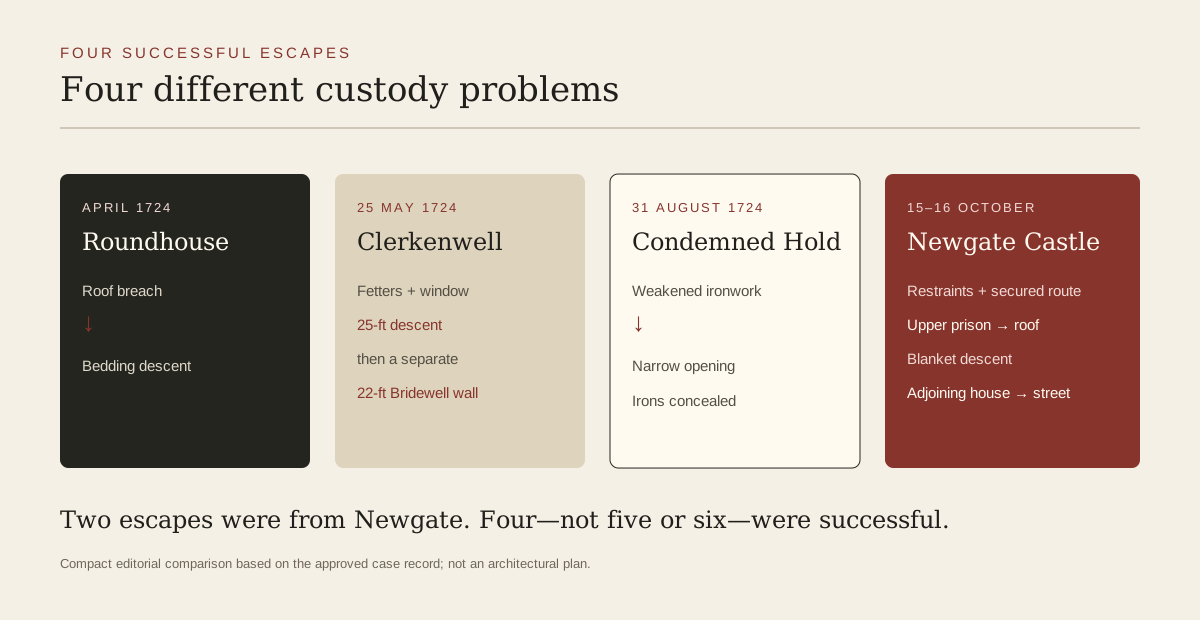
The first time, he broke through the roof of a parish roundhouse. The second time, he escaped a stronger prison with Elizabeth “Edgeworth Bess” Lyon, cutting through bars, lowering them from a high window, and then discovering that they had descended into the yard of another prison. The third time, already condemned to death, he squeezed through a gap in Newgate’s Condemned Hold and left the prison in irons hidden beneath a nightgown.
Then the authorities put him in what they believed was the safest room in Newgate. They called it the Castle. Sheppard got out of that too.
His final breakout, on the night of 15–16 October 1724, forced the keepers of Newgate to confront an embarrassing fact. Locks, bolts, chains, staples, stone walls, barred doors, and height had all been added around one prisoner, yet the carpenter-turned-burglar had treated the prison as a sequence of problems rather than a single barrier.
That did not make Sheppard harmless. He was repeatedly accused and ultimately convicted of burglary, returned to theft after escaping, and associated with violent criminal companions. But his ability to escape transformed him into something unusual for eighteenth-century London: a criminal whose prison breaks became a public story almost in real time.
By the time he was finally hanged at Tyburn on 16 November 1724, the authorities had secured his body more effectively than they had ever managed to secure his reputation.
Before the legend: a carpenter who understood buildings
Sheppard was born in 1702 and trained as a carpenter. That trade matters because later retellings sometimes make his escapes sound almost supernatural. They were not.
His background gave him practical familiarity with wood, fastenings, tools, frames, walls, and the way buildings were assembled. The prisons holding him were not modern high-security institutions engineered around standardized steel doors, electronic surveillance, and controlled circulation. They were buildings full of joins, bars, locks, timber, chimneys, roof spaces, yards, neighboring structures, visitors, servants, and routines.
Sheppard repeatedly found the weak relationship between those elements.
His criminal career accelerated in 1723 and 1724. A 1724 printed life describes him leaving his apprenticeship before its completion, associating with thieves including Joseph Blake—“Blueskin”—and taking part in burglaries. The same account also describes an early incident in which Sheppard forcibly freed Elizabeth Lyon from a roundhouse by taking keys from the custodians.
That episode later contributed to inflated claims about how many times Sheppard “escaped.” It was a rescue, not one of his own prison breaks.
His first successful escape from custody came soon afterward.
Escape One: through the roof of St Giles’s Roundhouse
In the spring of 1724, Sheppard was betrayed by an acquaintance and taken before a magistrate. He was sent to the St Giles’s Roundhouse to be held overnight for further examination.
The strongest near-contemporary narrative does not give a secure calendar day, but later biographical sources place the episode in April. He was confined in the upper part of the building, two stories above ground.
According to the 1724 account, he had little to work with: a razor and part of a chair. Within about two hours, he had broken through the upper structure of the roundhouse. He tied a sheet and blanket together, descended into the churchyard, and escaped.
The mechanism is straightforward enough that it is easy to underestimate what it established.
Sheppard had been placed high in the building because height itself was part of the security system. His answer was to convert bedding into a descent line and the roof into an exit.
That pattern would recur throughout the year. A feature intended to prevent movement became useful once he reached the other side of it.
Escape Two: out of New Prison—and into another prison yard
Sheppard was arrested again on 19 May 1724 after a commotion in Leicester Fields. Elizabeth Lyon was also detained when she came to see him. The two were committed to New Prison at Clerkenwell, where the authorities had reason to take Sheppard more seriously.
The 1724 account says he was put in the secure area known as Newgate Ward and loaded with irons. This escape required more work than the roundhouse.
Friends were able to visit, and the account says they supplied implements. During several days of confinement, Sheppard worked on the barriers. By the early hours of 25 May, he had cut through his fetters, removed an iron window bar, and bored through a heavy oak muntin until an opening was large enough to use.
Then came the descent.
The printed account gives the drop as about 25 feet. A sheet and blanket were fastened to the remaining bars. Lyon went first; Sheppard followed.
They reached the ground. They were still not free.
New Prison stood beside Clerkenwell Bridewell, and the pair had descended into the neighboring prison yard. The story suddenly acquired a second perimeter. The 1724 source gives the remaining wall as roughly 22 feet high.
Sheppard had brought gimlets or piercing tools. The account says he used them to create footholds or a makeshift climbing system in the wall. The pair crossed it and completed the escape.
Whether every measurement in the pamphlet could survive a modern architectural survey is impossible to establish from the surviving evidence. What matters is the documented structure of the problem: they broke out of one secure room, descended from height, discovered they had entered another confined yard, and then solved a second vertical barrier.
It was the first escape that clearly displayed Sheppard’s skill as more than opportunism.
Arrested again—and now Jonathan Wild was involved
Freedom did not persuade Sheppard to leave London or abandon burglary.
During June and July, he returned to crime. His name also became entangled with Jonathan Wild, the celebrated “Thief-Taker General,” whose public career depended on recovering stolen goods and delivering criminals to justice while he himself operated deep within London’s criminal economy.
On 23 July, Sheppard was captured again. He was committed to Newgate and tried during the August sessions at the Old Bailey.
Three indictments were put before the court. He was acquitted on two but convicted of breaking into the house of William Kneebone and stealing woollen cloth. The court sentenced him to death.
At this point, escape changed meaning. From the roundhouse and Clerkenwell, getting out meant avoiding trial or further imprisonment. From Newgate’s Condemned Hold, getting out meant avoiding the gallows.
Material evidence
Tools across four escapes
Sheppard repeatedly adapted available building fabric, bedding and small cutting or piercing tools; later images are not treated as artifact evidence.
- 01Shows how ordinary objects became escape tools during his first breakout.
Razor and chair stretcher
The 1724 account says Sheppard used a razor and a wooden stretcher from a chair while breaking through the St Giles’s Roundhouse.
- 02A recurring solution to height rather than a single specialized device.
Sheets and blankets
Bedding was repeatedly adapted as a means of descent, notably at St Giles’s, Clerkenwell and in the final Newgate escape.
- 03Helped solve the second obstacle after the prisoners had already descended from New Prison.
Gimlets or piercers
During the New Prison escape, the contemporary account says small boring tools were driven into the Bridewell wall and used as makeshift climbing aids.
- 04Central to the repeated contest between stronger restraints and Sheppard’s ability to alter them.
Files and cutting tools
Files and similar tools were repeatedly associated with Sheppard’s efforts to weaken fetters, bars or other prison ironwork; officers later found hidden tools after recapture.
- 05Provided leverage or striking force during the route through the upper prison.
Ironwork removed from the Castle/chimney area
Investigators found that an iron bar had been removed and apparently used during the final Newgate escape.
Escape Three: through the Condemned Hold
Sheppard was scheduled to die on 4 September 1724.
A 1724 account describes condemned prisoners receiving access to visitors through a barred or spiked opening associated with the hold. Sheppard acquired small cutting tools and worked on one of the iron spikes. By Monday, 31 August, his execution warrant had arrived.
That afternoon Elizabeth Lyon and another woman visited him.
Between about five and six, Sheppard completed the break. He removed or snapped the weakened spike and squeezed his body through the opening. One fellow prisoner, Stephen Fowles, helped from inside.
Sheppard’s slight build mattered. Contemporary reporting specifically emphasized how he passed through the narrow gap.
Outside the hold, a nightgown concealed the irons still on his body. A coach carried him away from the Old Bailey area toward Blackfriars Stairs. From there he crossed the Thames by boat to Westminster. Only later, in another location, were the remaining chains sawn off.
The detail that makes this escape almost too perfect is supported by contemporary newspaper reporting: while Sheppard was getting away, keepers elsewhere in the lodge were discussing his earlier escape from New Prison and the precautions necessary to prevent him from doing it again. He was four days from execution. Now he was back on the street.
Why he was caught so quickly
Sheppard’s ability to escape prison was better than his ability to remain hidden.
After a brief excursion outside London, he returned to familiar neighborhoods. On 10 September, Newgate officers and armed assistants tracked him to the Finchley area and recaptured him.
The authorities responded by increasing the physical security around him.
They searched him repeatedly. A small file was reportedly discovered hidden in a Bible on 12 September. On 16 September, two files, a chisel, and a hammer were found concealed in the rushes of a chair.
The message was obvious: putting Sheppard back into an ordinary condemned cell was not enough. He was transferred to Newgate’s strongest room, the Castle, heavily ironed and chained to staples fixed into the floor. Even that was not the end of his attempts.
The 1724 account says Sheppard discovered that a nail could manipulate the large padlock connecting his chain to the floor. He demonstrated the trick to astonished keepers after they discovered what he had done. They chained him more securely.
The next escape would have to overcome not just the room but the prison above and beyond it.

The Castle was supposed to end the story
By October, Sheppard’s confinement had become a contest between cumulative security and cumulative knowledge. The keepers knew he could cut bars. They knew visitors might pass tools. They knew he could work on chains.
They knew he could exploit small openings. They knew he could manipulate a padlock. So they put him high inside Newgate, away from other prisoners, behind multiple locked rooms, in handcuffs and leg irons, chained to the floor. The timing of the Old Bailey sessions appeared to give Sheppard his opportunity.
On Thursday 15 October, between one and two in the afternoon, assistant keeper William Austin visited the Castle with several other men. According to the contemporary account, they examined Sheppard’s fetters and handcuffs and found them secure. Because many prison officers were occupied with the sessions at the Old Bailey, Sheppard was told they would not return until morning.
After they left, nobody can document every movement with certainty. That uncertainty is important.
The 1724 narrator wrote after officials had traced the damage through the prison. They knew which locks were broken, where masonry had been disturbed, which ironwork had been removed, and where a blanket had been used. But the source itself admits that parts of the exact method remained unknown.
What follows is therefore partly physical evidence and partly contemporary reconstruction.
Escape reconstruction
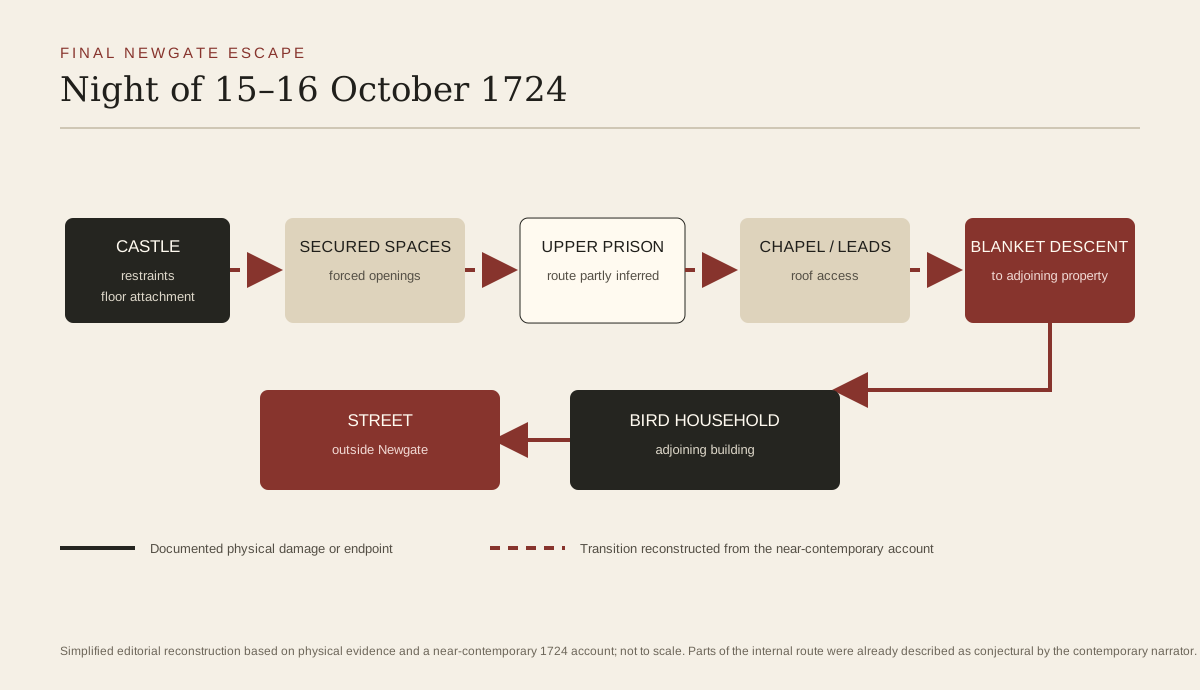
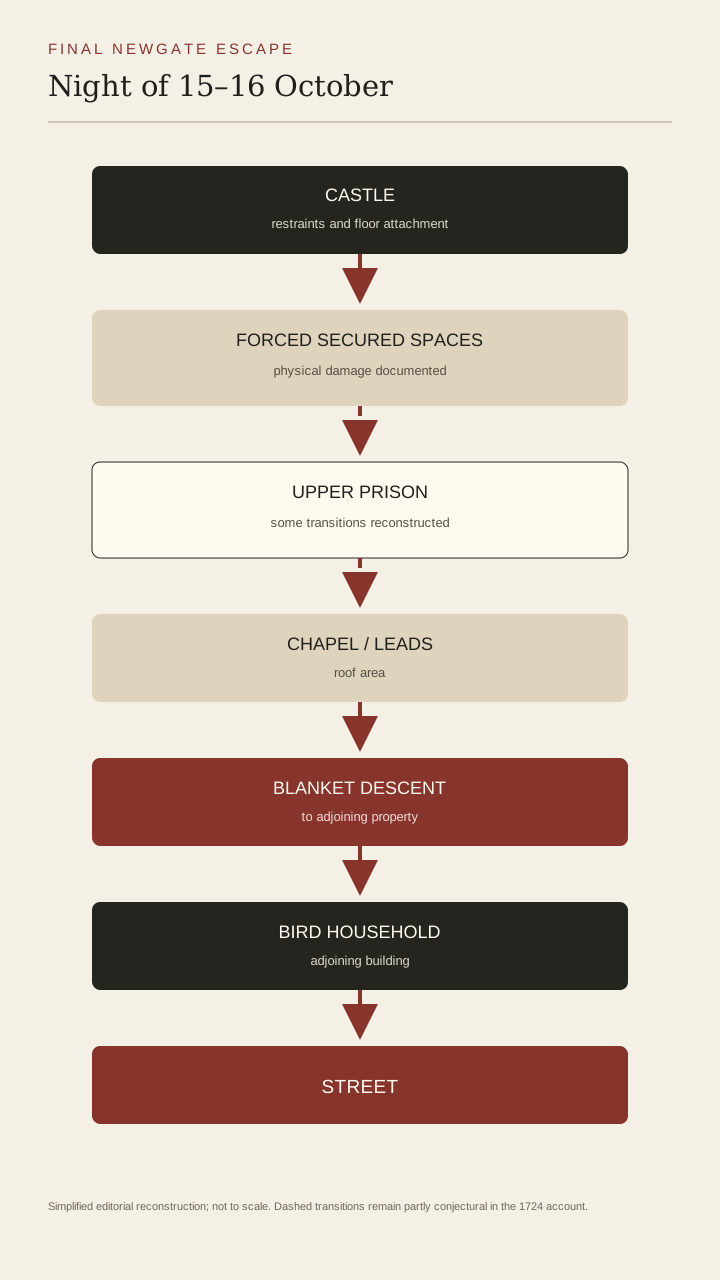
The final route out of Newgate’s Castle
The cutaway distinguishes physical evidence from transitions that the near-contemporary narrator already treated as conjectural.
- 01
Castle
Sheppard began in enhanced restraints attached to the floor.
- 02
Secured spaces
Physical damage supports forced movement through multiple barriers; some exact transitions are reconstructed.
- 03
Upper prison
The route rose toward the chapel and leads area.
- 04
Blanket descent
A blanket system bridged the final height to adjoining property.
- 05
Bird household and street
The adjoining house provided the final passage out of Newgate.
Simplified editorial reconstruction based on physical evidence and a near-contemporary 1724 account; not to scale. Parts of the internal route were already described as conjectural by the contemporary narrator.
Escape Four: the night of 15–16 October
Sheppard first had to free himself enough to move around the Castle.
Investigators believed he broke or released the restraint connecting him to the floor. A heavy iron bar was removed from the chimney area and became a tool. From there he forced his way out of the Castle into another strong room.
The path upward became a sequence of doors, locks, bolts, walls, and enclosed spaces.
The near-contemporary account says six major doors were forced, including one door said not to have been opened for seven years. Locks and bolts were broken or wrenched apart. At some point Sheppard reached the upper parts of Newgate and gained access to the chapel area and the leads—the flat or accessible roof surfaces of the building.
He still had another drop to solve.
A later reconstruction familiar from nineteenth-century biographies says Sheppard realized he needed his blanket and retraced part of his route to retrieve it. The 1724 account firmly supports the end result: a blanket was fastened to an iron spike and used to descend from Newgate onto the adjoining house of a turner named Bird.
Shortly after midnight, the Bird household was disturbed. The street door was later found open.
At about eight the next morning, Austin returned to the Castle. Sheppard was gone.
The room contained rubble. Doors between the Castle and the roof had been broken. The blanket route showed where he had descended.
Newgate opened the damaged route to curious visitors, partly to prove that the keepers had not simply accepted a bribe and released him. The prison had contained him behind more security than at any earlier point in the year. It had also given him more obstacles to turn into tools.
Problem → response
Escape was a sequence of problems
Each response solved a practical obstacle while often creating the next one.
- 01→
Obstacle
Upper-floor confinement at St Giles’s
The first roundhouse confinement placed Sheppard above ground level with no ordinary exit.
Response
He breached the upper structure and descended using bedding.
- 02→
Obstacle
Fetters, barred window and oak framing at New Prison
The second confinement combined personal restraints with window ironwork and heavy timber.
Response
Sheppard cut or removed successive barriers before lowering himself and Bess into the neighboring yard.
- 03→
Obstacle
Bridewell boundary wall
After descending from New Prison, the pair still faced a high wall around the adjoining Bridewell yard.
Response
Sheppard used small tools as improvised climbing holds and completed a second ascent/descent stage.
- 04→
Obstacle
Condemned Hold hatch
Newgate’s Condemned Hold was secured by ironwork and a narrow opening while Sheppard remained in irons.
Response
He weakened or removed an iron spike and squeezed through with assistance while visitors were present.
- 05→
Obstacle
Visible leg irons after leaving the Condemned Hold
Even outside the immediate cell area, restraints could reveal that Sheppard was an escaping prisoner.
Response
A nightgown concealed the irons while he was taken away from Newgate.
- 06→
Obstacle
Enhanced Castle security
After previous escapes and tool discoveries, Sheppard was isolated, handcuffed, placed in leg irons and chained to the floor behind multiple secured spaces.
Response
He freed himself sufficiently to move, appropriated prison ironwork as a tool and forced a route toward the upper prison.
- 07→
Obstacle
Height between Newgate and the adjoining property
Reaching the prison roof did not by itself place Sheppard in the street.
Response
A blanket was fixed for a descent into the adjoining Bird household, from which he reached an exit.
October 15 or October 16?
Both dates appear in modern accounts, and both can be explained.
Sheppard was last inspected on the afternoon of 15 October and began the breakout after that. The adjoining house was disturbed shortly after midnight, meaning he probably reached the street in the early hours of 16 October. His absence was discovered that morning.
So the most accurate description is not to force one date at the expense of the other:
The final Newgate escape took place during the night of 15–16 October 1724.
Four escapes—or more?
Sheppard is sometimes credited with five, six, or even more “escapes.” Those numbers usually mix different categories.
There are four well-attested successful escapes by Sheppard himself in 1724:
- St Giles’s Roundhouse;
- Clerkenwell New Prison;
- Newgate’s Condemned Hold;
- Newgate’s Castle.
An earlier incident in which he freed Elizabeth Lyon from custody was a rescue. Several later incidents inside Newgate were escape attempts that failed before he got out.
Those events belong in the story. They should not be used to inflate the number of successful breakouts.
The distinction matters because four is already enough to explain why London became fascinated with him.
Evidence discipline
What the record supports
Status labels distinguish secure conclusions from uncertainty and rejected claims. Color is never the only signal.
MYTH
Jack Sheppard successfully escaped prison five or six times in 1724.
The strongest chronology supports four escapes by Sheppard himself. Higher totals commonly mix in his earlier rescue of Edgeworth Bess from a roundhouse, failed escape attempts, or later retellings that count episodes differently.
Sources: SRC-001, SRC-004, SRC-006DISPUTED
The final Newgate escape happened on either 15 October or 16 October 1724.
The disagreement is mainly a dating convention. The contemporary narrative says the opportunity began after the keepers left on the afternoon of the 15th, while disturbance in the adjoining house occurred shortly after midnight and the escape was discovered on the morning of the 16th. ‘Night of 15–16 October’ best preserves the evidence.
Sources: SRC-001, SRC-003, SRC-004MYTH
Every step of Sheppard’s final route through the Castle and upper Newgate is known exactly.
The 1724 narrative describes extensive physical evidence after the breakout but explicitly acknowledges that important parts of Sheppard’s method remained secret and labels some reconstruction as conjecture.
Sources: SRC-001DISPUTED
Daniel Defoe certainly wrote Sheppard’s 1724 life and the first-person Narrative was genuinely written by Sheppard.
Several eighteenth-century Sheppard texts have been attributed to Defoe, but modern bibliographic authorities treat the attribution as disputed. The Folger catalogue also states that the first-person Narrative was not in fact written by Sheppard.
Sources: SRC-002, SRC-012MYTH
The May escape required Sheppard to climb a single 25-foot prison wall.
The near-contemporary account describes two separate vertical problems: a descent of about 25 feet from New Prison into the neighboring yard, followed by a Bridewell wall of about 22 feet. Modern summaries sometimes collapse the measurements.
Sources: SRC-001, SRC-004LATER CLAIM
Exactly 200,000 people attended Sheppard’s execution.
Very large crowd estimates became part of Sheppard’s legend and remain common in modern retellings, but exact attendance cannot be established with comparable precision. The surviving evidence supports describing an enormous crowd without treating a precise figure as documented fact.
Sources: SRC-011, SRC-016The problem with the “autobiography”
Sheppard’s fame was being manufactured in print almost as quickly as he was escaping.
Pamphlets appeared in 1724 purporting to tell his life and methods. One Narrative announced itself as written by Sheppard during his confinement. Another History of the Remarkable Life claimed to draw on magistrates, prison officers, shopkeepers, and his confession.
For centuries, Daniel Defoe was frequently credited with one or both works.
Modern bibliographic catalogues are more cautious. Folger Shakespeare Library records state that the Narrative was not actually written by Sheppard and that attribution to Defoe is disputed. The authorship of the History is also uncertain.
That does not make the pamphlets useless. Their publication in the same year, their access to contemporary information, and their close agreement with newspaper notices on crucial events make them indispensable.
But their dramatic language, commercial purpose, moralizing tone, and uncertain authorship mean they must be checked rather than simply believed. Jack Sheppard became a media figure before the word “celebrity” had its modern meaning. The sources that preserve his escapes helped create the legend they were describing.
The final recapture
After the Castle escape, Sheppard again remained close to London instead of disappearing permanently. He committed another burglary, acquired fashionable clothing and a sword, and moved visibly through neighborhoods where his name was already known. On 31 October, he was captured for the final time after drinking heavily in the Clare Market and Drury Lane area.
This time Newgate did not rely only on architecture. He was watched continuously.
Visitors still came. His fame had become profitable enough that gaolers charged people to see him. The artist James Thornhill visited Newgate and drew him in confinement; prints based on that likeness circulated afterward.
On 16 November 1724, Sheppard was taken to Tyburn and hanged.
The crowd was enormous. Later sources supplied spectacular numerical estimates, but the exact number cannot be treated as a modern headcount. What is secure is the extraordinary public attention surrounding the execution and the speed with which Sheppard had become a popular figure.

Why Jack Sheppard mattered after 1724
Sheppard’s historical importance is not that he was a master criminal whose victims did not matter. It is that the struggle between one prisoner and London’s penal machinery became public entertainment, popular mythology, and eventually political symbolism.
His escapes were retold in ballads, prints, pamphlets, plays, chapbooks, and later novels. In 1839, William Harrison Ainsworth’s Jack Sheppard and George Cruikshank’s illustrations revived the story on a huge scale. Victorian critics worried that the character glamorized crime and taught audiences to admire an outlaw.
That later cultural history can distort the 1724 events if it is allowed to flow backward into them. The real sequence is more interesting than the legend because it shows adaptation. At St Giles’s, Sheppard found a roof. At Clerkenwell, he solved a barred window, a long drop, and a second wall.
At the Condemned Hold, he used a weakened iron spike, visitors, concealment, and his own body size. At the Castle, the exact mechanics become partly reconstructive—but the physical aftermath still records a path through restraints, masonry, multiple doors, upper rooms, roof space, and an adjoining house. Each prison learned from the previous escape. So did Sheppard.
That is why four escapes in one year became one of the defining prison-break stories of eighteenth-century London.
Selected chronology
Four escapes and final recapture
First escape: St Giles’s Roundhouse
Sheppard escapes from the upper part of the St Giles’s Roundhouse by breaking through the structure and descending into the churchyard. The exact day is not securely established by the strongest near-contemporary narrative.
Arrested again
Sheppard is arrested and committed with Edgeworth Bess to Clerkenwell New Prison.
Second escape: Clerkenwell New Prison
Sheppard and Bess escape through a window route, descend into the neighboring Bridewell yard and climb its boundary wall.
Recaptured and sent to Newgate
Sheppard is taken at Rosemary Lane and committed to Newgate Prison.
Convicted and condemned
After the August Old Bailey sessions, Sheppard is convicted on the indictment concerning William Kneebone’s property and sentenced to death.
Third escape: Newgate’s Condemned Hold
Sheppard escapes through the Condemned Hold hatch with assistance while visitors are present, days before his scheduled execution.
Recaptured near Finchley Common
Newgate turnkeys and others recapture Sheppard after his first Newgate escape.
Security tightened after tools and failed attempts
Files and other tools are discovered and Sheppard is moved into the Castle, where further attempted escape activity leads to heavier restraint.
Fourth escape: the Castle at Newgate
Sheppard breaks out of Newgate’s most secure confinement, reaches the upper prison, descends into an adjoining house and disappears into London.
Final recapture
Sheppard is recaptured after approximately two weeks at liberty.
Executed at Tyburn
Jack Sheppard is hanged at Tyburn after his final recapture.