
Casanova's Escape from the Leads: How He Got Out of the Doge's Palace
Before Giacomo Casanova became inseparable from his own legend, Venice locked him beneath the roof of its most important political building.
During the night of 25–26 July 1755, officers of the Venetian state arrested him and took him to the Piombi, the prison cells built into the upper part of the Doge's Palace. The name came from the sheets of lead covering the roof above them.
Casanova was not given an ordinary public trial. He later wrote that he was never formally told why he had been imprisoned. Venetian records examined by historians indicate that the State Inquisitors had in fact sentenced him to five years.
He served only about fifteen months.
During the night of 31 October–1 November 1756, Casanova and an imprisoned monk named Marino Balbi went upward through the prison instead of trying to pass through its guarded doors. They reached the roof of the Doge's Palace, found a way back inside the building, descended through administrative rooms, and at dawn emerged into Venice.
That broad escape is historical. The extraordinary detail with which we know it comes mainly from Casanova himself.
More than thirty years later, he turned the episode into Histoire de ma fuite des prisons de la République de Venise qu'on appelle les Plombs—The Story of My Escape from the Prisons of the Republic of Venice Called the Leads. His account describes improvised tools, a ruined first attempt, secret messages, a Bible used to smuggle an iron pike, openings hidden behind pictures, a precarious crossing of the palace roof, a ladder found when the route seemed to fail, doors forced from inside, and a final locked exit opened by a palace custodian who did not realize whom he was releasing.
Some of those details cannot be independently checked. The route itself can.
A Prison Above the Government
The Piombi were not a separate fortress outside Venice. They were inside the Doge's Palace.
The palace was the center of Venetian government, and the upper prison cells lay beneath its lead-covered roof. The modern Doge's Palace describes the Piombi as cells reserved for prisoners associated with the Council of Ten, often in cases involving political offenses. Casanova's two cells have been reconstructed for the palace's special itinerary.
That location created an unusual prison problem. The obvious way out led deeper into the machinery of the state.
To reach the Piombi normally, movement passed through controlled palace spaces. The State Inquisitors and their secretary governed access. Guards, locked passages, and administrative rooms stood between a prisoner and the public city below.
Casanova therefore did not begin by looking for a conventional door. His first idea was to go through the floor.

The First Escape Fails
Casanova's later memoir describes how he gradually acquired the one thing every structural escape requires: a tool.
During limited access to a garret area outside his cell, he said he found a piece of black marble and later a straight iron bar. He used the marble as an improvised whetstone, grinding the bar into a sharp pike.
The exact crafting process comes from Casanova's own retrospective account, but the larger point matters. The Piombi did not supply him with escape equipment. He had to turn what he could find inside the prison into something capable of attacking the building itself. His first plan aimed downward.
Casanova worked beneath his bed, cutting through the floor and trying to create a route into the palace rooms below. He nearly completed it. Then the prison changed around him. Officials transferred Casanova to another cell.
The hole beneath his bed was discovered. The route he had spent months preparing was useless.
The first escape had ended without Casanova ever leaving the prison. One thing survived the transfer.
According to his account, the sharpened iron bar had been concealed inside an armchair that was moved with his belongings. His guards found the damage from the failed escape but did not find the tool.
The problem had changed. Casanova still possessed a way to cut through the prison. He no longer had a route.
The Second Plan Goes Up
In the new cell, repeating the floor attempt was dangerous. The recent discovery meant fresh damage would be more conspicuous, and the space itself did not offer the same conditions as the first cell. Casanova began looking upward. The successful plan would depend on another prisoner: Marino Balbi, a monk confined nearby.
The two men could not simply meet in a workshop and plan together. Their collaboration depended on secret communication between cells and on Balbi eventually doing physical work from his own side of the prison.
That created an immediate practical problem. Balbi needed the pike. Casanova had it. The gaoler stood between them.
The Bible, the Pike, and the Macaroni
The most memorable solution in the escape comes entirely from Casanova's own account, and it should be understood that way.
He wrote that he obtained a very large Bible and tried to use its binding to conceal the sharpened bar. The pike was slightly too long to disappear completely.
Simply sending the book to Balbi therefore risked exposing the ends. Casanova's answer was distraction.
He prepared a large dish of macaroni with melted butter and placed it over the Bible. In his version, the gaoler's attention stayed on carrying the unstable dish without spilling it, while the concealed pike traveled underneath.
The tool reached Balbi.
No independent record allows us to replay that exact scene and verify every movement. But the episode illustrates the structure of the successful plan: Casanova could no longer do all the cutting himself, so the tool had to cross the prison before he could.
Balbi now had what he needed. He began cutting upward.
Material evidence
Tools & Deceptions
Many object-level details come primarily from Casanova's later account; the module preserves that distinction instead of treating every object as independently documented.
- 01Essential in Casanova's account
Iron pike
A sharpened iron bar that Casanova says he fashioned inside the Piombi and preserved after his first failed escape attempt.
- 02Supporting
Black-marble whetstone
Piece of polished black marble Casanova says he used to sharpen the iron bar.
- 03High in retrospective account
Large Bible
Used in Casanova's account to conceal and transport the pike to Marino Balbi.
- 04Deception device in retrospective account
Macaroni dish
Casanova says a large dish of macaroni and melted butter was placed over the Bible to keep the gaoler's attention away from the projecting tool.
- 05Concealment device in retrospective account
Picture and improvised paste
Balbi is said to have concealed ceiling work behind a picture attached using breadcrumbs.
- 06High
Improvised rope
Rope assembled for the roof and interior descent according to Casanova's account.
- 07Critical adaptation in retrospective account
Found ladder
A ladder Casanova says he found on the roof and maneuvered into an upper palace opening when the rope route could not safely lower both escapees.
- 08Supporting
Chancery punch
An iron implement Casanova says he found in the ducal chancery and used alongside the pike while forcing an interior wooden door.
Hiding a Hole in the Ceiling
A ceiling opening posed the same problem Casanova had faced with his first floor route. Making a hole was only half the work. The hole also had to remain invisible. Casanova wrote that Balbi covered one section of his work with a picture attached to the ceiling using breadcrumbs as an improvised paste.
The pair continued the operation in stages.
Balbi first created the necessary opening from his own area, then worked through the separating structure and toward Casanova's cell. Treccani independently confirms the broad sequence: Balbi cut through the ceiling of his own cell and then through the ceiling associated with Casanova's, allowing the two men to move upward.
By late October, the route was almost ready. The escape had reversed the logic of Casanova's first attempt. The floor had failed. The roof became the way out.
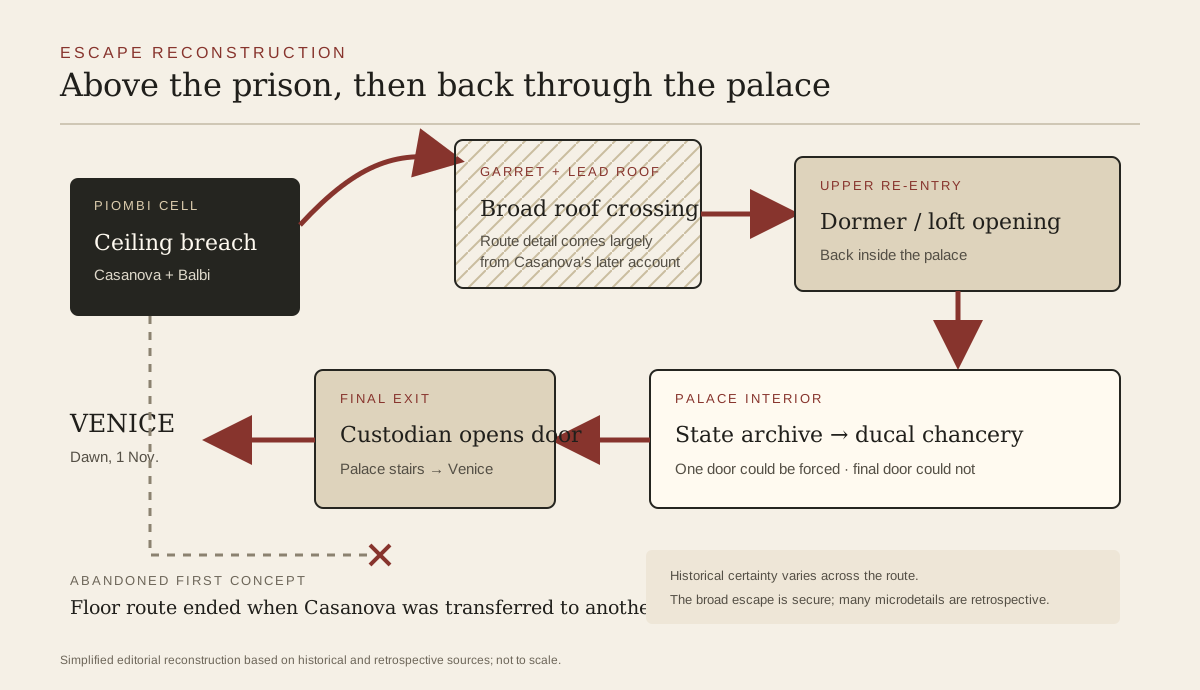
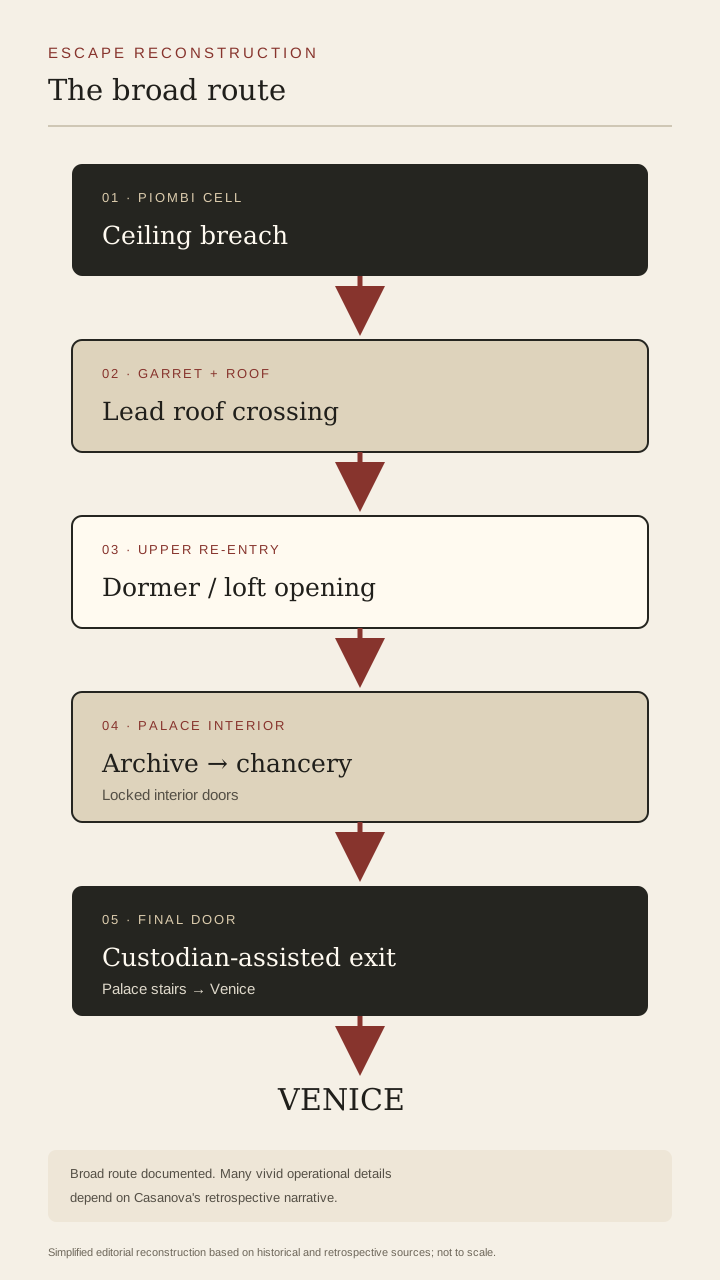
Escape reconstruction
Through the roof—and back into the palace
The broad route is historically secure. The graphic distinguishes that route from the unusually vivid details preserved principally in Casanova's retrospective account.
- 01
Cell
Casanova and Marino Balbi breached the ceiling of the Piombi.
- 02
Roof
They crossed the palace roof and sought a way back inside.
- 03
Upper re-entry
An upper opening led into the loft and palace interior.
- 04
Interior
They passed the archive and chancery areas while confronting locked doors.
- 05
Final exit
A custodian opened the final door after being deceived about how they came to be inside.
Simplified editorial reconstruction based on historical and retrospective sources; not to scale.
The Night of 31 October
Casanova chose the transition between October and November for the attempt.
His later memoir adds an elaborate personal meaning to the date, including a remembered line from Ariosto that he treated almost like a prophecy. That belongs to Casanova's own literary account rather than to the independently verifiable mechanics of the escape.
The important fact is simpler. During the night of 31 October, Balbi completed the opening and joined Casanova. They climbed out of the prison cells and into the space beneath the roof. They were no longer locked inside the Piombi.
They were still inside the Doge's Palace. The next barrier was directly above them: the lead-covered roof that gave the prison its name.
Onto the Leads
Casanova and Balbi opened a route through the roof covering and emerged onto the palace roof.
This is one of the moments most frequently depicted by later artists. It is also the point at which the escape becomes spatially difficult to understand without a diagram.
Leaving a prison cell had not placed them at street level. It had placed them high above Venice on the roof of the government's palace. They needed to move across that roof without falling, without being noticed, and—most importantly—without reaching an edge from which there was no usable descent. Casanova's memoir describes a cautious search across the roof, using the pike to work around obstacles and looking for a point where the pair could re-enter the building.
The solution was not to climb all the way down the outside. It was to go back in.
A Window Below the Roof
Casanova described finding a dormer window on the canal side of the palace roof. A small metal grating blocked access.
The pike that had survived the failed floor escape, the cell transfer, and the passage to Balbi still mattered. Casanova wrote that he used it to remove the grate and then broke through the glass behind it.
Now there was an opening into a loft beneath the roof. But finding an opening created another problem. According to Casanova, the drop inside was too great for both men simply to jump. He could lower Balbi on an improvised rope.
Once Balbi was below, however, Casanova had no secure point from which to lower himself in the same way. The route worked for one man. It failed for the second. Casanova went back across the roof looking for another answer.
The Ladder
In Casanova's account, the solution was already lying elsewhere on the palace roof. He found a ladder near building materials and dragged it toward the dormer opening.
This is one of the most dramatic parts of his memoir, complete with a near-fall and precise descriptions of how he maneuvered the ladder. Those details are not independently recoverable and should not be presented as though an investigator measured the scene in 1756.
The important mechanical point is clear:
a found ladder solved the vertical drop that the rope could solve for only one escapee.
Casanova got the ladder into the opening and descended into the palace interior with Balbi. Once again, they had solved the obstacle immediately in front of them. Once again, freedom was not on the other side. They were now inside an unfamiliar upper portion of the Doge's Palace.
Back Inside the Palace
Casanova's account places the pair in a large loft and then in a gallery containing state records. They descended stone stairs and recognized the ducal chancery. The modern Doge's Palace confirms that administrative and archival spaces existed below the Piombi and that its special itinerary still moves visitors between the roof prison, attic spaces, and rooms associated with the institutions that governed the Republic.
That architectural relationship matters more than whether every doorway in Casanova's memoir can be mapped with certainty today. The escapees had succeeded in moving from the prison into ordinary government space. That changed the security problem. They were no longer trying to break out of a cell.
They were trapped inside a locked palace before normal business had begun.
A Door They Could Cut—and One They Could Not
Casanova wrote that he tried doors as the pair descended through the chancery. One could not be opened normally. The pike became a cutting tool again.
He also found an iron punch used in the chancery and put it to work. Together, the men cut a hole through a wooden door large enough to squeeze through.
The escape had now used the same piece of iron against:
- prison flooring;
- ceilings;
- roof access;
- a window grating;
- and an interior palace door.
But the palace still contained a final barrier. The main exit could not simply be hacked apart in the same way. The escapees had reached a point where force was no longer a practical solution. They needed someone with a key.
The Final Door
Casanova's memoir provides an extraordinary solution. He opened a window where he could be seen from the palace courtyard.
A passerby noticed a strangely dressed man inside the locked building so early in the morning and alerted the palace doorkeeper. The doorkeeper, Casanova wrote, apparently assumed that someone had accidentally been locked inside overnight.
He brought the keys. The door opened. Treccani's independent biographical account preserves the core of this episode in much simpler form: after descending back into the palace, Casanova and Balbi deceived the custodian and gained the exit. That is the limit of what the evidence supports.
Whether every glance and assumption occurred exactly as Casanova remembered it decades later is less important than the final reversal: The prisoners could not defeat the last door themselves. Someone inside the palace opened it for them.
Into Venice
Casanova and Balbi moved out of the Doge's Palace and into the city. They had crossed the Piombi, the roof, the upper palace, its administrative spaces, and its locked interior without using the normal prison exit. Casanova's own account says they entered the first available gondola and initially gave one destination before redirecting the boat toward Mestre.
The precise conversation with the gondoliers is another memoir detail that does not need to be recreated as dialogue. The strategic purpose is clear. Getting out of the Doge's Palace was not enough. Venice itself remained under the authority that had imprisoned them.
The two fugitives therefore moved toward the mainland and continued north. Treccani records that they eventually reached Bolzano, putting themselves beyond immediate Venetian control. Casanova later made his way into a wider European exile and was in Paris by early 1757.
Problem → response
Escape was a sequence of problems
Each response solved a practical obstacle while often creating the next one.
- 01→
Obstacle
Lack of tools
Prisoners did not have normal cutting equipment for breaching floors, ceilings, or locks.
Response
Casanova says he fashioned an iron bar into a pike using black marble as a whetstone.
- 02→
Obstacle
Failure of the first floor route
Casanova's first escape passage became useless when officials moved him to another cell.
Response
He abandoned the downward route and later organized a second attempt through the ceilings with Balbi.
- 03→
Obstacle
Visible ceiling damage
Open structural work could expose the plan before escape night.
Response
Balbi concealed the work; Casanova's account describes a picture attached over an opening.
- 04→
Obstacle
No direct route from roof to street
Reaching the lead roof placed the fugitives high above Venice rather than outside at ground level.
Response
They searched the roof for an upper opening through which they could re-enter the palace.
- 05→
Obstacle
Locked internal palace doors
After re-entering the palace, the fugitives still encountered locked administrative rooms.
Response
Casanova says they forced locks and cut through one wooden door.
- 06→
Obstacle
Final locked palace exit
The last exterior door could not simply be forced with the tools available.
Response
The fugitives obtained an opening from a palace custodian; Treccani describes the custodian as deceived.

The Escape That Casanova Published
The escape became part of Casanova's public identity long before modern biographies turned him into a symbol of seduction.
In 1787, more than thirty years after the event, he wrote a dedicated account of the Piombi episode. Histoire de ma fuite was published in 1788.
He later incorporated the story into the larger autobiography that became Histoire de ma vie. The time gap matters.
Casanova was not writing an official deposition immediately after reaching the mainland. He was an elderly author reconstructing the event that had helped establish his reputation as an adventurer.
Modern Venetian museum interpretation explicitly warns that Casanova participated in creating his own myth and that the escape may have been partly romanticized. That does not erase the history. It tells us how to read it. The broad framework is supported beyond Casanova:
- imprisonment in the Piombi;
- an initial failed escape;
- cooperation with Balbi;
- movement through the ceiling;
- access to the roof;
- re-entry into the palace;
- deception at the exit;
- escape at dawn on 1 November 1756.
Inside that framework, Casanova supplied the extraordinary close-up view, provided it is read for what it is: his own later memory of the escape.
Evidence, Myth and What Casanova Told Us
Did Casanova really escape from the Piombi?
DOCUMENTED
Yes.
Venetian archival scholarship, institutional history, contemporary reaction, and Casanova's own account all support the escape. The broad event is not merely a literary invention.
Did he escape alone?
MYTH
No. The monk Marino Balbi was essential to the successful attempt and escaped with him. Reducing the episode to Casanova single-handedly cutting his way out removes a major participant from the history.
Had Casanova already tried to escape once?
DOCUMENTED
Yes.
Treccani reports that his first attempt involved cutting through the floor beneath his bed. The attempt was ruined when Casanova was moved to another cell.
Was Casanova simply imprisoned "for seducing women"?
MYTH / MISLEADING
No single simple charge explains the imprisonment.
Treccani reports an official accusation involving anti-religious verse and secret reports portraying Casanova as an unbeliever, corrupting influence, swindler, and danger to Senator Bragadin. Other institutional summaries emphasize libertinism, occult books, Freemasonry, and irreligion.
Casanova himself was not formally told the reason for his arrest.
Was he serving a life sentence?
MYTH
Archival evidence summarized by Treccani indicates a five-year sentence. Casanova did not know the term and feared he might remain imprisoned indefinitely.
Did Casanova really smuggle his pike beneath a dish of macaroni?
LATER CLAIM / SELF-REPORTED
That detailed episode comes from Casanova's own later narrative. It is plausible and consistent with the need to transfer the tool to Balbi, but the exact macaroni-and-Bible operation is not independently documented point by point and remains explicitly attributed to Casanova.
Did Balbi hide a hole with a religious picture pasted up with breadcrumbs?
LATER CLAIM / SELF-REPORTED
Again, this comes from Casanova's detailed account. The broader fact that Balbi concealed ceiling work is compatible with the escape sequence, but the breadcrumb-paste detail should remain attributed.
Did Casanova almost fall from the roof while moving a ladder?
LATER CLAIM / SELF-REPORTED
Casanova described an extremely dangerous ladder maneuver and a near-fall.
No independent source can verify the exact physical episode. It is appropriate to say that Casanova claimed or recalled it, not to reconstruct it as certain fact.
Did the doorkeeper simply unlock the palace for them?
WELL-SUPPORTED IN BROAD FORM
Treccani confirms that the fugitives deceived the custodian and obtained their exit. Casanova supplies the more elaborate explanation that he was spotted at a window and mistaken for someone accidentally locked inside. The broad mechanism is well supported; the exact misunderstanding is memoir-derived.
Was the escape account written immediately afterward?
MYTH
No. Casanova wrote Histoire de ma fuite in 1787 and published it in 1788, more than thirty years after the 1756 escape. His larger memoir project followed.
Evidence discipline
What the record supports
Status labels distinguish secure conclusions from uncertainty and rejected claims. Color is never the only signal.
DOCUMENTED
Giacomo Casanova escaped the Piombi at dawn on 1 November 1756.
The event is supported by Venetian archival scholarship, institutional histories, contemporary reaction reported in later scholarship, and Casanova's own account.
Sources: SRC-001, SRC-002, SRC-003, SRC-005DOCUMENTED
Marino Balbi escaped with Casanova and played an essential role in cutting the successful ceiling route.
Treccani independently identifies Balbi as the monk whose ceiling work enabled the successful escape, agreeing with Casanova's account.
Sources: SRC-001, SRC-003DOCUMENTED
Casanova's first escape attempt failed because he was transferred after cutting through the floor under his bed.
This sequence is reported by Treccani from the historical literature as well as by Casanova.
Sources: SRC-001, SRC-003MYTH
Casanova was serving a life sentence.
Archival evidence summarized by Treccani indicates a five-year sentence. Casanova did not know the term and feared indefinite imprisonment.
Sources: SRC-001MYTH
Casanova was imprisoned simply because he was a famous seducer.
The evidence points to a more complicated mix of anti-religious accusations, informer reports, unconventional conduct, irreligion, and broader suspicion by the State Inquisitors.
Sources: SRC-001, SRC-005LATER CLAIM
Casanova smuggled the pike to Balbi along a Bible beneath a large dish of buttery macaroni.
This memorable mechanism is described in Casanova's own account written more than thirty years later. It is not independently documented in equivalent detail.
Sources: SRC-003, SRC-006LATER CLAIM
Balbi concealed ceiling work with a religious picture pasted up using breadcrumbs.
The detail comes from Casanova's retrospective narrative. The broader ceiling breach is independently supported.
Sources: SRC-001, SRC-003LATER CLAIM
Casanova nearly fell from the palace roof while maneuvering a ladder.
Casanova gives a detailed account of the incident, but it cannot be independently verified at that level of precision.
Sources: SRC-003WELL-SUPPORTED
The successful escape route crossed the roof and then descended back through the interior of the Doge's Palace.
Treccani confirms the roof-to-palace route in broad form, Casanova supplies the detailed sequence, and the palace's current architectural interpretation confirms the relationship between the Piombi, attic, and government rooms below.
Sources: SRC-001, SRC-002, SRC-003MYTH
Casanova's detailed escape narrative was a contemporaneous report written in 1756.
Histoire de ma fuite was written in 1787 and published in 1788, more than three decades after the escape.
Sources: SRC-004, SRC-005, SRC-006MYTH
Every precise detail in Casanova's escape narrative can be independently verified.
The broad event is strongly established, but modern MUVE interpretation explicitly notes the role of Casanova's own storytelling in creating his legend and allows that the famous escape may have been partly romanticized.
Sources: SRC-001, SRC-005Why the Escape Worked
Casanova's route succeeded because the plan changed whenever the palace made the previous solution useless. He first tried the floor. The prison moved him. The route disappeared.
The tool did not. In the new cell, Casanova could not simply repeat the same work. He recruited Balbi and redirected the escape upward. Balbi needed the pike.
Casanova found a way—at least in his own account—to send it through the gaoler's hands without exposing it. A hole in the ceiling would reveal the plan. The work was concealed. The roof offered freedom from the cell but no safe road to the street.
They crossed it looking for a way back inside. A dormer opened into the palace, but the drop defeated Casanova's rope plan. He found a ladder. The palace interior replaced prison walls with locked administrative doors.
They cut through one. They could not cut through the last. So they stopped trying to break the building and allowed a palace custodian to open it. That final change is what makes the escape distinct.
Casanova did not follow one perfect plan from beginning to end. The first plan failed completely. The successful escape was a chain of revisions. And because the most detailed version of that chain was written by Casanova himself decades later, the case carries one final challenge for the historian:
reconstruct the escape without becoming trapped inside the legend.
Selected chronology
Confinement, escape and publication
Casanova is arrested
Venetian authorities arrest Casanova and confine him in the Piombi of the Doge's Palace.
Secret five-year sentence
Records of the State Inquisitors later examined by historians indicate a five-year sentence, although Casanova was not told its duration.
First escape attempt
Casanova begins cutting through the floor beneath his bed.
Cell transfer ruins the first route
Officials move Casanova to another cell, ending the floor-based attempt.
Balbi joins the plan
Casanova and Marino Balbi coordinate a new escape based on breaching the prison ceilings.
The escape from the Piombi
Casanova and Balbi move through the ceiling, reach the palace roof, re-enter the building, descend through its interior and obtain an exit at dawn.
The fugitives reach safety
Casanova and Balbi move beyond Venice; Treccani records their eventual arrival in Bolzano, outside immediate Venetian control.
Casanova returns to Paris
Casanova is again in Paris, beginning the next phase of his European career.
Casanova publishes his escape story
Histoire de ma fuite, written in 1787, appears in print and becomes a central source for the detailed mechanics of the escape.