
Gunther Plüschow was outside Donington Hall before the hardest part of his escape had really begun. On 4 July 1915, the German naval officer and a fellow prisoner broke through the perimeter of the British officers' camp in Leicestershire. The wire put them outside captivity, but not outside Britain. Plüschow still had to cross the country, evade a public manhunt and find a way across wartime waters to a neutral state. Nine days later, he was back in Germany.
At a Glance
- Escape began: 4 July 1915
- Camp: Donington Hall, Leicestershire
- Escapees from camp: Gunther Plüschow and Oberleutnant Trefftz
- Long-term success: Plüschow only; Trefftz was recaptured
- Route: Donington Hall → Derby → Leicester/London → Tilbury/Gravesend → Vlissingen → Germany
- Successful ship: Dutch ferry Prinses Juliana
- Boarding: Early 11 July 1915
- Germany reached: By 13 July 1915
- Main methods: Concealment, wire crossing, civilian disguise, rail travel, dock-worker disguise, small boat, stowaway passage
- Evidence caution: Many exact fence and Thames details come from Plüschow's own memoir
An officers' camp in an English country house
Donington Hall was not a purpose-built prison. The British government requisitioned the eighteenth-century Gothic house during the First World War and converted it into a prisoner-of-war camp for German officers. A photographic book produced around 1916, now held by the University of Edinburgh, shows officers assembling for roll call, eating in the dining hall and sleeping in dormitories while lower-ranking German personnel served as orderlies in huts on the grounds.
Plüschow arrived there in 1915 after an extraordinary journey of his own. He had been a German naval aviator at Tsingtao in China, escaped the collapsing German enclave, crossed the Pacific and the United States, and then been captured by the British at Gibraltar on his attempted return to Europe. For him, Donington was not an endpoint.
Choosing 4 July
The most detailed description of the camp breakout comes from Plüschow himself. He later wrote that he and a fellow naval officer, Oberleutnant Trefftz, chose 4 July for their attempt. They reported sick that morning and were entered on the sick list, creating a reason for them to be absent from ordinary activity.
Bad weather arrived during the afternoon. According to Plüschow, the two men concealed themselves in the grounds while another prisoner helped disguise their hiding place with garden furniture.
Their comrades then had a second job: delay discovery. Plüschow wrote that, during evening checks, other prisoners occupied the two escapees' beds. Later, when another inspection came, men shifted between beds to maintain the impression that both sick officers were still inside. This deception is central to Plüschow's account, but it should be understood for what it is: first-person memoir evidence, not a surviving British guard log reproduced alongside the story.
The wire
After the last inspection and a change of guard, Plüschow and Trefftz moved toward the perimeter. His memoir describes several layers: a high wire fence, alarm wiring, a broad low obstacle and another barrier. He gives exact dimensions for the fences and distances between them.
Those numbers make the scene vivid. They are not necessary to establish what happened.
The secure fact is that both men crossed Donington Hall's wire perimeter after midnight and reached the countryside. Their hands and clothing were damaged in the process, but neither was stopped at the camp boundary. Once clear, they put on civilian outer clothing and began walking toward Derby.
Derby before dawn
The two escapees moved at night, leaving the main road when vehicles approached. Plüschow's account places them on the outskirts of Derby at about four in the morning.
There they cleaned themselves up and prepared to use the railway. Their plan was to separate, reducing the chance that two German naval officers travelling together would attract attention. Plüschow took a route through Leicester toward London. He knew the capital from a pre-war visit, an advantage that made him less dependent on conspicuous questions or maps once he arrived.
The men intended to reunite at St Paul's Cathedral. Trefftz never reached the meeting.
One escape becomes two outcomes
Plüschow waited at the agreed London rendezvous. By the time he searched the newspaper placards and reports, he learned that Trefftz had been recaptured.
Modern accounts place Trefftz's arrest around the London docks. Whatever the exact point, the operational result was clear: the joint escape from Donington had become Plüschow's solo evasion.
British authorities now had another advantage. They could publish a detailed description.
The notices gave Plüschow's build, fair complexion, blond hair and blue eyes. Most distinctive was a Chinese dragon tattoo on his left arm. Plüschow needed a new appearance before police attention tightened.
Turning himself into a dock labourer

He did not solve the problem with a forged passport. Plüschow's memoir is explicit: during this phase he had no papers or passport at all.
Instead, he altered how strangers categorized him. He discarded or hid clothing that matched the police description, used a mixture of vaseline, bootblack and coal dust to darken his blond hair, dirtied his hands and clothes, and transformed the smart naval officer into what he hoped looked like an ordinary waterfront labourer.
A photograph published with his English memoir shows him in this disguise. The method had a practical logic. A visibly grimy dock worker could move through the industrial Thames environment with less scrutiny than a well-dressed foreign officer. The disguise did not provide an identity that could survive formal questioning; it was meant to prevent formal questioning from beginning.
The problem of leaving an island
Plüschow still needed a neutral destination. One morning on a London bus, he overheard two businessmen discussing Dutch steamers leaving Tilbury for Flushing—Vlissingen—in the neutral Netherlands.
The fragment of conversation gave him the route he had been looking for. He travelled to Tilbury and began studying the lower Thames. Dutch cross-Channel ferries offered something a south-coast fishing boat or British vessel did not: a regular passage directly into neutral territory. Finding the ferry was easier than boarding it.
The lower Thames
The next part of the escape is where the memoir becomes both richest and hardest to map precisely. Plüschow moved between Tilbury, Gravesend and London while trying to get from shore to a Dutch steamer. Mud, tides, current, guarded wharves and the absence of usable oars repeatedly defeated him.
Kent Archaeological Society's modern reconstruction divides these episodes into five attempts. The fifth succeeded. That is a useful way to organize the memoir, although the society also cautions that Plüschow's narrative has unclear dates, uncertain locations and possible embellishment. The historical core is simpler: Plüschow made several failed efforts on the Thames before securing a small boat and finally reaching the Prinses Juliana.
A ferry that kept sailing without him
The Dutch steamer Mecklenburg figured prominently in the failed attempts. Plüschow could see the vessel he wanted and still be unable to reach it. At low tide, mud cut him off from boats. At other times, the current was too strong. One small craft filled with water.
Each failure created a new problem. Remaining near the river increased the chance that police would recognize him; returning to London created more travel but also allowed him to blend into the city's crowds before trying again. The repeated failures explain why the camp breakout and the successful departure from Britain were separated by nearly a week.
The final small boat
On the final attempt, Plüschow returned to the Thames and obtained a small boat. His account describes passing a guarded military pontoon bridge, becoming caught briefly at an anchor cable, and later concealing the boat near the riverbank while waiting for the tide. Kent researchers have tried to connect these descriptions to specific surviving or historical locations, but some identifications remain interpretations rather than proven waypoints.
The Mecklenburg sailed again without him. Then another Dutch ferry appeared. It was the Prinses Juliana.
Onto the Prinses Juliana
Plüschow waited until the early hours of 11 July. In his account, he rowed out, reached the ferry's buoy and abandoned the small boat. He then climbed a heavy steel cable toward the ship, looked over the rail and pulled himself aboard.
Once on deck, he still needed to become invisible. He first sheltered near deck machinery and then moved toward a lifeboat, where he concealed himself beneath or within the boat covering.
The ferry sailed. This was the decisive boundary in the escape. Donington's wire had ended his physical confinement; the departure of the Prinses Juliana was what finally carried him out of British jurisdiction.
Vlissingen

Plüschow woke to the ship approaching Vlissingen. The Netherlands was neutral in the First World War. Reaching Dutch territory did not automatically make every legal difficulty disappear, but it removed the central British-custody problem that had governed the previous week.
Plüschow says he mingled with people leaving the ship and got ashore without submitting himself to the ordinary passenger-control process. He then turned east by rail.
His memoir contains an encounter with Dutch security personnel who questioned him but ultimately allowed him to continue. Without a Dutch archival file in the present source base, the exact dialogue and circumstances of that encounter are best left as memoir detail.
Arrested by his own side
Crossing into Germany produced one final reversal. Plüschow was dirty, undocumented and carrying an extraordinary story about escaping from Britain. German troops at or near Goch initially suspected that he might be a spy.
He was detained and moved to Wesel. There, a German naval acquaintance recognized him and established his identity. By 13 July 1915, Plüschow was travelling onward inside Germany. Nine days had passed since the escape from Donington Hall.
Was he really the only one?
Plüschow is often described as the only German prisoner of war to escape from Britain and return to Germany in either world war. That distinction is defensible only if its boundaries remain clear.
Historian Panikos Panayi's study of German civilian and combatant internees in First World War Britain estimates that hundreds, perhaps thousands, attempted escape. Across that broader internment population, he says only three people succeeded in getting back to Germany. He identifies Plüschow as the Donington military escapee who made it home, but he also notes other successful escapees in wider categories, including the Austro-Hungarian internee Pál Stoffa. The careful claim is therefore narrower: Plüschow is widely identified as the only German combatant POW held in Britain during the world wars to escape and successfully return to Germany. It would be misleading to expand that into "the only enemy internee ever to escape Britain."
What the memoir can tell us
Plüschow first published his story in German in 1916, while the war was still underway. The English edition appeared in 1922 with photographs, reproductions of wanted notices and a long account of his travels.
That proximity gives the memoir real evidentiary value. It also makes its adventure-story style impossible to ignore.
The camp concealment, disguise, river mishaps and boarding are described from Plüschow's viewpoint. Some can be corroborated by later institutional and local research; others survive mainly because he said they happened.
That is why the strongest reconstruction uses layers of confidence. Donington, Derby, London, Tilbury/Gravesend, the Prinses Juliana, Vlissingen and Germany are solid route anchors. Exact fence measurements, the formal number of Thames attempts, particular riverbank hiding places and colorful conversations deserve more caution.
Why the escape worked
The first success came from delayed discovery. If Plüschow's account of the sick list and occupied beds is substantially correct, the prisoners did more than breach wire. They manipulated the camp's information system so the guards did not immediately know there was an escape to pursue.
The second success came from changing environments. Plüschow left the countryside for railways, then used London's anonymity, then remade himself for the industrial waterfront. He did not keep one disguise or one mode of travel simply because it had worked once.
The third success was persistence at the coast. Several Thames efforts failed. None forced him to return to Donington, and each left him able to attempt another route to the Dutch steamers.
The physical breakout was one night. Escaping Britain took the rest of the week.
The one who made it home
Trefftz crossed the Donington wire too. He did not reach Germany.
That contrast defines Plüschow's case better than the broadest version of the "only one" legend. Breaking out of a POW camp and escaping the country were different achievements.
Plüschow completed both. He moved from an English country-house camp to the streets of London, from a coal-blackened dock disguise to a small boat on the Thames, from the deck of a Dutch ferry to neutral Netherlands, and finally across the German frontier.
The route was improvised in places and later dramatized in print. Its outcome was not.
Documentary reconstruction
Two distinct problems: leave the camp, then leave Britain
A case-local visual focused on the historical question that the surviving evidence can answer.
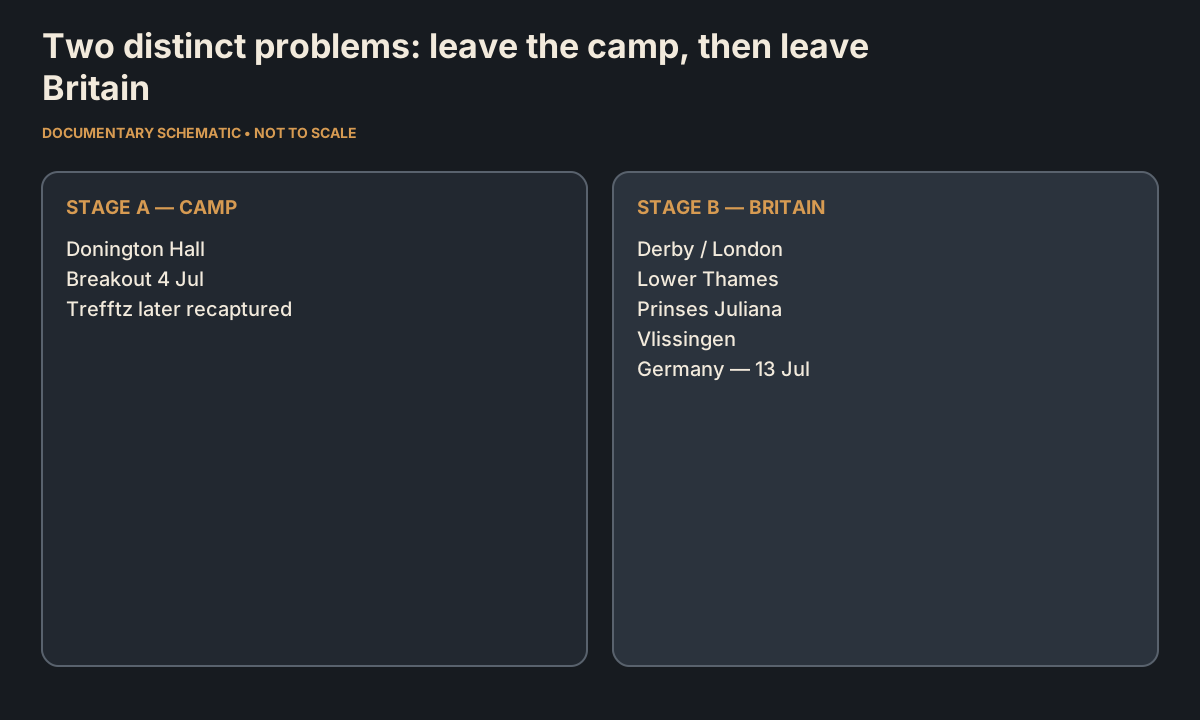
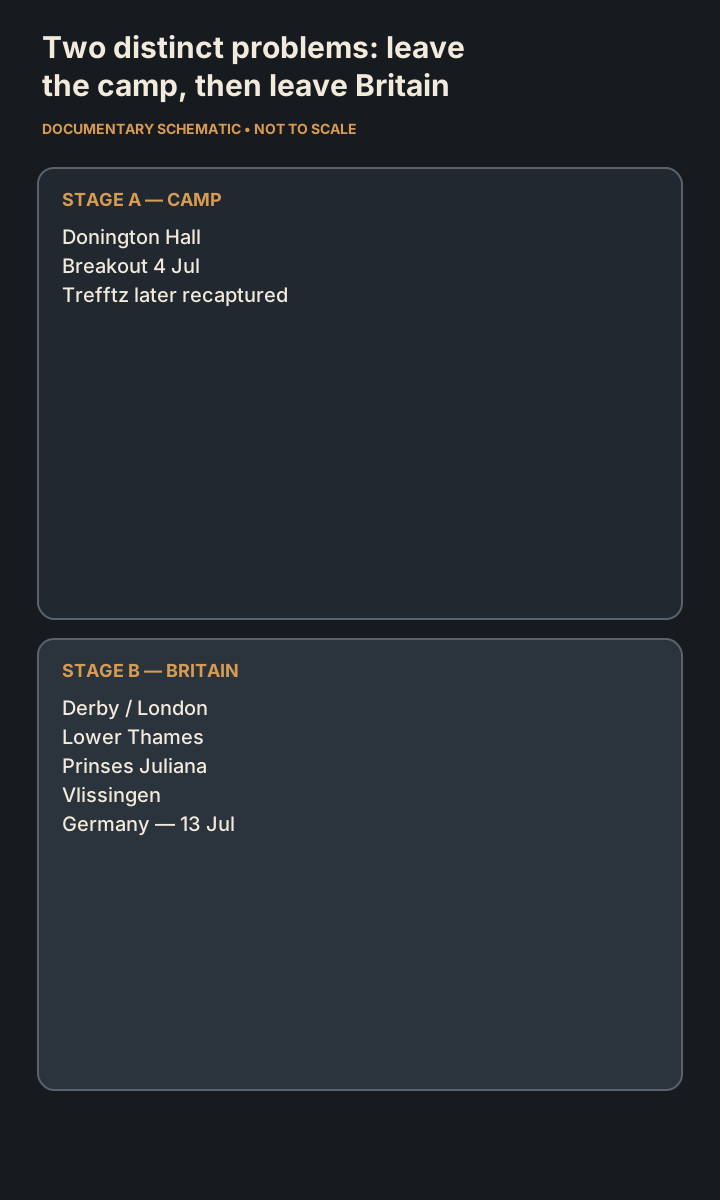
Simplified documentary reconstruction; not to scale. Evidence qualifications are written directly into the visual and explained in the adjacent text.
Evidence discipline
What the record supports
Status labels distinguish secure conclusions from uncertainty and rejected claims. Color is never the only signal.
DOCUMENTED
Plüschow and Trefftz escaped Donington Hall on 4 July 1915 and Plüschow reached Germany nine days later.
Plüschow's early published account, institutional Donington history and local Thames research agree on the core chronology and successful return.
Sources: SRC-001, SRC-004, SRC-005, SRC-006UNKNOWN
The precise heights and spacing of every Donington Hall wire obstacle are independently verified.
Plüschow supplies exact dimensions in his memoir, but the institutional sources reviewed here confirm the breakout rather than independently auditing those measurements.
Sources: SRC-001, SRC-004MYTH
Plüschow used forged identity papers in London.
His memoir explicitly states that he had no papers or passport during the London/Thames evasion. His protection came from appearance, behavior and clandestine boarding.
Sources: SRC-001LATER CLAIM
Plüschow made exactly five separate Thames escape attempts before succeeding.
Kent Archaeological Society organizes the memoir-derived Thames episodes into five attempts but also warns that Plüschow's dates, timings and exact locations can be unclear.
Sources: SRC-001, SRC-005UNKNOWN
The exact riverbank sites of every failed Thames attempt are known.
Kent local history proposes likely identifications for some places, including possible Canal Basin and Bawley Bay locations, but labels several as uncertain.
Sources: SRC-005DOCUMENTED
The successful escape ship was the Dutch ferry Prinses Juliana.
Plüschow identifies the vessel, and local historical research independently centers the same ferry in the final Gravesend/Tilbury escape stage.
Sources: SRC-001, SRC-005, SRC-006WELL-SUPPORTED
Plüschow was the only German combatant POW held in Britain during the world wars to escape and successfully return to Germany.
Specialist histories repeatedly make this narrow claim, and Panikos Panayi's academic survey identifies Plüschow as the German military internee who escaped Donington and returned home. The wording is kept narrow because the wider internment system included other successful escapees in different categories.
Sources: SRC-003, SRC-005, SRC-008MYTH
Plüschow was the only German or enemy internee of any kind ever to escape British wartime internment.
Panayi's wider study of civilian and combatant internment says three people from the broader First World War internment population succeeded in getting back to Germany and identifies other successful escapees, including Austro-Hungarian Pál Stoffa.
Sources: SRC-003, SRC-008LATER CLAIM
Every dramatic Thames and Dutch-security episode in Plüschow's memoir is independently documented.
The memoir is an essential early participant source, but modern local researchers explicitly caution that it may contain embellishment and uncertain dates or locations.
Sources: SRC-001, SRC-005