
Henri Giraud's escape from Königstein began with a problem larger than the fortress wall. Even if the French general could get down from the sandstone plateau, he would still be hundreds of kilometres inside German-controlled Europe, a recognizable senior officer travelling through a police state in wartime.
On 17 April 1942, after nearly two years in captivity, he solved the first part of that problem with a rope. The rest of the escape depended on disguise, false papers, railway travel, outside helpers and a route through occupied Alsace to neutral Switzerland. The broad sequence is well documented; the most spectacular measurements and anecdotes are not always equally secure.
At a Glance
- Date: 17 April 1942
- Place: Königstein Fortress, Saxony, Germany
- Escapee: General Henri Giraud
- Captivity: Oflag IV-B, a prisoner-of-war camp for senior Allied officers
- Main method: Assisted rope descent through the fortress perimeter
- Second phase: Civilian disguise, false identity and rail travel
- Frontier: Entered Switzerland on 22 April
- Return to France: Reached Lyon on 25 April
- Outcome: Successful escape; Giraud refused pressure to return voluntarily to German captivity
A general inside a fortress
German forces captured Giraud on 19 May 1940 during the collapse of the French front. Six days later he reached Königstein, an imposing fortress above the Elbe southeast of Dresden that had been converted into a prisoner-of-war camp for senior officers.
The geography did much of the guarding. Königstein stood on a high sandstone plateau bounded by walls and steep rock faces. Even a prisoner who crossed the internal perimeter still faced a difficult descent before reaching the town and railway network below.
Giraud was sixty-one when he arrived and sixty-three when he escaped. He had already escaped German captivity once, during the First World War, so another attempt was not an abstract possibility. Königstein's own museum says he began preparing systematically from September 1940.

Preparing inside Oflag IV-B
Prisoners at Königstein could receive letters and parcels, although their communications were controlled. That routine traffic offered material and a limited channel to the outside world.
According to the fortress museum, Giraud and trusted fellow prisoners made an escape rope from the cords used to tie parcels and strengthened it with telephone wire. He also accumulated civilian clothing, German money and a current railway timetable. A secret code passed through generals released from the camp allowed preparations to be coordinated with people in France.
The escape plan therefore extended well beyond the fortress. French military historian Christine Lévisse-Touzé describes officers of the armistice army organizing the operation with help from Alsatian and Lorraine resistance networks. In July 1942, U.S. diplomat Robert Murphy recorded General Charles Mast saying that he had organized Giraud's escape with the consent of the French Second Bureau.
That outside network was essential. A successful descent would otherwise leave Giraud at the foot of a German fortress without valid papers, a safe identity or a route back toward France.
The rope descent
The fortress museum identifies a section of Königstein as Giraud's point of descent. On the morning of 17 April, two fellow prisoners helped lower him through an embrasure using the prepared rope.
The dimensions are where later versions begin to diverge. One Königstein account gives a fifty-metre rope, while other publications have supplied different heights for the wall or rock face. A Baden-Württemberg state-archive study explicitly notes published estimates from roughly seventeen to sixty metres and warns that postwar descriptions, including Giraud's own, accumulated embellishments.
The physical mechanism does not depend on choosing a single number. Giraud crossed the vertical fortress perimeter by rope and reached the ground below without being detected. Several hours passed before his absence was discovered, giving the escape an important head start.
Becoming Heinrich Greiner
Once below the fortress, Giraud needed to stop looking like General Henri Giraud. Archival reconstruction describes him changing into civilian clothes, removing his prominent moustache and putting on black horn-rimmed glasses before setting out toward Bad Schandau.
Königstein's museum confirms that a helper waited at Bad Schandau with false identification. Swiss historical records later place Giraud under the identity Heinrich or Henri Greiner, presented as an Alsatian commercial traveller.
This was a practical disguise rather than a theatrical one. A later story that Giraud escaped dressed as an elderly woman has circulated widely, but the Baden-Württemberg archive study identifies that version as a later legend. The stronger evidence supports altered appearance, ordinary civilian clothing and documentation that gave him a plausible identity inside German-controlled territory.
Bad Schandau
Giraud walked from the fortress area toward Bad Schandau, where he met his outside guide around midday. By then, the escape had changed from a prison break into a long-distance transport problem.
The authorities did not discover his absence until the evening. By that time he was already using the railway system under civilian cover. On 18 April, German authorities expanded the search across the Reich and mobilized police and other security organizations.
A reward of 100,000 Reichsmarks was eventually offered for information leading to his recapture. The delay before the alarm gave Giraud distance, but the false identity and planned route were what allowed him to exploit it.
Across Germany by rail
The Baden-Württemberg state-archive reconstruction traces Giraud from Bad Schandau through Eger—today Cheb—and Nuremberg to Stuttgart. From there, he and his guide altered their plan rather than wait for a route that appeared too exposed, travelled toward Metz, left that train at Landau and continued through Strasbourg, Sélestat and Mulhouse.
This sequence is strong enough to establish the broad westward corridor, but not every railway episode rests on independent contemporary documentation. Some of the detailed route narrative ultimately comes from Giraud's memoir and later synthesis.
That distinction already existed in 1942. TIME reported competing versions of the escape within weeks of Giraud's return and acknowledged that parts of the increasingly dramatic story might be too good to be true. Colorful accounts of conversations with German police and spectacular train maneuvers therefore deserve more caution than the basic fact of extensive rail travel under false papers.
The secure picture is still remarkable: while a national manhunt developed behind him, Giraud moved across German-controlled territory in civilian guise toward an organized frontier relay.
The resistance relay in Alsace
Near Mulhouse, local assistance became more important than the railway. Archival reconstruction places Giraud in the care of people connected with the escape network around the Thann and Liebsdorf area, including a priest and a forester involved in the final approach to Switzerland.
Jurassian historical chronology provides valuable dated anchors. It places Giraud at Liebsdorf on 20 April and at the Swiss frontier post at Charmoille on 22 April under the Greiner identity.
Five days after leaving Königstein, he had reached neutral territory. The rope had solved the fortress; the disguise, rail system and resistance contacts had solved the much larger geographic problem.
Switzerland was not simply a victory lap
Neutral Switzerland reduced the danger of immediate German recapture, but clandestine entry created another legal problem. A Baden-Württemberg archival study drawing on Swiss Federal Archives material says Giraud spent his first night in the district jail at Porrentruy and received a ten-franc fine for crossing the frontier illegally.
Swiss officials did not initially treat "Greiner" as a famous French general. Once Giraud's identity was established, the matter moved to higher levels. Swiss intelligence chief Roger Masson became involved, and Jurassian chronology records contact with Swiss intelligence leadership on 24 April.
The Swiss authorities then enabled Giraud's onward departure rather than permanently intern him. Lyon's municipal archives record his arrival there on 25 April, eight days after the escape from Königstein.
Back in France
Returning to France did not end the political consequences. Giraud came back to the Vichy-controlled zone rather than immediately joining Charles de Gaulle in London, and his position did not fit neatly into later political categories.
He professed loyalty to Marshal Philippe Pétain while insisting that France would eventually have to resume the war against Germany. Pierre Laval, now at the center of the Vichy government, wanted Giraud to resolve the diplomatic crisis by submitting again to German captivity.
Giraud refused. That refusal turned his successful escape into a continuing dispute between German authorities and Vichy officials.
The meeting at Moulins
German pressure produced an extraordinary meeting on 2 May at Moulins, inside occupied France. Giraud travelled there with Laval and Admiral François Darlan to meet Otto Abetz, the German ambassador.
German military officials wanted the fugitive arrested, but Abetz had promised safe conduct and attempted instead to persuade him to return voluntarily. The Baden-Württemberg archive study, using German military documentation, records the disagreement over whether the safe-conduct promise should be honored if Giraud refused.
He did refuse, and he was allowed to return. Two weeks after leaving Königstein on a rope, Germany's escaped senior French prisoner had sat across from the German ambassador and declined to become a prisoner again.
What Giraud's memoir can—and cannot—prove
Giraud published Mes Évasions after the war. It remains indispensable because he was the central participant and described the planning, disguise and journey in detail.
It is also a retrospective memoir written after the escape had become part of his public reputation. German archival scholarship has shown that some later descriptions became more elaborate, while contemporary journalism demonstrates that contradictory versions were already circulating in 1942.
The rope descent is secure; the exact height is not. Civilian disguise, removal of the moustache and false papers are strong; an old-woman costume is not. A long rail journey through Germany and occupied Alsace is secure, but every dramatic railway conversation is not independently documented.
The same caution applies to the escape network. Contemporary diplomatic evidence strongly supports the French Second Bureau and French military involvement, while resistance help in Alsace and Lorraine is well attested. The precise part played by every foreign intelligence service is less complete.
Why the escape worked
Königstein's physical defenses were formidable, but the human system around them contained exploitable weaknesses. Prisoners could accumulate parcel cord, communicate indirectly with France, obtain clothing and study the transport environment.
The count system also helped. Königstein's historical interpretation notes that prisoner counts had become less frequent, helping explain why Giraud's absence was not immediately detected. Those hours mattered once he entered the railway network.
The greater strength was continuity between the inside and outside plans. Giraud did not reach the base of the fortress and then invent the rest of the journey. A guide, papers, money, railway knowledge and resistance contacts were already part of the system that carried him west.
Each stage solved a different security problem. The rope defeated the fortress perimeter; the disguise reduced recognition; the false identity made civilian travel possible; the railway created distance; local helpers solved the frontier; Switzerland removed him from German custody.
From fugitive to political problem
German police reports continued to generate false sightings after Giraud was already beyond their reach. Archival research shows how widely the search spread and how quickly uncertainty multiplied around his supposed route.
By 30 April, German security authorities were told to end the search inside the Reich. Giraud was already back in France.
His freedom soon mattered strategically. In July, Robert Murphy reported that French officers in North Africa were in contact with Giraud and discussing renewed military action against the Axis. Months later, Allied planners would place him near the center of their complicated political arrangements during Operation Torch.
Those later events explain why the escape mattered beyond Königstein. Giraud did not intend merely to remain an escaped prisoner. He intended to return to the war.
Documentary reconstruction
Secure anchors and memoir-dependent links in Giraud’s route
A case-local visual focused on the historical question that the surviving evidence can answer.
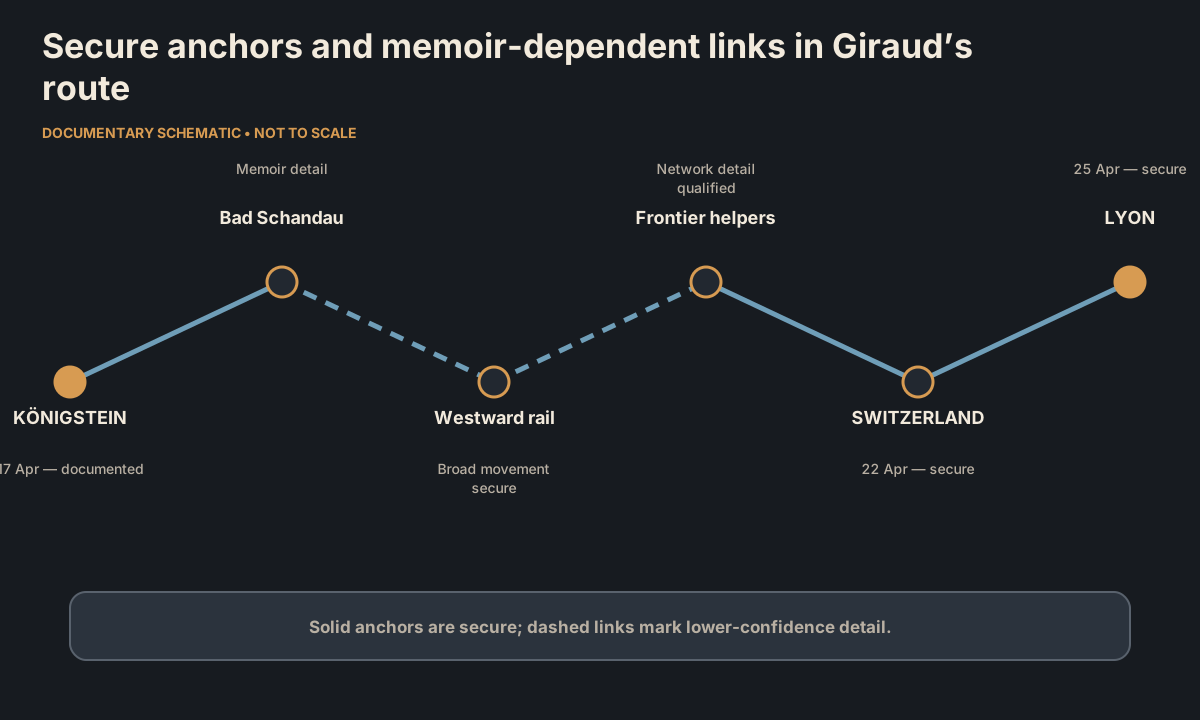
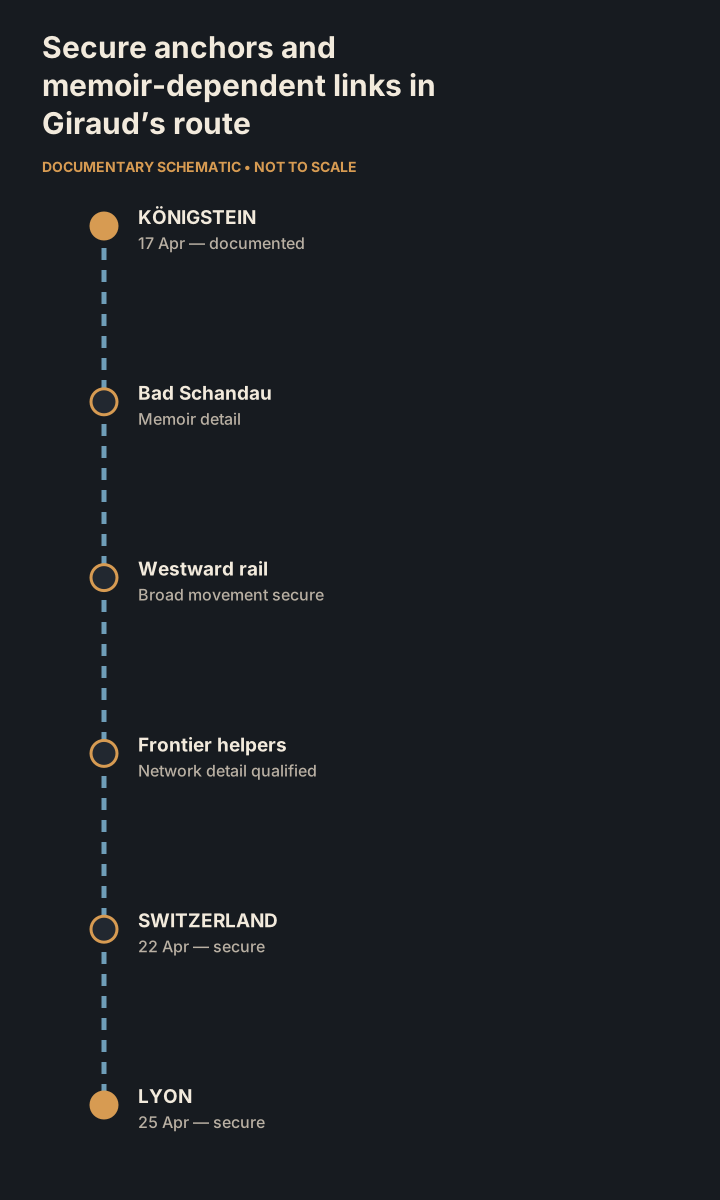
Simplified documentary reconstruction; not to scale. Evidence qualifications are written directly into the visual and explained in the adjacent text.
Evidence discipline
What the record supports
Status labels distinguish secure conclusions from uncertainty and rejected claims. Color is never the only signal.
DOCUMENTED
Giraud escaped Königstein on 17 April 1942 by being lowered through the fortress perimeter on a homemade rope.
Königstein Fortress identifies the descent location and states that two fellow prisoners lowered him through an embrasure using a rope made from parcel cords and strengthened with telephone wire.
Sources: SRC-001, SRC-010DISPUTED
The exact vertical distance of Giraud's descent is securely known.
Published figures differ markedly. Baden-Württemberg archival scholarship notes estimates of roughly seventeen to sixty metres and warns that later accounts acquired embellishments.
Sources: SRC-002, SRC-003, SRC-004MYTH
Giraud escaped disguised as an old woman.
Archival and fortress sources support civilian clothing, a shaved moustache, glasses and false papers. The old-woman version is identified as a later legend.
Sources: SRC-002, SRC-010MYTH
Giraud jumped onto a moving train immediately after descending from Königstein.
Official fortress history says he walked to Bad Schandau, where a helper awaited him with false identification. The moving-train version is a later popular simplification.
Sources: SRC-001, SRC-009MYTH
The escape was a purely solo effort by Giraud.
Fellow prisoners assisted the descent, French military personnel coordinated from France, and resistance helpers supported the route and frontier relay.
Sources: SRC-001, SRC-004, SRC-005UNKNOWN
British SOE can be identified as the sole external organizer of the escape.
Some later accounts assign a British role, but French military scholarship and a contemporary U.S. diplomatic record strongly document French Second Bureau and resistance organization. The exact intelligence division of labor remains incomplete.
Sources: SRC-002, SRC-004, SRC-005LATER CLAIM
Every colorful railway encounter in Giraud's memoir can be treated as independently documented fact.
Giraud's memoir is a valuable participant account, but contemporary reports circulated conflicting stories and archival scholarship explicitly warns of later embellishment.
Sources: SRC-002, SRC-003, SRC-008MYTH
Reaching Switzerland ended all legal and political complications.
Swiss authorities detained and fined Giraud for clandestine entry before his identity was handled at higher levels; after his return to France, Vichy and German officials pressured him to return to captivity.
Sources: SRC-002, SRC-004, SRC-007