
Winston Churchill’s Boer War Escape: From Pretoria to Portuguese East Africa
On the evening of 12 December 1899, Winston Churchill waited inside the State Model Schools in Pretoria for two Boer sentries to look away at the same time. The prison was not a fortress in the usual sense.
It was a school building temporarily converted to hold captured British officers. Its boundary was guarded, but the prisoners could observe the sentries, learn their routines, and look for moments when the combination of movement and electric lighting created a brief blind spot.
Churchill had not planned to go alone.
Captain Aylmer Haldane and Regimental Sergeant-Major Adam Brockie were part of the escape scheme. Brockie was especially valuable because he knew the region and local languages. Churchill was supposed to get over first, with the others following.
When the opportunity appeared, Churchill climbed the boundary. The others did not make it. That transformed a group escape into a solo journey whose route beyond the prison had barely been planned at all. He had escaped the State Model Schools.
He was still hundreds of miles inside enemy territory.

Captured as a Correspondent
Churchill had gone to South Africa for the Morning Post after leaving the regular Army earlier in 1899. On November 15 he accompanied a British armoured train moving through the Natal front. The train was ambushed and partly derailed by Boer forces.
Although present as a journalist, Churchill did not remain a passive observer. He helped organize efforts to clear the track and get the locomotive and wounded soldiers away from the ambush.
He was later captured. That created an immediate argument over what he was. Churchill maintained that he was a correspondent, that he had not fired a shot, and that he had been captured unarmed. The Transvaal authorities looked at the same episode differently.
From their perspective, Churchill’s actions had materially helped the British train escape. They therefore held him as a prisoner of war.
Churchill protested. The Boers did not release him. By the first weeks of December, he had turned his attention almost entirely to getting out.

The State Model Schools
The captured officers were held in the State Model Schools in Pretoria. Churchill’s 1900 book included a plan of the compound. The important feature was not a tunnel, a hidden door, or a bribed guard. It was a short section of the eastern boundary where the sentries’ movements could momentarily leave the top of the barrier difficult to see.
The electric lights in the quadrangle helped create the effect. A guard looking from behind the bright interior lighting toward the darker edge of the compound did not always have a clear view of the same section.
Churchill, Haldane, Brockie, and other prisoners watched the routines. The escape party initially intended to try on December 11. The sentries never gave them the opening they needed. They waited for roughly two hours and abandoned the attempt.
The next night they tried again.
December 12
Churchill moved into position near the offices and latrine area and watched the guards. For approximately half an hour, nothing changed. Then one sentry walked toward another. Both turned away.
Churchill ran for the boundary. His own near-contemporary account describes hesitation at the top before he finally committed and lowered himself into the neighboring garden. He had crossed. He then hid among the shrubs and waited for Haldane and Brockie.
They never arrived. The opportunity inside the prison had closed. Communication through the boundary eventually made clear that the others could not follow.
Churchill’s later relations with Haldane were complicated partly by what happened that night. Haldane later resented Churchill’s decision to continue and promoted versions of the episode implying that he had abandoned the original party.
The surviving accounts support a less theatrical conclusion. Churchill got out first. He waited. The others were prevented from following.
He then chose to go on alone.
Escape route
A planned wall crossing became an improvised journey
Haldane and Brockie were part of the original plan, but only Churchill crossed the boundary. From there, rail travel, concealment and outside assistance developed in stages.
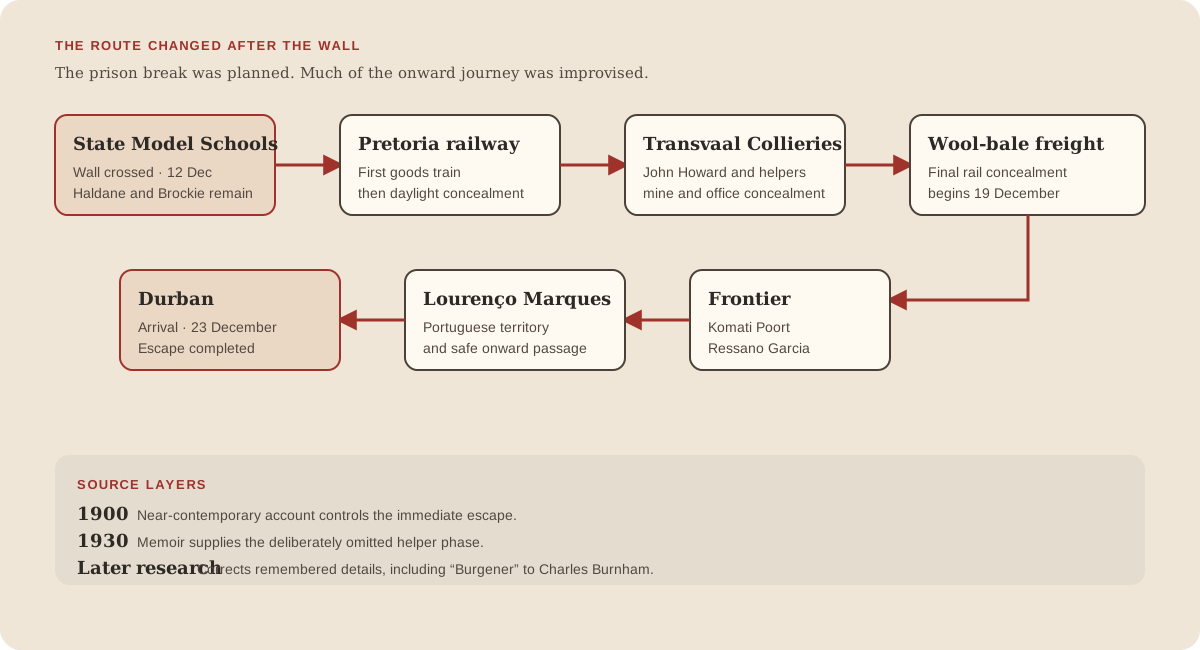
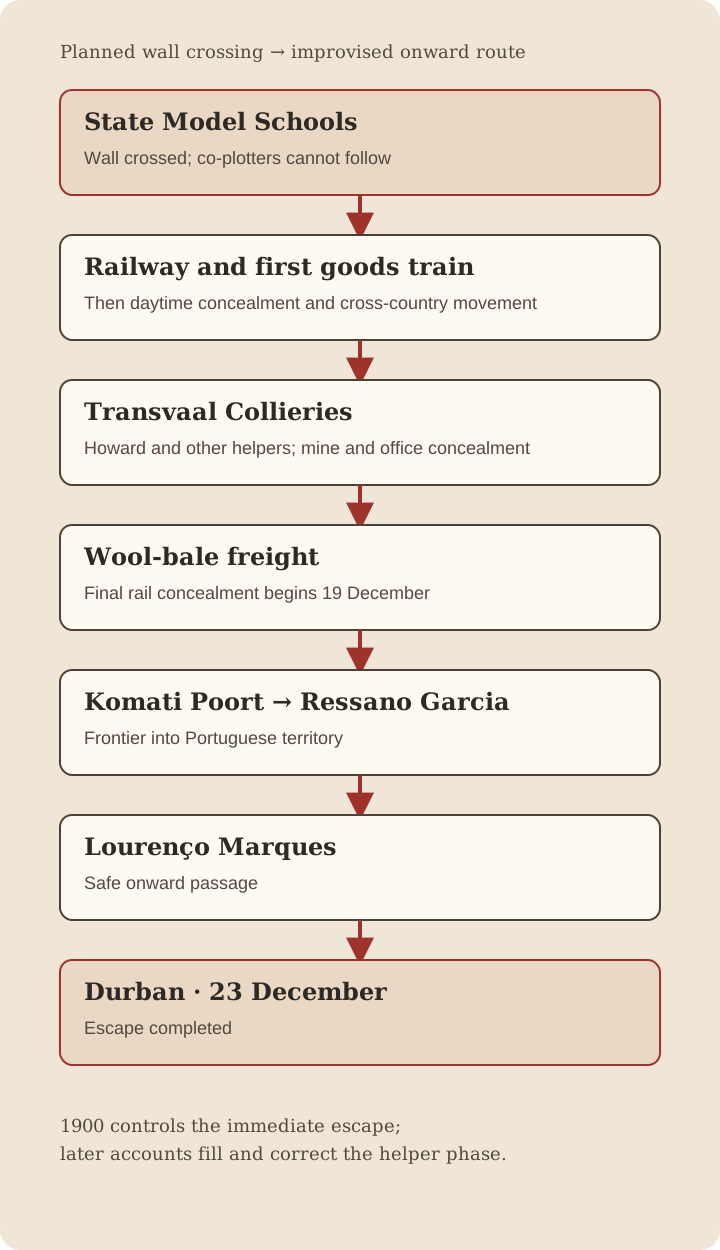
- 01
Boundary
Churchill crossed first; Haldane and Brockie could not follow.
- 02
Railway
He found the Delagoa Bay line and boarded a first goods train.
- 03
Mine assistance
John Howard and other helpers concealed him at Transvaal Collieries.
- 04
Wool freight
A second rail phase hid him among wool bales toward the frontier.
- 05
Safety
Portuguese territory led to Lourenço Marques and Durban.
Simplified editorial route based on near-contemporary reporting, Churchill's later memoir and subsequent corrective research; not to scale. The onward route was not one complete plan made before the wall crossing.
The Plan Ends at the Wall
This is the point where popular retellings often make the escape look more organized than it really was. Beyond the prison boundary, Churchill did not have a complete route to freedom. In his 1900 account he admitted that the plan after crossing the wall was vague. He needed to:
- leave the neighboring property;
- get through Pretoria;
- avoid patrols;
- identify the correct railway;
- travel roughly 280–300 miles toward the Portuguese frontier;
- find food and water;
- avoid the searches that would begin once his absence was discovered.
He had money. He had some chocolate. He did not have a guide waiting outside. He did not have an arranged horse.
He did not have a safe house in Pretoria. He began moving.
Find the Delagoa Bay Railway
Churchill’s first strategic decision was simple. He would try to locate the railway running toward Delagoa Bay and Portuguese East Africa. If he could stay with that line, it offered both direction and transportation. He walked through and beyond Pretoria and eventually struck a railway.
At first, he was not even certain it was the correct one. The line appeared to be running in the wrong direction. He followed it anyway. As he moved, the plan changed again.
Walking the entire distance to the frontier was unrealistic. He would try to board a train.

The First Goods Train
After several hours along the railway, Churchill saw the lights of a station. He positioned himself beyond it where a departing train would still be moving slowly enough to catch. A goods train came. Churchill waited for the engine to pass and ran alongside the wagons.
He missed his first grips. Then he caught a handhold and pulled himself onto the couplings. The trucks carried soft sacks covered with coal dust. He buried himself among them.
For part of the night, the railway that the Transvaal depended upon for movement was carrying its most famous escaped prisoner away from Pretoria. Before daylight, Churchill decided he could not remain aboard. He would need water. He also risked being seen once the sun came up.
He climbed out and jumped from the moving train. He survived the landing. But once again, the temporary solution had ended.
A Day in Hiding
Churchill found water and concealed himself during daylight. From his hiding place he could watch trains moving through the valley. His plan was to board another one after dark. The problem was that the railway was guarded.
Bridges had watchers. Stations meant people. The countryside offered concealment but little certainty. When night came, Churchill tried to continue.
He walked for hours, circling guarded places and leaving the railway where necessary. By his own account, hunger, lack of sleep, and the physical strain of the previous month in captivity were beginning to tell. Then he saw lights.
The Coal Mine
The lights led toward a coal mine. Churchill knew this was a gamble. A Boer household could turn him in immediately. But the mining districts also contained British residents whose technical skills were still needed to keep some facilities operating.
He approached a house associated with the mine. The man he encountered was John Howard, manager of the Transvaal Collieries. Howard was British-born but had become a naturalized burgher of the South African Republic. He had not been called into active service against Britain and had remained at the mine with a small group of British employees.
According to Churchill’s later memoir, Howard immediately understood the danger and agreed to help. The identity of these helpers is absent from Churchill’s 1900 book for a reason. The war was still underway when he published it. He wrote that revealing the missing part of the story could endanger another man’s life.
Hidden Underground
Howard and the British workers decided to hide Churchill below ground. Among those involved was Daniel Dewsnap, an engineer from Oldham. Churchill was lowered into the mine and led through underground workings to a concealed location. The 1930 memoir supplies memorable details about the darkness, the mine galleries, food, candles, and rats.
Those details come from Churchill’s memory three decades later. The broad fact is firmer:
the mine sheltered him while Boer authorities searched the region.
After a period underground, Churchill moved to a concealed room around the mine office. The helpers now faced a different problem. Hiding him could not last indefinitely. They needed a way to move him across the frontier.
Problem → response
Escape was a sequence of problems
Each response solved a practical obstacle while often creating the next one.
- 01→
Obstacle
Armed sentries
The State Model Schools boundary was guarded from inside by armed sentries.
Response
The prisoners observed their movements and waited for a short blind interval.
- 02→
Obstacle
Co-plotters unable to follow
Haldane and Brockie could not use the same opening after Churchill crossed.
Response
Churchill waited, attempted communication, and then continued alone.
- 03→
Obstacle
No complete plan beyond the prison
The original scheme did not solve the entire journey to Portuguese territory.
Response
Churchill used the Delagoa Bay railway as both guide and transport opportunity.
- 04→
Obstacle
Daylight exposure
Remaining aboard the first freight train into daylight risked discovery and denied Churchill access to water.
Response
He jumped from the moving train and hid during daylight.
- 05→
Obstacle
Guarded railway infrastructure
Bridges, stations, and railway settlements increased the chance of detection.
Response
Churchill made detours, moved at night, and left the railway when necessary.
- 06→
Obstacle
Exhaustion and lack of supplies
Walking alone across the Transvaal was not sustainable.
Response
Churchill risked approaching the coal mine and received help from John Howard.
- 07→
Obstacle
Intensive search and frontier controls
Authorities circulated Churchill's description and searched rail traffic.
Response
Howard and Burnham concealed him within a legitimate wool shipment.
- 08→
Obstacle
Komati Poort
The frontier station was a major point of search and inspection.
Response
Churchill stayed buried inside the freight wagon until the train had entered Portuguese territory.
The Search Expands
Back in Pretoria, Churchill’s absence had been discovered. Descriptions circulated. Railways were watched. Searches were conducted.
A reward notice was issued for his recapture. The railway was simultaneously the best route toward Portuguese territory and the place where the authorities most expected him to appear. Howard needed a shipment that would pass through the border without looking unusual. The opportunity came from commercial freight.
“Burgener” Was Burnham
Churchill’s 1930 memoir says that a Dutchman named Burgener was sending wool to Delagoa Bay and agreed to include him in the shipment. Later evidence corrects that memory. The man was Charles Burnham. Documentary research cited in Churchill scholarship shows that Burnham corresponded with Churchill after the war, was recognized for his assistance, and was one of the men Churchill thanked with an inscribed watch.
This is a useful example of how to read My Early Life. Churchill remembered the structure of the event correctly: a local man had a wool consignment moving east; Howard recruited him;
the wool shipment became Churchill’s route out. But he did not preserve the man’s name accurately. The strongest identification is:
Charles Burnham, whom Churchill later misremembered as “Burgener.”
Into the Wool
In the early hours of December 19, the final stage began. Large railway trucks were being loaded with wool bales. The bales were arranged so that a narrow concealed space remained inside one truck. Churchill climbed in.
The opening was covered as loading continued. He had food and drink. His later memoir also says he was given a revolver. Once the truck was sealed beneath its tarpaulin, Churchill again surrendered control over the escape.
He could not decide where the train stopped. He could not know when it would be searched. He could not safely climb out while the train remained in the Transvaal. The railway would either carry him through the frontier or deliver him back to his pursuers.
Toward Komati Poort
The train moved east. Churchill tried to identify his location from station names and features of the railway. The journey included delays. At Waterval Boven, the train was held overnight.
The next day it continued toward Komati Poort, the frontier station. That was the most dangerous point. Search instructions had been distributed along the railway. Churchill remained buried inside the wool.
People moved around the train. At times he believed the wagon might be searched. The tarpaulin was not removed deeply enough to expose him. Eventually the train moved again.
Churchill still was not certain he had crossed the frontier. Then he saw the name:
Ressano Garcia.
Portuguese uniforms were visible. The South African Republic was behind him. He had reached Portuguese East Africa.
Lourenço Marques
Late that afternoon, the train reached Lourenço Marques, the port now known as Maputo. Churchill slipped out of the freight wagon and entered the goods yard. He then made his way to the British Consulate. The young correspondent who had begun the journey over a prison wall now had diplomatic protection in neutral territory.
A steamer was leaving for Durban that evening. He boarded it.
Durban
On December 23, Churchill arrived in Durban. He discovered that the escape had become international news. Crowds gathered. He was greeted publicly as a hero.
The fame did not come only from clearing the State Model School boundary. It came from the entire sequence: captured in a widely reported armoured-train episode; held despite his insistence that he was a civilian correspondent;
escaped alone after his companions could not follow; disappeared into the Transvaal; evaded a highly public search; and reappeared in Portuguese territory.
Churchill returned to the war. He continued writing and also obtained a commission in the South African Light Horse. Within months he would return to Pretoria with the advancing British forces. The prisoner who had escaped the city was now one of the most famous young men in the British Empire.
Evidence discipline
What the record supports
Status labels distinguish secure conclusions from uncertainty and rejected claims. Color is never the only signal.
DOCUMENTED
Churchill escaped from the State Model Schools in Pretoria on December 12, 1899.
Churchill's near-contemporary account, later memoir, South African historical sources, and Churchill archival material all support the event and date.
Sources: SRC-001, SRC-002, SRC-003, SRC-005MYTH
Churchill devised the December 12 escape entirely by himself.
Aylmer Haldane and Adam Brockie were co-plotters in the immediate plan. Churchill became the sole escapee that night only after the others could not follow.
Sources: SRC-006, SRC-007DISPUTED
Churchill intentionally abandoned Haldane and Brockie without waiting.
The accounts agree Churchill crossed first and the others were unable to follow. Churchill waited outside and communication occurred before he continued alone, but Haldane later resented and disputed Churchill's conduct.
Sources: SRC-001, SRC-007MYTH
Churchill walked roughly 300 miles from Pretoria to Portuguese East Africa.
Walking was important during the early evasion stage, but Churchill used a moving goods train and later a long-distance freight wagon concealed among wool bales.
Sources: SRC-001, SRC-002, SRC-004MYTH
Churchill remained hidden in coal sacks for the entire rail journey to the frontier.
The first train carried sacks covered in coal dust and Churchill left it before daylight. His final frontier journey was inside a railway truck loaded with wool bales.
Sources: SRC-001, SRC-002MYTH
Churchill escaped without significant outside assistance.
John Howard, Daniel Dewsnap, other mine workers, and Charles Burnham were essential once Churchill reached the coalfield.
Sources: SRC-002, SRC-008, SRC-009MYTH
The man Churchill called 'Burgener' in My Early Life was actually named Burgener.
Later documentary evidence identifies the freight helper as Charles Burnham. Churchill's later memoir appears to have misremembered or disguised the name.
Sources: SRC-009MYTH
Churchill's 1900 book gives the complete escape story.
Churchill explicitly stated that he was withholding an essential part of the story because revealing it while the war continued could endanger a helper.
Sources: SRC-001, SRC-003UNKNOWN
The State Model Schools boundary was exactly ten feet high.
Churchill described it as about ten feet high, but later local testimony challenged that measurement. The precise height is not necessary to reconstruct the escape.
Sources: SRC-001, SRC-009MYTH
Churchill's detention as a prisoner of war was uncontested.
Churchill argued that he was a civilian correspondent captured unarmed; the Transvaal authorities argued that his active role in saving the armoured train justified holding him as a military prisoner.
Sources: SRC-001, SRC-002, SRC-006Evidence, Memory and the Escape Legend
Did Churchill really escape from a Boer POW camp?
DOCUMENTED
Yes. The escape is supported by Churchill’s near-contemporary 1900 account, his later memoir, South African historical sources, military collections, and surviving search material.
Did Churchill plan the escape by himself?
MYTH / MISLEADING
No. Aylmer Haldane and Adam Brockie were central to the immediate escape scheme. Churchill was the first man over the boundary and became the only one of the group to get out that night.
Did Churchill deliberately leave Haldane and Brockie behind?
DISPUTED / OVERSTATED
Churchill escaped first, waited outside, and tried to determine whether the others could follow. Sentry activity prevented them from doing so. Haldane later resented Churchill’s decision to continue alone and promoted a more hostile interpretation. The sequence is clearer than the motives, which cannot be proved with the same confidence.
Did Churchill walk 300 miles to freedom?
MYTH
No. He walked substantial portions of the route, but rail transportation was essential. He boarded one moving goods train soon after leaving Pretoria and later travelled most of the decisive frontier route concealed in a wool shipment.
Did he hide in a coal train all the way to Portuguese East Africa?
MYTH / OVERSIMPLIFIED
No. The first train carried sacks coated in coal dust. Churchill left it before daylight. His final long-distance railway concealment was inside a truck loaded with wool bales.
Did Churchill spend the entire escape alone?
MYTH
No. He was alone during the dangerous stage after leaving Pretoria, but John Howard, Daniel Dewsnap, other mine employees, and Charles Burnham were crucial to getting him safely across the frontier.
Who was “Burgener”?
LATER MEMORY ERROR
Churchill’s 1930 memoir calls the freight helper “Burgener.” Later documentary evidence identifies him as Charles Burnham.
Did Churchill reveal his helpers immediately?
NO
His 1900 book deliberately withheld the key mine-assistance episode because the war was still underway and disclosure could endanger the men who helped him.
Was the prison fence exactly ten feet high?
UNKNOWN / SOURCE-VARIANT
Churchill described the boundary as about ten feet high. Later local testimony challenged that measurement. The exact height is not important to the mechanics and should not be overclaimed.
Was Churchill a normal military POW?
DISPUTED AT THE TIME
Churchill argued that he was a civilian correspondent who had not fired a shot. The Boer authorities considered his active assistance during the armoured-train incident sufficient to detain him as a prisoner. That historical dispute remains unresolved and should not be retrospectively settled with unsupported certainty.
Why the Escape Worked
The prison boundary had sentries. Churchill and the other prisoners watched until the sentries created a blind spot. His companions failed to follow. He continued alone.
Walking hundreds of miles was unrealistic. He used the railway. Daylight made the first train dangerous. He jumped off.
The railway was guarded. He moved cross-country. He could not survive indefinitely without help. He risked approaching the mine.
John Howard turned the gamble into a support network. The mine could hide him. It could not get him across the frontier. A commercial wool shipment could.
The frontier station could expose him. The wagon was not searched deeply enough. At each stage, the previous solution stopped being enough. The escape succeeded because Churchill kept changing the plan—and because, once he reached the coalfield, other people chose to take serious risks on his behalf.
That final point is essential. The famous story belongs to Churchill. The successful escape did not belong to Churchill alone.
Selected chronology
Capture, improvisation and arrival
Churchill is captured
Boer forces ambush a British armoured train. Churchill helps with efforts to clear the line and is later taken prisoner.
Prisoners reach Pretoria
Churchill and other captured British officers are held in the State Model Schools.
Churchill turns 25 in captivity
Churchill spends his twenty-fifth birthday as a prisoner in Pretoria.
First breakout attempt abandoned
The sentries do not provide the required opening and the prisoners abandon the attempt for the night.
Churchill crosses the boundary
Churchill gets over the State Model Schools perimeter. Haldane and Brockie are prevented from following.
First freight-train ride
Churchill follows the railway, boards a moving goods train, hides among sacks, and jumps off before daylight.
Churchill reaches the coal mine
After further movement on foot, Churchill reaches the Transvaal Collieries and receives help from John Howard and the British mine staff.
Hidden among wool bales
Churchill enters a concealed space in an eastbound wool shipment arranged through Howard and Charles Burnham.
Portuguese territory
The train passes the Transvaal frontier and reaches Ressano Garcia, confirming that Churchill is in Portuguese East Africa.
Lourenço Marques
Churchill reaches the port and the British Consulate and departs by steamer for Durban.
Hero's welcome in Durban
Churchill arrives in Durban to a large public reception and quickly returns toward the British front.
Near-contemporary escape account published
London to Ladysmith via Pretoria publishes Churchill's escape narrative but deliberately omits the identities and assistance of the men who hid him.
Churchill publishes the fuller version
My Early Life reveals the mine and freight-assistance episode in detail, while later research shows that some names and physical details were imperfectly remembered.