
The Wooden Horse Escape: How Three POWs Tunnelled Out of Stalag Luft III in 1943
The object carried across the exercise yard at Stalag Luft III looked like ordinary gym equipment. That was the point. It was a wooden vaulting horse: hollow, light enough for prisoners to carry, strong enough for men to vault over, and large enough to conceal a digger, tools and bags of sand.
Every day the prisoners brought it into the open East Compound and placed it close to the perimeter. Men then exercised around it while somebody hidden inside opened the ground beneath the horse and continued a tunnel that guards could not see.
At the end of the session the opening vanished again. The digger climbed back into the horse. Excavated sand went into bags. The prisoners carried the entire worksite away.
They repeated the deception for 114 days.
On 29 October 1943, Flight Lieutenant Eric Williams, Lieutenant Michael Codner and Flight Lieutenant Oliver Philpot used the completed tunnel to escape Stalag Luft III. All three reached neutral Sweden. All three ultimately returned to Britain.
The Wooden Horse escape worked because it reversed the normal logic of prison tunnelling. Instead of hiding the start of a very long tunnel inside a hut, the prisoners found a way to hide the start of a much shorter tunnel in open ground near the wire. The horse did not carry them over the perimeter.
It carried the tunnel entrance to the place where it needed to be.
A camp built to expose tunnels
Stalag Luft III had been created to hold captured Allied airmen and to make escape difficult.
Its location near Sagan presented a particular problem for anyone who wanted to tunnel. The soil was pale and sandy. Barrack huts were raised above the ground, reducing the number of places where men could secretly disappear beneath a floor. German security had good reason to watch for excavation: tunnelling was already a recurring feature of prisoner life.
The ordinary solution was to start inside a building.
That gave the diggers concealment at the entrance, but it created another problem. A tunnel starting well inside the compound had to travel a long way before it could pass under the perimeter and reach useful cover outside.
Every extra foot meant more sand, more time, more structural risk and more opportunities for guards to discover what was happening. Eric Williams and Michael Codner developed a different idea. What if the entrance did not begin beneath a hut at all? What if the prisoners could begin the tunnel close to the wire, in the open?
The obvious objection was also the reason the idea might work. Nobody expected prisoners to begin a tunnel where guards could look directly at the ground.
The Trojan Horse idea
The deception depended on turning something completely visible into cover. Williams and Codner's concept echoed the ancient Trojan Horse: place something apparently harmless in front of the enemy and hide the real operation inside it.
The object they needed was not a theatrical prop. It had to survive daily use.
Wing Commander Roger Maw built it.
A detailed account published after Maw's death describes a hollow vaulting horse constructed from timber available in camp and plywood from Canadian Red Cross parcel boxes. It had to be light enough to carry into the yard but strong enough for repeated gymnastics.
That combination mattered. If the prisoners had simply carried a large box toward the perimeter each afternoon, German guards would have had an obvious question. A vaulting horse explained why several men were carrying it. It explained why prisoners gathered around it.
It explained why men ran toward it and landed heavily nearby. And because the exercise was real, the cover did not need to stop when a guard watched closely. The prisoners could simply keep vaulting.
Escape sequence
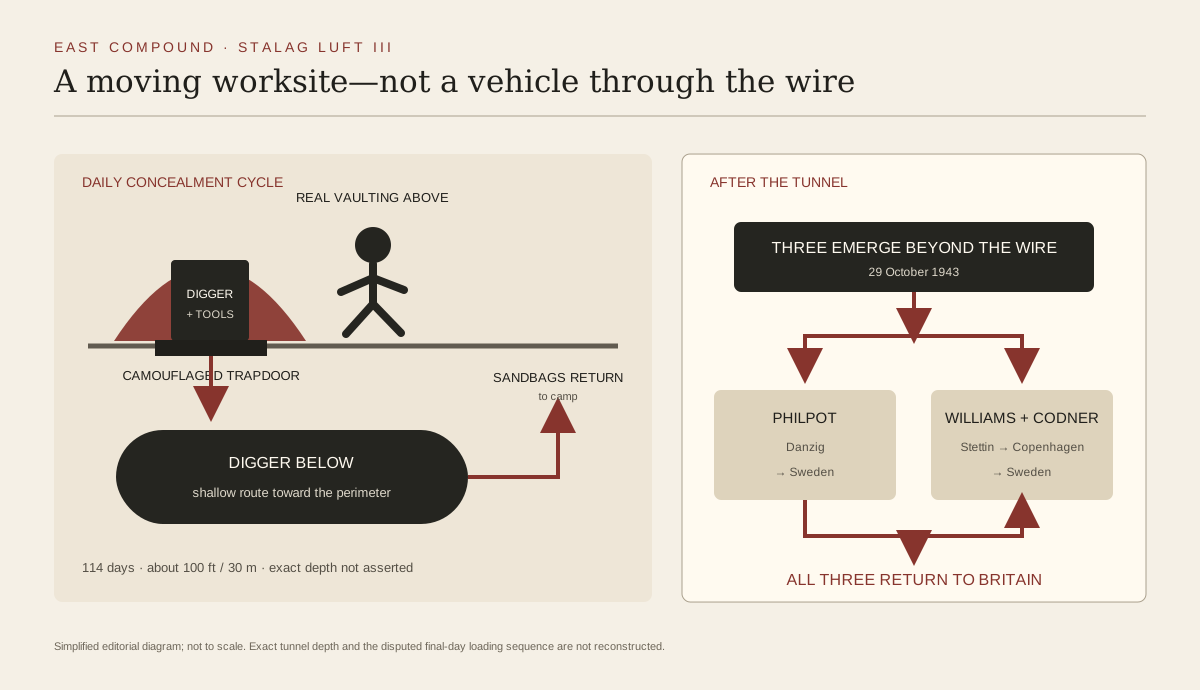
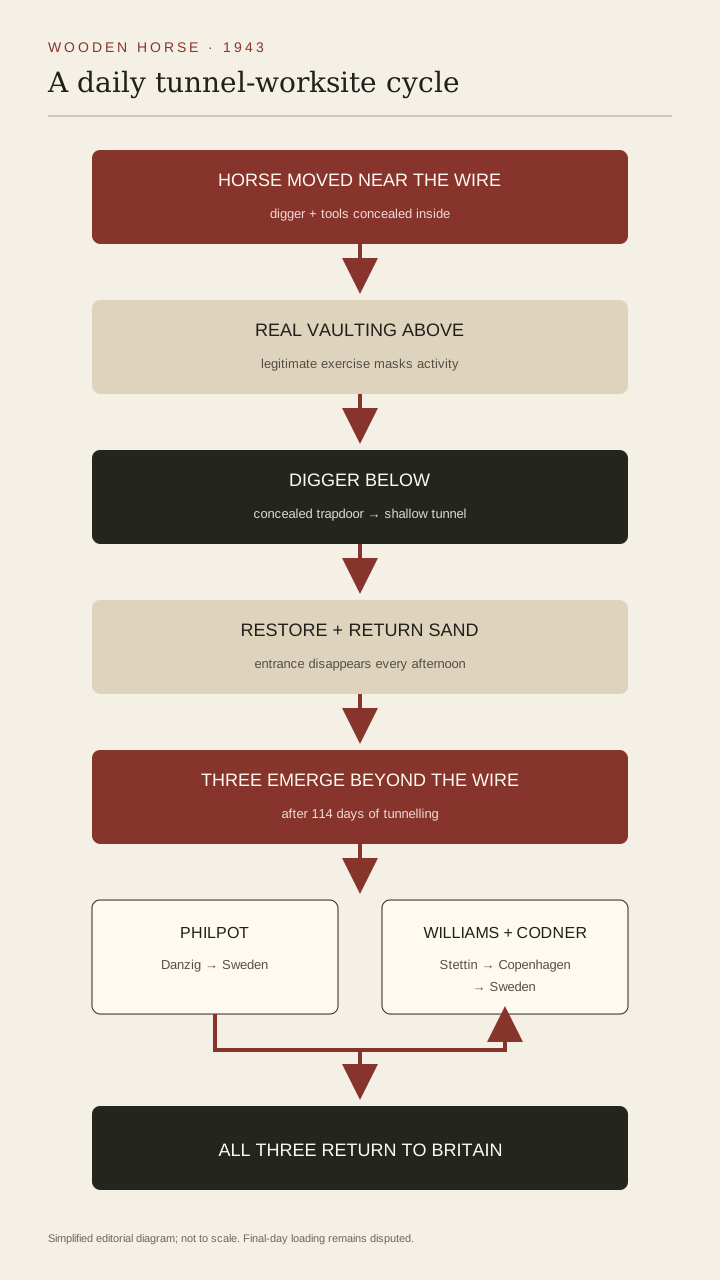
The horse was a moving worksite
The horse concealed a digger and the tunnel entrance while real vaulting above made the daily activity look legitimate.
- 01
Move the horse
Prisoners carried the horse, digger and tools toward the perimeter wire.
- 02
Exercise above
Real vaulting activity concealed the tunnel work below.
- 03
Restore the surface
The entrance disappeared each afternoon and excavated sand returned to camp.
- 04
Escape
Williams, Codner and Philpot emerged beyond the wire.
- 05
Split routes
Philpot travelled through Danzig; Williams and Codner through Stettin and Copenhagen. All reached Sweden.
Simplified editorial diagram based on historical sources; not to scale. Exact tunnel depth and the final-day loading sequence remain uncertain.

The horse was a moving worksite
The famous name can create the wrong mental picture. The prisoners did not climb into the horse and let their comrades carry them out through the gate. The horse's main job was to hide the place where the tunnel started.
During the construction phase, one or more tunnellers could be concealed inside with tools. The horse was carried to the same area of the exercise ground and placed over the hidden entrance.
The digger opened the ground beneath it and disappeared below the surface. Above him, other prisoners exercised.
Their running, vaulting and landing made the scene look exactly like what it claimed to be. The activity also helped mask the noise and vibration of digging beneath them.
This was the central innovation. The tunnel entrance itself did not have to survive visibly in the yard from one day to the next. The prisoners reopened it when the horse arrived and hid it when the horse left.
Material evidence
The moving worksite
The horse, trapdoor and sandbags supported a repeatable concealment system rather than carrying the men through the perimeter.
- 01It allowed the prisoners to begin a tunnel in open ground close to the perimeter instead of underneath a hut.
Hollow vaulting horse
A light but strong gymnastics horse concealed diggers, tools and sand while appearing to be ordinary exercise equipment.
- 02Daily concealment was essential because the tunnel mouth was in exposed ground.
Camouflaged trapdoor
The opening beneath the horse was closed and re-covered after each session.
- 03They solved the spoil-disposal problem that would otherwise have revealed digging close to the wire.
Sandbags
Excavated sand was placed into bags and carried back inside the horse.
- 04Leaving the camp was only the first stage; successful travel required an identity and navigation tools.
Philpot's escape kit
Philpot carried forged papers, maps, a compass and modified civilian clothing for his journey through Germany.

A hole that had to disappear every afternoon
Digging in open ground created a stricter standard of concealment than digging beneath a hut. At the end of each day's work, nobody could leave behind a visible shaft. The entrance was closed with a board or trapdoor and carefully recovered with surface material until the ground looked ordinary again. Then the digger, tools and excavated soil went back inside the horse.
The whole operation was carried into camp.
Roger Maw's detailed account describes twelve bags of sand being loaded into the horse during a digging session. The National Archives' surviving sketch of the device likewise depicts the horse in relation to full sandbags.
The exact disposal route for every load is less important than the system itself. The dirt did not accumulate beside the tunnel. It moved with the workers. That made the wooden horse simultaneously:
- camouflage;
- transport;
- a tool locker;
- a spoil carrier;
- and the centrepiece of the fake activity above ground.
Few escape devices solved so many problems at once.
Digging a tunnel without a hut above it
The trade-off for starting close to the perimeter was depth. The Wooden Horse tunnel did not need the elaborate thirty-foot shafts and hundreds of feet of underground engineering later associated with tunnels Tom, Dick and Harry in the North Compound. It was a much smaller operation.
Roger Maw's account gives a total length of about 100 feet, with the exit roughly fifteen feet beyond the wire. Other later accounts describe it as approximately thirty metres or slightly more than 100 feet.
Those figures are close enough to establish the scale, but not precise enough to justify pretending that the passage was measured to a universally agreed exact length. The important point is comparative. The horse had allowed the men to remove much of the distance that a conventional tunnel would have required. They had traded a long hidden tunnel for a short exposed entrance that had to be concealed perfectly every day.
For 114 days, it worked.
Oliver Philpot joins the operation
Williams and Codner were the original core of the plan. Oliver Philpot became the third principal escaper and tunneller.
His surviving Imperial War Museums collection shows how far the operation extended beyond the tunnel itself. Philpot assembled clothing, forged papers, maps and a compass for the journey after Stalag Luft III.
That preparation was as important as the horse.
A POW who emerged beyond the wire was still deep inside German-controlled Europe. He needed to travel through railway stations and cities without drawing attention. He needed a plausible identity. He needed to know where he was going. He needed some route to neutral territory.
The tunnel could make a prisoner absent from camp. It could not make him safe.
Problem → response
Escape was a sequence of problems
Each response solved a practical obstacle while often creating the next one.
- 01→
Obstacle
Raised huts and sandy soil
Stalag Luft III had been designed to make conventional tunnel starts easier to detect and underground work difficult to conceal.
Response
The Wooden Horse plan shifted the tunnel entrance into the open exercise area near the perimeter, shortening the underground route.
- 02→
Obstacle
Open ground near the wire
A normal tunnel mouth in the exercise yard would have been immediately visible.
Response
The vaulting horse became a movable cover for the entrance, and the surface was restored after each digging period.
- 03→
Obstacle
Noise and visible activity
Digging close to guards risked detection through sound, vibration or suspicious gatherings.
Response
POWs conducted repeated vaulting exercises above the horse, creating plausible activity and masking the work beneath.
- 04→
Obstacle
Excavated sand
A shallow tunnel in pale sandy soil produced spoil that could not be left near the entrance.
Response
The sand was bagged, hidden inside the horse and carried back to camp for disposal.
- 05→
Obstacle
Crossing Germany after escape
The three men still had to pass railway checks, maintain cover identities and find shipping to neutral territory.
Response
They used civilian disguises, forged papers, maps and compasses, then split routes toward Danzig and Stettin before reaching Sweden.
114 days without discovery
The length of the construction period is one of the best-established numbers in the story. The National Archives and Imperial War Museums both give 114 days. That means the deception had to survive not once, but again and again. The horse had to appear in roughly the same part of the yard.
The exercise had to remain plausible. The ground had to be restored. The sand had to disappear. The men carrying the horse had to behave as though nothing important was inside it.
And the Germans had to see an athletic routine rather than an engineering project. The success of the escape therefore did not depend on one moment of daring. It depended on repetition without visible deterioration. The more ordinary the horse became, the more useful it was.
Evidence discipline
What the record supports
Status labels distinguish secure conclusions from uncertainty and rejected claims. Color is never the only signal.
DOCUMENTED
The escape took place on 29 October 1943 after 114 days of tunnelling.
The date and 114-day figure are consistent across The National Archives and Imperial War Museums.
Sources: SRC-001, SRC-002, SRC-003MYTH
The horse was a vehicle that carried all three men directly out of the camp.
Its main function was to hide the tunnel entrance and daily excavation. The men actually escaped through the tunnel. The National Archives' exhibition summary describes all three inside the horse on the final day, but a detailed account associated with horse-builder Roger Maw says Codner was sealed into the tunnel earlier while Williams and Philpot were later carried out in the horse. The exact final-day loading sequence is therefore not treated as settled.
Sources: SRC-001, SRC-010DISPUTED
All three men were carried out inside the horse together on 29 October.
A recent National Archives summary says all three were inside the horse, whereas Roger Maw’s detailed account says Codner entered earlier and Williams and Philpot were carried out later. Neither version is established as definitive.
Sources: SRC-001, SRC-010WELL-SUPPORTED
The tunnel was exactly 100 feet long.
Roger Maw’s detailed account gives 100 feet, with an exit 15 feet beyond the wire, while other retrospective accounts use ‘over 100 feet’ or approximately 30 metres. About 100 feet is the best-supported approximate description.
Sources: SRC-009, SRC-010MYTH
The three escapees were the only successful home runs from Stalag Luft III.
They were the only successful home runs from the East Compound. The later Great Escape from the North Compound also produced three men who reached safety. The compound qualifier is essential.
Sources: SRC-003DOCUMENTED
Philpot travelled disguised as a Norwegian salesman and escaped via Danzig.
The National Archives and IWM both support the route and cover identity at this level, although some later accounts add more specific commercial identities that should not be preferred without stronger documentation.
Sources: SRC-001, SRC-002WELL-SUPPORTED
Peter Butterworth was rejected from the 1950 film despite having helped the real escape operation.
The National Archives exhibition notes both his help covering for the escapers and the later irony that he auditioned unsuccessfully for the film.
Sources: SRC-005The final day is less certain than the basic mechanism
The broad sequence of 29 October is firmly established. The precise loading of the horse that day is not. A recent National Archives exhibition summary says Williams, Codner and Philpot were squeezed inside the hollow horse when it was carried into position. A much more detailed account associated with Roger Maw gives a different sequence: Codner was sealed into the tunnel earlier in the afternoon, while Williams and Philpot were carried out later and joined him below ground.
Both accounts agree on the facts that matter most:
- all three used the Wooden Horse tunnel;
- the escape took place on 29 October 1943;
- the tunnel was completed after 114 days of work;
- all three emerged beyond the perimeter.
Where the sources diverge, the uncertainty remains. So the exact question of whether all three rode inside the horse together on the final day remains disputed. The object was still essential either way.
Breaking the surface
The men waited for the right moment to open the final section. Philpot later described seeing the night sky from the tunnel and realizing that a German sentry was close enough to be visible above him. The guard was looking inward toward the camp. The escapers moved quickly.
They crossed the ground outside the tunnel and reached the pine woods that bordered Stalag Luft III. Only then could they begin the second half of the operation. The three men separated. Philpot chose one route.
Williams and Codner stayed together.
Philpot goes to Danzig
Philpot travelled north by train from Sagan toward Danzig.
His cover was Norwegian. The National Archives describes him as disguised as a Norwegian salesman; later retellings sometimes make the commercial identity more specific, but the broader description is better supported.
His escape kit mattered now. IWM preserves objects associated directly with his journey, including the compass he used and clothing from his escape kit. At Danzig he found passage on a ship to neutral Sweden. Imperial War Museums records that he reached Stockholm on 4 November.
That was less than a week after crawling out of the tunnel. For Philpot, the home run was effectively complete.
Williams and Codner go to Stettin
Williams and Codner travelled together on a different route. A later prisoner memoir preserved by the International Bomber Command Centre records that they headed north through the German transport network toward Stettin. Getting to a port was not enough. They still needed a ship willing or able to carry them out of German-controlled territory.
The same account describes a route through Copenhagen and then into Sweden, where they eventually reached the British Legation in Stockholm. By mid-November, all three Wooden Horse escapees had reached neutral territory. They were later returned to Britain. That result made their operation exceptional even by the standards of Stalag Luft III.
Three out, three home
The camp became famous the following year for a much larger tunnel operation.
In March 1944, seventy-six men escaped through Harry during the Great Escape. Seventy-three were recaptured. Fifty were murdered by the Gestapo. Only three reached safety.
The Wooden Horse operation had a completely different scale. It was built for three. Three escaped. Three got home.
The National Archives later described Williams, Codner and Philpot as the only prisoners to make successful home runs from the East Compound. That last phrase matters.
They were not the only men ever to escape Stalag Luft III and reach safety. The later Great Escape also produced three successful escapers from the North Compound.
The Wooden Horse distinction belongs specifically to the East Compound.
The men behind the three escapees
A three-man success can sound like a three-man operation. It was not. Roger Maw built the horse. Other prisoners carried it.
Others vaulted over it. Men helped create the appearance of an ordinary exercise period and kept attention away from the ground beneath the equipment. The National Archives highlights an especially memorable participant: Peter Butterworth, later famous for the Carry On films, was one of the prisoners who helped cover for the escapers. After the war, Butterworth auditioned for the 1950 film The Wooden Horse and did not get a part.
The irony is almost too neat, but it is documented by the institution preserving the archival story. The episode is a useful reminder that the three men who crawled out were only the visible end of a larger cooperative effort.
From escape report to famous story
Eric Williams published The Wooden Horse in 1949. The book was a fictionalised account rather than a literal transcript of the operation, but it gave the escape its lasting name in popular culture. The film adaptation appeared the following year. Its success ensured that the wooden horse became one of the best-known POW escape devices of the Second World War.
That fame had an unintended effect. The prop became so memorable that it could overshadow the actual mechanism. People remember men hiding inside a horse. The real engineering achievement was subtler.
They were hiding a tunnel beneath it.
Why the plan worked
The Wooden Horse escape solved five problems in one system. Distance: placing the tunnel entrance near the perimeter reduced the amount of underground travel required. Concealment: the horse hid the opening while the men worked. Noise: gymnastics gave the prisoners a plausible reason to create repeated impact and movement above the digger.
Spoil: the same object carried excavated sand away from the entrance. Routine: daily repetition turned suspicious activity into something guards learned to regard as normal. That last point may have been the most powerful. An escape tunnel normally depends on nobody noticing something unusual.
The Wooden Horse depended on guards noticing the same thing over and over until it no longer seemed unusual at all. The prisoners did not make themselves invisible. They made themselves boring.
The Wooden Horse before the Great Escape
The later Great Escape understandably dominates the history of Stalag Luft III. Its scale was immense, its aftermath murderous, and its cultural legacy enormous. The Wooden Horse deserves to stand on its own rather than as a footnote. It was a different solution to the same central question:
How do prisoners dig through a camp designed to expose tunnelling? The Great Escape answered with depth, redundancy, mass organization and industrial-scale preparation. The Wooden Horse answered with proximity and camouflage. Move the entrance toward the wire.
Hide it under something guards expect to see. Carry the evidence away every afternoon. Repeat until the tunnel reaches freedom. On 29 October 1943, that answer worked perfectly for three men.
Selected chronology
114 days beneath the exercise yard
Daily horse operation begins
Roger Maw's detailed account places the start of the horse-and-tunnel routine on 8 July 1943.
The tunnel advances under the exercise yard
The horse is carried to the same area repeatedly while POWs vault above and tunnellers work beneath it.
The Wooden Horse Escape
Williams, Codner and Philpot use the completed tunnel to leave the East Compound and reach cover outside the perimeter.
Philpot reaches Stockholm
After travelling via Danzig and finding passage to Sweden, Philpot arrives in Stockholm.
Williams and Codner reach the British Legation
A later POW memoir preserved by the IBCC places Williams and Codner at the British Legation in Stockholm by 13 November after travel through Stettin and Copenhagen.
Return to Britain
All three successful escapers were repatriated to Britain from neutral Sweden.
The Wooden Horse appears in print
Eric Williams publishes a fictionalised account that popularises the escape story.
Film adaptation
The Wooden Horse is adapted into a successful British film, further shaping popular memory of the escape.