
Franz von Werra's Escape: The POW Who Got from Canada Back to Germany in 1941
The British had already caught Franz von Werra twice after he escaped. Their next solution seemed obvious: send him farther away.
In January 1941, the Luftwaffe officer was shipped across the Atlantic with other German prisoners of war and placed aboard a train carrying them deeper into Canada. Germany was now an ocean away. Britain controlled the North Atlantic. Canadian guards surrounded him. Winter covered eastern Ontario.
But the transfer created a problem his captors had not eliminated. The train passed within reach of the United States, and in January 1941 the United States was still neutral.
Von Werra escaped through a carriage window, made his way toward the St. Lawrence River, crossed from the Prescott area to Ogdensburg, New York, and turned what had begun as a prison break into an international diplomatic problem. German officials then helped him move south through the Americas and back across the Atlantic.
By April, he was in Germany again. That final return made him one of the most famous prisoner-of-war escapers of the Second World War—and gave the later film of his story its title: The One That Got Away.
Two escapes had already failed
Von Werra entered British custody during the Battle of Britain.
On 5 September 1940, his Messerschmitt Bf 109 was forced down in Kent. The Battle of Britain London Monument identifies the pilot as Oberleutnant Franz von Werra and places his capture near Marden after a combat with RAF fighters.
He did not settle into captivity.
Transferred to Grizedale Hall in the Lake District, a prisoner-of-war camp for officers, von Werra escaped from a working party on 7 October 1940. He remained outside the camp for several days in poor autumn weather before searchers found and recaptured him.
The attempt had failed, but it established the pattern: von Werra was willing to keep moving even when a first plan collapsed. His second major attempt was more elaborate.
After transfer to Camp 13 at Swanwick, Derbyshire, von Werra joined a group of prisoners digging a tunnel. Sources agree on the escape and its date but disagree on one often-repeated measurement: the current Hayes site calls the tunnel 30 metres long, while the specialist Pegasus Archive says the planned route was 13 metres. The difference does not matter to the larger story, and there is no reason to pretend it has been resolved.
On 20 December 1940, five men got out.
Von Werra then tried something very different from hiding in the countryside. He used a false RAF identity to reach an airfield, apparently hoping to obtain an aircraft and fly away. He came close enough for the episode to become one of the defining scenes in later retellings, but the attempt ended in another recapture.
Britain now had a repeat escaper on its hands. The next transfer would take him across the Atlantic.
Canada looked like the end of the road
Sending German prisoners to Canada solved several British problems at once. It put prisoners far from continental Europe and removed them from a country that still feared invasion.
For an escaper, however, Canada created a new map. The important border was no longer the English Channel. It was the United States.
The United States would not enter the war until December 1941. In January, an escaped German prisoner who reached American soil would enter a legal and diplomatic situation very different from the one he faced in Britain or Canada.
Von Werra understood the geographic opportunity as the prisoner train moved through eastern Canada.
The exact date of his jump has become muddled in later histories. A contemporary wire report dated 25 January 1941 said he had escaped on 23 January. A later RCMP Veterans chronology gives the same date. Some modern accounts give 24 January, and others 21 January.
The best-supported date is 23 January 1941, with the disagreement acknowledged rather than hidden.
Escape route
A train window, a border river and neutral territory
The secure geography is clear at this scale. Exact jump, launch and intermediate Latin American points are not.
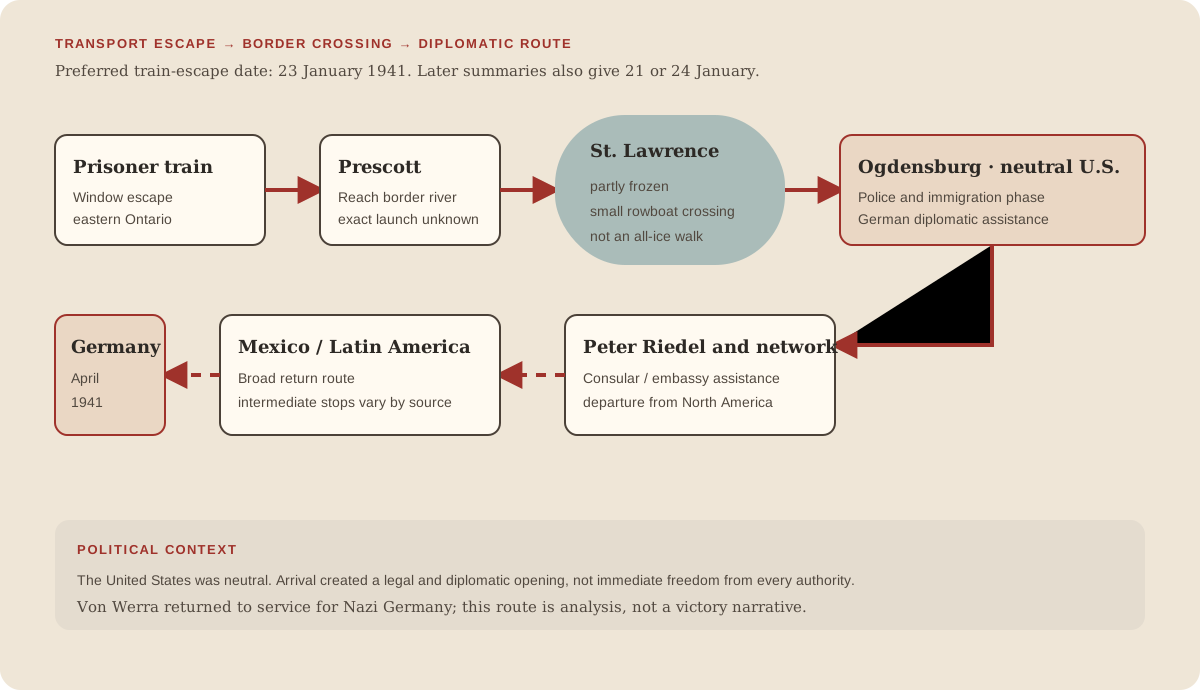
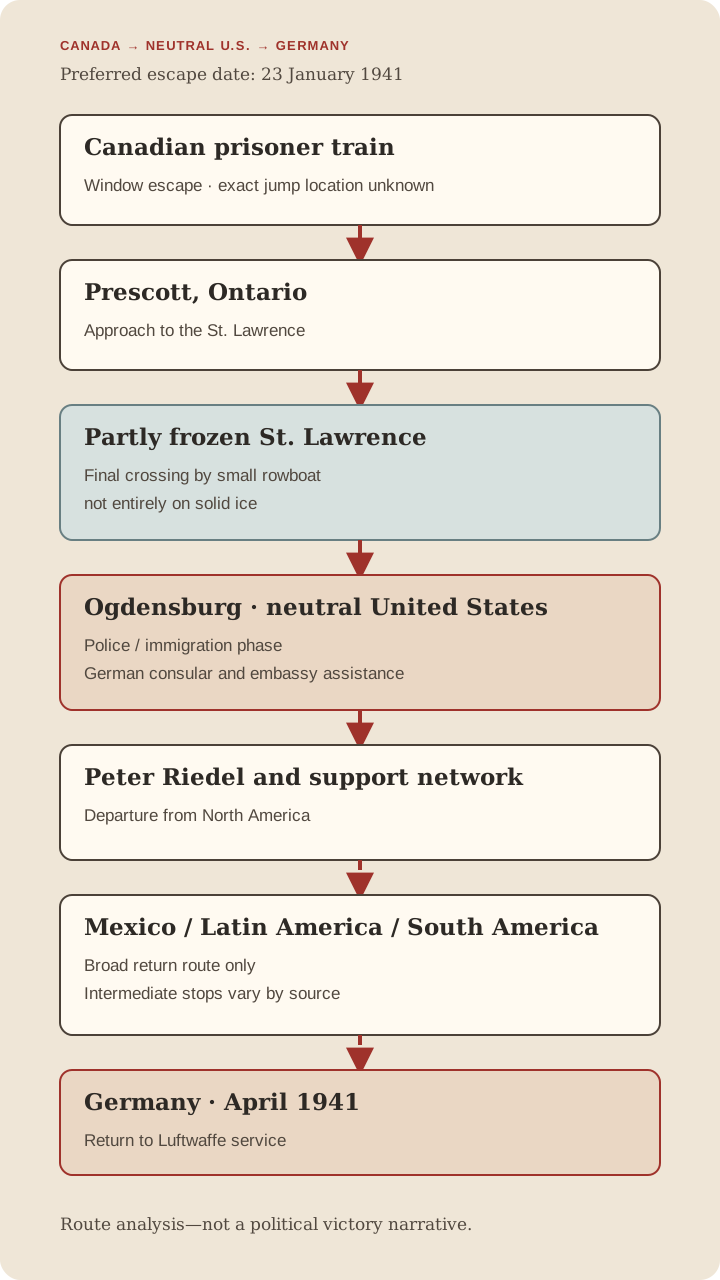
- 01
Train
Von Werra escaped through the window of a moving Canadian prisoner train.
- 02
Prescott
He made his way toward the St. Lawrence in eastern Ontario.
- 03
River
The partly frozen river required a small rowboat; it was not an all-ice crossing.
- 04
Neutral U.S.
Ogdensburg began a police, immigration and diplomatic phase.
- 05
Return
German assistance enabled a broad route through Mexico and Latin America to Germany; exact stops vary.
History Escaped reconstruction of Franz von Werra's successful 1941 route. The Canadian border sequence is well supported at this scale. Sources differ on the exact train-escape date in later retellings and on intermediate stops during the Latin American return; the diagram avoids invented precision.
Out the window
The physical breakout was remarkably simple compared with the tunnel at Swanwick. Von Werra escaped through a window of the moving prisoner train.
A detailed specialist reconstruction says fellow prisoners helped create cover inside the carriage while he prepared the window and dived out. Contemporary American reporting also described him jumping from the train after dark.
Once outside, the escape problem changed immediately. He no longer needed to defeat a fence. He needed direction, transport and distance.
Accounts describe von Werra moving through eastern Ontario using ordinary roads and civilian lifts. TIME reported that his French helped him obtain a ride and that he acquired a road map on the way. The detailed Pegasus reconstruction likewise places a map in the journey.
His target was the St. Lawrence corridor near Prescott, Ontario.
Across the river was New York State. Across the river was neutrality.

The St. Lawrence was not a frozen bridge
Popular retellings sometimes compress the next stage into a dramatic walk across the ice. The surviving accounts do not support such a clean picture.
The Battle of Britain Monument describes a crossing of the partly frozen St. Lawrence. Contemporary TIME reporting says von Werra used a rowboat to reach Ogdensburg. The Pegasus Archive gives a more complicated sequence: von Werra tried to move over the ice, found open water blocking the route, returned to the Canadian side, located a small boat and used it to finish the crossing.
The broad sequence is straightforward.
The river was partly frozen, and von Werra ultimately crossed by small rowboat.
Whether the boat was “stolen,” as TIME described it, or simply found at a deserted seasonal property, as the later specialist reconstruction says, is not important enough to force into certainty. On the American side, he reached Ogdensburg, New York. He had escaped Canadian custody. He had not escaped politics.
Neutral territory was not the same as home
Von Werra's arrival in New York is sometimes written as though he had stepped across a line and instantly become untouchable. The reality was less simple.
He soon came into American police and immigration custody and faced an illegal-entry issue. Canadian and British authorities wanted him back. German officials wanted to prevent that from happening. American authorities had to handle the case while the United States was still formally outside the war.
Contemporary TIME reports describe German consular involvement and bond. U.S. National Archives research adds an important diplomatic layer: von Werra reached the German embassy in Washington, and German air attaché Peter Riedel advised him on a covert route out of North America through Mexico and South America.
The legal details are easy to oversimplify in hindsight. A 1941 TIME article stated categorically that international law prevented the United States from returning him to Canada, while later handling of escaped prisoners changed. The central point is the practical outcome rather than a retrospective legal memorandum.
The historically important point is narrower:
American neutrality created time, uncertainty and diplomatic space.
Von Werra and the German diplomatic network used it.
The escape became an international journey
Getting to Ogdensburg was the dramatic geographic break. Getting back to Germany was the logistical achievement.
The sources agree on the broad route but not every intermediate stop. The U.S. National Archives describes Riedel advising von Werra to enter Mexico, continue through South America, and then fly back toward Europe. Contemporary TIME reporting later traced him through Peru, Bolivia and Rio de Janeiro, followed by an Italian aircraft across the Atlantic and onward transport to Germany. The Battle of Britain Monument gives a slightly different Latin American route and includes Panama.
Those differences are a warning against drawing a falsely precise line across a map. What can be stated confidently is that German officials helped von Werra leave the United States, he travelled south through Latin America, reached South America, crossed the Atlantic on Axis-linked transport and returned to Germany in April 1941. The man whom Britain had sent to Canada because he would not stop escaping was back in Luftwaffe territory.
Problem → response
Escape was a sequence of problems
Each response solved a practical obstacle while often creating the next one.
- 01→
Obstacle
Guarded movement on a prisoner train
Von Werra remained under guard aboard a prisoner train moving through eastern Ontario.
Response
Exploit a carriage window and the movement of the train rather than attempt another camp-perimeter breach
- 02→
Obstacle
Winter terrain and the partly frozen St. Lawrence
The St. Lawrence was partly frozen, but the final crossing still required open water and a small rowboat.
Response
Reach the Prescott corridor and use a small boat to cross open water to Ogdensburg
- 03→
Obstacle
Illegal entry into the neutral United States
Crossing from Canada into the United States created an immigration and legal risk of return to Canadian custody.
Response
Use German consular and embassy assistance while the case moved through U.S. legal and diplomatic channels
- 04→
Obstacle
No direct safe route back to Germany
Returning to Germany from neutral North America required an indirect international route rather than a direct Atlantic crossing.
Response
Move south through Mexico and Latin America and reach Europe by Axis-linked transport
Why the third major attempt worked
Von Werra's successful escape did not depend on one miraculous trick. It worked because several advantages aligned.
The transfer created a new border problem
Canada was far from Germany, but eastern Canada was close to the United States. The British decision solved one escape problem while creating another.
A moving train was not a permanent camp
At Grizedale and Swanwick, von Werra had to defeat camp routines and perimeter security. On the Canadian transfer, the opportunity was temporary. Once he was outside the carriage, there was no enclosing camp wall around the countryside.
Ordinary civilian infrastructure became useful
Roads, maps, rides and towns were enough to move him toward the border. He did not need a prepared underground network for the Canadian leg.
The St. Lawrence was difficult, not impassable
Winter conditions complicated the crossing but did not close it. A small boat was enough to turn the river into an international exit.
Neutrality changed the problem after the border
Most prison escapes end with a pursuit.
Von Werra's became a diplomatic case. German consular officials could help him openly or semi-openly in ways that would have been impossible inside an Allied country at war with Germany.
Outside assistance completed what individual escape could not
Von Werra got himself out of the train and across the river. He did not get himself from New York to Germany alone. The final “home run” required diplomatic advice, documents, money, transportation and an indirect international route.
Evidence discipline
What the record supports
Status labels distinguish secure conclusions from uncertainty and rejected claims. Color is never the only signal.
WELL-SUPPORTED
Von Werra escaped the Canadian prisoner train on 23 January 1941.
A 25 January wire report published on 27 January states that he escaped on 23 January, and an RCMP Veterans historical chronology gives the same date. Valour Canada gives 24 January, while some popular retellings give 21 January. Use 23 January while preserving the conflict in QA.
Sources: SRC-005, SRC-009, SRC-013MYTH
Von Werra crossed the St. Lawrence entirely by walking over solid ice.
Institutional and contemporary accounts describe a partly frozen river, while TIME and the Pegasus Archive support a small-boat crossing. The detailed specialist account says he first tried the ice but encountered an open channel and returned for a rowboat.
Sources: SRC-002, SRC-004, SRC-006DISPUTED
The exact route from the United States back to Germany is identical in all reliable sources.
The broad sequence—United States, Mexico or Latin America, South America, Europe, Germany—is secure. Intermediate stops vary: U.S. National Archives research emphasizes Mexico and South America; contemporary TIME reporting gives Peru, Bolivia, and Rio; another British institutional account mentions Panama. The surviving evidence supports only a broad route unless further primary documents resolve the itinerary.
Sources: SRC-001, SRC-002, SRC-008, SRC-004DISPUTED
Von Werra was literally the only German prisoner ever to escape Canadian custody during the war.
RCMP Veterans and Valour Canada use an 'only successful escape' formulation, but the Pegasus Archive states that two German prisoners had previously escaped Canadian custody, one of whom made it home by another route. The safest distinction is that von Werra became the famous Canadian 'home run' back to Germany, not that no other German ever got out of Canadian custody.
Sources: SRC-004, SRC-009, SRC-013DISPUTED
The Swanwick escape tunnel was exactly 30 metres long.
The current Hayes site gives 30 metres; the detailed Pegasus Archive reconstruction says the tunnel was planned as 13 metres. The measurement concerns a failed prelude rather than the successful Canadian escape, and the conflict remains unresolved.
Sources: SRC-004, SRC-010DISPUTED
Von Werra's aircraft loss on 25 October 1941 is definitively established as an engine-failure accident.
The U.S. National Archives states that his Bf 109F engine failed; the Battle of Britain Monument gives the date and sea loss but says the cause is unknown. The aircraft’s loss over the North Sea is secure, but its cause is not.
Sources: SRC-001, SRC-002What the famous story gets wrong
The most common oversimplification is that von Werra simply “walked across the frozen St. Lawrence into neutral America.”
The river was only partly frozen, and the best-supported reconstruction ends with a boat crossing.
A second oversimplification is the claim that every source agrees he escaped the train on 21 January. Contemporary reporting instead supports 23 January, while later accounts vary.
A third is the idea that “the only German POW to escape Canada” is an uncomplicated factual title. Some Canadian historical summaries use that description, while the Pegasus Archive says earlier German prisoners had escaped Canadian custody and distinguishes what happened to them afterward. The more defensible distinction is that von Werra became the best-known German POW to escape Canadian captivity and complete a return to Germany.
Finally, the 1957 film The One That Got Away should be treated as popular culture, not as evidence. Its power comes from turning a complicated sequence of failed attempts, improvisation and international politics into a coherent screen story. Historical reconstruction has to be less tidy.
The return had a short aftermath
Back in Germany, von Werra resumed Luftwaffe service. His survival after multiple captures and escapes made him useful for propaganda, but the war gave him little time to enjoy the reputation.
On 25 October 1941, only months after his return, von Werra died when his aircraft was lost over the North Sea. The U.S. National Archives account attributes the loss to engine failure; the Battle of Britain Monument gives the same date but says the cause is unknown. The safest conclusion is therefore the simplest one: his aircraft went down at sea and he did not survive.
His escape lasted longer than his return.
The reason the story endures is not that he was impossible to hold. Britain did hold him, more than once.
It is that every time the geography of captivity changed, he recalculated the route out. At Grizedale, he ran. At Swanwick, he tunneled and bluffed. In Canada, he used a window, a road, a river and a neutral border.
And after reaching the United States, the escape stopped being a prison story at all. It became an international one.
Selected chronology
Capture, failed attempts, border escape and return
Shot down and captured in Kent
Von Werra's Bf 109 was forced down near Marden, Kent, during the Battle of Britain. He entered British prisoner-of-war custody.
First British escape
He escaped from a working party associated with Grizedale Hall and remained at large for several days before recapture.
Swanwick tunnel escape
Von Werra and four other prisoners escaped from Camp 13 at Swanwick. Von Werra reached an RAF airfield while attempting a deception-based aircraft escape, but he was recaptured.
Transferred to Canada
British authorities sent von Werra and other German prisoners across the Atlantic to Canada.
Escapes the Canadian prisoner train
Contemporary reporting and later RCMP historical notes date his train escape to 23 January. Other later sources give 21 or 24 January.
Crosses into the United States
Von Werra crossed the St. Lawrence near Prescott and Ogdensburg and came into U.S. police and immigration custody, where German diplomatic officials became involved.
Leaves the United States and returns to Europe
With German assistance he left the United States and travelled through Latin America. U.S. National Archives research places his return to Germany in April 1941.
Killed after returning to Luftwaffe service
Von Werra died when his aircraft was lost over the North Sea. Sources differ on whether an engine failure can be stated as the established cause, so the page should not over-specify the loss mechanism.