
Geoffrey Pyke and Edward Falk escaped from the Ruhleben civilian internment camp outside Berlin on 9 July 1915. Their breakout was only the first stage. After getting beyond the camp perimeter, the two men returned toward Berlin, adopted the appearance of ordinary German tourists, travelled west by train, and then spent roughly two weeks moving mostly at night toward the neutral Netherlands.
The date and partnership are unusually secure. Pyke’s 1916 memoir names Falk as a District Commissioner in the Political Service of Nigeria and states plainly that they escaped together on 9 July. Contemporary British press reports, based on news sent from the Netherlands, confirm the same date and identify both men.
The most famous detail of the initial breakout requires more care. Pyke deliberately withheld part of the escape method while the war was still being fought because he feared consequences for friends who remained at Ruhleben. Later editions and biographies supplied the story of a sports-equipment hut, tennis nets, and glare that helped conceal the pair. That later version is plausible and widely repeated, but the 1916 memoir itself does not fully document it.
At a Glance
- Escapees: Geoffrey Nathaniel Pyke and Edward Falk
- Camp: Ruhleben civilian internment camp, west of Berlin
- Escape date: 9 July 1915
- Status: British civilian internees, not military POWs captured in battle
- Falk’s occupation: District Commissioner in the Political Service of Nigeria
- First stage: escape the camp perimeter and hide nearby until movement was safer
- Second stage: move through Berlin under civilian cover, travel west by rail, then continue largely on foot
- Broad route: Berlin → Bielefeld area → Teutoburg Forest region → Dutch frontier near Enschede
- Border reached: about two weeks after the escape
- Outcome: both reached the Netherlands and returned to Britain
- Evidence warning: Pyke’s memoir is the principal firsthand narrative, but he intentionally concealed part of the original breakout method during wartime
Why Ruhleben existed
Ruhleben was not a conventional military prisoner-of-war camp. It was Germany’s principal camp for British civilian men who happened to be inside the German Empire when war began.
The camp opened at the Ruhleben racecourse in November 1914. Modern scholarship estimates that roughly 5,500 civilians passed through it during the war, with the population reaching more than 4,200 in early 1915. The internees included businessmen, students, musicians, athletes, sailors, academics, tourists, and other civilians whose nationality made them enemy aliens in wartime Germany.
The first months were badly overcrowded. Horse-racing stables and newly erected barracks became living quarters. Over time, the internees created an extensive internal society with schools, sporting organizations, theatrical productions, magazines, libraries, clubs, and elected committees.
That later community life should not disguise the nature of the confinement. The men could not leave freely. Guards, fences, roll calls, and wartime regulations kept them inside Germany precisely because the authorities did not want British civilian males returning home and assisting the enemy war effort.
Pyke and Falk
Pyke had reached Germany under circumstances unlike most of the men at Ruhleben. A young would-be journalist, he entered wartime Germany in 1914 hoping to report from Berlin. German authorities arrested him within days, and he spent months moving through prisons and long periods in solitary confinement before being sent to Ruhleben in early 1915.
His health was poor when he arrived. Pyke later described serious illness during his first months at the camp. By summer, however, he was again thinking intensely about escape.
Edward Falk was the older and steadier partner. Pyke’s memoir calls him a District Commissioner in the Nigerian Political Service. Contemporary newspaper reporting used the same description, and a 1918 House of Commons answer confirms that Edward Falk had served as District Commissioner at Owerri in Southern Nigeria.
That evidence matters because a much later secondary biography described Falk as a forty-year-old clerk caught in Germany while on holiday. The occupation is contradicted by Pyke, wartime reporting, and the parliamentary record. His exact reason for being in Germany at the outbreak of war is less important to the escape than his verified colonial-service position.
Pyke later credited Falk with strong German and with planning for the problems they would face after getting out of Ruhleben. Pyke concentrated on the immediate problem of leaving the camp; Falk prepared for movement through Germany.
Planning around failure
Other internees had already tried to escape. Some got outside the camp and were caught before reaching a neutral frontier.
Pyke became interested in those failures as data. His later biographies describe him comparing earlier attempts and asking what had exposed them. The approach suited a man who would spend much of his later career trying to reduce practical problems to systems and probabilities.
The pair also prepared physically. Pyke’s 1916 memoir describes unusual crawling techniques that he had practiced under a fictitious health explanation. Once outside the most immediate perimeter, he and Falk used those movements while trying to avoid observation.
The exact method by which they first defeated the internal camp watch is more complicated. In the preface to To Ruhleben—and Back, Pyke told readers that he had deliberately been “discreet” because German retaliation against men still in the camp remained possible. Contemporary newspaper accounts therefore reported only the broad result: on the afternoon of 9 July, Pyke and Falk got out past armed guards and multiple lines of fencing.
Later retellings say they hid in a small sports-equipment hut beneath tennis nets, exploiting late-afternoon glare so that a guard looking inside would not notice them. Those details appeared only after the wartime need for secrecy had passed. They belong in the evidence record, but should be labeled as later-revealed rather than contemporary public documentation.
9 July 1915
Once beyond the inner camp security, Pyke’s published memoir becomes much more detailed.
By about 10:30 that evening, he and Falk were outside the principal cordon and wire. They waited for darkness before moving farther because soldiers and officers still used the surrounding roads.
The two men then spent hours crawling and moving across open ground. Pyke describes a succession of wire fences beyond the immediate camp boundary, some difficult enough that the men helped one another climb. He was still physically weakened from illness and at one point nearly failed to get over a particularly difficult fence before Falk helped him down on the far side.
They followed a canal and hid nearby through the remainder of the night.
The escape had cleared Ruhleben, but the most dangerous strategic problem remained. Two British civilians without valid wartime papers were still deep inside Germany, hundreds of kilometres from the Dutch frontier.
Back into Berlin
Their solution was counterintuitive: go toward Berlin before trying to go west.
The next morning they walked through Charlottenburg and boarded a tram into the city. Pyke and Falk maintained German civilian cover even when they found themselves near soldiers associated with the camp.
They ate breakfast, studied railway timetables, and bought the equipment of respectable walking tourists. Pyke’s memoir describes purchases including rucksacks, dark travelling cloaks, cooking equipment, food, a water bottle, and a luminous compass.
The disguise was social as much as visual. Instead of trying to look invisible, they tried to look ordinary: men setting out for a walking holiday.
They chose railway travel that did not point directly toward the Dutch frontier. Bielefeld became the major western rail objective. Falk’s familiarity with parts of the region was useful, although it also created a risk that someone might recognize him.
At Bielefeld they stopped using the long-distance railway. Pyke explains that they were approaching a zone in which identity papers were more likely to be demanded. They continued through Brackwede and by a smaller local train toward Dissen in the Teutoburg Forest before beginning the long overland portion.
Walking west
From there, Pyke and Falk moved mostly by night.
Contemporary newspaper reports said the walk took about a fortnight and emphasized the same broad features that appear in Pyke’s memoir: fields and forests, heavy rain, improvised food, and navigation by luminous compass.
The men avoided relying on ordinary roads where possible. They crossed agricultural fences, drainage ditches, woodland, heath, and wet ground. When buying food seemed too risky, they took potatoes, turnips, sugar beets, fruit, and other food from fields and gardens.
This part of the story is extensively narrated by Pyke and is therefore richer in detail than the camp breakout itself. It is also still a memoir written by one participant. Exact conversations, moments of panic, and the emotional rhythm of the journey should be understood as Pyke’s recollection rather than independently witnessed fact.
The partnership remained central. Falk’s German helped in encounters with local people. Pyke, still suffering from the effects of earlier illness, at times struggled physically. In one of the memoir’s most striking episodes, Falk became stuck in marshy ground and Pyke helped him with a rope they had made from string.
Neither man separated permanently from the other. They reached neutral territory together.
A border crossed without realizing it
Near the Dutch frontier, they expected the most dangerous part of the journey to come last.
Instead, the decisive crossing happened without either man recognizing it at first.
Pyke recalled that a uniformed man found them resting in cover. The pair assumed they had been discovered by a German soldier and tried to maintain their tourist explanation. Then the man told them that they were already standing on Dutch soil.
Pyke at first thought it was a trick. Only when Falk’s conversation with the man continued did they understand that he was a Dutch frontier guard and that they had passed the German sentries during the previous night.
Pyke later placed them only a short distance inside the Netherlands, near the Enschede area. Contemporary reports say they were briefly suspected of being smugglers before their situation was accepted.
By 25 July, news of their arrival was being transmitted from Amsterdam. British and imperial newspapers carried the story almost immediately.
What made the escape unusual
Ruhleben produced many escape attempts, but Pyke and Falk’s success came from solving two different problems.
The first was escaping the camp. The second was remaining believable inside Germany for long enough to reach neutral territory.
Their plan shifted between concealment and conspicuous normality. Near Ruhleben they crawled through darkness and wire. In Berlin they rode a tram, ate in a restaurant, shopped in a department store, and used the railway. Farther west they abandoned that public performance and moved at night across open country.
The approach also divided responsibilities. Pyke later wrote that getting out of the camp had been his specialty while Falk had worked through the problems likely to arise afterward.
That division is one reason the case should remain a two-person story. Pyke became much more famous in later life, but the escape was not a solo feat with an incidental companion.
Memoir, press, and later legend
The source record is unusually revealing about how escape stories change.
The first newspaper reports appeared while Pyke and Falk had only just reached safety. They gave the date, the names, the broad journey, and some of the hardships. They also presented the escape in openly patriotic wartime language.
Pyke’s 1916 memoir then supplied a much longer first-person account. Yet he intentionally concealed part of the initial breakout because he believed publishing it could expose other internees to retaliation or close an escape opportunity still available at Ruhleben.
Later biographies filled that gap with the sports-hut and tennis-net story. That may preserve information Pyke was willing to release after the war, but it is a different category of evidence from the material he published in 1916.
The same source discipline corrects Falk’s identity. Primary and contemporary sources call him a District Commissioner in Nigeria. The later description of him as a clerk should not replace those records.
Return to Britain
From the Netherlands, Pyke and Falk returned to Britain.
The story made Pyke briefly famous. The Daily Chronicle, which had sent him toward Germany the previous year, now had a better story than the reporting mission that had ended with his arrest. In 1916 he published To Ruhleben—and Back.
Falk returned to his colonial-service career. A House of Commons exchange in 1918 referred to his Ruhleben internment and stated that he had been one of the first two men from the camp to escape successfully back to England.
Pyke’s later life would include education experiments, social research, and wartime invention projects, but those belong to another biography.
For this case, the ending is simpler. Two civilian internees left Ruhleben on 9 July 1915, moved from concealment to calculated public disguise and back to concealment, crossed Germany together, and reached neutral territory roughly two weeks later. The escape succeeded because they did more than get out of a camp: they found a way to remain free all the way to the border.
Evidence discipline
What the record supports
Status labels distinguish secure conclusions from uncertainty and rejected claims. Color is never the only signal.
DOCUMENTED
Pyke and Falk escaped Ruhleben on 9 July 1915.
Pyke states the date in his 1916 memoir, and contemporary newspaper reports independently use the same date.
Sources: SRC-001, SRC-002, SRC-003MYTH
Edward Falk was merely a clerk who happened to be holidaying in Germany.
Pyke identifies Falk as a District Commissioner in the Nigerian Political Service; wartime reporting and a 1918 House of Commons answer independently confirm his colonial-service position.
Sources: SRC-001, SRC-002, SRC-006MYTH
The 1916 memoir openly revealed the complete method used to defeat the Ruhleben camp watch.
Pyke explicitly said that he was being discreet to avoid exposing friends and escape opportunities while the war continued.
Sources: SRC-001, SRC-007LATER CLAIM
The sports-hut, tennis-net, and sunlight-glare method was fully documented in the original wartime account.
The detailed version appears in later editions/biographical tradition. Contemporary public accounts state only the broad escape through the guarded perimeter.
Sources: SRC-001, SRC-002, SRC-007MYTH
Pyke escaped alone and Falk joined later.
All strong sources describe them as partners from the Ruhleben breakout through the crossing into the Netherlands.
Sources: SRC-001, SRC-002, SRC-006MYTH
They walked all the way from Ruhleben to Holland.
The pair used a tram in Berlin and substantial rail travel west before beginning the long cross-country walking phase.
Sources: SRC-001, SRC-002Documentary reconstruction
Ruhleben breakout and cross-Germany evasion
A case-local editorial visual clarifies the evidence structure without adding false precision or reusable operational detail.
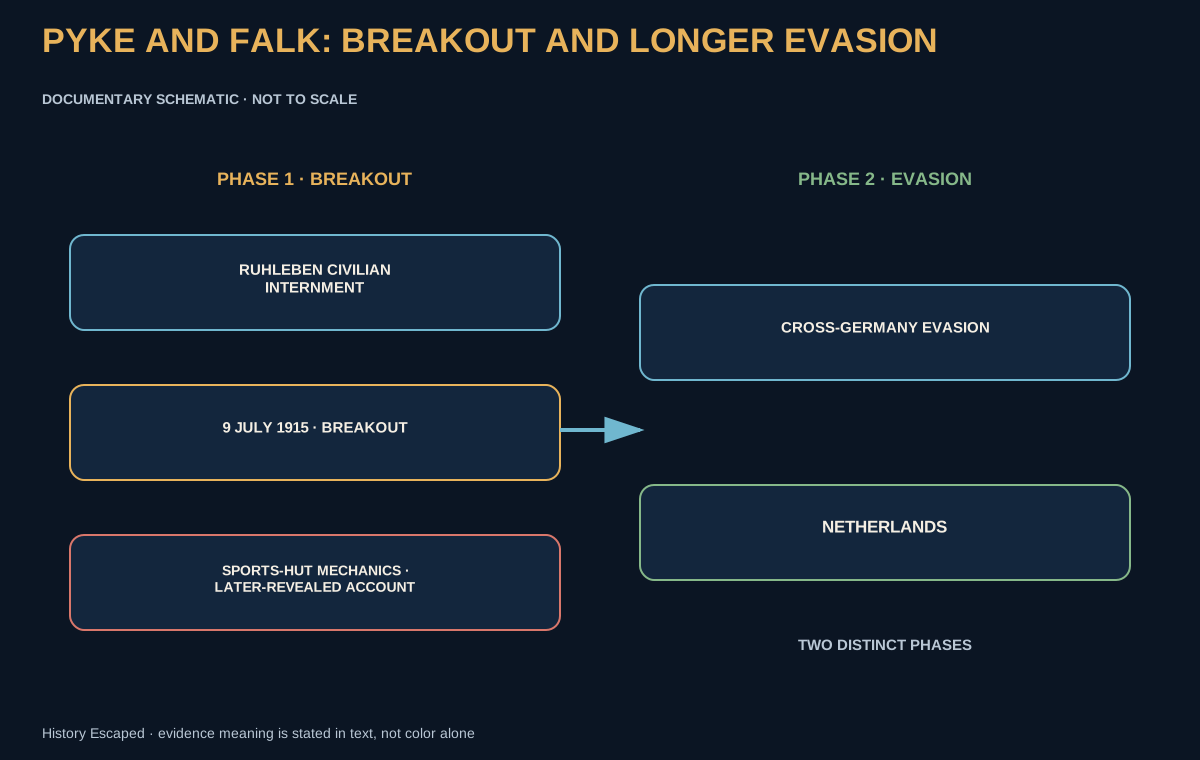
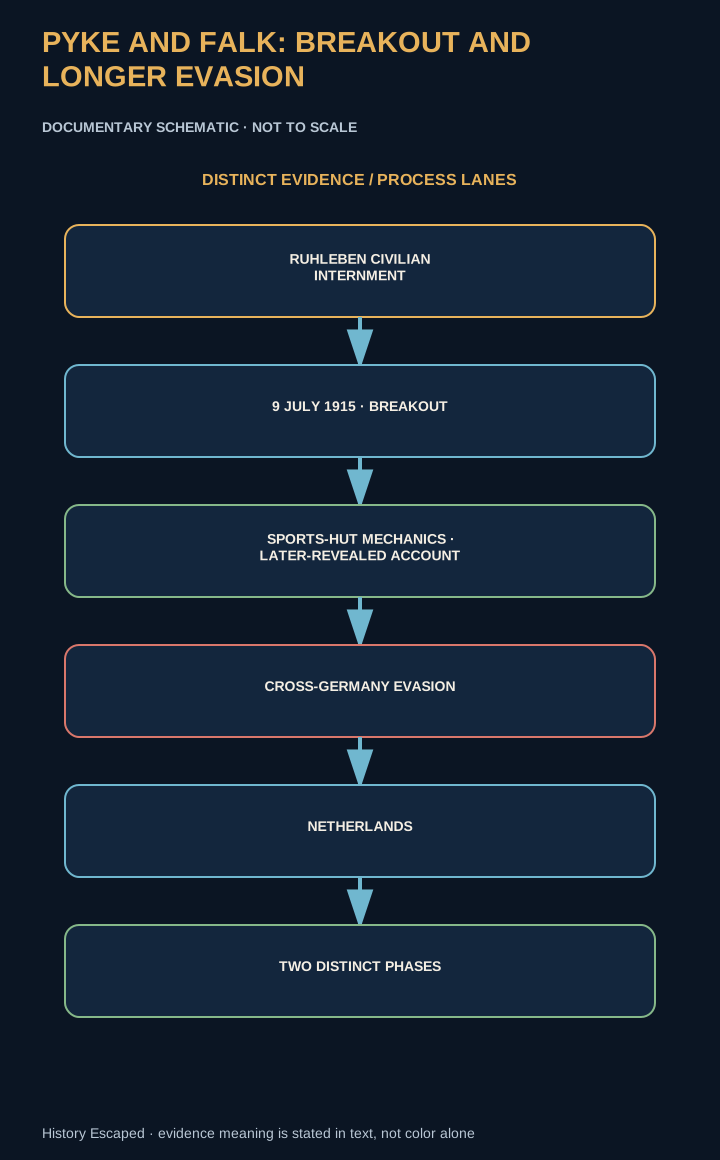
Simplified evidence-led editorial reconstruction based on the cited record; not to scale. Uncertainty is stated directly in the visual and adjacent text.