
How Airey Neave Escaped Colditz in 1942
On 5 January 1942, British officer Airey Neave did not tunnel under the walls of Colditz Castle or climb down them in the dark. He escaped by entering the German side of the prison and then behaving as though he belonged there.
The plan depended on several deceptions working together. Neave and Dutch officer Tony Luteyn wore improvised German uniforms. They carried false papers. They used a concealed route connected to the prisoners’ theatre to reach the German guardhouse from inside the castle. Then they walked out past the sentries.
Getting through the gate was only the first half of the problem. Colditz stood deep inside Germany. Neave and Luteyn still had to travel hundreds of miles through a country at war, avoid police and railway checks, and reach neutral Switzerland before their disguises and documents failed them.
They succeeded. Neave became the first British officer to make a successful escape from Colditz and reach freedom.
Why Neave Ended Up at Colditz
Colditz was not an ordinary prisoner-of-war camp. The Germans used Oflag IV-C to confine Allied officers considered especially troublesome, important, or prone to escape. The castle’s position above the town, its walls, its internal divisions and its guarded approaches gave it a reputation as a place from which repeated escapers could finally be contained.
Neave had already demonstrated why he qualified.
A Royal Artillery officer, he was wounded and captured during the fighting at Calais in May 1940. He was eventually sent to Stalag XXA near Thorn, in German-occupied Poland. In April 1941 he escaped with another prisoner but was recaptured. He was then transferred to Colditz, arriving on 15 May 1941 at the age of 25.
Colditz concentrated men who were already thinking about escape among other men doing the same. That made the prison more secure in one sense—the guards expected trouble—but it also created an unusual reservoir of experience. Prisoners studied routines, cultivated specialists, improvised clothing and equipment, and shared knowledge about routes across Germany.
Neave tried again from Colditz and failed. The lesson was not that German disguise was useless. His later account shows that he remained convinced that impersonating a German offered the best chance. The problem was making the impersonation convincing enough and finding a route that placed the disguised escaper where a German uniform would make sense.
The prisoners’ theatre helped solve that second problem.
A Route Through the German Side of the Castle
The crucial discovery was not a tunnel to the countryside. It was an internal route that brought escapers into the German-controlled portion of Colditz.
P. R. “Pat” Reid, one of the central British escape organizers at the castle, later described reconnaissance through a disused corridor connected to the theatre area. The route ultimately reached attic space over the German guardhouse, from which stairs descended into the guards’ quarters. Other accounts compress the same movement into a simpler description: Neave passed through the theatre floor and into the guardhouse below.
The details differ in how much of the intermediate space they describe, but the underlying mechanism is consistent. The theatre gave the prisoners access to a hidden passage into an area where German personnel were expected to appear. Instead of trying to cross the most obvious boundary between prisoner and guard territory under observation, the escapers would emerge on the German side already dressed as German officers.
That changed the logic of the escape.
A prisoner climbing a wall had to avoid being seen. A man walking from a German guardhouse in a German uniform needed, for a few critical moments, to be seen and accepted as what he appeared to be.
Material evidence
Disguise and escape materials
Uniforms, papers, a compass and civilian clothing supported both the castle exit and the journey that followed.
- 01Central to passing the guardhouse and sentries without a physical breakout at the final gate.
Improvised German officer uniforms
Altered garments and fabricated details created the appearance of German officers within the guard-controlled part of Colditz.
- 02Necessary for a deception-based escape through wartime Germany.
Forged papers
False documentation supported the German identity at the castle and later travel cover.
- 03Navigation aid after leaving the camp.
Compass
National Archives exhibition material identifies a compass carried by Neave during the escape.
- 04Supported the post-camp phase of evasion toward Switzerland.
Civilian clothing
Civilian clothes allowed the pair to abandon the immediate German-officer presentation after clearing Colditz.
Building the Disguise
A convincing uniform could not simply be stolen without creating obvious problems. The Colditz prisoners instead turned available materials into imitations.
Reid’s retrospective account describes Dutch greatcoats being altered to resemble German ones. Lead was melted and cast for metal fittings such as buttons, buckles and insignia. Other uniform pieces were improvised from materials inside the camp. The result did not have to survive a quartermaster’s inspection in daylight. It had to look credible to guards who expected German officers to pass through their own area.
Language mattered too.
The four men assigned to the operation were organized as two British-Dutch pairs. The Dutch officers spoke German well, giving each pair someone better equipped to handle an unexpected conversation or challenge. The first pair would be Neave and Tony Luteyn, an officer of the Royal Netherlands East Indies Army.
They also carried forged papers. The National Archives’ account of Neave’s escape records a compass as part of his equipment. Beneath the German disguises, civilian clothing provided another identity once the pair was away from the immediate military environment of Colditz.
The plan therefore had layers. The theatre route was meant to get them into the guard side. German uniforms were meant to get them through the gates. Civilian cover and forged documents were meant to carry them through Germany. A successful escape required all three stages.
Escape route
From the POW side to the German-controlled exit
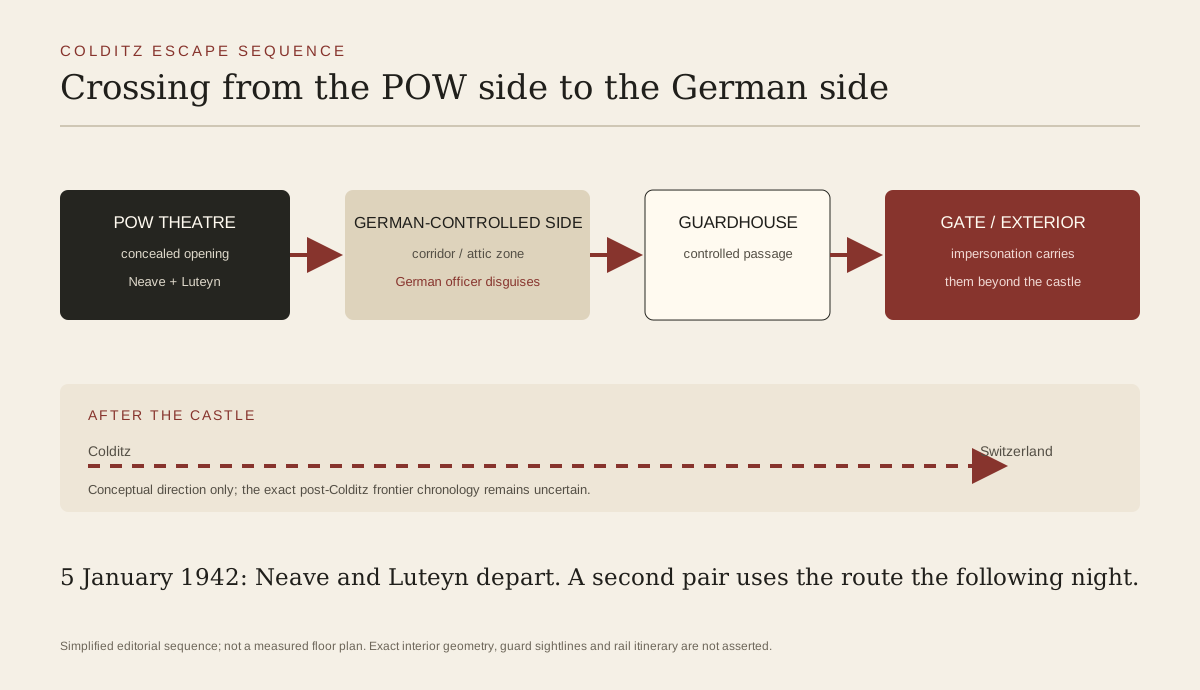
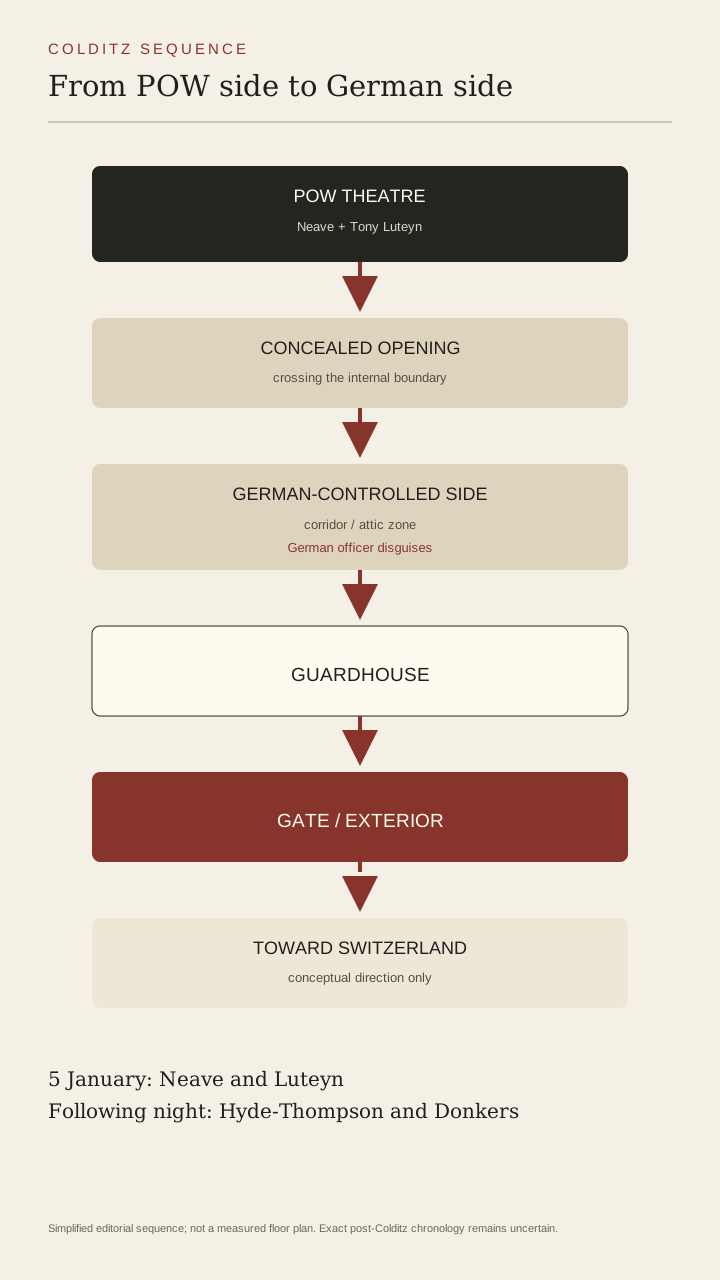
The disguise worked because an internal theatre route placed Neave and Luteyn on the German side of the castle before they approached the guardhouse and gate.
- 01
POW theatre
The theatre created a concealed opening into space beyond the normal prisoner side.
- 02
German-controlled side
German officer disguises and forged papers became useful only after the pair reached this zone.
- 03
Guardhouse and gate
Neave and Tony Luteyn passed sentries as apparent German officers.
- 04
Outside Colditz
Leaving the castle began a second phase across hostile territory.
- 05
Switzerland
The pair completed the home run; exact post-Colditz frontier chronology varies in later summaries.
Simplified editorial route; not an exact floor plan, guard-sightline study or rail itinerary.
5 January 1942
After the evening roll call on 5 January, Neave and Luteyn moved into the theatre route.
Reid later recalled leading them through the concealed opening beneath the stage and toward the attic above the guardhouse before returning to conceal the traces of the operation. From there the two escapers entered the German guard area.
The decisive moment was almost anti-dramatic in its design. They did not rush the gate. They walked.
Imperial War Museums describes the pair, disguised as German officers, passing sentries through a gate into the dry moat, crossing the park and getting over the outer wall. The National Archives likewise records that the uniforms and false identity allowed them to walk away from the castle undetected.
That apparent normality was the point. The escape depended on guards interpreting two men leaving the German side of the prison as German personnel rather than prisoners who had penetrated it.
Once they were clear of the castle, the uniforms had done their most important work. The men could turn to the longer journey toward Switzerland.
Problem → response
Escape was a sequence of problems
Each response solved a practical obstacle while often creating the next one.
- 01→
Obstacle
Guarded separation between prisoners and the German side
A prisoner openly moving from the POW compound toward a main exit would attract immediate attention.
Response
Use the theatre route to enter the guard-controlled side internally before presenting as German officers.
- 02→
Obstacle
Visual scrutiny by sentries
The pair had to appear to be legitimate German personnel while passing a guardhouse and exterior sentries.
Response
Improvised German officer uniforms, normal movement and forged documentation.
- 03→
Obstacle
Risk of being challenged in German
An unexpected conversation could expose a British escaper's accent or limited fluency.
Response
Pair each British officer with a German-speaking Dutch officer.
- 04→
Obstacle
Hundreds of miles of hostile territory after leaving the castle
Clearing Colditz did not provide immediate safety; rail and police checks remained a major recapture risk.
Response
Use forged identities, civilian cover, rail travel, walking and an established direction toward the Swiss frontier.
The Second Escape Began Outside the Walls
A “home run” from a German POW camp meant more than getting outside the perimeter. A prisoner who emerged from Colditz was still hundreds of miles from a neutral frontier and could be recaptured by railway police, local police, military patrols, document checks or simple bad luck.
Neave and Luteyn used trains where they could and covered part of the journey on foot. Dutch specialist histories and later reconstructions based on Swiss archival material trace them through the German rail network toward the Lake Constance region and the Singen area, a route already known to Dutch escapers.
Their journey was not frictionless. Accounts agree that they attracted police attention during the southbound trip. The surviving versions differ in some geographical detail, and the exact sequence should not be turned into a falsely precise itinerary. What is well supported is that the pair escaped renewed detention or supervision and continued south rather than being returned to Colditz.
By the fourth day of the journey, they reached the Swiss frontier. They crossed into neutral Switzerland wearing civilian clothes.
The physical distance from Colditz had been as important as the castle gate itself. The escape was successful because the men survived both problems: leaving the prison and then crossing Germany.

The Pair Who Followed
Neave and Luteyn were only half of the planned operation.
The route was intended for four officers in two British-Dutch pairs. The second pair—John Hyde-Thompson and Dutch officer H. G. Donkers—followed by the same method on the next evening. They successfully got out of Colditz but were caught at Ulm and returned to captivity.
Their failure is important because it shows how narrow the margin remained even after the castle had been defeated. A route that worked perfectly at the guardhouse did not make forged papers invulnerable to scrutiny hundreds of miles away.
It also helps explain a common dating problem. Some later accounts describe the Colditz operation under 6 January 1942. The stronger archival-based chronology places Neave and Luteyn’s departure on 5 January, with the second pair following on the next night. Treating the operation as a two-night sequence reconciles much of the apparent contradiction without moving Neave’s escape away from the date given in his MI9 material.
What Made the Escape Work
The Neave-Luteyn escape is memorable because no single device explains it. The route solved the problem of reaching the German side of the prison without crossing the usual guarded boundary. The uniforms solved the problem of appearing in that space without immediately looking like prisoners. The Dutch-British pairing reduced the risk that a conversation in German would expose the disguise.
The forged papers and civilian clothing carried the deception beyond Colditz. Existing escape knowledge pointed them toward a workable neutral frontier.
Each solution depended on the one before it. A perfect uniform would have been less useful if Neave had first been seen emerging from the prisoner compound. A perfect exit from the guardhouse would have achieved little if the pair had no plan for the railway system and Swiss border. The escape worked as a chain rather than a single trick.
What “First British Escaper” Actually Means
Neave is often introduced as the first man to escape Colditz. That is too broad.
He was the first British officer to make a successful escape from Colditz and complete a home run. Other Allied prisoners, including Dutch officers, had already succeeded in reaching freedom from the castle. Those earlier Dutch successes mattered directly because knowledge of routes toward Switzerland circulated among the prisoners.
The distinction does not diminish Neave’s achievement. It makes the story more accurate—and more revealing. Colditz escaping was cumulative. Prisoners learned from failed attempts, successful routes and one another’s national networks.
From Escaper to MI9
After reaching safety and eventually returning to Britain, Neave joined MI9, the War Office organization concerned with escape and evasion.
That made his Colditz experience useful beyond his own freedom. The National Archives preserves Neave’s escape account and a detailed plan of Colditz within MI9-related records. His later work helped turn the practical knowledge of a former prisoner into intelligence that could support other Allied personnel trying to evade capture or escape imprisonment.
There is a fitting reversal in that trajectory. Colditz had been designed, in part, to concentrate persistent escapers where they could be watched. Neave left it with the experience that would help a British organization study exactly how captivity could be defeated.
Evidence discipline
What the record supports
Status labels distinguish secure conclusions from uncertainty and rejected claims. Color is never the only signal.
DOCUMENTED
Neave and Luteyn escaped Colditz on 5 January 1942.
The National Archives dates Neave's final attempt to 5 January 1942 from MI9 material in WO 208/3308/676; IWM independently gives the same date. A later PBS/NOVA summary gives 6 January, likely reflecting or collapsing the second night's departure in the four-man operation.
Sources: SRC-001, SRC-005, SRC-009MYTH
Neave was the first person ever to escape Colditz.
Neave was the first British officer to make a successful home run from Colditz. Other Allied prisoners, notably Dutch officers, had previously escaped successfully.
Sources: SRC-001, SRC-006MYTH
The successful escape was a solo operation by Airey Neave.
Neave escaped with Dutch officer Tony Luteyn, whose German fluency was operationally important. The broader plan involved four officers in two British-Dutch pairs.
Sources: SRC-001, SRC-004, SRC-005UNKNOWN
The theatre route can be reconstructed as an exact measured architectural path from the current evidence package.
The major topology is well supported, but compressed institutional accounts and fuller retrospective accounts differ in the amount of intermediate corridor and attic detail they describe. A not-to-scale explanatory diagram is defensible; a measured cutaway is not yet.
Sources: SRC-004, SRC-009, SRC-015MYTH
Neave was 24 when he made the January 1942 escape.
A National Archives exhibition summary calls him 24, but he was born on 23 January 1916 and The National Archives' own POW-card feature records that he arrived at Colditz in May 1941 aged 25. He was still 25 on 5 January 1942.
Sources: SRC-001, SRC-015Evidence, Uncertainty and the Story That Survives
The basic outline of Neave’s escape is unusually secure because it is supported by his wartime MI9 material, other participant accounts, institutional histories and later archival work. The details still require discipline.
The date should be 5 January 1942 for Neave and Luteyn, despite a 6 January date in some later summaries. The word “first” should be restricted to the first successful British officer from Colditz. Luteyn should not disappear from a story sometimes reduced to Neave alone. And the internal theatre route should not be rendered as a precise architectural cutaway unless a publication-quality floor plan and measurements can support it.
Those limits improve the reconstruction rather than weakening it. The documented mechanism is already remarkable: two prisoners moved from a theatre into the German side of one of the most guarded POW camps in Europe, transformed themselves into people the guards expected to see, walked through the exit, and then survived the much longer journey to a neutral border.
Colditz was not defeated by one miraculous device. It was defeated by accumulated knowledge, improvised materials, language, timing and a plan built around what the guards believed they were looking at.
Selected chronology
Capture, Colditz and the two-night escape
Captured at Calais
Neave was wounded and captured during the fighting at Calais.
Escape and recapture from Stalag XXA
Neave escaped from Stalag XXA with another prisoner but was recaptured, contributing to his transfer to Colditz.
Arrives at Colditz
Neave arrived at Oflag IV-C aged 25.
Neave and Luteyn leave Colditz
The first British-Dutch pair used the theatre-to-guardhouse route in German disguises and walked out of the castle.
Second pair follows
Hyde-Thompson and Donkers used the route the next evening but were later recaptured at Ulm.
Neave and Luteyn reach Switzerland
Specialist Dutch and Swiss-archive-derived accounts place the pair at the Swiss frontier by the fourth day of their journey.
Neave joins MI9
After returning to Britain, Neave worked with MI9 and provided intelligence about Colditz and escape methods.