
The Great Escape from Stalag Luft III: How 76 Allied Airmen Broke Out in 1944
On the night of 24 March 1944, 200 Allied prisoners of war were waiting for their chance to disappear through a hole concealed beneath a stove in Hut 104 of Stalag Luft III.
Below them ran Harry, a narrow tunnel driven deep beneath a German POW camp at Sagan in Lower Silesia. The prisoners had spent months excavating it, supporting it with scavenged timber, supplying it with air and electric light, moving men and soil through it, and preparing the forged papers, civilian-looking clothes, maps and compasses they hoped would keep the escapees alive once they reached the other end.
The plan was to send 200 men out.
Eighty emerged from Harry before the breakout was stopped. Four were caught almost immediately. Seventy-six escaped beyond the immediate camp perimeter.
Only three ultimately reached safety. Seventy-three were recaptured, and 50 of those men were murdered on Adolf Hitler's orders. The Great Escape was therefore two histories at once: one of the most elaborate prisoner-of-war escape operations of the Second World War, and a war crime committed against the men who took part in it.
A camp designed to make tunneling difficult
Stalag Luft III had been established for captured Allied airmen near Sagan, in what was then Germany. Its location and construction created immediate problems for anyone considering a tunnel.
The compound stood in sandy ground. Barrack huts were raised above the surface, making activity beneath them easier to detect. An escape tunnel had to travel not merely underneath a wall but beneath the camp's security perimeter and out far enough for men emerging from it to have some chance of disappearing.
These conditions did not prevent tunneling. They changed the kind of tunneling that was required.
A shallow, casually dug passage was unlikely to survive either the soil or German searches. The prisoners needed concealment, structural support, ventilation, a system for removing enormous quantities of spoil, and enough depth to place the main passage well below the normal level of inspection.
That turned the problem from a simple act of digging into an engineering and organizational project.

Roger Bushell's plan was bigger than one tunnel
Roger Bushell had already attempted escape before reaching Stalag Luft III. At the North Compound he became the central organizer of a much larger effort.
The plan that developed around him did not depend on a single tunnel. Three were begun and given deliberately ordinary names: Tom, Dick and Harry.
That redundancy mattered. If German guards discovered one tunnel, work elsewhere might survive.
The undertaking spread far beyond the men at the digging face. A postwar report preserved by The National Archives stated that roughly 600 prisoners were engaged in some aspect of preparing the escape. Men excavated, shored passages, disposed of sand, obtained material, watched guards, altered clothing, produced documents and organized equipment for travel beyond the wire.
Canadian airman Wally Floody, whose pre-war mining experience was particularly valuable, became one of the men most closely associated with the technical tunneling effort.
The scale was necessary because the tunnel itself was only the first problem. Escaping from the camp would mean very little if hundreds of men emerged without papers, clothing, directions or a way to pass through wartime Germany without attracting immediate attention.
Building Harry
Harry began beneath Hut 104.
Its entrance was concealed beneath a stove. From there the prisoners sank a shaft before driving the tunnel horizontally toward the camp perimeter.
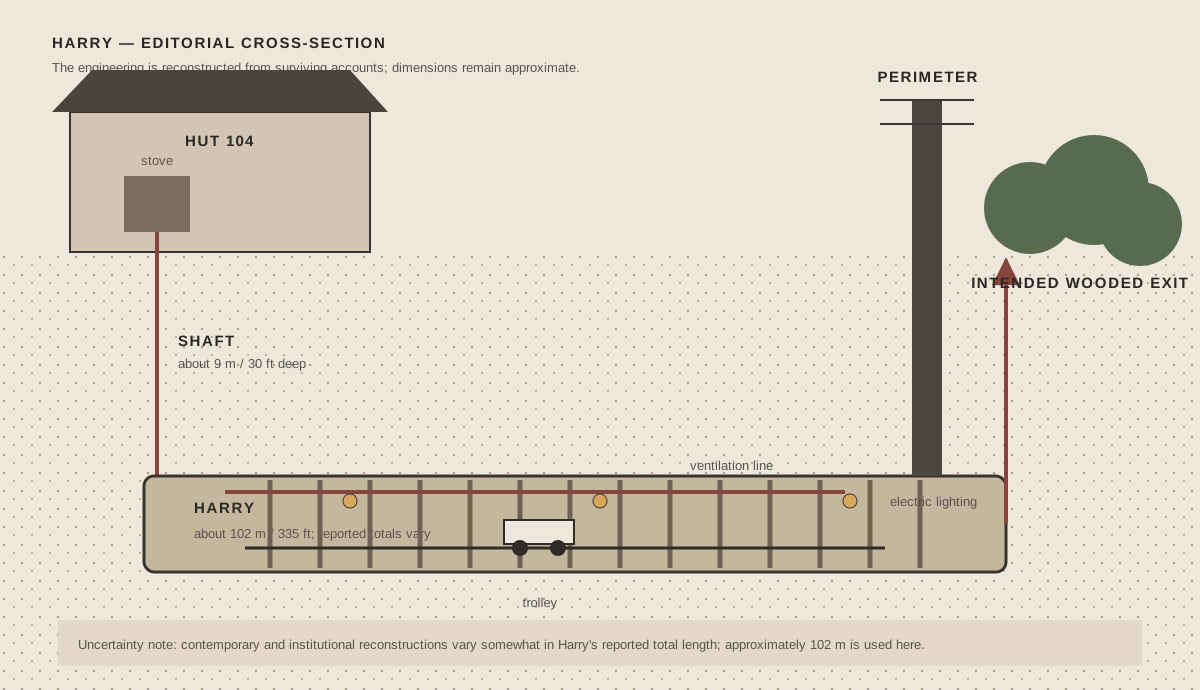
The surviving institutional accounts differ slightly over its exact dimensions, but the best-supported modern figure places Harry at roughly 102 metres — about 335 feet — in length and approximately nine metres, or 30 feet, beneath the surface. At that depth, digging created another problem: air.
The prisoners improvised ventilation equipment and ducting to move fresh air toward the men working underground. Timber taken from camp materials was used to shore the passage. A small trolley system running along wooden rails helped move soil and people through the confined space. Electric lighting was also installed.
None of these systems existed independently. Every metre of tunnel created more sand that had to disappear without alerting the guards. Every piece of timber used underground had to come from somewhere above ground. Every modification increased the number of prisoners who could expose the operation if German security discovered what was happening.
The escape organization therefore became a logistical network above and below the surface.
Tunnel reconstruction
How tunnel Harry crossed the perimeter
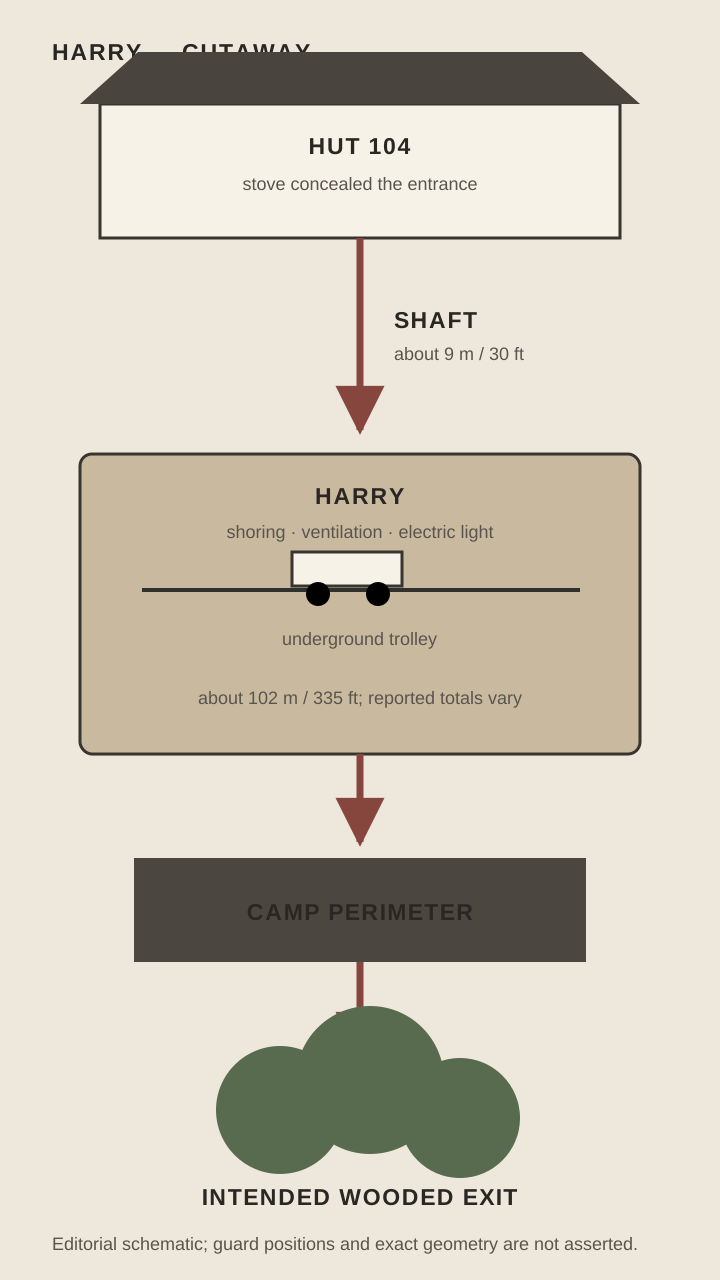
The schematic emphasizes the engineering system and intended exit without inventing precise guard positions.
- 01
Hut 104
A concealed stove entrance opened into the vertical shaft.
- 02
Deep shaft
The tunnel ran at approximately 9 metres / 30 feet below ground.
- 03
Harry
Timber shoring, ventilation, trolley haulage and electric lighting sustained the long passage.
- 04
Perimeter
The tunnel crossed beneath the camp's controlled boundary.
- 05
Intended wooded exit
The outlet fell short of the intended cover, exposing escapees as they emerged.
Simplified editorial reconstruction based on historical sources; not to scale. Harry is often described as about 102 metres / 335 feet long, but measurements vary.
A tunnel was useless without an identity
Harry could get a prisoner outside Stalag Luft III. It could not get him through a railway station, past a document check or across a national frontier.
That required a second operation.
The escape organization prepared forged or altered documents, maps and compasses. Uniforms and other clothing were modified to make some prisoners less immediately recognizable as Allied servicemen. Money and food were assembled. Routes were considered according to language ability, documents and the likelihood that a particular escaper could travel by rail rather than attempting the journey entirely on foot.
The first men through Harry were therefore not chosen simply by who had spent the most time digging. Priority reflected the chances they appeared to have once outside.
This distinction is central to understanding the Great Escape. Digging Harry was an engineering project. Turning 200 prisoners into fugitives capable of moving through Nazi-controlled Europe was an intelligence and logistics project layered on top of it.
Material evidence
Tools of Escape
The objects used in an escape reveal how a plan worked under constraint.
- 01Without structural support, Harry could not safely extend for the required distance.
Timber shoring
Scavenged camp timber supported the tunnel against the unstable sandy soil.
- 02The depth and length of Harry made fresh-air circulation essential.
Improvised ventilation
Prisoners constructed air-moving equipment and ducting to supply the deep underground workings.
- 03It increased the practicality of transporting material through a passage too confined for normal movement.
Underground trolley
A small trolley and rail arrangement moved soil and prisoners through the narrow tunnel.
- 04It enabled sustained underground work and movement.
Electric lighting
Harry was equipped with improvised electric lighting connected to the camp's electrical system.
- 05The operation had to solve movement through wartime Germany as well as the physical camp perimeter.
Escape documents and navigation equipment
Forged or altered papers, maps, compasses, money and route preparations were assembled for selected escapees.
Tom was lost. Dick found another use.
The three-tunnel strategy eventually justified itself.
Tom was discovered by the Germans later in 1943. Modern institutional sources disagree over the precise month, but its loss forced the organization to reconsider the remaining tunnels.
Dick ceased to be the principal route out and was instead useful for concealing material and spoil. Harry survived. Work eventually concentrated there, and by March 1944 it was ready for the attempt that the prisoners had spent months preparing. The Germans had found one major tunnel.
They had not found the one that mattered on 24 March.
Problem → response
Escape was a sequence of problems
Each response solved a practical obstacle while often creating the next one.
- 01→
Obstacle
Sandy soil
The camp's pale, loose sand made excavation, structural stability and concealment of spoil difficult.
Response
Prisoners dug deeply, shored Harry with timber and created organized systems for spoil removal and disposal.
- 02→
Obstacle
Raised barracks and searches
The barracks were elevated, making hidden activity underneath them more difficult.
Response
Harry's access point was concealed beneath a stove in Hut 104.
- 03→
Obstacle
Loss of a tunnel
German security discovered Tom before the March 1944 breakout.
Response
The original three-tunnel redundancy allowed work to continue elsewhere, with Harry becoming the operational escape route.
- 04→
Obstacle
Travel through Nazi-controlled territory
Once outside, escapees faced rail checks, police scrutiny, language barriers and long routes to neutral or Allied-controlled territory.
Response
The organization prepared documents, clothing, maps, compasses, money and route plans before the breakout.
- 05→
Obstacle
Harry's exposed exit and limited throughput
The tunnel did not emerge as safely into cover as intended and could move men only slowly.
Response
Escapees controlled movement from the exit, but only 80 emerged before the breakout was stopped.
The night 80 men came out of Harry
The breakout began on the night of 24 March 1944. The first major problem appeared at the far end.
Harry had not carried the men as safely into the woods as the planners had expected. The exit left the escapees more exposed near the perimeter, forcing movement above ground to be controlled rather than allowing men simply to pour out of the tunnel.
That reduced the rate of escape.
So did the physical limitations of Harry itself. A tunnel built secretly by prisoners was never going to move people at the speed of an open corridor. Each man had to descend, travel through the narrow underground passage and emerge without exposing the exit.
The plan had selected 200 men. Only 80 emerged before the operation was discovered and stopped. Four were caught immediately in or around the tunnel mouth. That left 76 men who actually got away from the immediate camp area.
This is why histories of the Great Escape sometimes appear to give two different totals. Eighty came out of Harry. Seventy-six escaped into the surrounding country.
Seventy-six men outside the wire
Getting out of Stalag Luft III did not mean getting out of Germany.
The escape triggered an enormous search. Railway stations, roads, police organizations and security agencies could now work against men who possessed limited supplies, often spoke imperfect German and had to cross a continent at war.
Some attempted to travel by train using prepared papers. Others set out on foot.
Roger Bushell was among those who initially succeeded in moving far from the camp. Traveling with French-born RAF officer Bernard Scheidhauer, he reached Saarbrücken before the two men were arrested on 26 March.
Their recapture illustrates the central weakness that no tunnel could solve: once dispersed across Germany and occupied Europe, the escapers were no longer protected by the walls of a prisoner-of-war camp or by the collective organization that had built Harry. They were isolated fugitives inside a police state. Within weeks, 73 of the 76 had been recaptured.
Breakout and atrocity
76got beyond the immediate camp perimeter
Reached safety
Bram van der Stok, Per Bergsland and Jens Müller avoided recapture.
Recaptured and survived
Twenty-three of the 73 recaptured escapees were not among the 50 murdered; their subsequent places of detention varied.
Murdered after recapture
Fifty recaptured officers were deliberately killed following Hitler's order.
3 + 23 + 50 = 76
The three who made it
Only three men escaped recapture.
Per Bergsland and Jens Müller, both Norwegian airmen, made their way north. Their escape ultimately carried them to neutral Sweden and from there back to Britain.
Dutch pilot Bram van der Stok followed a different and much longer path. He reached the Netherlands and, with assistance from resistance and escape networks, continued through Belgium and France, crossed into Spain and eventually reached Gibraltar before returning to Britain.
Their success shows just how much had to happen after Harry. The tunnel solved one boundary: the perimeter of Stalag Luft III. Bergsland, Müller and Van der Stok still had to solve every boundary that came after it.
The murder of fifty recaptured prisoners
What followed the recaptures changed the historical meaning of the Great Escape.
Prisoners of war were permitted to attempt escape. Under Article 50 of the 1929 Geneva Convention, a prisoner recaptured before rejoining his own armed forces or leaving territory occupied by the detaining power was subject only to disciplinary punishment for the escape itself.
Hitler nevertheless ordered that more than half of the recaptured Stalag Luft III escapers be killed. Fifty men were selected.
They were not killed in one place or at one time. Prisoners were removed in groups under the control of German security personnel, taken to different locations and shot. German authorities then circulated accounts claiming that the men had been shot while attempting escape.
Roger Bushell and Bernard Scheidhauer were among the dead. After their arrest at Saarbrücken, both were killed near Ramstein on 29 March.
The remaining 23 recaptured men were not murdered. Fifteen were eventually returned to Stalag Luft III; others were held elsewhere.
The escape had failed to carry 73 men permanently to freedom. That did not give their captors the lawful right to kill them.
Investigating the killings
The deaths did not disappear into the final chaos of the war.
British authorities investigated what had happened to the missing escapers. The National Archives now holds files from the subsequent war-crimes investigation, including material on the search for those responsible.
The murders also appeared in evidence presented during the International Military Tribunal at Nuremberg. But the major dedicated trial of personnel accused in the Stalag Luft III killings did not take place at Nuremberg.
It was held before a British military court at Hamburg in 1947 in the case commonly identified as the trial of Max Wielen and seventeen others. The proceedings examined the orders, custody transfers and individual killings connected with the recaptured officers.
That distinction matters. Nuremberg helped establish the wider criminal system of the Nazi state and heard evidence concerning the Great Escape murders. The Hamburg proceedings were the specific British military prosecution focused on defendants connected with the Stalag Luft III case.

What the film changed
For millions of people, the Great Escape is inseparable from the 1963 film. Its basic setting is historical: Stalag Luft III, a mass tunnel operation and the murder of recaptured escapers. Many individual episodes are not.
Most notably, no American prisoner was among the 76 who escaped in March 1944. American POWs had assisted with preparations earlier, but they were transferred out of the North Compound months before the breakout.
The film's celebrated motorcycle chase is therefore not a disguised version of something an American escaper actually did. It is a fictional sequence created for the movie.
That does not make the real operation less dramatic.
It makes the historical achievement stranger and more impressive in a different way: hundreds of prisoners created a functioning clandestine organization inside a guarded POW camp, built a deep tunnel with improvised equipment, fabricated the material needed for men to travel across wartime Europe, and managed to put 80 prisoners outside their barracks through a hidden shaft before the operation was stopped.
Evidence discipline
What the record supports
Status labels distinguish secure conclusions from uncertainty and rejected claims. Color is never the only signal.
DOCUMENTED
Seventy-six prisoners escaped beyond the immediate camp perimeter, 73 were recaptured and three reached safety.
The figures are consistent across major institutional and postwar legal sources. Eighty men emerged from Harry, but four were caught immediately, explaining the separate figure of 80 sometimes encountered.
Sources: SRC-004, SRC-005, SRC-008, SRC-013WELL-SUPPORTED
Harry was exactly 102 metres long.
Several major institutional histories use approximately 102 metres, while others give approximately 110 metres or 363 feet. Approximately 102 metres is the preferred figure, not an uncontested exact measurement.
Sources: SRC-002, SRC-003, SRC-005, SRC-011DISPUTED
Tom was discovered in a precisely established month in 1943.
IWM and UK Ministry of Defence accounts give September, while the Żagań museum gives June and another National Archives account uses a broader summer chronology. The exact month remains unresolved.
Sources: SRC-003, SRC-004, SRC-005, SRC-011MYTH
The 50 recaptured prisoners were legitimately shot while trying to escape.
The postwar investigation and trial established organized killings followed by false explanations. Article 50 of the 1929 Geneva Convention permitted only disciplinary punishment for recaptured escapees in these circumstances.
Sources: SRC-007, SRC-008MYTH
American prisoners participated in the March 1944 breakout.
Americans participated in earlier preparations but had been transferred from the North Compound before the escape; none of the 76 was American.
Sources: SRC-003UNKNOWN
German authorities deliberately allowed the escape so prisoners could later be killed.
The possibility has appeared in later discussion, but the National Archives lecture notes the absence of documentary proof. It should not be presented as established history.
Sources: SRC-003What the Great Escape actually accomplished
Measured only by permanent freedom, the result was stark. Three of 76 escapees reached safety.
Measured as an engineering operation, Harry was extraordinary. The prisoners had solved problems of concealment, excavation, structural support, ventilation, lighting, underground transport, spoil disposal, documentation and coordination with materials available inside a prison camp.
Measured by its consequences, however, the story cannot end with the tunnel. Fifty recaptured officers were deliberately murdered. That is why the Great Escape should not be remembered simply as a spectacular prison break or as the true story behind a famous film. Its real history lies in the collision between two systems.
One was created secretly by prisoners: improvised, cooperative and built to carry men toward freedom. The other belonged to the Nazi state. Harry explains how the prisoners got out. What happened afterward explains why their escape still matters.
Selected chronology
The breakout, murders and pursuit of justice
Tom, Dick and Harry
The North Compound escape organization developed the three-tunnel plan under Roger Bushell.
Tom is discovered
German security discovered Tom. Institutional sources disagree over the exact month, so the broader date is retained.
Harry is ready
Harry became the route selected for the mass breakout.
The Great Escape
Eighty prisoners emerged from Harry; four were caught immediately and 76 escaped into the surrounding country.
Bushell and Scheidhauer recaptured
Roger Bushell and Bernard Scheidhauer were arrested at Saarbrücken.
Recaptured officers are murdered
Fifty recaptured escapees were deliberately killed under orders issued following Hitler's decision.
Stalag Luft III murder trial
A British military court at Hamburg tried Max Wielen and seventeen other defendants in the principal Stalag Luft III case.