
Tunnel 57: How 57 People Escaped Beneath the Berlin Wall
On October 2, 1964, the men digging beneath Berlin expected to break into a basement. They did not. After months underground, the tunnel from West Berlin reached the courtyard of Strelitzer Straße 55 on the eastern side of the Wall and came up inside a disused toilet building. It was the wrong room.
For a tunnel project, that could have been enough to destroy six months of work.
The builders had already learned what one badly placed exit could do. Their previous tunnel from the same West Berlin bakery had surfaced in an exposed coal yard where East German border guards could see it. Only three women escaped before that route was lost.
The new opening was unexpected. But it was concealed. They could use it. The following night, the first groups began arriving.
By the time the operation ended, 57 people had crossed beneath the Berlin Wall.
A Street Cut in Two
Bernauer Straße had become one of the most visible places where the Berlin Wall divided ordinary life.
When East German authorities closed the sector border beginning on August 13, 1961, the border did not always run neatly between neighborhoods. Along Bernauer Straße, the political boundary passed directly in front of buildings whose entrances opened toward West Berlin while the buildings themselves stood on the eastern side.
Early escape attempts could be brutally direct. Residents jumped from windows. People crossed through buildings. Others used sewers and existing underground routes.
As the border system became more elaborate and above-ground opportunities disappeared, some escape helpers turned to a slower solution. They would go underneath it.
At least ten tunnel projects were attempted around Bernauer Straße between 1962 and 1971. Only a small number became usable escape routes.
The reasons were obvious once digging began. A tunnel had to start somewhere that could hide construction. It had to cross beneath a fortified border without collapsing. It had to surface inside a protected East Berlin location.
And it had to remain secret long enough for people on the eastern side to use it. Tunnel 57 grew out of an earlier failure to solve that last problem.
The First Tunnel From the Bakery
The base was a former bakery at Bernauer Straße 97 in West Berlin. Its basement offered something the tunnel builders badly needed: a concealed place from which they could work and store the earth coming out of the excavation. In 1963, escape helpers began digging eastward. The first tunnel took about five months.
The physical digging succeeded. The placement did not. When the tunnel reached East Berlin in January 1964, it emerged in a coal-storage area close to the border installations and within sight of guards. A tunnel can be structurally complete and still be unusable.
Only three young women managed to escape through the opening before the East German authorities discovered it. The builders had spent months getting under the border and had surfaced in almost the worst place possible. A few months later, they tried again.
The Second Attempt Goes Deeper
The next tunnel began from the same bakery. This time the builders went much deeper.
Institutional sources usually place Tunnel 57 about twelve meters below the surface, while some accounts use eleven meters. The difference is not important enough to force a false precision. What mattered was the scale: the passage ran far beneath the streets and border installations above it.
The target lay roughly 145 meters away at Strelitzer Straße. The tunnel itself was barely large enough for a person to crawl through. Jugendopposition and the Chronicle of the Wall give commonly cited dimensions of about 90 centimeters high and 80 centimeters wide. There was no room for two people to work side by side at the face.
Every meter forward increased the difficulty of moving air, people, tools, and excavated material through the underground route. The problem was not simply digging a hole. It was keeping a miniature construction site alive beneath a border policed by one of the most security-conscious states in Europe.
More Than Thirty Builders
More than thirty students took part over the months of construction, though not all worked at once. Wolfgang Fuchs played the leading organizational role. The group around him included people whose reasons for digging were not abstract. Many had already crossed from East to West themselves.
They knew exactly who remained behind.
Joachim Neumann had escaped East Berlin in December 1961 using another person's Swiss passport. Once in the West, he joined the tunnel-building scene and participated in several projects. In later oral history, he described a direct motive: he had friends and relatives in the East and had promised to help.
One person mattered especially.
His girlfriend Christa remained in East Berlin. She had already tried to use another escape tunnel, was betrayed before she could do so, and spent time in prison. After her release, Tunnel 57 finally gave her a route west.
Hubert Hohlbein had escaped East Germany by swimming through border waters in November 1963. He then joined escape helpers. His mother remained behind. She would become one of the 57.
The builders therefore were not constructing an anonymous passage for some future group. For many of them, every meter had names attached to it.
Tunnel reconstruction
From Bernauer Straße to Strelitzer Straße
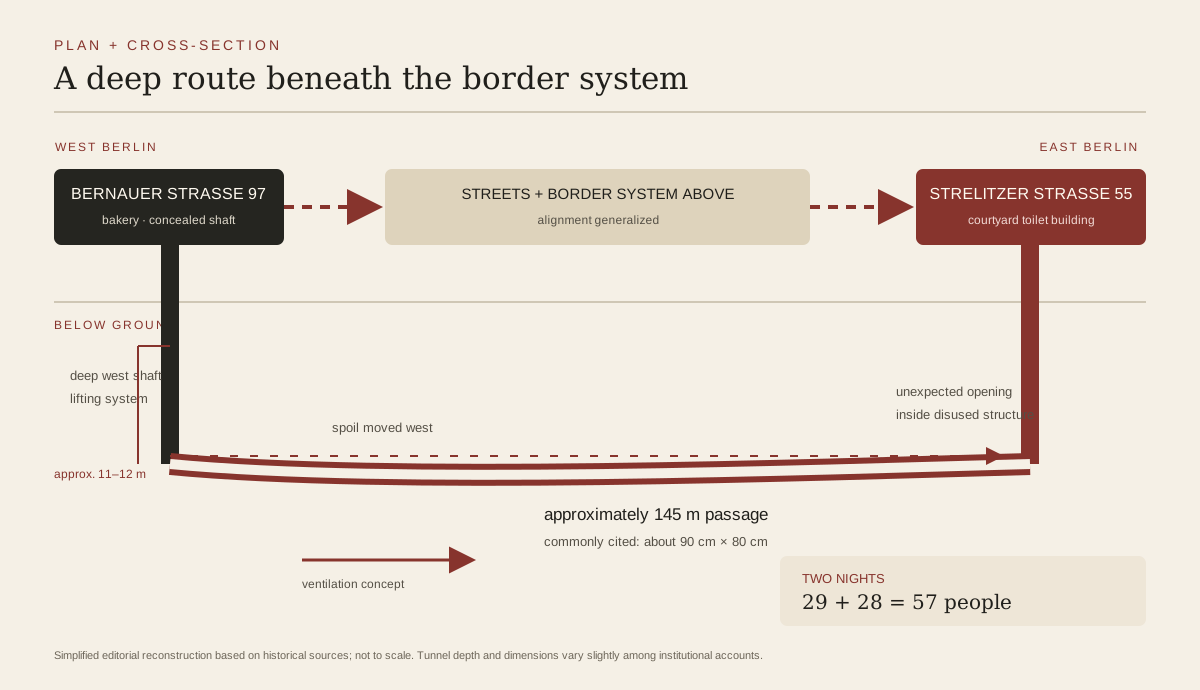
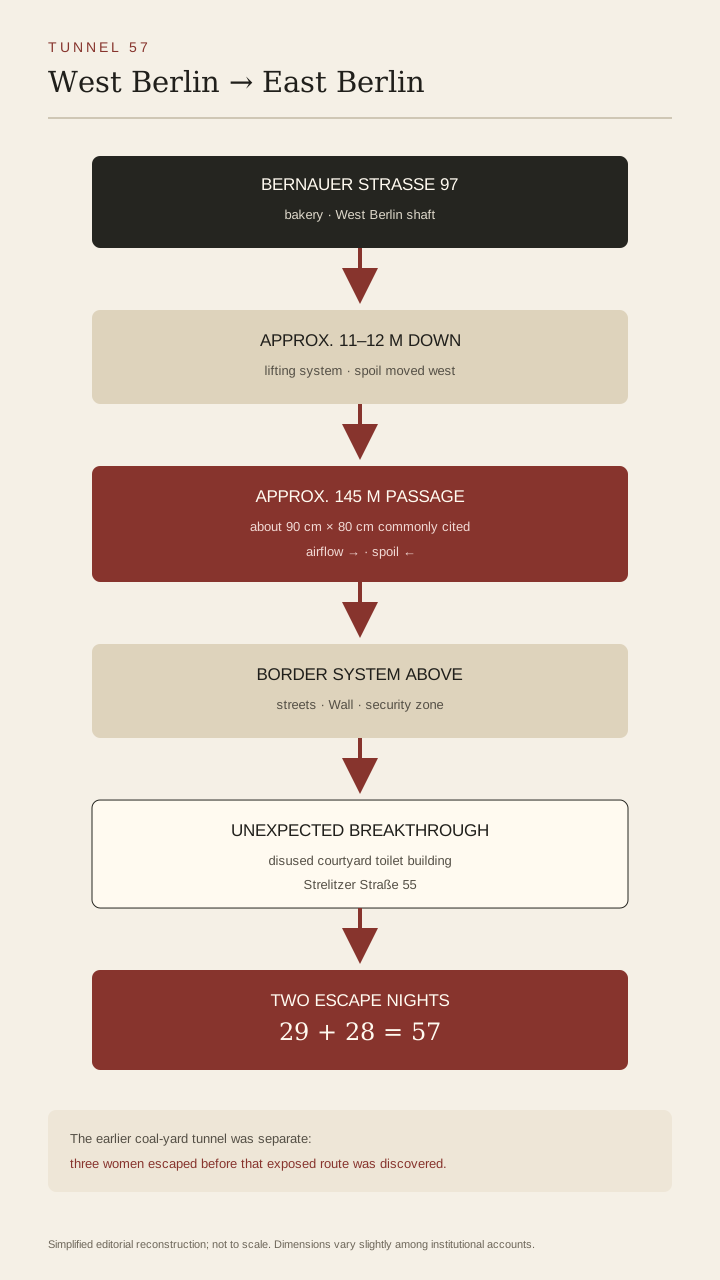
The combined plan and cross-section explains the depth, long underground passage, border zone and unexpected final opening without implying surveyed precision.
- 01
West Berlin shaft
The bakery at Bernauer Straße 97 concealed a deep shaft and lifting system.
- 02
Underground passage
More than thirty participants worked over approximately six months, moving spoil and air through a confined route.
- 03
Border above
The passage crossed beneath streets and the Wall's security system at roughly 11–12 meters depth.
- 04
Unexpected opening
The tunnel broke into a disused courtyard toilet building rather than the intended basement.
- 05
Two escape nights
Twenty-nine people left on the first night and twenty-eight on the second.
Simplified editorial reconstruction based on historical sources; not to scale. Tunnel depth and dimensions vary slightly among institutional accounts.
Digging Under Berlin
Tunnel 57 took approximately six months to complete. The underground work was physically punishing.
At the digging face, space was so limited that the work had to proceed largely one person at a time. Soil had to move back toward the bakery while supports and the passage itself extended forward.
As the tunnel lengthened, air became another problem.
Secondary accounts based on participant recollections describe workers becoming short of breath underground and improvised ventilation being added. The dimensions and length make that development plausible, but the sources do not establish a precise engineering system.
A lookout system also became part of the operation. Jugendopposition describes watchers on the West Berlin side observing the target area for suspicious border activity. The builders were trying to solve two very different problems at once:
Can the tunnel physically reach East Berlin?
and:
Can nobody in East Berlin discover where it is going?
The second question became increasingly important as the breakthrough approached.
Material evidence
Building and operating the route
Excavation, ventilation, spoil movement, lookout work and the deep western lifting system had to function together.
- 01Essential
Excavation tools
Hand and powered tools used to advance the narrow tunnel over roughly 145 meters.
- 02Essential as tunnel length increased
Ventilation system
An improvised means of bringing air into the increasingly long underground passage.
- 03Essential
Spoil-removal system
A concealed process for moving excavated earth away from the digging face and storing it at the West Berlin construction base.
- 04High
Lookout system
Observers watched the East-side target area for suspicious border or security activity.
- 05Essential
West-side lifting equipment
The deep shaft required a system for bringing escapees up approximately twelve meters to the West Berlin basement level.
The Border Above Them
Above the tunnel lay the Berlin Wall and the controlled border zone. The underground route bypassed walls, patrol routes, fences, and other barriers by passing beneath the system rather than through it. But the tunnel could not make the border irrelevant. If East German security forces discovered the project before the first escapee entered, the entire structure could be sealed.
If they discovered it while people were moving through it, the tunnel could become a trap. For that reason, the people intended to flee were not simply handed the address months in advance. Couriers approached them close to the operation. Information was controlled.
Escapees were instructed to arrive in small groups and at intervals. The builders hoped to move more than one hundred people. That ambition depended on secrecy surviving not just construction, but the escape itself.
Problem → response
Escape was a sequence of problems
Each response solved a practical obstacle while often creating the next one.
- 01→
Obstacle
A first tunnel with an exposed exit
The initial tunnel from Bernauer Straße 97 surfaced in a coal yard visible to border guards.
Response
The builders abandoned that route and began a deeper second tunnel from the same basement.
- 02→
Obstacle
Long underground distance
The new route had to extend roughly 145 meters beneath streets and the fortified border zone.
Response
Rotating crews sustained construction for roughly six months.
- 03→
Obstacle
Limited air
The narrow passage became increasingly difficult to work in as the digging face moved farther from the West Berlin shaft.
Response
The builders added improvised ventilation.
- 04→
Obstacle
Risk of security detection
Months of work and a planned mass escape increased the chance that the Stasi or border troops would discover the project.
Response
The group used a concealed base, lookouts, couriers, restricted information, and staggered arrival of escapees.
- 05→
Obstacle
Breakthrough in the wrong structure
The tunnel missed the intended basement and emerged in a disused toilet building.
Response
The builders judged the unexpected location sufficiently concealed and used it as the East-side entrance.
- 06→
Obstacle
Deep West Berlin exit shaft
Escaping the tunnel still required people to be raised from a depth of roughly twelve meters.
Response
The helpers used lifting equipment at the western shaft.
October 2: The Wrong Exit Again
The breakthrough came on October 2, 1964. After the earlier coal-yard failure, the builders were aiming for an indoor location at Strelitzer Straße 55. The shaft missed. It entered a disused toilet building in the courtyard.
The mistake was serious. It was not fatal. Unlike the exposed coal yard from the first tunnel, the structure offered enough concealment to function as the eastern entrance. The builders adapted.
That decision transformed a second inaccurate breakthrough into the most successful tunnel escape beneath the Wall. The route was ready. Now the people had to reach it.
The First Night: 29
The escape operation began on October 3. People arrived in small groups. The details of individual approaches varied, but the logic did not: nobody wanted a crowd forming near the entrance. Once inside the courtyard structure, an escapee entered the shaft and descended into a passage that was not designed for comfort.
The tunnel was narrow enough to require crawling or crouched movement. The journey then ran west beneath the border. At the Bernauer Straße end, the depth that helped hide the tunnel created a final physical problem. The escapees had to be brought up the West Berlin shaft.
Surviving photographs from East German security archives show the lifting arrangement and the confined tunnel itself. They are unusually valuable evidence for the escape mechanics.
By the end of the first night:
29 people had escaped.
The tunnel was still secret enough to continue.
The Second Night: 28 More
The operation resumed. Another stream of people entered through Strelitzer Straße 55. Among the escapees were adults, young people, and children. The demographic breakdown preserved by Jugendopposition records:
- 20 men
- 27 women
- 5 young people up to age 18
- 5 children up to age 14
Total:
57
For Joachim Neumann, the tunnel accomplished the purpose that had helped keep him digging. Christa reached West Berlin. For Hubert Hohlbein, it brought his mother out. But the tunnel builders had intended to move more than one hundred people.
The operation stopped at fifty-seven because the secrecy that had protected the tunnel for months finally failed.
Two nights beneath the Wall
57people escaped through Tunnel 57
Escaped first night
Twenty-nine people reached West Berlin during the first night of the operation.
Escaped second night
Twenty-eight people escaped during the second night before the operation was discovered.
Total escaped
Fifty-seven people escaped through the tunnel, giving Tunnel 57 its name.
The Stasi Begins Looking
The Ministry for State Security received information pointing toward an escape operation. The exact path from information to discovery should be handled cautiously because later summaries often reduce it to a single word—“betrayal”—without explaining what was established at each stage. What is well documented is what happened at Strelitzer Straße 55. Plainclothes Stasi officers approached the building.
They presented themselves as people interested in escaping. Escape helpers on the East Berlin side encountered them without immediately recognizing who they were. The officers withdrew. Then they returned with armed border troops.
The escape operation had changed in a few minutes from secret movement to imminent arrest.
The Helpers Retreat
Several escape helpers were still on the East Berlin side, directing people toward the tunnel. Among them was Reinhard Furrer, who decades later became an astronaut. The courtyard was dark. When the security force returned, Furrer recognized the danger and moved back toward the tunnel, warning the other helpers.
They retreated. At that point, the tunnel no longer existed only as an engineering route. It had become the only immediate exit for the people who had been operating illegally on the eastern side of the border. Some of the escape helpers were armed with small pistols.
That fact became central to everything that followed.

The Shooting at Strelitzer Straße 55
The confrontation occurred shortly after midnight, in the early hours of October 5. Shots were fired. Christian Zobel, one of the escape helpers, fired first. His pistol bullet struck Egon Schultz, a twenty-one-year-old East German border soldier.
The bullet wounded Schultz. It did not kill him. An East German border soldier then fired his Kalashnikov in the dark courtyard on the orders of a Stasi officer. That burst struck Schultz as well.
The East German weapon caused the fatal wound and internal bleeding from which Schultz died. The surviving escape helpers reached the tunnel and returned to West Berlin. Tunnel 57 would not be used again.
The Story the DDR Published
The East German state quickly announced a much simpler version of the shooting. West Berlin agents had murdered Egon Schultz. The government turned Schultz into a public symbol.
He was presented as a victim of western terrorism and escape-helper violence. Streets, schools, military units, and other institutions were named after him.
The propaganda campaign worked in part because West Berlin investigators could not see the evidence held in East Germany. The DDR refused meaningful cooperation. Its own investigation, meanwhile, had already revealed the truth. The fatal shot did not come from Zobel.
East German authorities classified the findings. The Stasi removed or concealed relevant autopsy material. The public story remained politically useful, so the state maintained it. That manipulation also damaged the reputation of the tunnel builders in the West, where the fatal shooting complicated public sympathy for escape assistance.
What the Records Revealed
After German reunification, investigators could examine records that had been inaccessible while the Wall existed. The evidence allowed the shooting to be reconstructed more precisely. Zobel had fired. Schultz had been hit.
But forensic and investigative evidence showed that Zobel's pistol wound was not the one that killed him. The fatal injury came from another border soldier's Kalashnikov. The later legal investigation accepted that the border soldier had fired in the chaotic confrontation and did not treat the shooting as an intentional killing of Schultz. The historical correction therefore does not make the event morally or physically simple.
An escape helper used a gun. A border soldier died. Another border soldier fired the fatal shot. And a state that knew those facts deliberately replaced them with a politically useful story.
Why Tunnel 57 Was Different
Tunnel 57 is often remembered because of the number. Fifty-seven was extraordinary. But the number alone does not explain the operation. The tunnel succeeded because the builders learned from failure.
The first route surfaced in the wrong place. They began again and went deeper. The second project required months of work. They rotated builders.
As distance increased, they addressed ventilation. As they approached the East, they controlled information. The planned basement was missed. They used the toilet building instead.
More than one hundred people were supposed to escape. Secrecy held long enough for fifty-seven. Then it failed. The operation did not end because the tunnel collapsed.
It ended because the political and security system above it finally found the eastern entrance.

The Wall Underground
Tunnel 57 also shows something important about the Berlin Wall. The Wall was not only a concrete barrier. It was a system. Walls, fences, guarded zones, surveillance, informers, border troops, legal restrictions, and the Ministry for State Security all worked together to control movement.
The tunnel builders therefore did not simply burrow under concrete. They attempted to bypass an entire border regime. Their solution depended on the fact that the border was strongest where authorities could see. Below it, for a time, a narrow strip of earth remained outside direct observation.
That temporary weakness was enough for fifty-seven people.
Evidence discipline
What the record supports
Status labels distinguish secure conclusions from uncertainty and rejected claims. Color is never the only signal.
DOCUMENTED
Fifty-seven people escaped through Tunnel 57.
Institutional histories consistently document twenty-nine escapees during the first night and twenty-eight during the second.
Sources: SRC-001, SRC-002, SRC-003WELL-SUPPORTED
Tunnel 57 was approximately 145 meters long and about eleven to twelve meters deep.
Major institutional sources agree on approximately 145 meters; depth varies between eleven and twelve meters depending on source and reference point.
Sources: SRC-001, SRC-002, SRC-003, SRC-004MYTH
The successful tunnel emerged exactly where the builders planned.
The tunnel missed the intended basement and surfaced in a disused toilet structure in the courtyard of Strelitzer Straße 55. The builders adapted because the location remained concealed enough to use.
Sources: SRC-002, SRC-004MYTH
Tunnel 57 was the first attempt from the bakery at Bernauer Straße 97.
A previous tunnel from the same basement had surfaced in an exposed coal yard and was used by three women before discovery.
Sources: SRC-003, SRC-010DOCUMENTED
Christian Zobel fired a shot that hit Egon Schultz.
Post-reunification investigation established that Zobel fired first and that his pistol bullet wounded Schultz.
Sources: SRC-004MYTH
Christian Zobel fired the shot that killed Egon Schultz.
Zobel's bullet was not fatal. The fatal wound came from a Kalashnikov fired by another East German border soldier.
Sources: SRC-004, SRC-008MYTH
The DDR did not know who fired the fatal shot.
East German investigators established the friendly-fire cause, classified the evidence, concealed relevant autopsy material, and publicly blamed the escape helpers.
Sources: SRC-004, SRC-008MYTH
Egon Schultz was killed entirely by friendly fire without first being struck by an escape helper.
The fatal shot was friendly fire, but Schultz had first been wounded by Christian Zobel's pistol bullet.
Sources: SRC-004UNKNOWN
The tunnel was discovered through a single fully documented act of betrayal by one identified informer.
Institutional accounts describe betrayal or Stasi information leading to discovery, but the secure sequence is that Stasi officers received information, located Strelitzer Straße 55 while posing as potential fugitives, and returned with border troops. The surviving evidence does not justify reducing the discovery to one fully documented informer narrative.
Sources: SRC-003, SRC-004Evidence, Propaganda and What Happened to Egon Schultz
Did 57 people really escape through Tunnel 57?
DOCUMENTED
Yes. Twenty-nine people escaped during the first night and twenty-eight during the second, for a total of fifty-seven.
Was Tunnel 57 approximately 145 meters long?
DOCUMENTED / APPROXIMATE MEASUREMENT
Major institutional sources consistently describe it as about 145 meters long. Its depth is usually given as eleven or twelve meters depending on the source.
Was Tunnel 57 the first tunnel from Bernauer Straße 97?
NO
A previous tunnel from the same bakery basement was completed in January 1964.
It emerged in an exposed coal yard. Three young women escaped before it was discovered.
Did the successful tunnel emerge exactly where the builders intended?
NO
The builders intended to reach a basement at or near Strelitzer Straße 55. Instead, they broke through into a disused toilet building in the courtyard. Unlike the first tunnel's misplaced exit, this location was still concealed enough to use.
Were all the tunnel builders professional engineers?
MYTH / MISLEADING
More than thirty students participated over time. Some had technical or civil-engineering backgrounds, but the project was a volunteer escape-help operation rather than a conventional professional tunneling contract.
Did West Berlin escape helper Christian Zobel shoot Egon Schultz?
DOCUMENTED
Yes. Zobel fired the first shot and wounded Schultz.
Did Zobel's shot kill Schultz?
NO
Post-reunification investigation established that Zobel's pistol wound was not fatal. The fatal wound came from a Kalashnikov fired by another East German border soldier.
Did the DDR know that a border soldier had fired the fatal shot?
DOCUMENTED
Yes. East German investigators discovered the friendly-fire cause, classified the finding, and concealed evidence while the state publicly blamed the escape helpers.
Is it accurate to say that Egon Schultz was killed only by “friendly fire”?
INCOMPLETE
The fatal shot was friendly fire. But Schultz had already been wounded by Christian Zobel. The complete history requires both facts.
Was the tunnel simply “betrayed by one informer”?
OVERSIMPLIFIED
Institutional accounts state that the tunnel was betrayed or that Stasi information led to discovery. The documented discovery sequence includes plainclothes Stasi officers locating the building while posing as prospective fugitives.
The surviving evidence does not establish one definitive betrayal narrative or a complete informer chain.
Why the Escape Worked
The first tunnel proved that reaching East Berlin was not enough. The second tunnel had to reach East Berlin in the right place. So the builders went deeper and farther. The longer route created an air problem.
They added ventilation. The construction created months of exposure risk. They used concealed workspaces and lookouts. The East-side entrance had to remain unknown.
They limited information and contacted escapees close to departure. The breakthrough missed the intended basement. The toilet building still offered concealment. They used it.
Twenty-nine people crossed. The tunnel remained secret. Another twenty-eight crossed. Then the Stasi arrived.
At that point there was no engineering solution left. The helpers retreated through the passage they had built, and the operation ended. Tunnel 57 succeeded long enough to free fifty-seven people. Its final night then produced a second historical struggle—over who controlled the story of the man who died when the tunnel was discovered.
For decades, the East German state controlled that story. The records outlasted the propaganda.
Selected chronology
Two tunnels, six months and two escape nights
The sector border is closed
East German authorities begin closing the border through Berlin, initiating the system that becomes the Berlin Wall.
First tunnel begins from Bernauer Straße 97
Escape helpers begin a tunnel from the former bakery basement toward East Berlin.
First tunnel reaches the wrong place
The first tunnel surfaces in an exposed coal yard. Three young women escape before the route is discovered.
Tunnel 57 construction begins
A second, deeper tunnel project begins from the same bakery base.
Breakthrough at Strelitzer Straße 55
The tunnel reaches the East Berlin courtyard but emerges in a disused toilet building rather than the intended basement.
Twenty-nine people escape
The first groups enter the tunnel and reach West Berlin.
Twenty-eight more escape
A second wave brings the total number of escapees to fifty-seven.
Tunnel discovered and Egon Schultz killed
Stasi officers and border troops confront escape helpers at Strelitzer Straße 55. Christian Zobel wounds Schultz; another East German border soldier fires the fatal shot.
DDR blames the escape helpers
East German authorities publicly portray Schultz as murdered by western agents while concealing evidence that the fatal wound came from a fellow border soldier.
Concealed evidence becomes available
Access to former East German investigative records allows the fatal friendly-fire shot and state concealment to be established publicly.