
The Libby Prison Escape: How 109 Union Officers Tunneled Out of Richmond
On the evening of February 9, 1864, Colonel Thomas E. Rose entered a concealed passage inside Richmond's Libby Prison.
The route began behind a fireplace. It descended toward a dark cellar beneath the occupied prison rooms and then entered a narrow tunnel driven beneath the ground outside. At its far end was an enclosed area beyond the prison walls and, crucially, beyond the clearest view of Confederate sentries.
Rose went first. A.G. Hamilton followed.
Behind them came the men who had spent weeks solving one problem after another to make that moment possible.
Their original plan was cautious. Small groups would use the tunnel over several nights so that the prison would not suddenly lose a conspicuous number of officers.
That plan did not survive the evening.
Word of the tunnel spread through Libby. Prisoners crowded toward the concealed entrance. By the next morning, Confederate officials discovered that 109 Union officers were gone.
Fifty-nine would reach Union lines. Forty-eight would be recaptured. Two would drown.
The scale of the breakout made the Libby Prison escape famous. But the number 109 explains only the result.
The more remarkable story is how the route was created at all.
The prisoners had to reach a cellar they were not supposed to enter, conceal their movements from guards and other inmates, survive a dangerously cramped access passage, abandon failed tunnels, overcome structural obstacles and water, move excavated soil without exposing the operation, force breathable air to a digger working underground, disguise missing men during prison counts, correct a premature breakthrough, and finally emerge close enough to Confederate sentries that the location of the exit mattered as much as the tunnel itself.
Only after those problems had been solved could anyone crawl toward freedom.
A Prison Made From a Warehouse
Libby Prison had not been built as a prison.
The complex near Cary and 20th streets in Richmond consisted of connected buildings originally associated with the tobacco trade. Luther Libby later operated a shipping-supply and grocery business there. Confederate authorities converted the complex into a prison in 1862, and it eventually became especially associated with captured Union officers.
Its improvised nature did not make escape easy.
Prisoners occupied upper portions of the complex. Other spaces contained kitchens, hospital areas, offices, guardrooms, workshops and storage. Beneath them were cellar spaces, including the dark eastern cellar remembered by prisoners as Rat Hell.
That cellar offered something the crowded rooms above did not: concealed ground from which men might dig. The problem was reaching it.

The First Problem: Reaching Rat Hell
Thomas E. Rose of the 77th Pennsylvania was captured during the Battle of Chickamauga in September 1863 and taken to Libby soon afterward.
He and A.G. Hamilton of the 12th Kentucky Cavalry began looking for weaknesses in the prison.
They did not immediately settle on the tunnel that would eventually work. Rose and Hamilton investigated restricted parts of the building and considered other escape possibilities, including a forceful breakout if circumstances made one possible.
Those plans offered no dependable way to move a large group through Richmond. The cellar remained more promising. But prisoners could not simply walk downstairs into it.
Rose and Hamilton instead focused on a fireplace near the dining or kitchen area. Hamilton carefully removed material and cut a bent route through the masonry, creating a concealed passage toward the cellar.
The opening could then be closed again.
Bricks were returned to position. Soot and ash helped disguise disturbance around the fireplace. Work had to take place largely at night because the area was used during the day.
The prisoners had solved the access problem. Then the access itself nearly became fatal.
A Passage Almost Too Tight to Use
During an early descent, Rose became wedged in the concealed route.
The space was so restricted that he could not readily free himself, and the position threatened his breathing. Hamilton and another prisoner eventually pulled him out.
The tunnel project could not continue efficiently if reaching the work area was itself dangerous enough to trap the men using it. Hamilton improvised another solution: a rope ladder that made movement between the concealed entrance and the lower level more manageable. With a workable route into Rat Hell established, the men could finally focus on the ground beyond the prison.
That produced the next problem. They did not yet know where to dig.
Tunnel reconstruction
How the route fit together
The tunnel was only one part of a route linking the occupied prison to a protected outlet.
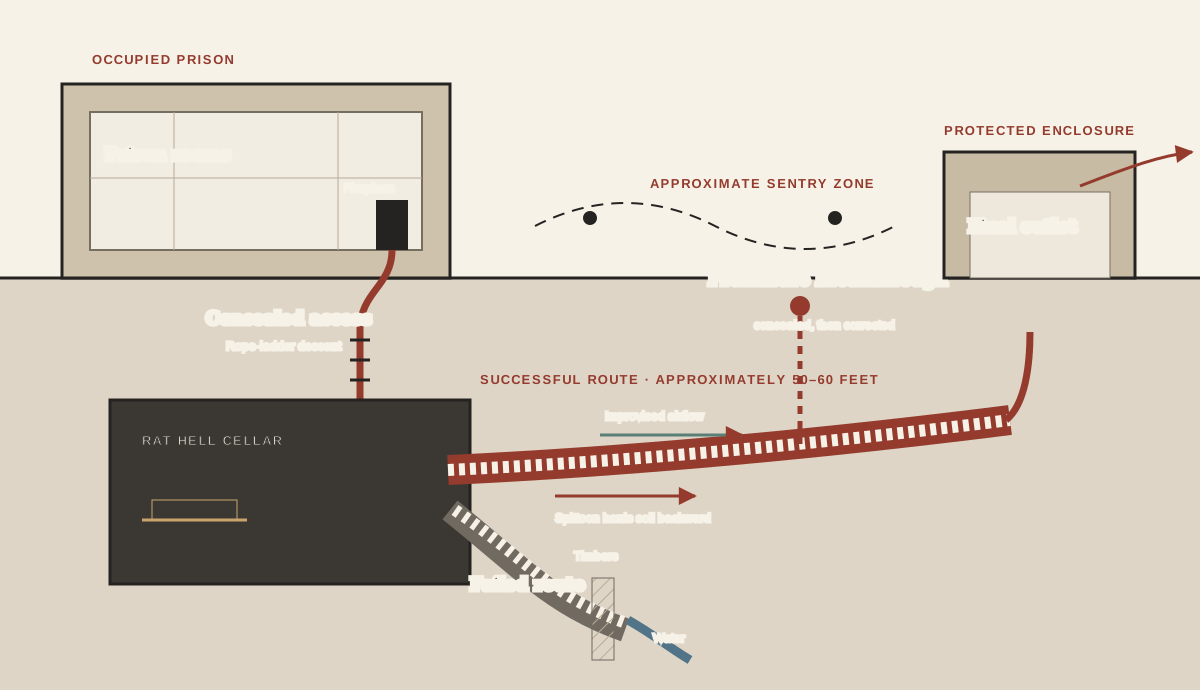
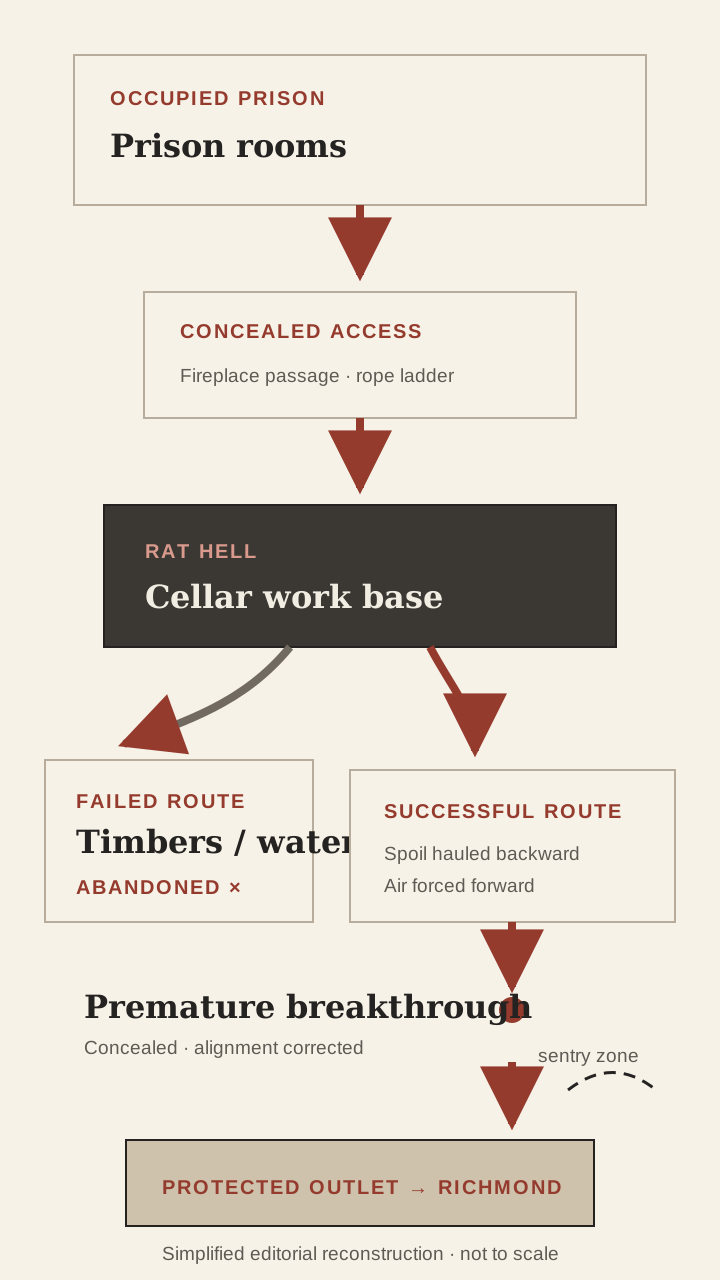
- 01
Occupied prison
The route began behind a fireplace in the occupied prison.
- 02
Concealed descent
A bent masonry passage and rope ladder led down toward Rat Hell.
- 03
Rat Hell cellar
The restricted eastern cellar became the concealed base for excavation.
- 04
Failed route
An earlier route met structural timbers and water and was abandoned.
- 05
Successful tunnel
Workers dug east, hauled spoil backward and forced air toward the tunnel face.
- 06
Course correction
A premature breakthrough exposed the misalignment; the route was corrected.
- 07
Protected outlet
The final passage emerged beneath a shed or enclosure screened from direct sentry view.
- 08
Richmond streets
Escapees left the enclosure in small groups timed around nearby guards.
Simplified editorial reconstruction based on historical sources; not to scale.
The Routes That Failed
The first tunneling efforts were not the successful passage later remembered in accounts of the escape. The prisoners initially explored routes that they hoped might connect with infrastructure near the canal, including a sewer that could potentially carry them beyond the prison perimeter. Their equipment was primitive. Knives were altered for cutting.
Chisels became excavation tools. Progress underground soon exposed the weakness of the plan. One route struck major structural timbers. The prisoners worked through them, only to encounter a more serious complication: water began entering the excavation because the passage had descended too low relative to the nearby canal.
Continuing would have made the route increasingly dangerous. The men withdrew and plugged the failed opening. Other approaches also proved unsuitable.
The failures cost time, but they changed the project. The prisoners stopped trying to force a route toward the sewer and instead reconsidered where an escape tunnel actually needed to end.
The important question was no longer simply: Can we get beyond the prison wall? It was: Where can we emerge without immediately being seen?
The new plan turned eastward.

A Tunnel Aimed at Concealment
The revised route would pass beneath the exterior ground toward an adjacent enclosed area. If the prisoners could emerge there, they would have a better chance of entering Richmond's streets without surfacing directly beneath a sentry's view. Rose organized a core working party of fifteen men, including himself and Hamilton. The men were divided into rotating reliefs.
That solved another practical limitation: one person could not dig continuously in the cramped passage. But rotation introduced a series of new requirements. Someone had to excavate. Someone had to move the soil.
Someone had to dispose of it. Someone had to keep air moving toward the tunnel face. Someone had to watch for danger. And all of those men had to disappear from the occupied prison without the guards realizing they were missing.
The digging itself was only one part of the system.
Digging With What They Had
At the tunnel face, a man worked with a broad-bladed chisel.
The soil he loosened could not simply be left behind him. Every additional foot of tunnel created more earth that had to be moved somewhere without attracting attention.
The prisoners turned a wooden prison spittoon into a hauling container.
Clotheslines attached to it allowed workers to pull loads backward through the narrow passage. Once the dirt reached the cellar, it could be spread or concealed among material already stored there.
That dealt with the excavated soil. As the passage lengthened, however, another problem became more urgent. The air at the tunnel face was becoming dangerous.
Material evidence
Tools of Escape
The objects used in an escape reveal how a plan worked under constraint.
- 01Essential
Broad-bladed chisel
The principal effective digging implement described in participant accounts.
- 02Essential
Wooden spittoon
Used as an improvised container for hauling excavated soil backward through the tunnel.
- 03High
Clotheslines
Attached to the spittoon so workers could pull soil between the tunnel face and cellar.
- 04High
Rope ladder
Improvised by Hamilton after the concealed access proved dangerously cramped.
- 05High
Jackknife
Used during the careful cutting of masonry around the concealed fireplace route.
- 06Essential for extended tunneling
Rubber-blanket ventilation fan
An improvised fan attributed to Hamilton that forced air toward the digger as the tunnel lengthened.
- 07Situational but important
Old shoe
Used as an improvised surface reference after the tunnel broke upward too early, helping Rose estimate the correction required.
The Air Runs Out
Early in the excavation, candles stopped burning only a short distance into the passage because the air was so poor. The deeper the men dug, the worse the problem became.
The tunnel was only a little wider than the body of the man working inside it. His position restricted natural airflow, and the increasing distance from the cellar made ventilation more difficult.
Without better circulation, the tunnel could become unusable before it reached its destination. The prisoners responded by assigning men to force air toward the digger. Hamilton eventually devised a more effective improvised fan using a rubber blanket stretched across a frame. The system was crude, but it addressed a problem that could not be solved by simply digging harder.
With air reaching the tunnel face, progress could continue. Above ground, meanwhile, the disappearance of the workers presented another danger.
How Do You Hide a Missing Prisoner?
The tunnel crews still officially belonged to a prison population that Confederate officials counted. A worker could be hidden underground. His absence from roll call could not. The conspirators therefore manipulated the count itself.
Frank E. Moran later described a technique known as repeating.
A man who had already been counted would move back through the formation and appear again somewhere else. If several tunnel workers were below, already-counted prisoners could effectively stand in for them.
The method was imperfect. Repeating could create confusion if too many men appeared twice or moved at the wrong moment.
But it gave the conspirators a way to keep men below ground without automatically producing a shortage in the official count. The operation now had answers for access, digging, spoil removal, ventilation and missing workers. The next challenge was location. Underground, the men could estimate their direction.
They could not easily see exactly where they were.
Breaking Through in the Wrong Place
At one stage, a digger began moving upward too early. The passage broke toward the surface in an exposed part of the lot. Had the opening been discovered, the entire escape route might have been compromised. The prisoners concealed the premature breakthrough.
Then they used it to improve their estimate.
On the following night, an old shoe was pushed through the opening as a temporary reference point. By observing where it appeared from inside the prison complex, Rose could better judge the tunnel's position relative to the intended destination.
The information showed that the route needed correction. The diggers adjusted and continued. That small mistake turned into a crude surveying tool. Now the tunnel had to reach the proper enclosure before the operation was discovered.
Problem → response
Escape was a sequence of problems
Each response solved a practical obstacle while often creating the next one.
- 01→
Obstacle
Restricted cellar access
The safest tunneling space was not openly accessible from the prisoner areas.
Response
Hamilton created a concealed route through the fireplace masonry.
- 02→
Obstacle
Structural timbers and water
Early tunneling routes encountered major timbers and an influx of water.
Response
The unsuccessful routes were abandoned and sealed, and the tunneling direction was reconsidered.
- 03→
Obstacle
Poor air
Candles failed and diggers struggled to breathe as the tunnel lengthened.
Response
Workers forced air toward the tunnel face and developed an improvised ventilation fan.
- 04→
Obstacle
Excavated soil
Large quantities of spoil could reveal the existence of the tunnel.
Response
Earth was hauled backward in a wooden spittoon and concealed in the cellar.
- 05→
Obstacle
Daily prisoner counts
Tunnel workers absent from the occupied rooms could expose the conspiracy.
Response
Other prisoners repeated themselves during counts so officials could still arrive near the expected total.
- 06→
Obstacle
Uncertain tunnel alignment
The prisoners could not precisely determine their underground position and broke upward too early.
Response
They concealed the opening and used a surface reference to correct the route.
The Final Push
By early February, the successful passage had advanced close to its target. Rose later described the final tunnel as the product of approximately seventeen nights of organized work. During the final push beginning February 8 and continuing into the early hours that followed, Rose dug upward again. This time he reached the intended protected area beneath a shed or enclosure beyond the most dangerous direct observation from the prison.
A tunnel exit alone was not enough. Rose still needed to know whether men emerging from it could actually leave. He climbed out, inspected the yard, located the gate and observed the movement of nearby sentries. Then he returned underground and concealed the opening.
The tunnel was ready. The prisoners decided not to begin immediately. Waiting until the next evening would give the first escapees a full night in which to move away from Richmond before daylight.
February 9: The Escape Begins
At about seven o'clock on February 9, the core party assembled. Rose entered first. Hamilton followed. The other workers came behind them.
The men crawled through the passage, emerged inside the protected enclosure and moved from the yard in small numbers, timing their departures around the nearby Confederate guards. The organizers had intended to preserve that controlled sequence.
Another selected party would follow later. Additional groups could use the tunnel on subsequent nights.
The logic was simple. A prison missing a modest number of men might not immediately reveal the method. A prison missing a hundred would. Then the secret spread.
The Plan Collapses
Before the evening was far advanced, prisoners elsewhere in Libby learned that a tunnel existed. The controlled schedule could no longer be maintained. Men moved toward the fireplace entrance. They descended into Rat Hell.
They crawled through the tunnel. The carefully organized work of fifteen men became the escape route for far more prisoners than the original party had planned to send through that night. This created a new danger. Every additional man increased the chance that guards would notice movement, that the entrance would be exposed, or that the escape would be discovered before everyone already committed to the attempt could get out.
Yet the tunnel continued functioning. One officer after another passed beneath the guarded exterior of the prison and emerged into Richmond. By morning, 109 were gone.
The Morning Count
When Confederate officials counted the prisoners, the totals did not reconcile. A subsequent roll call established the scale of the loss. One hundred and nine Union officers were missing. The first reaction included suspicion that guards had been bribed or had deliberately allowed men to pass.
Guards were arrested and searched. Then investigators found the underground passage. The tunnel explained how so many prisoners had vanished without crossing the guarded exits. The arrested sentries were released.
For the escapees, however, getting out of Libby had solved only the first part of the problem. They were still inside Confederate territory.
Escaping the Prison Was Not Escaping Richmond
Once officials understood what had happened, Richmond authorities mobilized pursuit. Likely roads, bridges and escape corridors were watched. Mounted parties searched outside the city. The fugitives scattered rather than moving as one group.
Some traveled in small parties. Some concealed themselves during daylight. Some received assistance from sympathetic civilians.
Abel Streight and several companions, according to Moran's later account, remained hidden for about a week in a vacant house while friendly residents supplied them before they continued their attempt to reach Union territory. For every mile the fugitives put between themselves and Libby, the original tunnel mattered less. The problem had changed again. They now had to move through enemy-controlled territory without being captured.

Fifty-Nine Made It
Of the 109 men who escaped the building: 59 reached Union lines. 48 were recaptured. 2 drowned.
More than half therefore succeeded in turning the prison break into a complete escape from Confederate control.
Thomas E. Rose was not among them.
The final accounting
109escaped
Reached Union lines
Escapees who ultimately regained Union-controlled territory.
Recaptured
Escapees returned to Confederate custody.
Drowned
Two escapees drowned during the attempt to reach safety.
59 + 48 + 2 = 109
Rose Escapes Libby—but Not the Confederacy
Rose left Richmond and moved eastward while trying to avoid Confederate patrols. Participant accounts describe an exhausting journey involving repeated efforts to avoid soldiers and find a route toward Union-held territory. He came close to safety. Then Confederate forces recaptured him.
Rose was sent back to Libby Prison. The man who had helped build the route out therefore became one of the forty-eight fugitives returned to Confederate custody. His confinement did not last indefinitely. Rose was exchanged on April 30, 1864 and returned to Union service.
Hamilton, his principal collaborator in the escape project, successfully reached Union lines.
What Made the Escape Work
The Libby Prison escape is sometimes summarized as a spectacular tunnel break. That description is accurate but incomplete. The successful passage was only the final component of a much larger system. The prisoners first had to find a way into the cellar.
When the access route almost trapped Rose, they improved the descent. When early tunneling routes struck timbers and water, they changed direction. When the tunnel became difficult to breathe in, they built ventilation. When the excavation produced incriminating soil, they created a hauling and concealment system.
When tunnel workers disappeared from the prison rooms, other prisoners manipulated the counts. When the tunnel broke through too early, Rose used the mistake to correct the route. When the surface beyond the prison was still watched by sentries, he selected an outlet that offered concealment and studied the guards' movements. Then the final plan encountered one last complication no engineering system could fully control:
too many people learned about it. The staged departure became a mass breakout. The tunnel still carried 109 men out before Confederate authorities understood what had happened. That sequence—not a single brilliant trick—is what made the Libby Prison escape possible.
Evidence, Myth and What Remains Uncertain
How many escapees reached safety? The best-supported outcome is: 59 reached Union lines; 48 were recaptured;
two drowned.
These figures appear in Frank E. Moran's participant account and agree with Encyclopedia Virginia and the Library of Virginia.
A current National Park Service page lists 49 recaptured while also giving 59 successful escapees and two drownings. Those numbers total 110 despite the same page identifying 109 escapees. The 49 appears to be a numerical or transcription error rather than evidence for a different total.
Did the successful tunnel take several months to build? Probably not. The Richmond Examiner, inspecting the discovered tunnel immediately after the escape, estimated that the work must have taken several months. Rose later stated that the successful final passage was completed in approximately seventeen nights.
The broader escape effort had begun much earlier and included reconnaissance, other plans and failed tunneling attempts. The best distinction is therefore: The escape project developed over months; the successful final tunnel was dug in roughly seventeen working nights. When exactly did the tunnel break through?
Some modern timelines identify February 8. Moran's detailed retrospective narrative describes the final effort beginning on February 8 and Rose reaching the surface at approximately 1:30 the following morning. The responsible interpretation is that the final breakthrough came late February 8 or in the early hours of February 9 depending on how the overnight work is dated.
The sequence itself is not meaningfully in dispute. Was the tunnel exactly 55 feet long? No exact measurement should be presented as certain. Historical descriptions and modern institutional summaries cluster around approximately 50–60 feet.
The Library of Virginia uses about 55 feet. The contemporary Richmond Examiner estimated at least 60.
Approximately 50–60 feet is the preferred publication language. Were Confederate guards bribed? Confederate officials initially suspected it. The guards were arrested after the scale of the escape became clear.
Once investigators found the tunnel, the physical route explained how the prisoners had left. The guards were released.
The evidence reviewed for this case does not support bribed sentries as the mechanism behind the breakout. Did Elizabeth Van Lew organize the escape? That has not been established. Some fugitives clearly received assistance after leaving Libby, and Richmond Unionists may have helped certain escapees.
The surviving evidence does not demonstrate that Elizabeth Van Lew's network designed, financed, excavated or directed the tunnel project.
Evidence discipline
What the record supports
Status labels distinguish secure conclusions from uncertainty and rejected claims. Color is never the only signal.
DOCUMENTED
109 Union officers escaped Libby Prison on the night of February 9, 1864.
The figure appears in a contemporary Richmond newspaper, participant accounts and modern institutional histories.
Sources: SRC-001, SRC-003, SRC-004, SRC-005, SRC-006DOCUMENTED
The final outcome was 59 reaching Union lines, 48 recaptured and 2 drowned.
These figures appear in Moran's participant account and agree with Encyclopedia Virginia and the Library of Virginia. A National Park Service page says 49 recaptured, but its figures total 110 and appear to contain an arithmetic or transcription error.
Sources: SRC-001, SRC-002, SRC-004, SRC-006UNKNOWN
The tunnel was exactly 55 feet long.
Sources give approximate measurements ranging from about 50 to at least 60 feet. The surviving evidence supports an approximate range of 50–60 feet.
Sources: SRC-001, SRC-004, SRC-005, SRC-006DISPUTED
The successful tunnel was completed on February 8.
Some modern timelines use February 8. Moran describes work continuing from February 8 until approximately 1:30 a.m. the following morning. The disagreement appears to concern the midnight date boundary rather than the underlying sequence.
Sources: SRC-001, SRC-004MYTH
The guards were bribed to allow the prisoners to escape.
Confederate officials initially suspected bribery and arrested guards, but released them after discovering the tunnel. No strong surviving evidence supports guard collusion.
Sources: SRC-005UNKNOWN
Elizabeth Van Lew's spy network planned the tunnel escape.
Some fugitives received assistance after leaving Libby, and institutional history allows that Van Lew's network may have helped some escapees. Evidence reviewed here does not establish that her network planned or constructed the tunnel.
Sources: SRC-001, SRC-004WELL-SUPPORTED
The successful final tunnel required approximately seventeen nights of work.
Rose explicitly gave a seventeen-night construction period for the successful tunnel, and Moran's later account provides the same general chronology.
Sources: SRC-003, SRC-004Why the Libby Prison Escape Matters
The escape succeeded because the prisoners repeatedly adapted. No single weakness in Libby handed them freedom. They had to discover weaknesses, test them, abandon failures and build new solutions around the prison's defenses. They found a concealed route into a forbidden cellar.
They dug, failed and changed direction. They improvised tools from prison objects. They created ventilation underground. They hid the evidence of excavation.
They manipulated the count above them. They corrected their own navigational mistake. They studied the sentries around the intended exit. And when their carefully controlled departure collapsed into an uncontrolled rush, the route they had built still carried 109 officers out of one of the Confederacy's best-known prisons.
Fifty-nine ultimately made it all the way back to Union lines. The result was dramatic. The process is what makes the case enduring.
Selected chronology
From captivity to exchange
Thomas E. Rose captured
Rose was captured during the Battle of Chickamauga.
Rose arrives at Libby Prison
Rose later stated that he arrived at Libby on October 1 and soon began considering escape schemes with A.G. Hamilton.
Reconnaissance and unsuccessful escape schemes
Rose, Hamilton and other prisoners explored restricted areas, considered other escape methods and attempted tunneling routes that proved impractical.
The successful tunnel is completed
Rose made the final push from February 8 into the early hours that followed and emerged beneath a shed or protected enclosure. Some modern timelines label the breakthrough February 8.
The first party leaves
Rose entered the tunnel first, followed by Hamilton and other members of the working party.
News of the tunnel spreads
The intended staged departure broke down as large numbers of prisoners learned about the passage.
109 prisoners are found missing
The morning count and subsequent roll call established that 109 Union officers had escaped.
Rose is exchanged
After being recaptured and returned to confinement, Rose was exchanged and returned to Union service.