
The Catalpa Rescue: How Six Fenian Prisoners Escaped Western Australia in 1876
On Easter Monday, 17 April 1876, six prisoners connected with the Irish Fenian movement slipped away from work details linked to the Convict Establishment at Fremantle. They did not head for another building, a hidden tunnel or a nearby safe house. They headed for the sea.
Waiting for them was a rescue operation that had been assembled across two hemispheres. Irish-American organizers had purchased an American vessel, sent it from New Bedford on what looked like a whaling voyage, placed undercover agents in Western Australia, arranged carriages to carry the escapees south to Rockingham, and coordinated a small whaleboat that would take them to the Catalpa offshore.
The land escape worked. The sea rescue almost did not.
Bad weather left the party trapped overnight in an open boat. Colonial authorities launched a police cutter and the steamship Georgette. The escapees finally reached the Catalpa on 18 April, only to face a more dangerous confrontation the next morning, when the Georgette returned armed and demanded the prisoners.
Captain George Anthony refused.
The Catalpa was an American ship. Anthony asserted that it had passed beyond colonial territorial control. The Georgette fired a warning shot but did not seize the vessel.
Six prisoners who had started the morning of 17 April in British custody were now on an American ship sailing away across the Indian Ocean.
The Catalpa Rescue worked because no single escape method had to solve the whole problem. Work parties solved the prison wall. Carriages solved the distance to Rockingham. A whaleboat solved the gap between shore and ship. The Catalpa solved the ocean. And the American flag transformed the final attempt at recapture into an international risk.
Why six men were still there
The Catalpa story began years before the ship itself sailed for Australia.
The Irish Republican Brotherhood, whose members were widely known as Fenians, sought to end British rule in Ireland. During the 1860s British authorities arrested and convicted members of the movement, including soldiers in the British Army accused of Fenian activity and military offenses.
In January 1868 the Hougoumont, the last convict transport sent to Western Australia, arrived at Fremantle carrying dozens of Fenians among its convict passengers. The group did not remain intact.
Clemency measures released many of the civilian Fenians, while men convicted in the military context were treated differently. Fremantle Prison's detailed institutional history says that eight military Fenians were still imprisoned in Western Australia in the years before the Catalpa operation.
That number matters because shorter accounts often say the mission rescued “the six remaining Fenians.”
The more precise story is that eight military Fenians remained, but only six were available for the rescue attempt in April 1876. Fremantle Prison states that two missed the escape because they were confined for insubordination.
The six who got out were Thomas Darragh, Martin Hogan, Michael Harrington, Thomas Hassett, Robert Cranston and James Wilson. They would become the Catalpa Six.
The escape that showed a whaler could work
One former prisoner had already demonstrated that Western Australia's coastline could offer a way out.
John Boyle O'Reilly had been transported as a Fenian prisoner and later assigned away from Fremantle. In 1869 he escaped with assistance that eventually placed him aboard an American whaling vessel.
O'Reilly reached the United States and built a prominent life in Boston as a writer and editor. He also remembered the prisoners left behind.
His escape mattered to the Catalpa plan because it supplied a practical idea. A vessel associated with the American whaling industry could appear off Western Australia for legitimate reasons. It did not have to announce itself as a rescue ship. If a prisoner could get from land to the vessel, the ocean could carry him far beyond the local prison system.
The problem was scaling that idea from one man's escape into a planned extraction of several prisoners. That required money, organizers, a captain and a ship.
A letter crosses the world
James Wilson helped force the issue.
In the 1870s a letter from Wilson was smuggled out of Western Australia and reached John Devoy, an Irish republican organizer in the United States. The appeal became one of the catalysts for a new effort to free the men still in custody.
Devoy and other members of the Irish-American movement raised funds for an operation that would have to look commercial enough to survive a voyage halfway around the world. They acquired the Catalpa.
The ship was not sent directly to Fremantle with a rescue party openly aboard. It was fitted and operated as a whaler. George S. Anthony, a New Bedford mariner, was recruited as captain. Fremantle Prison records that the vessel sailed from New Bedford on 29 April 1875 with a crew of 22 sailors, most of whom did not initially know the mission's true purpose.
That secrecy was not decorative. The Catalpa had to behave like a real whaling ship because its disguise depended on being one.
It hunted. It called at ports. Crewmen deserted. Supplies and navigational equipment had to be managed. The rescue plan had to survive the ordinary problems of a nineteenth-century voyage before it ever reached Western Australia.
The ship was one half of the operation. The other half had already gone ahead.
Two men build the escape from inside the colony
John Breslin and Thomas Desmond reached Western Australia before the rescue.
Breslin adopted the role of a prosperous American businessman. Desmond worked as a wheelwright. Their task was not simply to wait for the Catalpa. They had to understand local conditions, contact the prisoners without exposing the operation, prepare transport, find supporters and coordinate the exact day on which a ship offshore, a whaleboat near Rockingham and six prisoners on land could all become part of the same plan.
Breslin's cover was successful enough that he moved through respectable colonial society rather than behaving like a fugitive conspirator. The mission's communications were equally careful.
Fremantle Prison's history records the use of coded messages to coordinate the final operation. Even then, the technology of 1876 created unexpected problems. Anthony needed a telegram sent from Bunbury, only to discover the telegraph office closed for Good Friday. The telegraphist had to be located so the message could go through.
The rescue had traveled thousands of miles. It could still have failed because an office was closed for a holiday.
Why Easter Monday mattered
The operation was fixed for Easter Monday, 17 April 1876.
Fremantle Prison's account notes that the Perth Regatta drew officials and attention away, leaving security reduced. The six prisoners were able to get away from work parties outside the main prison.
Exactly how every man detached himself from custody is less certain than later retellings sometimes suggest.
A Western Australian newspaper published four days after the escape gave a much more elaborate story. According to that contemporary report, Robert Cranston occupied a trusted prison-constable role and used that status to help obtain other Fenian prisoners from work details under a false pretext.
The account is valuable because it is close to the event.
It is not identical to an official incident log. The newspaper itself introduced parts of the story as reported information.
Modern prison history supports the following broad sequence: the six men escaped from their outside work arrangements at a prearranged time and reached the waiting land party. Cranston's more elaborate ruse is plausible contemporary evidence, but not something that needs to be treated as an exact script.
Once the six were clear, Breslin and Desmond had two horse-drawn carriages ready. The next problem was distance.
Key objects
What made the rescue possible
The operation joined transport, communications disruption, a small boat, a transoceanic ship and the jurisdictional power of the American flag.
- 01It was both the extraction platform and the legal-maritime shield that ultimately carried the prisoners beyond colonial reach.
The bark Catalpa
An American vessel purchased and operated as a plausible whaler so that it could approach Western Australia without openly appearing to be a rescue ship.
- 02The prisoners had to cover a substantial stretch of coast before the authorities could organize a pursuit.
Two horse-drawn carriages
The land team used carriages to move the escapees rapidly from the Fremantle area to Rockingham.
- 03The Catalpa could not safely come into the beach itself; the whaleboat connected the land escape to the ocean vessel.
Whaleboat
Anthony and members of the Catalpa's crew used a small open boat to take the escapees from Rockingham toward the offshore ship.
- 04The rescue depended on a ship offshore and prisoners on work parties moving on the same day despite long distances and slow nineteenth-century communications.
Coded telegram
Anthony used coded communication to coordinate the timing of the ship's movement with the land operation.
- 05It was intended to slow coordination by colonial authorities once the prisoners were missing.
Cut telegraph line
Desmond's network disrupted telegraph communications between Fremantle and Perth.
- 06The confrontation shifted from ordinary recapture to the risk of forcibly seizing an American vessel outside or near the limit of colonial territorial authority.
American flag
Anthony used the Catalpa's U.S. nationality during the final confrontation with the Georgette.
The race to Rockingham
The Catalpa could not simply anchor at Fremantle and invite six escaped prisoners aboard. The extraction point was Rockingham, south of the prison area.
The carriages gave the rescuers speed. The party drove down the coast while another part of the plan tried to slow the authorities: Desmond's network cut the telegraph line between Fremantle and Perth.
That disruption did not keep the escape secret for long.
At Rockingham, a local worker named James Bell saw the group arrive. Fremantle Prison's account says he questioned what should be done with the abandoned horses and carriages. After the fugitives showed little concern about them, Bell rode toward Fremantle and alerted the authorities.
The operation had now changed. Before Rockingham, the rescuers were trying to move unnoticed. After Rockingham, they were in a race.
Rescue route
Three days from work parties to open sea
The rescue was not one uninterrupted dash. A failed rendezvous and overnight exposure separated the work-party escape from boarding Catalpa and the armed confrontation that followed.
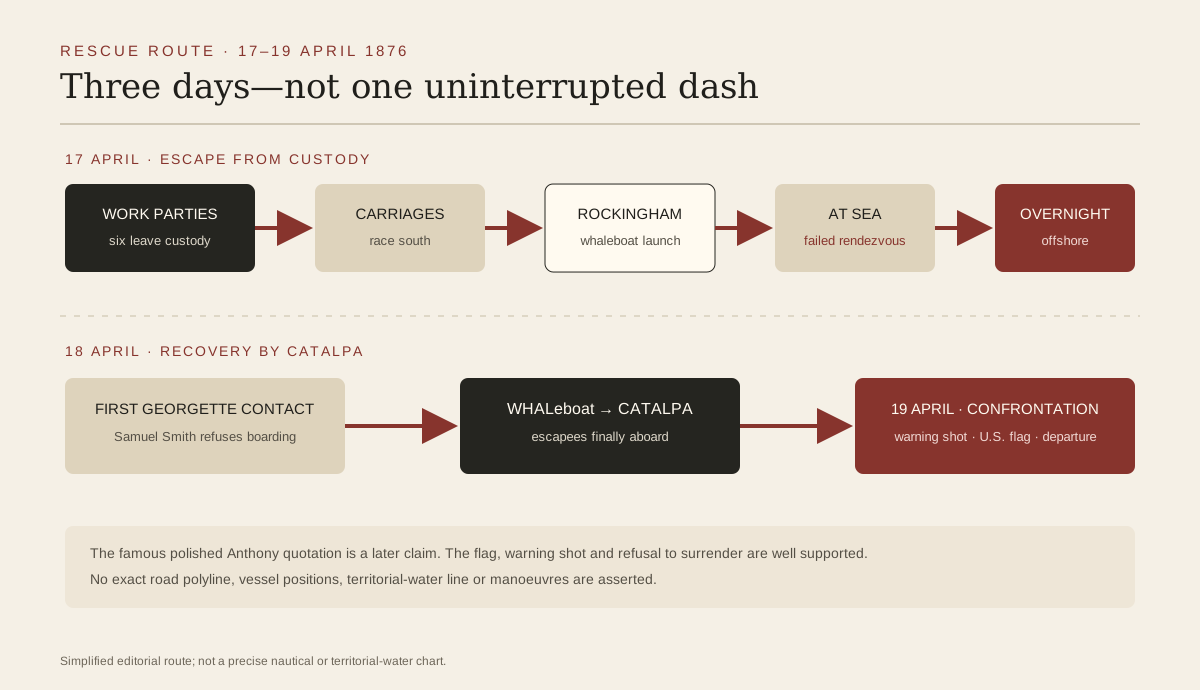
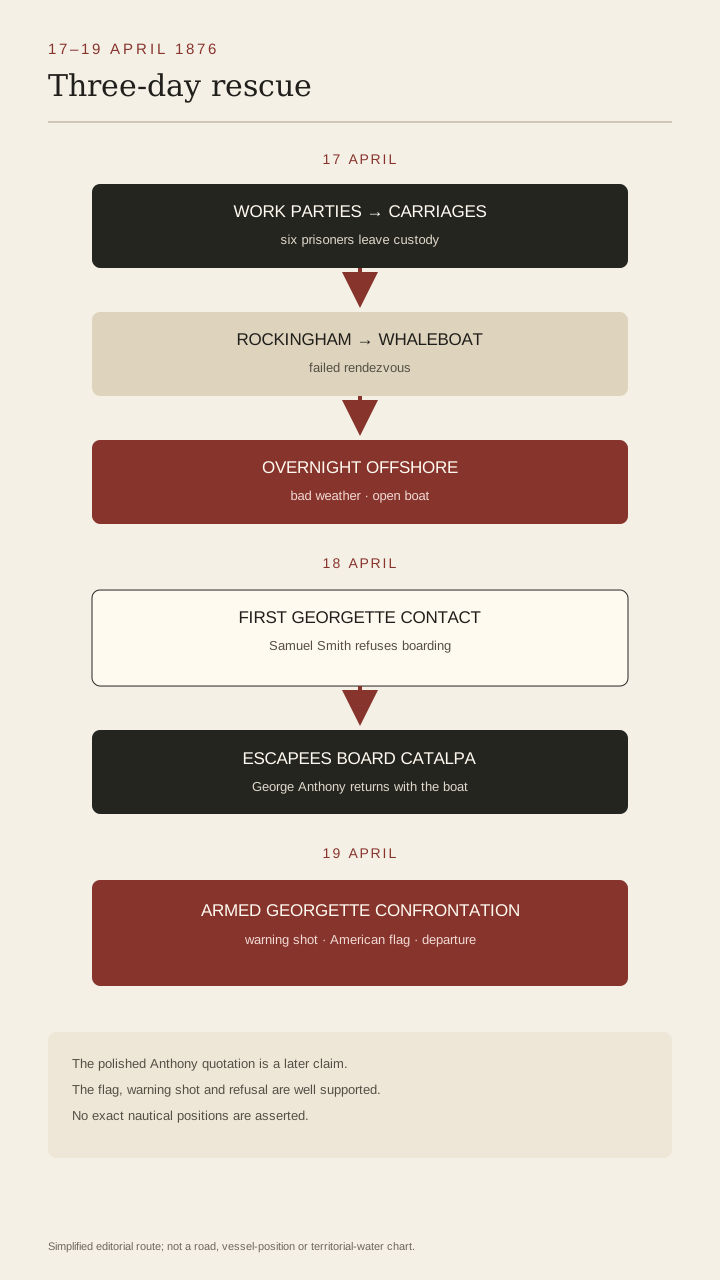
- 01
17 April
Six prisoners left work parties, reached carriages, travelled to Rockingham and put to sea in a whaleboat.
- 02
Overnight
Bad weather and a failed rendezvous left the rescue party offshore.
- 03
18 April
Samuel Smith refused the first Georgette boarding demand before Catalpa recovered the escapees.
- 04
19 April
The armed Georgette confrontation ended with Catalpa departing under the American flag.
Simplified editorial route; not a precise road, vessel-position, territorial-water or manoeuvring chart.
The whaleboat that had to find a moving ship
George Anthony had come inshore with a whaleboat from the Catalpa.
This small boat was the bridge between the land escape and the American vessel. It was also one of the most dangerous parts of the plan.
The Catalpa could not simply stay fixed near the coast. Remaining mobile reduced the risk of detention, but it made the rendezvous harder. The men leaving Rockingham did not have modern radio navigation, engines in their launch or a precise electronic position for the ship waiting offshore.
They had human eyes, sails, oars and an ocean. The rescue party initially made progress. Then the weather deteriorated.
Fremantle Prison's history says they sighted the Catalpa in the distance late in the day, but a squall broke contact as darkness approached. A more detailed specialist reconstruction describes the whaleboat's mast breaking in the bad weather.
Either way, the result is clear. The prisoners did not reach the ship on 17 April. They spent the night in the open boat.
The rescue almost becomes a maritime search
By the morning of 18 April, colonial authorities were also at sea.
A police cutter was searching. So was the Georgette, a steamship pressed into the pursuit.
The sequence on 18 April is easy to blur because the Georgette encountered the Catalpa before the fugitives were actually aboard. That creates one of the most important corrections in the story. One Fremantle Prison web account says Captain Anthony denied the authorities permission to board during this first contact.
But Anthony was not aboard the Catalpa at that point. He was with the escape party in the whaleboat.
More detailed accounts identify the man on the ship as first mate Samuel Smith. Smith refused the request. The authorities were not yet certain where the fugitives were, and the Georgette eventually had to break away, short of coal and supplies. That gave the whaleboat another chance.
A race for the side of the Catalpa
By the afternoon, the whaleboat was again approaching the Catalpa. The police cutter was also closing. The rescue now depended on which small boat could reach the ship first.
Smith maneuvered the Catalpa into position. The whaleboat came alongside. Breslin, Anthony, the boat crew and the six escaped prisoners climbed aboard.
The police had missed them. But the rescue was not yet secure. The Catalpa began moving toward the open sea while colonial authorities reorganized for another attempt. The Georgette returned to Fremantle, took on more coal and came back armed.
On the morning of 19 April, it caught the American ship again.
Problem → response
Escape was a sequence of problems
Each response solved a practical obstacle while often creating the next one.
- 01→
Obstacle
Distance between prison and extraction point
The men could not simply leave a work party and walk directly onto the Catalpa; the ship had to remain offshore and the extraction point was south at Rockingham.
Response
The organizers arranged two carriages and a whaleboat, turning the rescue into linked land and sea stages.
- 02→
Obstacle
Colonial communications
Telegraphy could rapidly alert officials beyond Fremantle.
Response
The rescue network cut the telegraph line between Fremantle and Perth, though a witness still carried news of the escape by horse.
- 03→
Obstacle
Moving rendezvous at sea
The Catalpa had to remain mobile enough to avoid seizure, which made it harder for the whaleboat to find the ship.
Response
Anthony's party continued rowing and sailing offshore, even after weather prevented a same-day rendezvous.
- 04→
Obstacle
Severe weather
A squall broke the whaleboat's mast and the rescue party spent an unscheduled night in the open boat.
Response
They resumed the rendezvous attempt the following morning using improvised sail support and rowing.
- 05→
Obstacle
Police cutter and Georgette
Colonial authorities pursued the escapees by sea using a police cutter and the steamship Georgette.
Response
The Catalpa maneuvered to take the whaleboat aboard before interception and then headed toward open water.
- 06→
Obstacle
Armed confrontation on 19 April
The Georgette returned with additional coal and a mounted gun and fired a warning shot while demanding the prisoners.
Response
Anthony refused to surrender them and relied on the American flag and the ship's claimed position beyond colonial territorial waters to deter forcible boarding.
The American flag changes the problem
The Georgette now carried a gun.
Contemporary Western Australian reporting described a warning shot fired across the Catalpa. Modern Fremantle histories identify a 12-pound weapon mounted for the pursuit.
The colonial demand was straightforward: stop and give up the prisoners. Anthony's answer changed the legal and political character of the confrontation. He raised or emphasized the American flag and refused to surrender the men.
Later versions of the story supply a perfect line in which Anthony warns that firing on the flag would mean firing on the United States. The sentiment matches the situation, and some institutional retellings repeat it, but the exact dramatic wording should not be mistaken for a verified transcript.
The important fact does not depend on the quotation. The Catalpa was an American vessel. Anthony maintained that it was outside the colonial territorial limit. The men pursuing him could not simply treat a foreign ship beyond their jurisdiction as though it were another prison work party.
A forcible boarding or exchange of fire could create an international incident. The Georgette did not take that risk. The six prisoners remained aboard.
What “international waters” really did for the escape
It is tempting to imagine the three-mile limit as a bright line painted across the Indian Ocean. It was not. The men on the two vessels had to judge their positions with nineteenth-century navigation, and later accounts suggest the colonial pursuers were not completely certain where the relevant limit lay at every moment. That uncertainty actually helps explain the outcome.
The rescue did not require Anthony to win a courtroom argument on the deck of the Catalpa. He needed to make forcible seizure dangerous enough—legally, politically and diplomatically—that the colonial authorities would not risk it. The American flag did not magically make the escapees free. It changed the cost of taking them back.
The Georgette turned away. The Catalpa sailed on.

Six names, one discrepancy
The names of the rescued men are well established:
- Thomas Darragh
- Martin Hogan
- Michael Harrington
- Thomas Hassett
- Robert Cranston
- James Wilson
One historical document creates a small complication. A police circular reproduced in an early history calls convict number 9707 James Darragh rather than Thomas Darragh. Modern prison and convict research identifies the man as Thomas Darragh and notes that he was also known as James Darragh. This is exactly the kind of small discrepancy that can become a false “mystery” if source names are copied without context.
The name used here is Thomas Darragh; the alias and name variation remains part of the evidence record.

The return to America
The Catalpa did not sail straight from the confrontation into an American harbor. The voyage home still took months. Sources also create another easily avoidable date confusion at the end of the story.
Specialist histories record the ship reaching New York on 19 August 1876. Fremantle Prison's escape history gives its return to its home port of New Bedford as 25 August.
Those dates describe two stages, not necessarily competing versions of the same arrival. For Irish-American supporters, the operation had achieved everything it was designed to do. Six prisoners were out. The colonial government had failed to recover them.
The rescue ship was back in the United States.
Evidence discipline
What the record supports
Status labels distinguish secure conclusions from uncertainty and rejected claims. Color is never the only signal.
DOCUMENTED
Six men, not all eight remaining military Fenians, were rescued by the Catalpa.
Fremantle Prison's detailed Fenian history says eight military Fenians remained, while two were unavailable because they were confined for insubordination. Some shorter institutional summaries simplify this to 'six remaining prisoners.'
Sources: SRC-001, SRC-002, SRC-006DOCUMENTED
Thomas Darragh was one of the six escapees.
Modern prison and convict records identify him as Thomas Darragh, convict number 9707. A police circular reproduced in an 1897 account calls him 'James Darragh.' Separate Western Australian convict research notes that Thomas Darragh was also known as James Darragh.
Sources: SRC-001, SRC-005, SRC-013WELL-SUPPORTED
Robert Cranston used his trusted prison-constable position to help remove other Fenians from their work details.
A Western Australian newspaper published four days after the escape gave this detailed account but introduced parts of it as reported information. The broader fact that the six escaped from work parties is secure.
Sources: SRC-004MYTH
George Anthony personally refused the Georgette's first request to board the Catalpa on 18 April.
One Fremantle Prison web narrative attributes the refusal to Anthony, but he was with the whaleboat and escapees during that phase. A more detailed Collections WA account and specialist chronology identify first mate Samuel Smith as the officer who refused the first boarding request.
Sources: SRC-001, SRC-003, SRC-017LATER CLAIM
Anthony said the exact words commonly quoted about firing on the American flag being an act of war.
The confrontation, American flag, refusal to surrender the men and colonial reluctance to force the issue are well supported. The exact dramatic quotation appears in later retellings and should not be presented as verified verbatim dialogue without a contemporary firsthand source.
Sources: SRC-001, SRC-003, SRC-004WELL-SUPPORTED
The Catalpa was unquestionably in international waters at every moment of the final confrontation.
The rescue depended on getting beyond the colonial territorial limit, and modern institutional accounts place the decisive standoff outside it. Contemporary and later descriptions also indicate uncertainty on the colonial side about exact position.
Sources: SRC-001, SRC-003, SRC-004MYTH
The Catalpa arrived in New Bedford on 19 August 1876.
Sources often compress the American return. A specialist history gives the New York arrival as 19 August; Fremantle Prison gives the Catalpa’s return to its New Bedford home port as 25 August. These are two distinct stages.
Sources: SRC-002, SRC-018Why the Catalpa Rescue worked
No single piece of the Catalpa plan was enough. Buying a ship did not free anyone. Escaping a work party did not get a prisoner out of Western Australia. Reaching Rockingham did not get him to the Catalpa.
Boarding the Catalpa did not end the danger while the Georgette could still overtake it. The rescue succeeded because each obstacle had its own answer. Prison routine: use work parties and inside contact. Distance: use carriages.
Colonial communication: cut the telegraph. Coast to ship: use a whaleboat. Bad weather: endure the delay and try again. Police pursuit: maneuver the Catalpa between the escapees and interception.
Final recapture attempt: make the American flag and maritime boundary part of the problem. The story is sometimes told as a confrontation between one fearless captain and one British steamer. That is the most cinematic moment. It is not the whole achievement.
The Catalpa Rescue took more than a year of preparation, a transatlantic political network, an ocean voyage, undercover work in the colony, precise timing, local help, transport on land and sea, and the ability to keep functioning after the original rendezvous failed. The six Fenians did not escape because one barrier collapsed. They escaped because the rescue had been designed as a chain—and enough links held.
Selected chronology
Planning, rescue and return
The Hougoumont reaches Fremantle
The final convict transport to Western Australia carried dozens of Fenian prisoners, including men who later became central to the Catalpa story.
John Boyle O'Reilly escapes
O'Reilly escaped Western Australia with maritime assistance and eventually settled in the United States, providing a precedent for a later rescue by sea.
James Wilson's appeal reaches John Devoy
A smuggled appeal from Wilson helped drive Irish-American organizers toward a rescue mission.
Catalpa leaves New Bedford
The bark sailed under the cover of a whaling voyage with George Anthony as captain.
Catalpa reaches Bunbury
Anthony arrived in Western Australia and coordinated with the land organizers before the final rescue attempt.
Six prisoners escape
The six men left their work details, reached waiting carriages, traveled south to Rockingham and put to sea in the Catalpa's whaleboat.
The whaleboat reaches Catalpa
After an unscheduled night in the open boat, the rescue party reached the Catalpa during a race with colonial pursuit vessels.
Georgette confronts Catalpa
The refueled and armed Georgette fired a warning shot and demanded compliance, but the Catalpa remained under the American flag and the prisoners were not surrendered.
Catalpa reaches New York
The rescued men reached the United States in August; specialist accounts distinguish the New York arrival from the ship's subsequent return to its New Bedford home port.
Catalpa returns to New Bedford
Fremantle Prison's official history records the ship's return to its Massachusetts home port on 25 August.