
Emperor Go-Daigo's escape from the Oki Islands in 1333 did more than free one political prisoner. It returned a defeated sovereign to the Japanese mainland while armed resistance to the Kamakura shogunate was already spreading.
Within days, Go-Daigo had a defensible base in Hōki Province and the backing of regional warriors. Within weeks, he was issuing imperial orders from Senjō-san. By the time he left that base, the Hōjō government at Kamakura had collapsed.
The broad sequence is secure, but the famous details of the sea escape are not nearly as certain.
At a Glance
- Exiled: 1332
- Place of exile: Oki Islands
- Escape: Genkō 3, intercalary second month, 24th day — spring 1333
- Mainland destination: Hōki Province
- Exact landing point: Disputed
- Principal mainland supporter: Nawa Nagatoshi
- Post-escape stronghold: Senjō-san
- Battle at Senjō-san: Intercalary second month, 29th day
- Political outcome: Renewed imperial mobilization and collapse of the Kamakura shogunate later in 1333
- Longer outcome: Beginning of the Kenmu government
- Evidence caution: Detailed boat concealment and miraculous pursuit episodes come from later war literature, especially the Taiheiki
An emperor trying to break Hōjō power
Go-Daigo had been emperor since 1318, but political authority in Japan was divided. The imperial court remained in Kyoto while the Kamakura shogunate, dominated by the Hōjō regency, exercised military government through a nationwide warrior network.
Go-Daigo sought to end that arrangement and recover effective imperial rule. In 1331 his effort to overthrow the shogunate failed. He fled the capital, resistance formed around him, and fighting centered on places including Mount Kasagi before shogunate forces defeated the movement. Go-Daigo was captured, and the punishment was exile.
Oki
In 1332 the defeated emperor was sent to the Oki Islands off the coast of western Honshu. Oki had a long association with political exile, and its separation from the mainland made it useful to governments that wanted important opponents removed from political centers without necessarily executing them.
Go-Daigo's exile looked like a decisive shogunate victory, but his removal did not end the rebellion. Prince Moriyoshi and warriors including Kusunoki Masashige continued armed resistance. Other regional opponents of Hōjō rule remained active or became increasingly willing to take up arms. The political world Go-Daigo would return to in 1333 was therefore different from the one from which he had been removed.
The escape date
Tottori Prefecture's historical research gives the departure in the traditional calendar as Genkō 3, intercalary second month, 24th day. For a modern article, "spring 1333" is safer than forcing that traditional date into a single Gregorian equivalent without a dedicated calendar-conversion source.
The essential chronology is firm: Go-Daigo got off Oki by sea and reached Hōki Province on the mainland. The exact mechanics are much less firm.
Where did he land?
Several places in modern Tottori Prefecture preserve traditions of Go-Daigo's arrival. Tottori's own historical work lists more than one candidate, including sites in present-day Kotoura and Daisen. A precise harbor should therefore not be built into the canonical route as though modern scholarship has settled the question.
The secure destination is Hōki Province. This uncertainty becomes important because later narratives make the crossing look much more precisely documented than it really is.
Selected chronology
Selected chronology
Go-Daigo's first revolt fails
The emperor's attempt to overthrow the Kamakura shogunate was defeated and he was captured.
Exiled to Oki
Go-Daigo was removed from the mainland and sent to the Oki Islands.
Escape from Oki
Go-Daigo left the Oki Islands by sea and reached Hōki Province.
Victory at Senjō-san
Regional forces supporting Go-Daigo defeated a shogunate force and secured his position in Hōki.
Imperial orders from Senjō-san
Go-Daigo used the mountain base to issue orders, recognize supporters and rally the anti-Hōjō movement.
Ashikaga Takauji defects
Takauji turned against the Kamakura shogunate and joined attacks that destroyed Rokuhara authority in Kyoto.
Kamakura regime collapses
Nitta Yoshisada's forces captured Kamakura and the Hōjō political order effectively ended.
Go-Daigo leaves Senjō-san
The emperor departed his temporary Hōki headquarters toward Kyoto after the fall of the shogunate.
Kenmu government begins
Go-Daigo resumed direct imperial rule in Kyoto in the political settlement conventionally called the Kenmu Restoration.
The Taiheiki version
The Taiheiki, the great fourteenth-century war tale of the conflicts that followed the fall of Kamakura, preserves the most dramatic version of Go-Daigo's escape. In that narrative, the emperor is hidden in a boat beneath bales of dried fish while pursuers search for him. The danger escalates into a large maritime pursuit, with more than a hundred pursuing vessels eventually appearing.
Then the story becomes explicitly providential. Go-Daigo throws a Buddhist relic onto the sea, and a favorable wind drives his pursuers away. These are memorable episodes, but they are exactly the kind of details that should not be treated as if they came from a contemporary guard report.
A war tale is not an escape log
The Taiheiki is indispensable to the history and memory of fourteenth-century Japan. It is also a literary war narrative, shaped by moral judgment, religious meaning, dramatic scenes and retrospective storytelling.
Modern scholarship treats it as a major source for the era while recognizing those literary characteristics. That distinction does not require throwing the story away: the dried-fish hiding place, enormous pursuit fleet and miraculous wind tell us how later medieval narrative culture wanted readers to understand Go-Daigo's survival. They do not provide the same kind of evidence as a dated political document from 1333.
Even Kyoto did not know exactly what had happened
A letter from retired emperor Hanazono provides a very different kind of evidence. More than ten days after Go-Daigo's escape, Hanazono recorded contradictory reports reaching Kyoto. One account placed Go-Daigo in a fortified position near Mount Daisen, while reports of his military following varied sharply, from roughly a thousand mounted warriors to only a few hundred.
Other rumors concerned whether Oki officials had caught up with him and fought. The court did not possess a neat, authoritative account of the escape and landing, and that contemporary confusion makes later narrative precision even more important to qualify.
Nawa Nagatoshi
What becomes much clearer after Go-Daigo reached Hōki is the role of Nawa Nagatoshi. Nawa was an influential local figure whose resources and connections appear to have extended beyond a small village warrior household. Tottori historical research emphasizes his regional wealth and possible links to maritime activity.
Nawa supported Go-Daigo after the emperor reached the mainland. That support gave the fugitive sovereign something more important than another boat: a local political and military base. Later legend sometimes folds Nawa directly into the mechanics of the Oki escape, but the stronger historical claim is narrower. His crucial documented role begins with the emperor's arrival in Hōki and the rapid defense of Go-Daigo there.
Problem → response
Escape was a sequence of problems
Each response solved a practical obstacle while often creating the next one.
- 01→
Obstacle
Island exile
Oki's separation from the mainland removed Go-Daigo from Kyoto and from direct access to political and military supporters.
Response
Go-Daigo escaped by sea during a period when anti-Hōjō resistance was already active on the mainland.
- 02→
Obstacle
Uncertain mainland reception
Leaving Oki did not guarantee safety because shogunate forces could still capture Go-Daigo after landing.
Response
Nawa Nagatoshi and other Hōki supporters protected the emperor and helped secure Senjō-san.
- 03→
Obstacle
Shogunate counterattack
Kamakura authorities ordered forces to attack the emperor's position in Hōki.
Response
Go-Daigo's supporters defeated the attacking force at Senjō-san and retained the mountain base.
- 04→
Obstacle
Need for national political leverage
A successful local refuge would not by itself destroy Hōjō government.
Response
Go-Daigo issued orders and calls for support while other anti-Hōjō leaders, including Takauji and Nitta Yoshisada, expanded the rebellion.
Senjō-san
The conflict reached Senjō-san only days after the escape. Tottori's chronology places the battle on the traditional intercalary second month, 29th day, five days after Go-Daigo left Oki. A shogunate force attempted to suppress the returned emperor and his supporters, but Go-Daigo's side prevailed.
The mountain then became more than a refuge. It became a temporary imperial headquarters from which Go-Daigo could summon additional warriors and reassert political authority. On Oki, Go-Daigo was an exiled sovereign controlled by his enemies; at Senjō-san, he was a claimant to national authority issuing commands in open rebellion.
A surviving order
One piece of evidence makes that transformation unusually tangible. Among the historical documents preserved by the Aimi family is a 1333 imperial order connected to Go-Daigo's headquarters at Senjō-san. Tottori's cultural-heritage research reports that the order was formally issued through courtier Chigusa Tadaaki but that handwriting analysis identifies the writing as Go-Daigo's own.
The document concerns the mobilization and reward world surrounding the emperor's cause. Its importance to the escape story is straightforward: Go-Daigo was not merely hiding after reaching the mainland. He had resumed the work of government and rebellion, a more secure consequence of the escape than any precise reconstruction of how many boats chased him.
Documentary reconstruction
The secure route and its evidence limits
A case-local editorial visual separates the documented sequence from uncertainty without implying exact modern geography or operational detail.
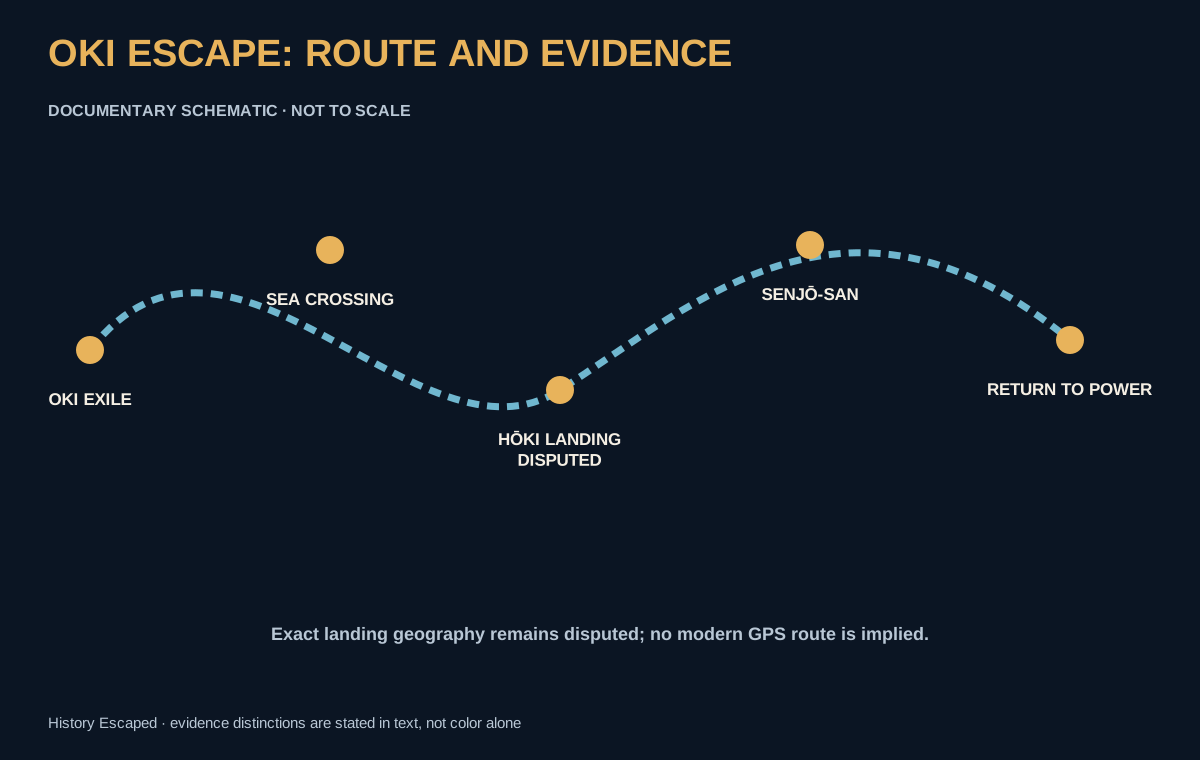
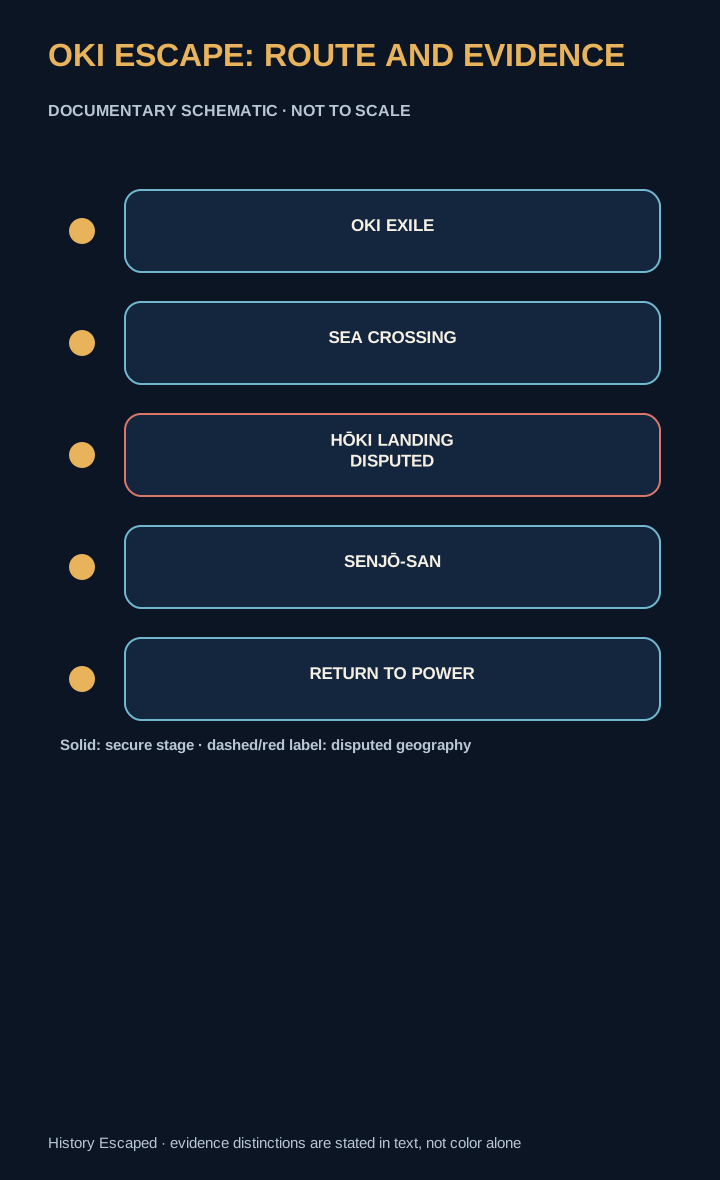
Simplified editorial reconstruction based on the cited historical record; not to scale. Uncertainty is stated directly in the visual and adjacent text.
An uprising already in motion
Go-Daigo's return mattered because the shogunate was already under pressure. Kusunoki Masashige had continued resistance after the emperor's capture, Prince Moriyoshi remained an organizer of opposition, and Akamatsu Norimura was active in western Japan.
The emperor's reappearance gave these movements a living sovereign around whom legitimacy could be organized, but it did not create every anti-Hōjō army. The collapse of Kamakura would depend on warriors making their own political choices, and two of those choices were decisive.
Ashikaga Takauji changes sides
Ashikaga Takauji belonged to one of the most powerful warrior lineages within the Kamakura political system. The shogunate sent him west to help suppress the imperial rebellion, but he defected.
Takauji then turned his forces against the shogunate's Rokuhara Tandai in Kyoto. The fall of Rokuhara destroyed the Kamakura government's principal administrative and military position in the imperial capital. Go-Daigo's cause now had support from a warrior whose resources were on an entirely different scale from the small group that had escaped Oki.
Nitta Yoshisada attacks Kamakura
The final destruction of the Hōjō regime came from the east. Nitta Yoshisada raised forces against the shogunate and advanced on Kamakura. In the traditional fifth month of 1333 his army broke into the shogunate capital.
Hōjō Takatoki and many members of the ruling family died as the regime collapsed. The Kamakura shogunate was finished, but Go-Daigo had not personally commanded the assault on Kamakura. His escape had helped transform the political environment in which warriors could defect to the imperial side, while the military destruction of the shogunate remained a multi-centered rebellion.
The final accounting
Outcome
Escape from exile
Go-Daigo successfully left Oki and reached Hōki Province.
Mainland political base
Senjō-san became a temporary imperial headquarters from which Go-Daigo could issue orders and recruit support.
Kamakura shogunate collapse
The Hōjō-led shogunate was destroyed later in 1333 through a wider rebellion involving multiple military leaders.
Leaving Senjō-san
Tottori's regional chronology places Go-Daigo's departure from Senjō-san on the traditional fifth month, 23rd day, immediately after the effective fall of Kamakura. For more than two months, Senjō-san had functioned as a temporary imperial base.
The emperor who had arrived in Hōki as an escaped exile was now leaving as the sovereign of a movement whose principal enemy had ceased to exist. His next destination was Kyoto, and the escape from Oki had become a restoration of rule.
The Kenmu government
Go-Daigo's return produced what is conventionally called the Kenmu Restoration or Kenmu government. The name can mislead if "restoration" is taken to mean nothing more than an attempt to recreate an ancient court system unchanged.
Modern historian Andrew Edmund Goble argues that Go-Daigo and his associates were pursuing substantial political reorganization. His interpretation presents the Kenmu regime as an ambitious attempt at systemic change rather than simply an archaic reaction against warrior government.
The government would prove short-lived. Conflict with Ashikaga Takauji opened another civil war, and competing imperial courts emerged. That later failure does not change what the escape accomplished in 1333.
Evidence discipline
What the record supports
Status labels distinguish secure conclusions from uncertainty and rejected claims. Color is never the only signal.
DOCUMENTED
Go-Daigo escaped the Oki Islands on Genkō 3, intercalary second month, 24th day.
Tottori Prefecture's historical chronology gives this traditional date and places his arrival in Hōki immediately afterward.
Sources: SRC-001, SRC-003DISPUTED
The exact Hōki landing point is known with certainty.
Tottori historical research identifies multiple competing landing traditions in modern Kotoura and Daisen.
Sources: SRC-002LATER CLAIM
Nawa Nagatoshi is securely documented as the person who organized Go-Daigo's physical boat departure from Oki.
Nawa's mainland protection and military support are strong, but the best regional scholarship does not require him to be the documented organizer of the Oki departure itself.
Sources: SRC-001, SRC-002LATER CLAIM
Go-Daigo hid beneath bales of dried fish while pursuers searched his escape boat.
This dramatic concealment appears in the Taiheiki war-tale tradition and is not independently established by contemporary administrative evidence.
Sources: SRC-007, SRC-008LATER CLAIM
More than one hundred pursuit vessels chased Go-Daigo and were defeated by a miraculous wind after he cast a Buddhist relic into the sea.
The episode belongs to the Taiheiki's religious-literary narrative and should be preserved as tradition rather than treated as secure escape mechanics.
Sources: SRC-007, SRC-008MYTH
Contemporary Kyoto authorities immediately knew the exact details of Go-Daigo's escape and force.
Retired emperor Hanazono's letter more than ten days later records sharply conflicting reports about Go-Daigo's position and military strength.
Sources: SRC-001DOCUMENTED
Go-Daigo issued orders from Senjō-san after reaching the mainland.
A surviving 1333 imperial order among the Aimi family documents is connected with the Senjō-san headquarters and has been identified through handwriting analysis as Go-Daigo's own writing.
Sources: SRC-004MYTH
Go-Daigo's escape single-handedly caused the fall of the Kamakura shogunate.
His return strengthened imperial mobilization, but the shogunate's destruction resulted from a broader rebellion involving continuing loyalist resistance, Takauji's defection, Nitta Yoshisada's campaign and many regional forces.
Sources: SRC-001, SRC-006DISPUTED
The Kenmu government was simply a reactionary attempt to restore an unchanged ancient court order.
Andrew Edmund Goble's modern scholarship argues that Go-Daigo and his associates pursued significant systemic political change, challenging the older purely reactionary interpretation.
Sources: SRC-006What the escape did—and did not do
The Oki crossing did not by itself overthrow the Kamakura shogunate. It did something politically more specific: it returned Go-Daigo to a mainland rebellion that had survived his exile, allowed regional supporters such as Nawa Nagatoshi to protect him, and gave him a base at Senjō-san from which imperial orders could again circulate.
It also strengthened the legitimacy of a movement in which powerful warriors were beginning to defect from the Hōjō regime. The shogunate fell because those developments converged.
The strongest reconstruction
The most secure escape sequence is surprisingly short. Go-Daigo was exiled to Oki in 1332. In spring 1333 he got off the islands by sea, reached Hōki Province at a landing place that remains disputed, and gained the support of Nawa Nagatoshi and other regional warriors. Five days after the traditional departure date, his side defeated a shogunate force at Senjō-san.
From there the history becomes political rather than nautical. Go-Daigo issued orders, warriors joined him, shogunate armies and commanders changed sides or were defeated, and Kyoto and Kamakura fell. That sequence survives without requiring dried-fish bales or miraculous winds to become historical fact.
History and the Taiheiki
The later literary tradition should still remain on the page because it shaped the escape's memory. A sovereign hidden beneath cargo, searched for at sea and saved by sacred intervention is a powerful medieval story, expressing the idea that Go-Daigo's return possessed providential significance.
The evidence levels should remain visible. The departure from Oki is history. The arrival in Hōki is history. The Senjō-san base and imperial orders are history. The exact landing beach is disputed. The dried-fish concealment and miraculous wind belong to the Taiheiki tradition.
Keeping those categories separate makes the case more interesting, not less.
From exile to political center
The central transformation of 1333 happened between two different conditions of political power. On Oki, Go-Daigo could issue no effective national challenge to the government that had exiled him. At Senjō-san, only days after reaching Hōki, he could.
His physical escape made that change possible, but the decisive resource was the network that formed around him after he landed. That is why the strongest version of Go-Daigo's escape is not a story about an emperor outwitting hundreds of boats. It is a story about an exile returning at the exact moment when a rebellion was becoming capable of destroying the regime that had sent him away.
