
Red Hugh O’Donnell’s successful escape from Dublin Castle began with a prepared rope and ended as a winter survival crisis in the Wicklow uplands. Three political prisoners got out of the castle together in January 1592; only one of the two men who remained on the southern route survived to reach Fiach MacHugh O’Byrne’s refuge.
The strongest early accounts agree on the central mechanism. O’Donnell, Art MacShane O’Neill, and Henry MacShane O’Neill removed their fetters, carried a long rope to a privy, descended into the castle ditch, met a prepared guide, and passed through Dublin before the city gates had closed. The details become less certain when later writers try to identify the exact tower, the tool used on the chains, or every mile of the route.
At a Glance
- Date: 6 January 1592 is the conventional and best-supported date
- Place: Dublin Castle
- Escapees: Red Hugh O’Donnell, Art O’Neill, and Henry O’Neill
- Captivity: Political hostage/prisoner
- Main method: Rope descent through a privy into the castle ditch
- Outside assistance: A prepared guide and the refuge network of Fiach MacHugh O’Byrne
- Outcome: O’Donnell reached safety and returned north; Art died during the flight
Why O’Donnell Was a Prisoner
O’Donnell had been taken into English government custody while still a teenager. In 1587, a vessel equipped in Dublin sailed to Lough Swilly under the appearance of commercial trade. Lughaidh Ó Cléirigh’s early seventeenth-century biography describes wine and beer being used to entice local gentlemen aboard near Rathmullan. Once O’Donnell was on the ship, the crew seized him and carried him to Dublin.
The political logic was straightforward even if Ó Cléirigh wrote from a strongly pro-O’Donnell perspective. Hugh Roe was heir to the lordship of Tír Chonaill, and the Dublin government feared the growing relationship between the O’Donnell family and Hugh O’Neill, Earl of Tyrone. Controlling the young heir gave the government leverage over one of the strongest Gaelic lordships in Ulster.
O’Donnell remained in Dublin Castle for years while his family and allies tried different ways to secure his release.
The First Escape Was Not the Famous One
He escaped once before the successful 1592 breakout. In January 1591, O’Donnell and other prisoners got out of the castle and moved into the Wicklow region, but the attempt collapsed. His footwear failed, his feet were badly cut, and he eventually sought help after being left behind by companions. Political pressure led to his return to government custody.
The failed attempt mattered because Dublin Castle now had every reason to treat him as a serious escape risk. Ó Cléirigh says heavier irons were put on him and his confinement became stricter. The second escape therefore required more preparation and should be reconstructed separately from the first.
A Date with a Real Source Problem
The successful escape is usually dated 6 January 1592, the Feast of the Epiphany. Ó Cléirigh says O’Donnell remained imprisoned into January “to Twelfth Night,” while modern Irish biographical sources and commemorative histories use 6 January.
An early seventeenth-century account by Philip O’Sullivan Beare differs, placing the escape a few days before Christmas. The disagreement is small in scale but historically real. Six January remains the strongest conventional date without pretending the early sources provide a single uncontested timestamp.
Selected chronology
Selected chronology
O’Donnell is seized at Lough Swilly
A vessel sent under the authority of Lord Deputy John Perrot lured the young O’Donnell aboard near Rathmullan and carried him to Dublin as a political hostage.
First escape fails
O’Donnell escaped Dublin Castle once before, reached the Wicklow area, but was recaptured and returned to the castle under heavier restraint.
Second escape from Dublin Castle
O’Donnell, Art O’Neill, and Henry O’Neill escaped by rope through a privy into the castle ditch and passed through Dublin before the gates closed.
Art O’Neill dies; O’Donnell reaches Glenmalure
Severe winter exposure killed Art. O’Donnell survived with serious frostbite and was carried to refuge under Fiach MacHugh O’Byrne’s protection.
O’Donnell returns north
After recovering enough to travel, O’Donnell moved through a protected route toward Hugh O’Neill at Dungannon, then through Fermanagh toward Ballyshannon.
O’Donnell assumes the Tír Chonaill lordship
After his return, Hugh Roe was inaugurated as O’Donnell, placing him at the center of the escalating Ulster conflict that preceded the Nine Years’ War.
Removing the Fetters
The prisoners’ first obstacle was their irons. Ó Cléirigh says O’Donnell, Art, and Henry took advantage of the guards before they were secured for the night and “took off their fetters.” The Annals of the Four Masters similarly say they exploited an opportunity and knocked them off.
Neither source explains the exact technique. A later account says O’Donnell had acquired a file. That may be true, but the file should not carry the same certainty as the rope or the privy route. The early sources establish that the fetters came off; they do not securely establish how.
Once free of the irons, the three men moved to the privy.
Material evidence
Tools of Escape
The objects used in an escape reveal how a plan worked under constraint.
- 01Core breakout tool
Long rope
The shared early accounts make the rope the decisive physical tool for descending through the privy into the castle ditch.
The Privy and the Rope
Here the evidence becomes unusually consistent. The fugitives had a long rope. They lowered themselves through the privy until they reached the deep ditch around the castle, then climbed the outer side.
The route bypassed the normal guarded exits by using part of the castle’s sanitation system. Later retellings often identify a specific tower as the place of confinement, usually the Record or Wardrobe Tower or, in other versions, Bermingham Tower. The surviving medieval tower at Dublin Castle certainly had prison functions at different periods, but the early O’Donnell narratives do not name the escape tower.
The exact cell therefore remains unknown.
A Guide Was Waiting
Once the fugitives were beyond the ditch, they were not alone. Ó Cléirigh describes a faithful servant who had been visiting them in the castle as a horseboy. The prisoners had told him their plan, and he was waiting when they emerged.
Later scholarship commonly identifies this guide as Edward Eustace. That identification is plausible and deeply embedded in modern accounts of the route, but Ó Cléirigh does not provide the name. The guide’s function is more secure than his identity: he knew where the fugitives were trying to go and led them away from the castle.
Problem → response
Escape was a sequence of problems
Each response solved a practical obstacle while often creating the next one.
- 01→
Obstacle
Heavy confinement after the failed 1591 escape
O’Donnell had already escaped once and was returned to Dublin Castle in heavier irons and under closer guard.
Response
The successful plan exploited the period before night confinement and used a prepared rope and outside guide rather than repeating the first escape exactly.
- 02→
Obstacle
Castle ditch and controlled exits
The castle was protected by a deep ditch and guarded gateways.
Response
The prisoners bypassed the formal gate by descending through the privy into the ditch, then crossed the city while its gates were still open.
- 03→
Obstacle
Winter exposure
The fugitives left without adequate outer clothing and encountered rain, snow, frost, and difficult upland ground.
Response
They headed for Fiach MacHugh O’Byrne’s refuge network at Glenmalure; when Art could go no farther, the guide ran ahead for rescue assistance.
Through the City Before the Gates Closed
The escape took place early enough in the evening that Dublin had not yet sealed itself for the night. The fugitives moved through crowded streets and, according to Ó Cléirigh and the Annals, drew no more attention than ordinary people. They avoided stopping unnecessarily and reached the city gates while they remained open.
That detail explains why the rope alone did not make the escape successful. Getting beyond the castle was only the first controlled boundary. They also needed to clear Dublin before the gates became another barrier.
Once outside the city, they moved toward the uplands and the territory of Fiach MacHugh O’Byrne, whose stronghold at Glenmalure offered refuge beyond the immediate reach of Dublin government forces.

Henry Disappears into the Night
The three escaped prisoners did not remain together. Both major Gaelic narratives say darkness and the speed of the flight separated Henry O’Neill from the others. O’Donnell and Art regretted losing him but continued with the guide.
Later versions offer more confident explanations, including that Henry deliberately made his own way north. The early accounts are less definite. The secure point is that Henry was no longer part of the group that struggled south through the winter weather.
Documentary reconstruction
Breakout, winter survival and rescue
A case-local visual focused on the spatial, mechanical or evidentiary relationship established by the surviving record.
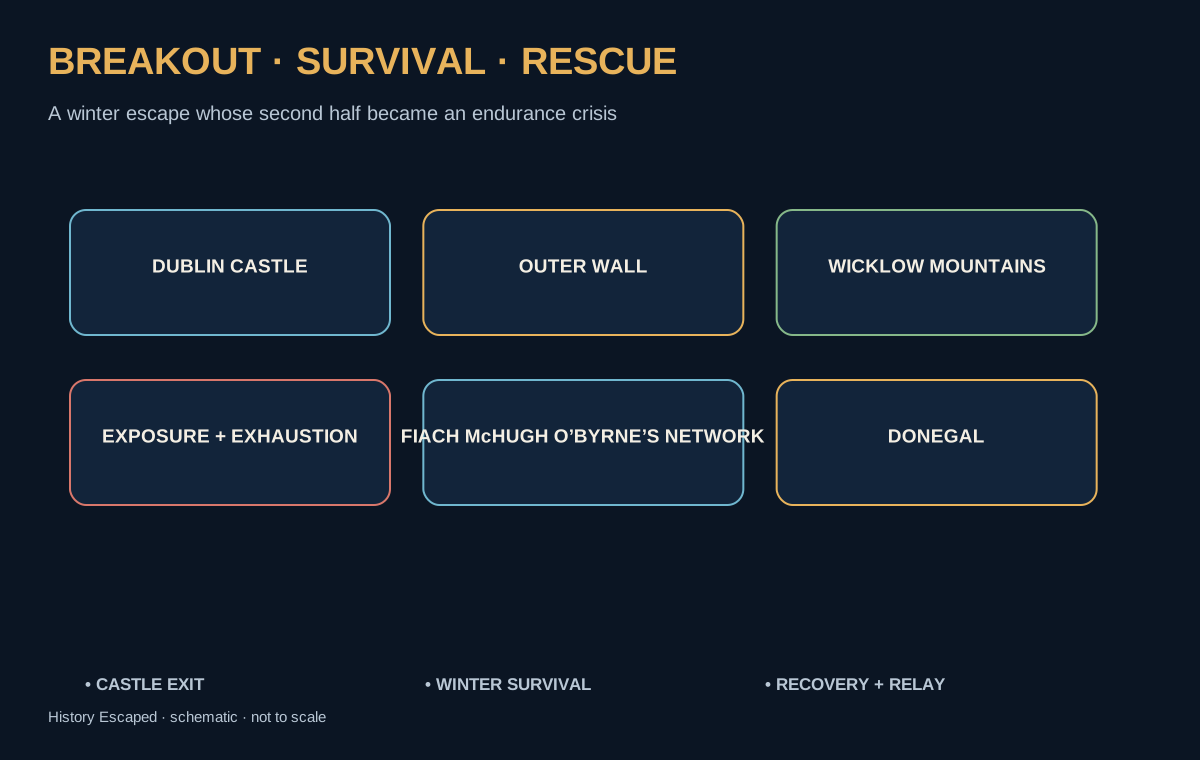
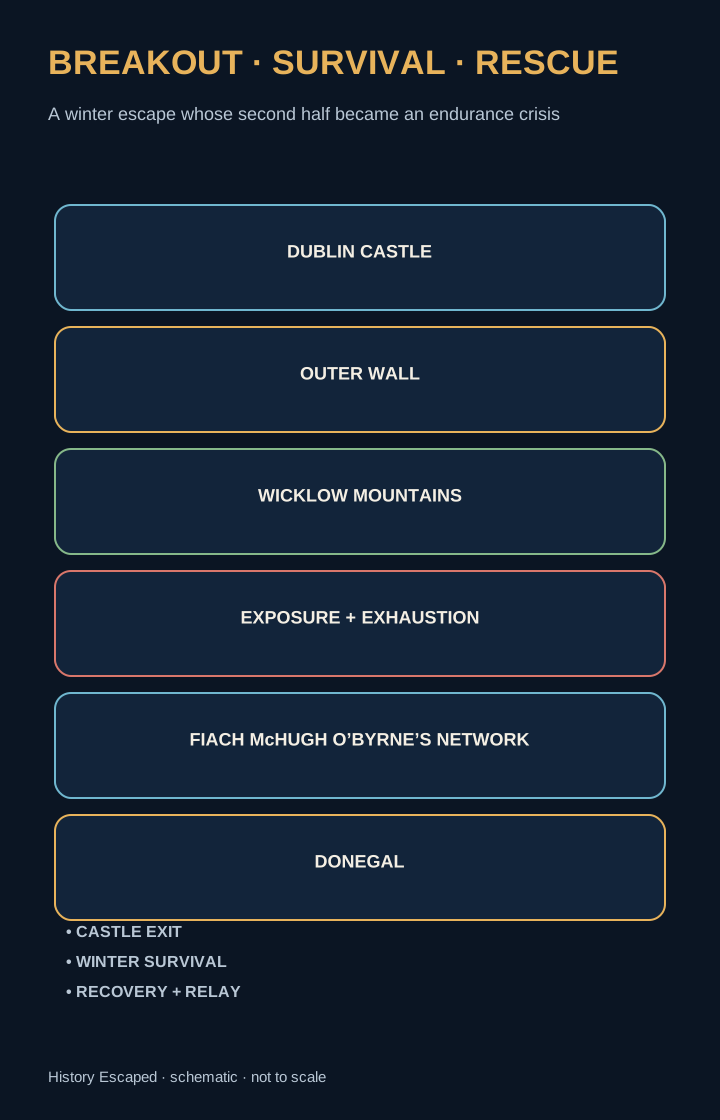
Simplified editorial reconstruction based on the cited historical record; not to scale. Uncertainty is stated directly in the visual and adjacent text.
Winter Changes the Problem
The weather turned the flight into an emergency. Ó Cléirigh describes rain, snow, slippery ground, and a lack of proper outer clothing. In their haste, the fugitives had left garments behind in the privy. The Annals preserve the same basic picture.
Art struggled most. The early sources explain his weakness partly through long confinement and loss of physical condition. Later accounts add that he was injured by a falling stone during the descent from the castle; that detail is not present in the strongest early narrative and is not needed to explain his collapse.
O’Donnell and the guide helped Art forward, with one of his arms over each man’s shoulder, until they could carry him no farther.
The Shelter in the Mountains
The group stopped under a projecting rock or cliff in the high ground. Modern commemorations connect the episode with the area around Conavalla and Art’s Cross, but the sixteenth-century sources do not provide coordinates that fix the exact shelter or burial place.
The critical decision was clear. The guide had to leave O’Donnell and Art and continue alone to Glenmalure. If he could reach Fiach MacHugh O’Byrne, help might return; if he could not, the two exhausted fugitives were unlikely to survive the weather.
The final accounting
Outcome
O’Donnell reached refuge
Red Hugh survived the escape and was carried to safety in the Glenmalure network before traveling north.
Art O’Neill died
Art died from the effects of winter exposure during the flight through the Wicklow uplands.
Political consequences in Ulster
O’Donnell’s return allowed him to assume leadership in Tír Chonaill and strengthened the political alignment that soon confronted the Tudor government in the Nine Years’ War.
Fiach MacHugh O’Byrne’s Rescue Network
The guide reached Glenmalure and reported what had happened. Ó Cléirigh and the Annals say Fiach immediately selected trusted men and sent them back with food and drink. The rescuers returned to the place where the fugitives had been left and found them in an extreme state of exposure.
Art did not recover. He died there and was buried in the mountains. O’Donnell managed to retain some drink and gradually revived, but the cold had badly damaged his feet. O’Byrne’s men carried him into the Glenmalure refuge network and placed him in a secluded house where he could recover.
The castle escape was complete, but the political flight was not.
Frostbite and the Cost of Survival
O’Donnell’s survival left a permanent physical consequence. Ó Cléirigh says his feet were swollen, blistered, and without feeling because of frost and snow. He remained unable to travel normally and needed assistance mounting and dismounting a horse.
After he eventually reached his own country, the source says, both of his great toes were amputated. That detail cuts against the clean heroic ending that later legend sometimes gives the escape. O’Donnell succeeded, but the journey nearly killed him and left lasting injury.
Evidence discipline
What the record supports
Status labels distinguish secure conclusions from uncertainty and rejected claims. Color is never the only signal.
WELL-SUPPORTED
The successful escape occurred exactly on 6 January 1592.
Modern Irish biographical and commemorative sources commonly give 6 January, while Ó Cléirigh places the escape at Twelfth Night in January 1592. Philip O’Sullivan Beare’s later account places it a few days before Christmas, creating a real chronological discrepancy.
Sources: SRC-001, SRC-003, SRC-004MYTH
Red Hugh escaped alone.
Art and Henry MacShane O’Neill escaped with him from the castle. Henry was separated later, and Art died in the Wicklow mountains.
Sources: SRC-001, SRC-002, SRC-004MYTH
The prisoners escaped through a normal castle door after overpowering guards.
The strongest early accounts instead describe removing fetters, carrying a rope to the privy, descending into the castle ditch, and climbing out beyond the normal gate route.
Sources: SRC-001, SRC-002DISPUTED
A file was definitely used to cut the prisoners’ chains.
Ó Cléirigh and the Annals say the prisoners removed or knocked off their fetters without naming a tool. O’Sullivan Beare later supplied a file. The exact release mechanism is therefore uncertain.
Sources: SRC-001, SRC-002, SRC-003DISPUTED
The guide can be identified with certainty as Edward Eustace.
Later scholarship and local historical tradition commonly identify Edward Eustace, but Ó Cléirigh describes only a faithful servant or horseboy who had visited the prisoners.
Sources: SRC-001, SRC-010UNKNOWN
The precise surviving Dublin Castle tower from which O’Donnell escaped is securely known.
Later traditions variously identify the surviving Record/Wardrobe Tower and Bermingham Tower. The primary narratives describe a strong stone prison, privy, ditch, and castle environment without naming the tower.
Sources: SRC-001, SRC-006, SRC-011UNKNOWN
Art O’Neill’s precise death spot is known exactly.
The early narratives place his death at the mountain shelter before rescue and say he was buried there. The modern Art’s Cross commemorates the tradition, but the exact sixteenth-century shelter and grave location are not established by contemporary survey evidence.
Sources: SRC-001, SRC-002, SRC-007MYTH
O’Donnell survived without lasting physical injury.
Ó Cléirigh states that severe frost damage left his feet without feeling and that his two great toes were later amputated after he returned to his own country.
Sources: SRC-001MYTH
The escape was wholly spontaneous and had no outside political preparation.
A prepared rope, outside guide, planned refuge at Glenmalure, and surviving government suspicion of bribery all point to substantial external preparation. The exact recipients and scale of bribery remain uncertain.
Sources: SRC-001, SRC-003, SRC-008, SRC-009From Glenmalure Back to Ulster
Once O’Donnell was strong enough to move, Fiach MacHugh O’Byrne organized protection for the next stage. The early narratives trace a cautious northern journey involving a Liffey crossing, movement toward the Boyne west of Drogheda, and assistance from men connected to Hugh O’Neill. O’Donnell later passed through Armagh and reached Dungannon, where Hugh O’Neill received and concealed him.
From there he continued through the political network of Ulster, including Fermanagh, until he returned to O’Donnell territory at Ballyshannon. The Gaelic narratives preserve substantial route detail, but a modern map should still resist drawing a perfectly certain line because sixteenth-century place names and movement corridors do not always map neatly onto present-day roads.
The broad direction is secure: Dublin Castle to the Wicklow refuge, then north through allied territory to Tír Chonaill.
Was the Escape Bribed?
The second escape appears much more organized than the first. A rope was ready, a guide was waiting, Glenmalure was prepared as a destination, and Hugh O’Neill had spent years trying to secure O’Donnell’s release.
Government suspicion soon focused on corruption. Queen Elizabeth’s correspondence in 1592 treated money as having enabled the escape and demanded investigation, while modern historian Hiram Morgan has examined the accusations surrounding Lord Deputy William Fitzwilliam and the Dublin administration.
The evidence does not provide a clean receipt identifying one official who sold the prisoners their freedom. Outside preparation is well supported; the exact bribery chain is not.
Why the Escape Mattered Politically
O’Donnell returned north at a moment when English intervention in Ulster was intensifying. Within months, he assumed the O’Donnell lordship in Tír Chonaill. His alliance with Hugh O’Neill became one of the central relationships in the Gaelic coalition that fought the crown during the Nine Years’ War.
The escape did not by itself cause that conflict. Tensions over lordship, sheriffs, garrisons, succession, religion, and crown authority were already deep. But imprisonment had removed a politically important heir from Ulster for years, and his successful return restored him to the regional balance of power.
That is why the 1592 breakout belongs in political history as much as prison-escape history. A rope through a castle privy opened the way for a young hostage to re-enter one of the largest struggles over power in late Tudor Ireland.