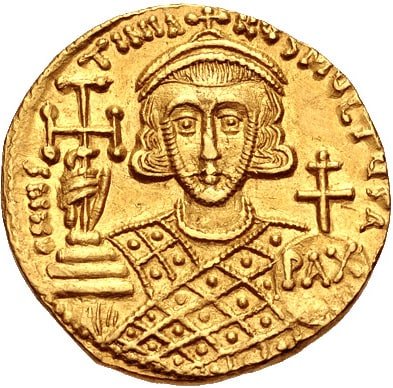
Justinian II spent years in exile at the edge of the Byzantine world before the people around him decided that exile was no longer enough.
He had once ruled the empire. In 695 a revolt removed him from the throne, mutilated him, and sent him to Cherson on the Crimean coast. There, according to the later Byzantine histories, Justinian did not quietly accept political extinction. He talked about becoming emperor again.
Around 704, Cherson’s leading citizens decided that this made him dangerous. They feared what the reigning emperor might do if the city became a base for Justinian’s restoration movement. Their solution, as preserved by Nicephorus and Theophanes, was stark: kill the exile or send him back to Constantinople. Justinian learned of the plan first and fled.
At a Glance
Who: Justinian II, Byzantine emperor from 685 to 695 and again from 705 to 711.
Why in Cherson: He was overthrown, mutilated, and exiled there in 695.
Why he had to leave: He openly planned or proclaimed his intention to regain the imperial throne, alarming Cherson’s leading citizens.
Escape date: Approximately 704; some chronological traditions support 703–704.
First destination: Doros in Crimean Gothia, probably the site later identified with Mangup.
Next refuge: The court of the Khazar khagan.
Immediate outcome: The khagan received Justinian honorably, allied with him, and gave him his sister in marriage.
Critical distinction: Justinian later fled a separate Khazar assassination plot. That was a second escape, not the same event as his flight from Cherson.
An Emperor Sent to the Edge
Justinian II had become sole emperor in 685 while still young. His first reign lasted ten years and ended violently.
In 695, the general Leontius became the focus of a revolt in Constantinople. Justinian was deposed. The Byzantine narrative tradition says his nose and tongue were mutilated before he was sent into exile at Cherson.
Physical mutilation had a political purpose in Byzantium. Imperial rule was associated with bodily wholeness, and disfigurement could mark a defeated ruler as unfit to return. Justinian’s later career demonstrated how unreliable that assumption could be.
Cherson was remote from Constantinople but not disconnected from imperial politics. The city stood on the Crimean Peninsula, near zones where Byzantine, Gothic, and Khazar influence overlapped. It had long served as a place to which inconvenient political and religious figures could be sent.
The sources do not describe Justinian locked in a cell. His exile appears to have allowed enough movement and contact for him to build relationships and speak about political restoration. That makes the case different from a conventional prison breakout: the threat came from political surveillance and local decision-making rather than a barred enclosure.
The Problem with Talking About a Comeback
By the early 700s, Constantinople had changed rulers again. Leontius himself had been deposed by Apsimar, who ruled as Emperor Tiberius III. Justinian therefore had enemies not only from the coup that had removed him but from a new regime with its own reason to prevent a former emperor from returning.
In Cherson, Justinian made no secret of his ambition.
Nicephorus’s Short History and Theophanes’s chronicle preserve essentially the same sequence. Justinian announced or openly discussed his intention to become emperor again. The leading men of Cherson feared that the imperial government would punish them if they tolerated such activity.
They considered two options: kill Justinian or deliver him to Tiberius. This is the actual trigger for the escape. The exile did not flee because Cherson had become physically unbearable; he fled because a political haven had become a trap.
Doros
Justinian received warning before the plan could be carried out.
Nicephorus says he escaped to a fortress called Doros, located near or within the Gothic country of Crimea. Theophanes preserves a closely related tradition.
Doros is widely identified by modern historians and archaeologists with Mangup, a fortified mountain site in southwestern Crimea. The identification is plausible and commonly used, but it should not be confused with a statement in the medieval text itself.
What matters for the escape is the change in political geography. Cherson was a Byzantine city whose leaders feared Constantinople. Doros lay in Crimean Gothia, where imperial control was looser and where Justinian could reach the expanding Khazar sphere beyond it.
His first move was therefore not a dash across the Black Sea. It was a political flight out of one jurisdiction and into another. From Doros he sought contact with the Khazar ruler.
Asking the Khazars for Protection
The Khazar khagan agreed to receive him.
Nicephorus says Justinian requested permission to come before the ruler and was accepted with honor. The Prosopography of the Byzantine Empire confirms the same core sequence from Nicephorus, Theophanes, and other traditions.
The alliance quickly became personal. The khagan gave Justinian his sister in marriage. The sources know her by the Christian name Theodora, almost certainly the name she received through baptism or marriage rather than her original Khazar name.
Justinian and Theodora later lived at Phanagoria, near the eastern end of the Crimean-Bosporan world. At that point the escape from Cherson had succeeded.
The people of Cherson could no longer seize him and send him to Tiberius. Justinian now possessed something far more useful than simple hiding: the protection and family alliance of one of the major powers of the northern Black Sea region.
Why the Date Is Not Exact
The event is normally dated around 704, but the precision should not be exaggerated.
Theophanes places the story under an annalistic year convention that modern scholars handle as 703/704 or 704. Other chronological traditions summarized by the Prosopography of the Byzantine Empire likewise place Justinian’s escape in 703/704.
The subsequent voyage is easier to anchor. PBE dates Justinian’s follower Myakes to 704 in connection with the journey from the Cherson region toward the Danube, and Justinian was back in Constantinople in 705.
The result is a narrow but not day-level window. The evidence therefore supports c. 704 rather than pretending the sources preserve a particular month or night.
A Second Death Plot
The Khazar alliance did not remain safe.
Tiberius III learned where Justinian was and sought to remove the threat permanently. The sources say he offered the khagan substantial rewards if Justinian were surrendered alive or killed.
The khagan accepted. Nicephorus says guards were placed around Justinian under the pretense of protecting him, while the actual plan was to prevent another escape and kill him when ordered. Two officials are associated with the plot in the sources: Papatzys at Phanagoria and Balgitzin, connected with Bosporus.
This created a second escape crisis. It should not be merged with Cherson. Justinian had already escaped exile, reached the Khazars, married into the ruling family, and established himself at Phanagoria before the new betrayal developed.
The person who saved him this time was Theodora.
Theodora’s Warning
A member of the khagan’s household disclosed the plan to Theodora, who warned her husband.
According to Nicephorus and Theophanes, Justinian then arranged private meetings with the two officials connected to the assassination order and killed them. The sources describe strangulation.
He sent Theodora back into Khazar territory and fled again. This time Justinian moved toward the sea. Nicephorus takes him to Tomis, then by ship toward Symbolon near Cherson. From there he contacted supporters in or around his old place of exile and took several of them aboard.
The irony is striking: the city from which he had fled now supplied men for the expedition that would eventually restore him. The sources do not say that Cherson as a whole reversed its position. Justinian gathered particular supporters, not the city government.
Across the Black Sea World
The voyage continued west.
Nicephorus says Justinian and his companions passed along the northern Black Sea and eventually reached the Danube. Theophanes adds a dramatic storm story involving a follower named Myakes.
In that anecdote, Myakes supposedly urged Justinian to promise God that he would forgive his enemies if they survived the storm and recovered the throne. Justinian refused the bargain and reaffirmed his intention to take vengeance.
Myakes himself belongs to the documented prosopography of Justinian’s followers, but the dialogue is a moralizing story preserved through one narrative tradition. It should not be treated like a ship’s log.
At the Danube, the exiled emperor sought another alliance.
Tervel and the Road Back
Justinian sent to Tervel, ruler of the Bulgars, asking for military support to recover his hereditary throne.
Tervel agreed. The precise bargains are reported somewhat differently in later sources, but gifts, rank, and a proposed marriage connection all appear in the tradition. What is secure is the political result: Bulgar power transformed Justinian from a refugee with followers into a viable claimant with an army.
In 705 Justinian appeared before Constantinople. When the city rejected his demands, Nicephorus says Justinian entered by night with a small party through an aqueduct and seized control from inside. Tiberius III’s regime collapsed.
A man sent to Cherson as a mutilated former emperor had returned to the palace.
The Price of Restoration
Justinian’s return did not produce reconciliation.
He executed both Leontius and Tiberius III and punished opponents. Later, Cherson itself became a target of imperial vengeance in one of the darkest episodes of his second reign. That later campaign helped set in motion the revolt that finally destroyed him in 711.
The revenge matters because medieval narrators present Justinian’s exile as formative. The man who returned in 705 is often portrayed as someone who had remembered every betrayal—from Constantinople, from Cherson, and from the Khazar assassination plot.
But that later reputation can distort the escape if allowed to dominate it. In 704 Justinian had no army and no restored throne. He was a politically mutilated exile in a distant city whose leading citizens had concluded that sheltering him had become too dangerous.
His immediate success was much smaller: he learned about the threat before his enemies acted, crossed out of Cherson’s control, reached Doros, and converted flight into Khazar protection. Everything else came afterward.
What the Sources Actually Establish
The core escape rests mainly on the closely related narratives of Nicephorus and Theophanes, supported and cross-indexed by modern Byzantine prosopography.
Justinian had been exiled to Cherson after his overthrow in 695. While there he planned to regain the throne. Cherson’s leaders feared the consequences and intended either to kill him or hand him over. He discovered the plan and fled to Doros.
From Doros he sought the Khazar khagan. The ruler received him honorably and married him to his sister, Theodora. Justinian then lived at Phanagoria.
The exact mechanics are missing. We do not know the hour he left Cherson, the gate or road he used, whether he traveled disguised, how many companions escaped with him, who first warned him, or precisely how he reached Doros. Even the usual identification of Doros with Mangup is a modern historical reconstruction rather than an explicit ancient coordinate.
Those limits do not make the event marginal. The escape ended nearly a decade of enforced political isolation and placed a deposed Byzantine emperor inside the alliance networks of the Black Sea steppe.
When Khazar protection later failed, Justinian escaped again, gathered followers, secured Bulgar military power, and restored himself in Constantinople. The first flight got him out of Cherson. The second turned survival into restoration.
Evidence discipline
What the record supports
Status labels distinguish secure conclusions from uncertainty and rejected claims. Color is never the only signal.
MYTH
Justinian II escaped from a locked prison in Cherson.
The sources describe political exile with enough freedom for Justinian to organize and proclaim restoration ambitions; they do not describe a cell breakout.
Sources: SRC-001, SRC-002WELL-SUPPORTED
The Chersonites planned to kill Justinian or hand him over because he intended to recover the throne.
Nicephorus, Theophanes as indexed by PBE, and later scholarship preserve this core causal sequence.
Sources: SRC-001, SRC-002DISPUTED
The escape happened in exactly 704.
704 is the standard working date, but some source chronologies and later traditions place the flight in 703/704. No exact day is preserved.
Sources: SRC-002, SRC-005DISPUTED
Doros can be identified with complete certainty as modern Mangup.
The identification is widely accepted in modern scholarship, but the medieval sources name Doros rather than providing a modern archaeological coordinate.
Sources: SRC-001, SRC-006MYTH
The Khazar princess’s original name was Theodora.
PBE notes that Theodora was almost certainly a Christian name adopted at baptism or marriage; her original Khazar name is not securely known.
Sources: SRC-004MYTH
Justinian’s flight from the Khazar assassination plot was the same event as his escape from Cherson.
The sources place Khazar reception, marriage, and residence at Phanagoria between the two crises. They were separate escapes.
Sources: SRC-001, SRC-002, SRC-004LATER CLAIM
Myakes urged Justinian during a storm to swear that he would forgive his enemies if restored.
Theophanes preserves the anecdote and PBE confirms Myakes as a participant on the 704 voyage, but the dramatic exchange is not independently corroborated.
Sources: SRC-005DOCUMENTED
Justinian regained Constantinople in 705 after securing Bulgar support.
Nicephorus, PBE, the Liber Pontificalis tradition, and later Byzantine sources agree on restoration in 705 with Tervel’s assistance.
Sources: SRC-001, SRC-002, SRC-003, SRC-007Evidence diagram
The first escape and the second flight
The first escape ends with Khazar asylum; the later flight and restoration belong to the aftermath.
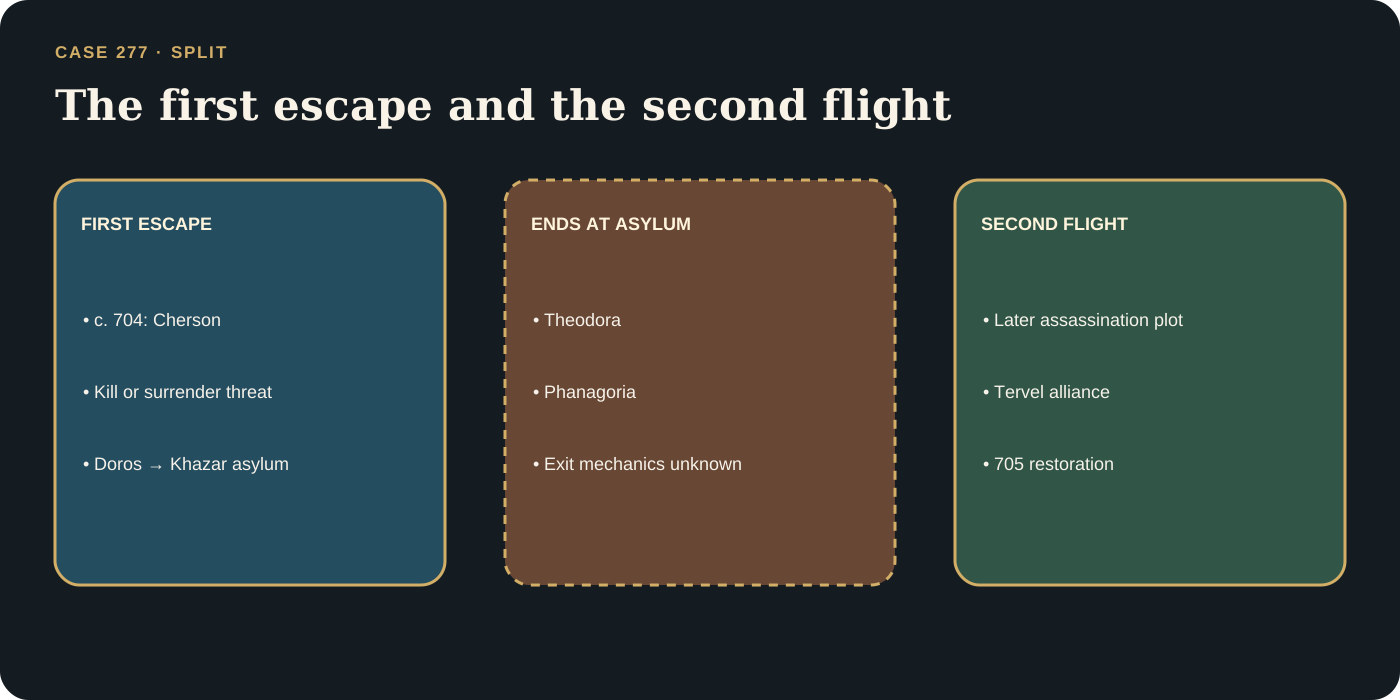
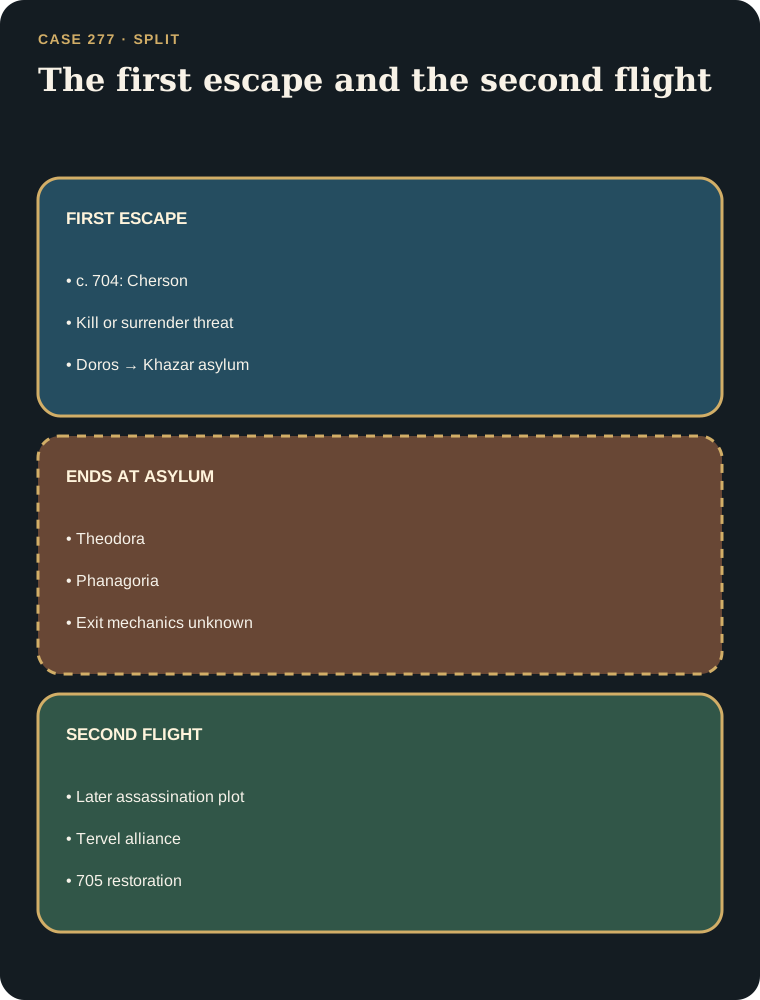
The first escape ends with Khazar asylum; the later flight and restoration belong to the aftermath.