Shivaji’s Escape from Agra: Reconstructing the 1666 Breakout
In August 1666, Shivaji vanished from Mughal custody in Agra. The disappearance was embarrassing enough that imperial officials immediately tried to seal roads and river crossings, question suspects and determine how one of the most closely watched political prisoners in northern India had escaped. The famous explanation is ingenious.
Shivaji, the story goes, pretended to be ill. He established a routine of sending large baskets of sweets and gifts out to holy men and others. Guards inspected them at first, then gradually became accustomed to the traffic. When the moment came, Shivaji and his young son Sambhaji concealed themselves inside large baskets and were carried through the cordon. A trusted follower remained in Shivaji’s bed so that anyone glancing in would still see what looked like the prisoner.
It is one of the best-known escape stories in Indian history. It is also more difficult to prove in every detail than the usual version suggests.
Contemporary correspondence establishes the confinement, the extraordinary guard arrangements, the disappearance, the delayed alarm and the Mughal response. Early narrative traditions preserve the basket trick. Later historians combined those sources into the familiar sequence.
The escape is real. The challenge is determining exactly how much of the mechanism can be reconstructed with confidence.
The Story Starts at Agra Fort—but the Escape Does Not
Shivaji arrived at Agra in 1666 after the Treaty of Purandar had temporarily reshaped his relationship with the Mughal Empire. The Mughal commander Mirza Raja Jai Singh had persuaded him to visit Emperor Aurangzeb.
Shivaji did not travel alone. His young son Sambhaji accompanied him, along with officers, servants and a substantial escort.
On 12 May 1666, Shivaji appeared before Aurangzeb at Agra Fort during a major court ceremony connected with the emperor’s fiftieth lunar birthday. The meeting went badly.
The exact emotional and ceremonial details vary by source, but the broad sequence is clear: Shivaji believed the position assigned to him in the imperial hierarchy represented an unacceptable slight. His visible protest violated the expected discipline of the Mughal court. He was removed from the audience.
Afterward his freedom narrowed. This is where popular shorthand often creates a false picture. Shivaji had appeared at Agra Fort, but the confinement from which he later escaped was not a cell inside that fortress.
Jadunath Sarkar’s reconstruction places him at Jaipur House, associated with Kunwar Ram Singh, outside the city walls. Modern historian John F. Richards likewise describes him as being under house arrest at Ram Singh’s mansion.
That changes the escape problem. There were no prison bars to saw through. There was a residence to leave without the people surrounding it realizing that their prisoner had gone.
A Prison Made of Watchers
House arrest did not mean weak custody. Shivaji could not simply walk away.
Ram Singh had become responsible for his security. Mughal officials also placed their own men around the residence. Later Rajasthani correspondence describes overlapping guard arrangements involving Ram Singh’s personnel, watchmen and imperial forces.
The exact diagram of those guards should not be treated as permanently fixed for every day of the confinement. What matters is the larger point:
Shivaji was being watched by more than one authority.
That created strength and weakness at the same time. Multiple guard groups could make escape more difficult. They could also make responsibility less clear. Who had inspected a visitor?
Who had checked a servant? Who controlled an outgoing delivery? Who was certain Shivaji was actually inside? A complex surveillance system is only as strong as the assumptions shared by the people operating it.
The escape appears to have attacked those assumptions.
Reduce the Number of People Who Have to Escape
One of Shivaji’s most important moves did not look like preparation for flight. He sought permission for much of his Maratha retinue to return to the Deccan.
From the Mughal perspective, allowing his followers to leave could make the prisoner easier to control. Fewer armed or loyal men around Shivaji meant fewer people capable of helping him resist.
From Shivaji’s perspective, it removed a major problem. A mass escape would have been almost impossible. A small one might work. By the time the decisive plan was attempted, the challenge had become much narrower: get Shivaji out, protect Sambhaji, create enough delay to prevent immediate pursuit, and reconnect with trusted people beyond Agra.
Illness as Cover
The established narrative says Shivaji began to present himself as ill. That served more than one purpose. A sick prisoner was expected to spend long periods in bed. Reduced movement was normal rather than suspicious.
Visitors, physicians, food and charitable offerings could also fit the performance. This is the setting in which the famous baskets appear.
According to the standard reconstruction, Shivaji began sending out gifts or sweetmeats for Brahmans, religious mendicants and other recipients. Large containers passed through the residence repeatedly.
The guards checked them. Nothing happened. The baskets came again. Still nothing.
Repeated harmless traffic can become invisible. Eventually, the story says, inspections became less rigorous. If that sequence is substantially correct, the ingenuity was not simply hiding in a basket. It was training the guards not to care about the basket.
Escape sequence
What the evidence can—and cannot—show
The diagram separates the Agra Fort audience from guarded residence, and labels the basket mechanism as a disputed but historically important tradition.
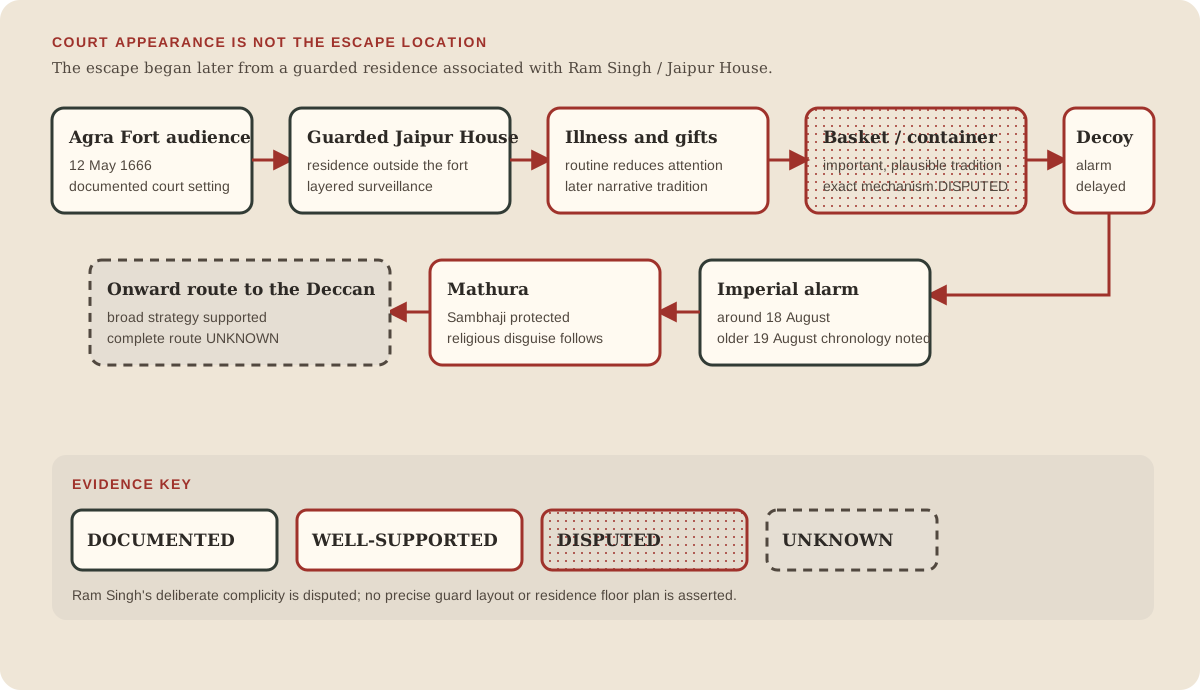
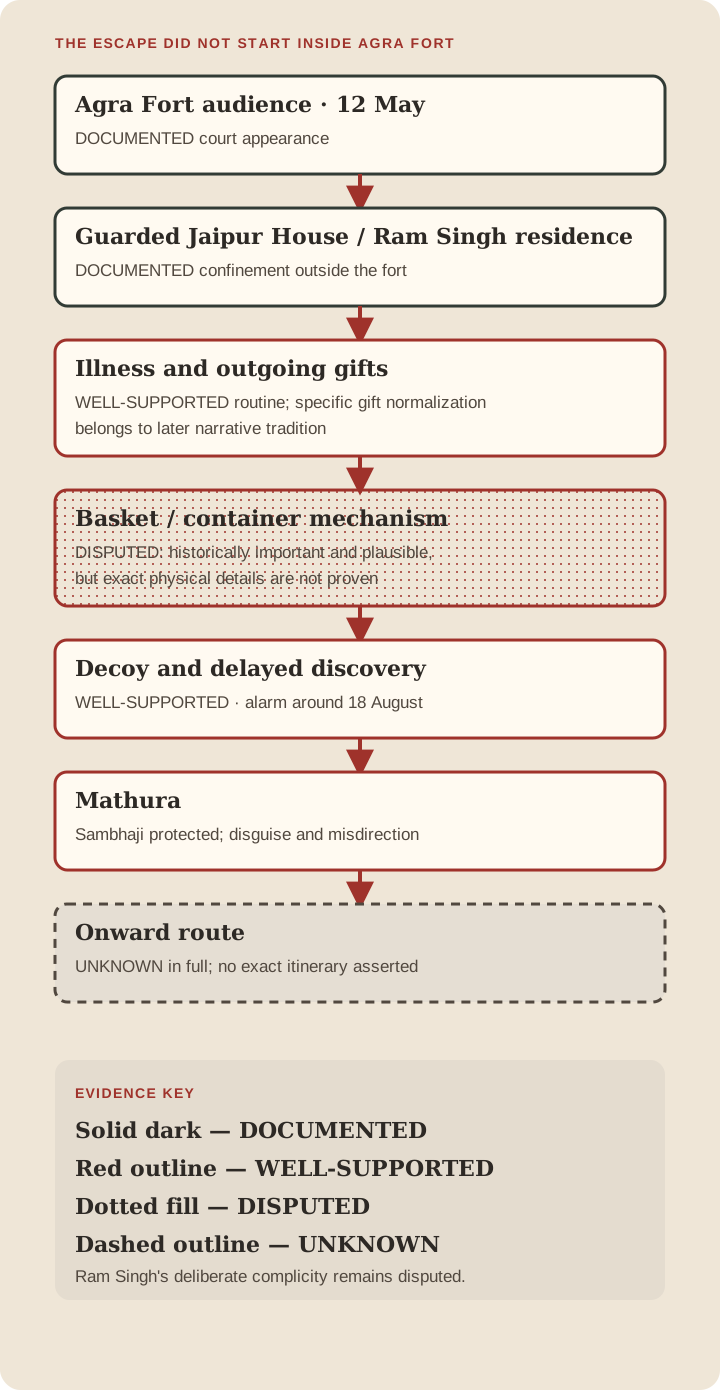
- 01
Court
Shivaji appeared at Agra Fort on 12 May; this was not the later escape site.
- 02
Custody
He was held at guarded residence associated with Ram Singh.
- 03
Routine
Retinue reduction, illness and outgoing gifts helped create opportunity.
- 04
Mechanism
The basket or container story is plausible and historically rooted, but its exact form is disputed.
- 05
Head start
A decoy delayed discovery before Mathura and an uncertain onward route.
Simplified evidence-conscious diagram; not to scale. It does not invent a Jaipur House floor plan, precise guard circles or a settled route from Mathura to the Deccan.
How Certain Is the Basket Story?
The evidence separates three different things.
The escape itself
Strongly established.
Contemporary correspondence and Mughal administrative reaction leave no serious question that Shivaji disappeared from guarded custody.
The deception and delayed discovery
Well-supported.
The authorities did not instantly know he was gone. Reports and later reconstructions preserve the idea that someone or something inside the residence continued to make guards believe Shivaji remained in bed.
Shivaji and Sambhaji physically leaving inside sweet baskets
Strong historical tradition, but not proven at the same documentary level.
Jadunath Sarkar’s influential reconstruction states that Shivaji and Sambhaji crouched in two large baskets among genuine loads of sweets. Marathi narrative traditions also preserve container-based escape stories. The problem is not that the basket story appeared centuries later from nowhere. The problem is that the closest surviving administrative correspondence does not give us a complete inspection report saying precisely which baskets carried which people through which gate.
Modern scholarship therefore sometimes describes the exit more cautiously. John F. Richards, for example, allows the possibility of bribery or connivance and simply says Shivaji contrived to slip out of the mansion.
The responsible conclusion is not:
“The baskets are fake.”
Nor is it:
“Every basket detail is documented fact.”
It is:
The basket escape is an old and plausible reconstruction, but its physical choreography is less certain than the disappearance itself.
The Man in Shivaji’s Bed
The classic version required one more deception. If guards could see that the bed was empty, the escape would fail quickly.
Sarkar identifies the man left behind as Hiraji Farzand, who resembled Shivaji sufficiently to serve as a decoy. The sleeper remained mostly covered while Shivaji’s gold wrist ornament stayed visible.
That small visible signal mattered. A guard did not need to see Shivaji’s face. He needed to see what he expected to see. A sick man.
A covered body. The familiar ornament. Nothing requiring immediate investigation. The deception reportedly continued into the next day.
Then the residence became too quiet. The supposed patient eventually disappeared. The guards entered. Shivaji was gone.
The decoy episode has more support than many picturesque escape anecdotes because scholarly discussion of Mughal information reporting also preserves the initial conflict between warnings that Shivaji had escaped and guards who believed he was still present. The exact staging remains reconstructed. The basic idea of delayed discovery is much stronger.
When Did He Actually Leave?
Even the date carries a source problem. Older histories frequently place the escape on 19 August 1666.
Later scholarship drawing on Rajasthani records from the Jaipur State Archives moved the chronology earlier. In that reconstruction, Shivaji left on 17 August, and his escape became known to authorities on the morning of 18 August.
An 18 August Rajasthani report describes the alarm and the need to watch crossings and investigate men travelling in religious disguise. Because seventeenth-century calendars, later translations and the difference between the moment of departure and the moment of discovery can all create confusion, The evidence is best summarized this way: Shivaji escaped in mid-August 1666, probably on 17 August, with the alarm spreading on 18 August. The difference of a day or two changes none of the operational logic.
But it matters if the goal is reconstruction rather than legend.

A Head Start
Once the absence was confirmed, the Mughal response was immediate. Roads and river crossings mattered. So did disguise. Orders warned officials to be alert for suspicious travellers, including men dressed as religious ascetics.
This tells us something important even if we cannot reconstruct every mile. The escape did not end when Shivaji left the residence. It only changed form. Inside Agra, the problem had been surveillance.
Outside Agra, the problem was identification. The Mughal state possessed roads, couriers, local officials and information networks capable of spreading a description of a fugitive far beyond the city. Shivaji needed his initial delay to become distance.
Mathura
The standard reconstruction takes Shivaji and Sambhaji first toward Mathura, rather than directly south-west toward the Deccan. That choice makes strategic sense. The obvious pursuit route would point toward Shivaji’s own country. Moving in another direction complicated the search.
At Mathura, according to the established historical narrative, Sambhaji was left temporarily with trusted Deccani Brahmans. The boy was young and the journey ahead promised to be exhausting and dangerous.
Shivaji continued under disguise. Sambhaji’s separation also created another layer of uncertainty for Mughal searchers. Were father and son together? Had they split?
Was the child still somewhere nearby? The more questions the pursuers had to answer, the more routes they had to cover.
The Ascetic Disguise
Sources repeatedly associate Shivaji’s flight with religious disguise. The Rajasthani warning after the disappearance specifically shows Mughal authorities concerned that a fugitive might pass in the appearance of a jogi or sannyasi. Later accounts describe shaved facial hair, ashes and changing forms of religious dress. The broad disguise strategy is well-supported.
The precise costumes should be handled more carefully. There is no reason to turn every later detail into a costume inventory. What mattered was social invisibility. A famous ruler surrounded by officers and cavalry was easy to identify.
A small group of itinerant religious men moving among the enormous flows of seventeenth-century India was a different problem.
Did Ram Singh Help?
The escape created a political crisis for Kunwar Ram Singh. He had been tied to Shivaji’s custody. His father, Jai Singh, had helped persuade Shivaji to come to the Mughal court and had pledged for his safety. After Shivaji vanished, Aurangzeb had obvious reasons to suspect the Rajput prince.
Ram Singh was punished. That does not prove he deliberately opened the door. Some captured Maratha associates were said to implicate him, but such statements cannot be separated from the coercive circumstances of seventeenth-century interrogation. Jai Singh strongly denied betrayal.
Modern historian John F. Richards regards connivance by Ram Singh—or bribery of guards—as possible.
The best answer is therefore unsatisfying but historically sound:
Ram Singh may have helped, tolerated, or failed to prevent the escape. The surviving evidence does not establish deliberate complicity beyond dispute.
The Long Way Home
Sarkar’s classic narrative sends Shivaji on an enormous eastward arc through places including Allahabad, Benares, Gaya and Puri before turning back toward the Deccan. Some parts of that route may preserve genuine memory. Other individual episodes belong to chronicle traditions written at varying distances from the event. The evidence supports a strategic rather than cartographic reconstruction.
Shivaji did not simply race down the most obvious road from Agra to Maharashtra. He used disguise. He separated from Sambhaji for part of the journey. He moved in ways designed to defeat the Mughal search.
He ultimately returned to his own territory. A precise colored line across India would imply more route certainty than the surviving evidence allows. A route with uncertain legs should look uncertain.
Problem → response
Escape was a sequence of problems
Each response solved a practical obstacle while often creating the next one.
- 01→
Obstacle
Layered guard cordon
Shivaji's residence was watched by personnel connected with both Ram Singh and Mughal authorities.
Response
The escape relied on deception and routine rather than force.
- 02→
Obstacle
Large retinue
A large body of followers would be difficult to conceal or move.
Response
Many followers and troops were permitted to return south before the escape.
- 03→
Obstacle
Need for delayed discovery
Immediate confirmation of an empty room would have triggered pursuit before Shivaji gained distance.
Response
A bed decoy and illness routine reportedly maintained the appearance that he remained inside.
- 04→
Obstacle
Imperial pursuit network
Mughal couriers could alert officials, road guards and crossing points over a wide area.
Response
The fugitives used disguise, separation and an indirect route rather than the obvious road to the Deccan.
- 05→
Obstacle
Travelling with a child
Sambhaji could not necessarily sustain the same pace or risk as adult fugitives.
Response
The standard reconstruction places him temporarily with trusted Brahmans at Mathura.
Why Aurangzeb’s Search Failed
No single failure explains the escape. The Mughal system had enough manpower to surround the residence. It had a police chief. It had imperial troops.
It had Ram Singh’s men. It had couriers who could alert distant officials. Yet the system still depended on human judgment. If the basket tradition is substantially accurate, guards became accustomed to harmless outgoing traffic.
If the decoy account is substantially accurate, observers saw a familiar wrist ornament and concluded their prisoner was still in bed. If bribery or connivance played a role, the numerical strength of the cordon mattered even less. Then came delay. A prisoner can be watched by hundreds of men and still escape if everyone believes someone else has verified the one fact that matters:
Is he actually still here?
Evidence discipline
What the record supports
Status labels distinguish secure conclusions from uncertainty and rejected claims. Color is never the only signal.
MYTH
Shivaji escaped from inside Agra Fort.
He attended Aurangzeb's court at Agra Fort, but the confinement from which he escaped was at a guarded residence associated with Ram Singh, commonly identified as Jaipur House.
Sources: SRC-001, SRC-003DISPUTED
Shivaji definitely escaped on 19 August 1666.
Older Sarkar editions give 19 August. Later Rajasthani-record scholarship favors departure on 17 August with discovery and alarm on 18 August.
Sources: SRC-001, SRC-002, SRC-007DISPUTED
Shivaji and Sambhaji left the guarded residence inside two sweet baskets exactly as popularly depicted.
The basket narrative has old and strong historical roots, and Sarkar reconstructs it, but surviving contemporary administrative material does not independently establish every physical detail. Modern scholarship also allows other mechanisms such as bribery or connivance.
Sources: SRC-001, SRC-002, SRC-003, SRC-004WELL-SUPPORTED
A decoy helped delay discovery by appearing to be Shivaji in bed.
Sarkar identifies Hiraji Farzand and the visible wrist ornament. Academic discussion of Mughal intelligence reporting independently preserves the initial belief that Shivaji was still inside.
Sources: SRC-001, SRC-006DISPUTED
Ram Singh deliberately enabled the escape.
Aurangzeb suspected and punished Ram Singh, and modern scholarship allows connivance as a possibility. Jai Singh denied betrayal, and deliberate assistance is not proven beyond dispute.
Sources: SRC-001, SRC-002, SRC-003UNKNOWN
Shivaji's complete route from Agra to the Deccan is known precisely.
Sarkar reconstructs a long eastward loop, but individual legs and adventures derive from sources of varying reliability. Mathura and the broad use of disguise are much stronger than every later itinerary detail.
Sources: SRC-001, SRC-003, SRC-004What We Know—and What We Do Not
Documented or strongly established
- Shivaji went to Aurangzeb’s court at Agra in 1666.
- The major audience occurred on 12 May.
- He was thereafter kept under guarded confinement.
- The confinement from which he escaped was associated with Ram Singh’s residence, not a dungeon inside Agra Fort.
- Shivaji disappeared in mid-August.
- Mughal authorities did not immediately prevent the escape.
- A serious search followed.
- Ram Singh came under suspicion and was punished.
- Shivaji evaded capture and eventually returned to the Deccan.
Well-supported
- Shivaji used illness as part of the deception.
- Discovery was delayed by a bed/decoy arrangement.
- Religious disguise formed part of the evasion.
- Mathura was an early stage in the flight.
- Sambhaji was protected separately for part of the journey.
Strong tradition, but not equally documented
- Shivaji and Sambhaji left the guarded residence inside separate sweet baskets.
- The guards had been deliberately conditioned through repeated charitable shipments to stop inspecting the containers closely.
- Hiraji Farzand performed every detail of the famous wristlet decoy exactly as later reconstructed.
Uncertain
- the exact escape hour;
- every layer and position of the guards at that precise moment;
- the exact basket design;
- whether Ram Singh knowingly assisted;
- whether individual guards were bribed;
- Shivaji’s exact route after Mathura;
- many of the colorful adventures later attached to the journey.
The Real Escape Is Better Than the Legend
Removing uncertain details does not make Shivaji’s escape less impressive. It makes the real problem clearer. He was not trapped by one wall. He was trapped by an information system.
His movements were watched. His host was responsible for him. Imperial and local guards surrounded the residence. The obvious roads home could be watched as soon as the alarm spread.
The escape therefore depended on making the surveillance system report the wrong reality for long enough. Whether the decisive exit was literally inside two sweet baskets or involved some additional bribery and cooperation, the result was the same: By the time Mughal officials accepted that the man in their custody was no longer there, Shivaji had turned a guarded house into an empty shell—and the search had already begun too late.
Selected chronology
Court appearance, custody and disappearance
Treaty of Purandar
The treaty reshapes Mughal-Maratha relations and provides the political background to Shivaji's later journey to court.
Shivaji appears before Aurangzeb
The court audience at Agra Fort deteriorates after Shivaji objects to his treatment and position in the ceremonial hierarchy.
Guarded confinement
Shivaji is kept under guard in a residence associated with Ram Singh, rather than imprisoned inside Agra Fort itself.
Escape preparations develop
Shivaji reduces his retinue and, according to the established narrative, feigns illness and normalizes outgoing charitable distributions.
Shivaji leaves Mughal custody
Later reconstruction from contemporary Rajasthani records places the departure on 17 August. The precise physical exit mechanism remains partly uncertain.
The alarm spreads
Rajasthani correspondence reports Shivaji's flight and urges closure of crossings and scrutiny of travellers in religious disguise.
Return to the Deccan
After evading Mughal pursuit, Shivaji ultimately returns safely to his own territory.