Wen Tianxiang’s first escape from Yuan custody in 1276 is unusually well documented because Wen himself wrote about it almost immediately afterward. He had gone to the Mongol commander Bayan’s camp as a Southern Song negotiator while the dynasty’s capital, Lin’an, was collapsing. The meeting did not end as an ordinary diplomatic exchange. Wen later wrote that he was prevented from returning, kept under guard, and then compelled to travel north with a Song delegation even though he was not treated as one of its regular envoys.
At Zhenjiang—then Jingkou—he escaped. That wording matters. Wen was under Yuan military and diplomatic custody, but he was not breaking out of a conventional prison cell. The successful plan depended on deception, sympathetic helpers, an improvised night route through an occupied city, a secretly arranged boat, and the good fortune of passing patrols without being stopped.
From Negotiator to Detainee
By early 1276 the Southern Song state was in crisis. Yuan armies had reached the approaches to Lin’an, and key Song officials were divided between continued resistance, negotiation, and flight.
Wen Tianxiang had already built a reputation as an advocate of resistance. In the final emergency he was appointed to high office and sent to meet Bayan, commander of the Yuan forces.
Wen’s own Guide Record describes the decision as a calculated risk. Previous Song envoys had generally been allowed to return, and he hoped to learn Yuan intentions while arguing for the dynasty’s position.
Instead, the negotiations broke down. In his later account, Wen says he was “held and unable to return.” He describes Yuan personnel assigned as escorts or hosts, with soldiers surrounding his lodging at night. Soon afterward he was driven north with Jia Yuqing and other Song officials, but Wen emphasizes that he was not formally listed as one of their envoys.
The History of Song gives the same essential sequence: Bayan detained Wen and sent him northward with other senior Song officials. The case therefore begins as diplomatic detention under military control, not ordinary criminal imprisonment.
Why Zhenjiang Became the Escape Point
Wen did not wait until Zhenjiang to think about escape. His own poem-headings and prose notes say he had looked for opportunities earlier but failed to find a workable opening. By the time the group reached Zhenjiang, he was actively trying to get back into Song-held territory.
The local geography made that possible but dangerous. Zhenjiang sat on the lower Yangtze near the routes toward Guazhou and the Huai region. Yuan vessels and troops were present throughout the area. Wen’s later notes describe waterways filled with northern ships, night movement restricted in the occupied town, and military guards attached to the detained Song officials.
His target was Zhenzhou, a Song-held position across the river system to the northwest. Wen’s retainer Du Hu and an officer named Yu Yuanqing became central to the plan.
Ten Days Looking for a Boat
The most difficult logistical problem was not getting out of a building. It was finding transport.
Wen’s own notes say Du Hu sounded out people around Zhenjiang, looking for anyone willing to help. Prospective helpers were sympathetic but repeatedly concluded that escape was impossible because they had no boat.
Eventually Yu Yuanqing encountered an acquaintance connected with one of the vessels operating under Yuan control. Wen’s account presents the man as willing to assist the Song chancellor and interested more in documentary proof of his service than immediate money.
The negotiations over reward and recognition survive in unusually granular form. They are evidence of how Wen remembered the escape and of the risks his helpers believed they were taking, but they are not necessary to reproduce as a reusable operational template.
The important point is that the boat was not simply waiting for him. Securing it took days of covert preparation. Wen says the opportunity finally came on the twenty-ninth day of the second lunar month.
Creating an Extra Night
That day, other detained Song officials were being moved across toward Guazhou. Wen needed to avoid leaving with them. He later wrote that he used an excuse to delay his own crossing until the following day, taking advantage of the fact that Yuan guards did not immediately suspect an escape.
That deception bought one night. It also made the plan extremely fragile. If the guards had insisted on immediate movement, or if anyone involved had exposed the arrangements, there would have been no second attempt. Wen’s own writings repeatedly stress that he expected discovery to mean death.
The Night Party of Twelve
Wen’s account states explicitly that twelve people escaped that night. Later histories sometimes phrase this as Wen, Du Hu, “and twelve others,” creating the impression of a larger party. The History of Song and the poem-notes are better read together: the escape group numbered twelve in total.
The group could not simply walk out together. Wen’s notes describe people being positioned in advance, an older local soldier who knew less obvious streets, and last-minute confusion when that guide became drunk and his wife nearly raised an alarm. Du Hu managed the crisis and kept the plan moving.
Wen also describes changing his appearance before moving through the streets. A small official lamp and escort arrangement helped the party pass through the night restrictions. The account says that a young attendant associated with the patrol system accompanied them part of the way, making the group appear legitimate enough that checkpoints did not immediately challenge them.
The sequence is striking because it was based less on force than on social recognition. They escaped by looking momentarily like people who were allowed to be moving.
Past the Guarded Streets
Getting through Zhenjiang did not mean getting through the entire cordon. Wen’s notes describe another guarded point near the edge of the occupied area. Horses blocked or narrowed the route, and the escapees feared discovery. The Yuan soldiers there were asleep, allowing the party to pass without a fight.
There was still no certainty that the boat would be where it was supposed to be. When Wen reached the riverbank, the agreed vessel was missing. Yu Yuanqing went into the water and searched along the bank until the boat was found and brought back. Only then did the escape shift from an urban evasion to a river flight.
Through the Yuan Shipping
The river was not empty. Wen wrote that Yuan-controlled ships extended along the banks for a considerable distance. His small vessel had to pass them rather than simply avoiding the occupied waterway.
At one point a patrol challenged the boat. The boatmen answered that it was a puffer-fish boat. The patrol apparently suspected trouble and tried to intercept.
Then the pursuing vessel grounded in the falling tide. Wen and his companions continued.
The scene is one of the most famous moments in his own escape record. Unlike later heroic anecdotes, it comes from Wen’s near-contemporary first-person notes. Even so, it remains one participant’s reconstruction, written to memorialize an ordeal he interpreted through loyalty, fate, and divine favor.
Arrival at Zhenzhou
The fugitives reached Zhenzhou around the beginning of the third lunar month. Miao Zaicheng, the Song commander there, initially received Wen warmly. The History of Song and later chronological histories describe Miao weeping with relief and discussing plans to coordinate Song forces along the Huai and Yangtze.
Wen believed he had returned to territory from which resistance might still be organized. Then the political situation turned against him.
A rumor had reached Li Tingzhi, the powerful Song commander at Yangzhou, that the Yuan had secretly sent a chancellor into Zhenzhou to persuade defenders to surrender. Because Wen had just come out of Yuan custody, Li suspected that he might be that agent.
Orders went out against him. Miao Zaicheng did not kill Wen, but he could no longer safely keep him inside the city. Wen was pushed back into uncertainty, this time hunted or mistrusted by both sides.
An Escape That Did Not End at the River
The night flight from Zhenjiang is the cleanest boundary for this case, but Wen’s return to active Song resistance took much longer. His own Guide Record traces the next stage through the Yangzhou, Gaoyou, Taizhou, and Tongzhou region. He traveled under an assumed identity, hid from patrols, went hungry, relied on local helpers, and repeatedly came close to capture.
Eventually he obtained passage by sea and reached Wenzhou. There he rejoined the surviving Song political network around the imperial princes. Wen resumed resistance to the Yuan and remained one of its most prominent leaders until he was captured again in 1278.
The second capture ended very differently. Wen was taken to the Yuan capital and imprisoned for years before his execution in 1283. That later martyrdom has often overshadowed the earlier escape.
What Wen’s Own Record Can—and Cannot—Tell Us
This case has a major advantage over many medieval escapes: the escapee himself left a detailed narrative close to the event. The Guide Record and its postface are therefore the controlling sources for planning, detention conditions, the twelve-person party, the night movement, the boat, the river patrol, and the desperate continuation south.
They are not neutral documents. Wen wrote to explain his conduct during the collapse of his dynasty and to preserve evidence of his loyalty. His prose and poems frame the journey as a succession of near-deaths survived for the sake of returning to the Song cause. Providential language appears repeatedly.
The official History of Song, compiled under the Yuan, independently preserves the core structure: Bayan detained Wen, he was sent north, and he escaped at Zhenjiang with Du Hu and a twelve-person party before reaching Zhenzhou. That agreement makes the basic escape unusually secure. The finest details—precise dialogue, motives of anonymous helpers, and moments Wen interpreted as heavenly assistance—remain best treated as his testimony rather than external fact.
Captivity, Not a Conventional Prison Break
The phrase “escape from Mongol custody” is broadly accurate. It is more precise, however, to describe Wen as escaping Yuan military and diplomatic custody. He had been detained during negotiations, guarded, compelled northward, and watched by Yuan personnel. At Zhenjiang he was lodged and supervised inside an occupied urban environment rather than confined behind the walls of a formal prison.
That distinction changes the character of the escape. Wen Tianxiang did not defeat a cell, tunnel under a wall, or overpower a jailer. He exploited delay, relationships, disguise, local knowledge, a covert boat, and mistakes or indifference inside a broad occupation-security system.
On the night of the twenty-ninth day of the second lunar month in 1276, twelve people left Zhenjiang under those conditions. By the next stage of the journey, Wen was back among Song forces—only to discover that surviving his enemy’s custody did not guarantee that his own side would trust him.
Evidence discipline
What the record supports
Status labels distinguish secure conclusions from uncertainty and rejected claims. Color is never the only signal.
MYTH
Wen Tianxiang escaped from a conventional Yuan prison cell in Zhenjiang.
The sources describe guarded diplomatic/military detention and supervised lodging, not a normal prison institution. The breakout was from custody inside an occupied city.
Sources: SRC-001, SRC-002, SRC-003MYTH
Wen escaped with twelve companions, making thirteen fugitives.
Wen’s own note states that twelve people escaped that night. The History of Song’s wording is best reconciled with a twelve-person total rather than twelve additional companions.
Sources: SRC-003, SRC-004MYTH
Wen’s boat simply crossed an unguarded river after he left the city.
His own notes describe Yuan vessels along the river and a patrol that challenged and tried to intercept the escape boat.
Sources: SRC-003MYTH
The escape narrative is known only from later patriotic legend.
Wen himself wrote detailed notes and a postface in 1276, very close to the events, and the early official History of Song independently preserves the core escape.
Sources: SRC-001, SRC-002, SRC-003, SRC-004UNKNOWN
Every detailed dialogue and providential interpretation in Wen’s escape notes is independently verified.
The first-person record is exceptionally valuable but self-authored. Fine dialogue, motives of unnamed helpers, and divine interpretation are testimony rather than externally corroborated facts.
Sources: SRC-001, SRC-003MYTH
Song authorities uniformly welcomed Wen once he escaped Yuan custody.
Miao Zaicheng initially welcomed him, but Li Tingzhi soon suspected he had been sent by the Yuan to induce surrender, creating a new danger.
Sources: SRC-004, SRC-005Evidence diagram
A twelve-person escape from Yuan custody
Wen’s own record preserves the twelve-person night escape without supporting a measured street or waterfront plan.
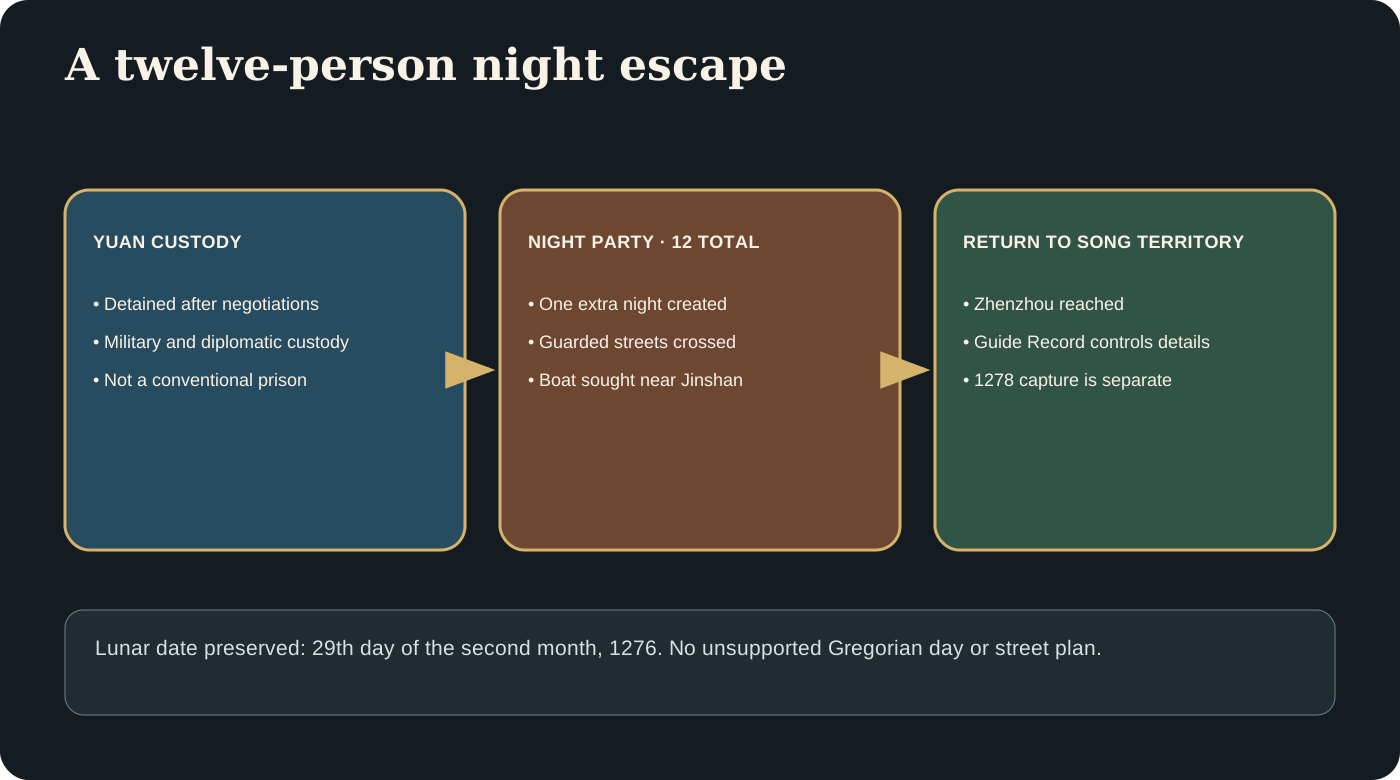
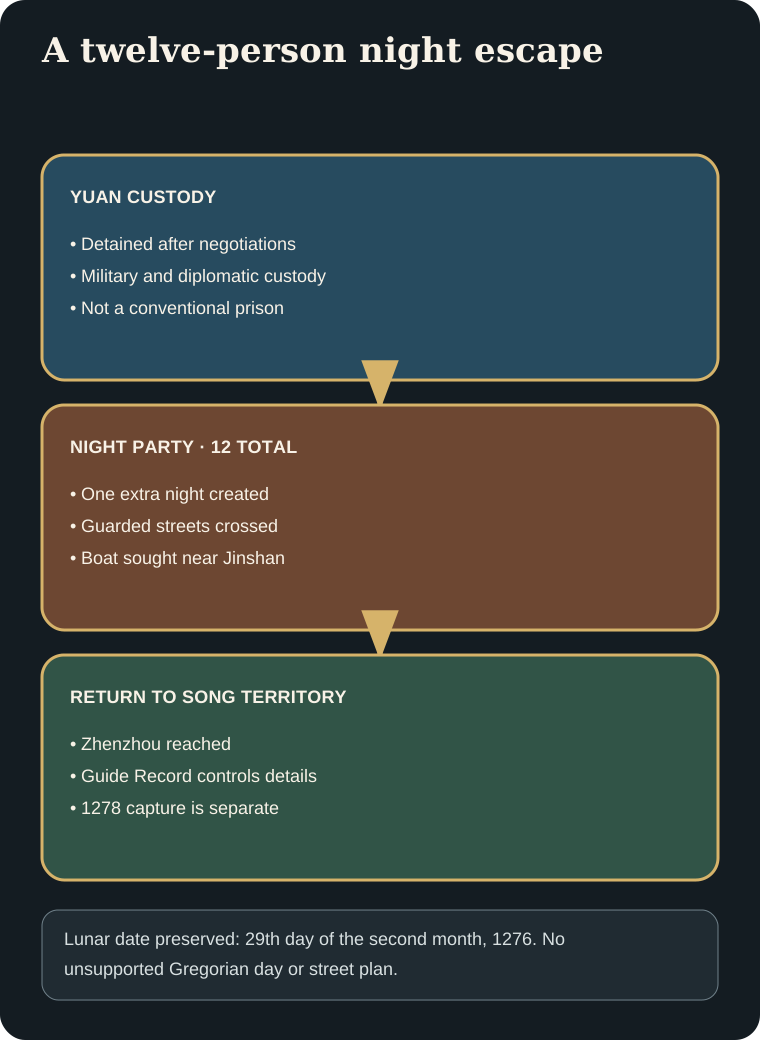
Wen’s own record preserves the twelve-person night escape without supporting a measured street or waterfront plan.