
On the night of 21–22 February 1619, Marie de’ Medici left the Château de Blois through a window in a pavilion that was still under construction. By the following day she was beyond the immediate reach of the household and guards assigned to watch her, moving toward allies who were prepared to protect a former queen and regent from her own son’s government.
The escape is often remembered as a rope-ladder descent from a high castle wall. Blois’s own modern historical interpretation is more cautious. The château says Marie used a window of the unfinished north-west pavilion and took advantage of incomplete earthworks; it explicitly calls the rope-ladder version a legend. The difference matters because the escape was less a solitary stunt than the opening move in a carefully supported political return.
At a Glance
- Escape: Night of 21–22 February 1619
- Escapee: Marie de’ Medici, queen mother of France
- Confinement: Political exile and guarded residence at the Château de Blois
- Escape site: Unfinished north-west pavilion of the château
- Primary external ally: Jean-Louis de Nogaret de La Valette, duc d’Épernon
- Secure route: Blois → Montrichard → Loches → Angoulême
- Immediate result: Marie escaped royal supervision and gained an independent political refuge
- Political settlement: Treaty of Angoulême, 30 April 1619
- Major myth: A 120-foot rope-ladder descent is not securely established
From Regent to Exile
Marie had once governed France. After Henri IV was assassinated in 1610, she served as regent for their young son Louis XIII. Her government relied heavily on Concino Concini, an Italian-born court favorite whose influence made him hated by many French nobles.
Louis eventually moved against the political structure surrounding his mother. In April 1617, Concini was killed during an attempted arrest ordered by the king’s government. Louis, now asserting personal rule with the help of Charles d’Albert de Luynes, removed Marie from power and sent her away from court.
Blois became her residence. Calling it simply a residence obscures the coercive element. The municipal archives of Blois refer to Marie’s two years there as captivity. Richelieu’s later memoir says she was eventually forbidden to leave Blois freely, that her promenades were restricted, and that access to her became controlled. She remained a queen mother with servants, money and rank, but she no longer controlled where she could go.
The Unfinished Pavilion
Marie changed the château while she was confined there. Soon after arriving, she began construction of a new pavilion in the north-west corner of the complex. That unfinished work later became part of the route by which she escaped.
The current Château royal de Blois describes the mechanism in unusually specific terms: on 22 February 1619, Marie left through a window in the pavilion under construction and used the unfinished earthworks outside it. That account differs from the famous rope-ladder story.
Richelieu’s memoir, written from the perspective of a man who later became one of the central political figures of the reign, says Marie had to use the night, windows rather than doors, and “a ladder” rather than stairs. He goes further and describes a descent of more than six score feet.
The modern château does not accept that picturesque version literally. Its own public history calls the rope ladder a legend.
The most defensible reconstruction therefore stops short of choosing an exact ladder, length or drop. Marie used the unfinished pavilion and left through a window; construction conditions outside made the escape possible. A ladder may belong to an early political tradition, but the dramatic 120-foot rope-ladder image cannot be treated as settled fact.
Selected chronology
Selected chronology
Marie loses power and is exiled
After Concino Concini is killed and Louis XIII asserts personal rule, Marie is removed from court and sent to Blois.
Restrictions tighten
Richelieu’s account records that Marie is forbidden to leave Blois freely, her walks are limited and access to her becomes controlled.
Escape from the Château de Blois
Marie leaves through the unfinished north-west pavilion and reaches supporters outside the château.
Marie writes from Loches
A contemporary letter later printed in 1619 places Marie at Loches one day after the escape.
Marie establishes refuge around Angoulême
Under d’Épernon’s protection, Marie develops an independent political base while negotiations with the king’s government begin.
Letter from Angoulême
Marie writes to the duc de Rohan from Angoulême in correspondence explicitly connected to her flight from Blois.
Treaty of Angoulême
The immediate crisis is settled through negotiated articles between Louis XIII and Marie; the settlement gives her the government of Anjou without restoring the regency.
Conflict resumes
The 1619 reconciliation proves temporary and mother and son again enter armed political conflict the following year.
Building an Escape Network
Leaving the château was only one part of the problem. Marie needed somewhere to go that Louis XIII’s government could not immediately compel to surrender her. That required the protection of a great noble with territory, troops and political standing.
The man who emerged as the best candidate was Jean-Louis de Nogaret de La Valette, duc d’Épernon. D’Épernon had served Henri III and Henri IV and remained one of the most powerful magnates in the kingdom. His government of Angoumois gave him a defensible political base far from Blois. Richelieu’s memoir says dissatisfied nobles considered several possible protectors before concluding that d’Épernon was the man best able to receive and defend the queen mother.
The preparation extended beyond him. Messengers carried information between Marie’s household and noble allies. Members of the La Valette family and trusted officers prepared to meet her along the route. Household servants and officers inside Blois also had roles. The precise participant list comes mostly from interested later narratives, so the broad network is more secure than every individual assignment.
D’Épernon’s Misdirection
D’Épernon did not simply ride to the castle gate. Richelieu describes an elaborate attempt to conceal his intentions. D’Épernon left Metz and moved in a way that made the royal court believe he was heading toward his own interests around Angoulême. Only later did he turn back toward Loches to meet Marie.
Whether every stage happened exactly as Richelieu narrates it is difficult to prove independently, but the larger point is convincing: the operation depended on keeping royal officials uncertain about where the queen would be received. D’Épernon’s son, then archbishop of Toulouse and later cardinal de La Valette, was part of the closer reception network. Other trusted agents moved toward Blois and the Loire valley. By the time Marie left the château, the escape had a destination and a protector.
The Night of 21–22 February
Night reduced the ability of guards and local officials to react. Marie crossed from the château’s controlled interior into the unfinished pavilion and out through a window. Beyond that point, the evidence becomes less exact. The site interpretation emphasizes earthworks; Richelieu gives a ladder and a formidable height.
He also supplies a detailed list of companions: one of Marie’s women, the comte de Brenne, two officers of her guards and a small group waiting with a carriage. Those names and numbers are useful evidence of organized help, but they are not sufficiently independent to turn into a precise diagram of who stood where.
The broad sequence is secure. Marie reached transport outside the immediate château perimeter and headed away from Blois.
Documentary reconstruction
The secure sequence and disputed details
A case-local visual focused on the spatial, mechanical or evidentiary relationship established by the surviving record.
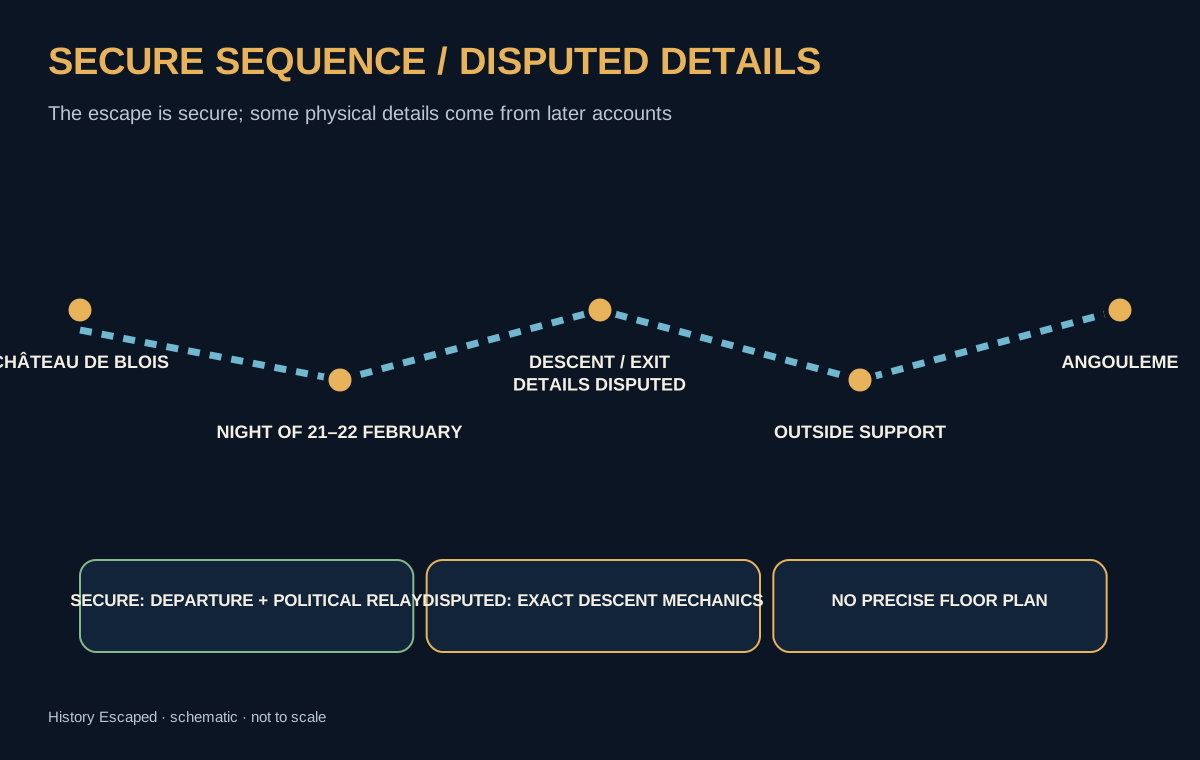
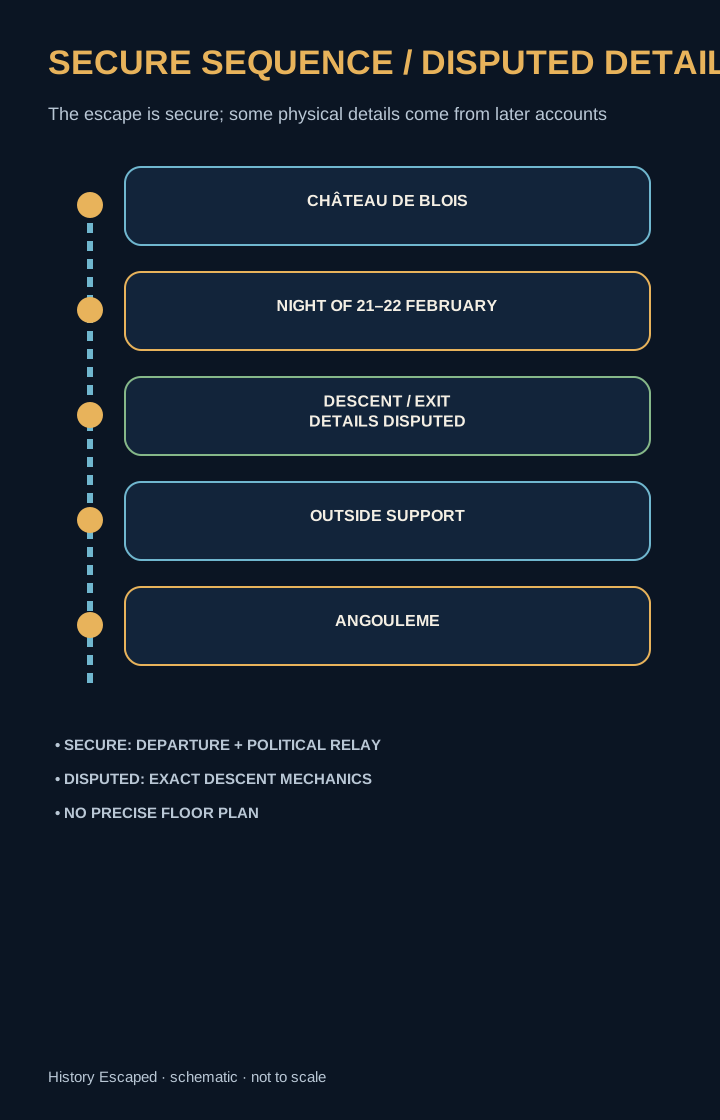
Simplified editorial reconstruction based on the cited historical record; not to scale. Uncertainty is stated directly in the visual and adjacent text.
Montrichard and Loches
The next stages turned escape into political protection. Richelieu’s account places Marie first at Montrichard, where she met the future cardinal de La Valette and a body of gentlemen. From there she continued toward Loches.
D’Épernon met her on that part of the route. The Folger Shakespeare Library preserves catalog records for a 1619 English translation of letters exchanged in the crisis. It includes Marie’s first letter to Louis XIII from Loches on 23 February 1619, only a day after the escape.
That letter matters because it anchors the route independently of later dramatic retellings. Marie was no longer merely missing from Blois. She was already speaking to the king from outside his immediate control and explaining her departure as a political act. The escape had succeeded at the level that mattered most.
Angoulême: Refuge Becomes a Political Base
From Loches, Marie’s faction moved toward d’Épernon’s sphere of power at Angoulême. By April there is direct documentary evidence for her presence there. The Bibliothèque nationale de France catalogs a letter from Marie to the duc de Rohan dated 10 April 1619 at Angoulême, written explicitly in the context of her flight from Blois.
She was no longer a supervised royal mother at the château. She now had her own political headquarters.
That transformation immediately raised the stakes. Nobles dissatisfied with Luynes and the king’s government could rally around her. Louis XIII could either force the confrontation or negotiate. The court chose negotiation before a larger war developed.
Where Richelieu Fits
Richelieu’s later prominence makes it tempting to put him at the center of every stage. He did not mastermind the physical escape.
The bishop of Luçon had been closely associated with Marie’s government before her fall, but he had also been removed from the center of power and was not the man placing carriages outside Blois or receiving her at Montrichard. His importance grew after she was free.
The royal government used him as an intermediary because he had Marie’s confidence and could communicate with her faction. By late March 1619 he was at Angoulême helping negotiate an accommodation between mother and son. That role mattered enormously to Richelieu’s own political recovery, but it belongs to the aftermath of the escape rather than its physical mechanics.
Evidence discipline
What the record supports
Status labels distinguish secure conclusions from uncertainty and rejected claims. Color is never the only signal.
MYTH
Marie de’ Medici was only a voluntary guest at Blois and could leave whenever she wished.
Blois institutions describe exile, surveillance and captivity, while Richelieu records explicit restrictions on leaving the town, walking and receiving visitors.
Sources: SRC-001, SRC-002, SRC-003MYTH
Marie certainly descended a 120-foot wall on a rope ladder.
The modern Château de Blois explicitly calls the rope-ladder story a legend and emphasizes the unfinished pavilion and earthworks. Richelieu’s later memoir mentions an unspecified ladder and a dramatic height, so exact descent geometry remains unverified.
Sources: SRC-001, SRC-003MYTH
Marie escaped without a prepared external support network.
D’Épernon’s involvement is confirmed by local archives and scholarship, while Richelieu describes a coordinated reception chain through Montrichard and Loches.
Sources: SRC-002, SRC-003, SRC-004MYTH
D’Épernon personally waited immediately outside the Château de Blois.
Richelieu places d’Épernon moving strategically toward Loches while closer agents and his son participated in the immediate reception chain.
Sources: SRC-003MYTH
Richelieu organized the physical extraction from Blois.
The escape network centered on Marie’s household and d’Épernon. Richelieu became important afterward as a mediator in the negotiations at Angoulême.
Sources: SRC-003, SRC-010MYTH
Marie went directly from Blois to Angoulême.
Richelieu’s route includes Montrichard and Loches, and contemporary printed correspondence independently places Marie at Loches on 23 February.
Sources: SRC-003, SRC-007MYTH
Rubens’s Flight from Blois is a documentary eyewitness reconstruction.
Rubens painted the work several years later in a monumental cycle commissioned by Marie. The Louvre explicitly characterizes the cycle as an idealized presentation of her own political story.
Sources: SRC-005, SRC-011The Treaty of Angoulême
Negotiations produced the Treaty of Angoulême on 30 April 1619. The agreement ended the immediate confrontation. Marie received the government of Anjou and a political position stronger than the one she had held under surveillance at Blois.
It did not restore the regency or reverse Louis XIII’s assumption of personal authority. The distinction is important. Marie escaped confinement and gained leverage, but she did not recover the political system that had existed before Concini’s death.
The settlement also proved temporary. Tensions between the queen mother’s faction and the king’s government resurfaced, leading to another armed crisis in 1620.
Escape had changed Marie’s bargaining position. It had not resolved the struggle over power.
The Painting That Made the Legend
Several years later, Marie commissioned Peter Paul Rubens to paint a monumental cycle of her life for the Luxembourg Palace. One canvas depicted the Flight from Blois.
It is a magnificent historical image and a poor piece of neutral documentary evidence. The Louvre explains that the entire cycle gave Marie an opportunity to tell her side of the story and stage an idealized image of her political life. Rubens combined historical scenes with allegory and mythological figures, transforming political reversals into episodes of royal destiny.
That makes the painting valuable precisely because it is partisan. It shows how Marie wanted the escape remembered.
The same caution applies to later images of a dramatic ladder descent. The physical mechanism was real enough: window, unfinished construction and an organized extraction. The most theatrical details became part of a political memory that Marie herself helped shape.
Why the Escape Worked
Marie’s success depended on three vulnerabilities in her confinement. First, Blois was a royal residence adapted to surveillance, not a purpose-built prison. The unfinished pavilion created a physical weak point.
Second, her royal rank meant she still possessed a household and channels of communication. Restriction had not severed every connection to the political world.
Third, d’Épernon could offer what a simple hiding place could not: protection backed by noble power, territory and armed followers. The escape therefore worked because the physical and political mechanisms reinforced each other. Getting out of the château created only temporary freedom. Reaching d’Épernon’s network converted that freedom into bargaining power. Within two months, the woman Louis XIII had confined at Blois was negotiating with him from Angoulême.