
The Dalai Lama’s Escape from Tibet: Fourteen Days from Lhasa to India in 1959
Shortly before ten o'clock on the night of 17 March 1959, the 14th Dalai Lama walked out of the Norbulingka Palace in Lhasa looking nothing like the figure Tibetans were accustomed to seeing. His monastic robes were gone. His glasses were off. Later accounts describe him in ordinary Tibetan clothing made to resemble a soldier or armed layman, with a rifle over his shoulder.
He was twenty-three years old.
Outside the palace, enormous crowds had gathered during a political crisis that had begun a week earlier. Chinese military positions stood around Lhasa. Tibetan resistance fighters and armed volunteers were active beyond the capital. Rumors, warnings and letters had created a situation in which every side believed the next move could be decisive.
The Dalai Lama's problem was therefore not simply to leave a palace. He had to disappear from one of the most politically watched places in Asia, cross rivers and high mountain passes, move through a country entering open warfare, keep a large accompanying party from being intercepted, and reach a border whose crossing would trigger an international crisis. Fourteen days later, on 31 March, he entered India.
He would never again live in Tibet.
Why Norbulingka became impossible to leave normally
The escape cannot be understood without the week before it.
On 10 March, the Dalai Lama was expected to attend a performance connected with Chinese military authorities in Lhasa. The circumstances of the invitation alarmed many Tibetans. Accounts associated with the Dalai Lama emphasize conditions that appeared to limit his normal bodyguard and ceremonial escort. Rumors spread that the invitation was a pretext to remove him from Tibetan control.
Tens of thousands of people gathered around Norbulingka to prevent him from leaving. That crowd was intended to protect him. It also created a trap.
As long as Norbulingka was surrounded by supporters, any normal departure by the Dalai Lama would attract immediate attention. Chinese officials knew where he was. Tibetan crowds watched the palace. Armed forces were deployed in and around Lhasa.
Meanwhile, the political crisis intensified.
Tibetan exile sources describe the events as a national uprising against Chinese rule. The People's Republic of China describes them as an armed rebellion led by reactionary elements of Tibet's old ruling class. Those interpretations remain fundamentally opposed.
For the escape reconstruction, the crucial point is narrower. By 17 March, the Dalai Lama was at the center of an armed political confrontation in which remaining visibly inside Norbulingka carried increasing risk.
The decision came late
Later memory can make the escape sound inevitable. It was not.
The Dalai Lama had spent the preceding days trying to reduce tension. Letters passed between him and Chinese officials. He later said he hoped to avoid armed conflict almost until the moment he left.
Even the precise artillery chronology is not perfectly clean.
His official chronology lists artillery shells falling outside Norbulingka before the final night. Jawaharlal Nehru, after speaking privately with the Dalai Lama in India, told Parliament that the Dalai Lama described shells fired near the palace on the afternoon of 17 March as the immediate event that forced a sudden decision. A contemporary CIA briefing similarly recorded that shells near the summer palace convinced him to leave.
The sources therefore agree on the basic development even if they do not align perfectly on the first shelling date:
the danger around Norbulingka had moved from political pressure toward direct military threat.
The plan had to become an escape plan.
The oracle, the shells and an operational decision
The Dalai Lama's own account gives religious divination an important place in the final decision.
On 17 March, the Nechung Oracle advised that he should leave. The Dalai Lama also performed a divination himself.
For him and his entourage, those religious acts were part of the decision-making process. A historical reconstruction does not need to decide whether divination possessed supernatural predictive power. It needs to record that the people making the decision believed it mattered.
At the same time, the military reasoning was concrete.
Artillery danger was increasing. Crowds around the palace could not protect Norbulingka from sustained attack. The Chinese authorities knew exactly where the Dalai Lama was supposed to be.
If he remained, the crisis could end with his capture or death. If he left, almost everything that happened next would be uncertain. They chose uncertainty.
The disguise removed the thing everyone was looking for
The Dalai Lama normally appeared in clothing that made him instantly identifiable. That had to disappear.
A few minutes before ten at night, he changed into ordinary clothing associated in later accounts with a Tibetan soldier or layman. He removed his glasses. A rifle was carried over his shoulder.
The disguise did not need to create a detailed false identity with forged papers. It needed to solve a shorter, more immediate problem.
Anyone watching the palace gates was looking for the Dalai Lama. They were not necessarily looking at every armed Tibetan man as though he might be the Dalai Lama.
The glasses mattered because he was known for wearing them. The clothes mattered because Tibet's religious and political leader did not normally leave his summer palace dressed as a common soldier. The rifle made the silhouette coherent.
For the first minutes of the escape, visual misclassification was enough.
The family did not leave as one royal procession
The entourage could not reproduce the visible structure of the Dalai Lama's normal court. The escape party therefore developed in stages.
Contemporary U.S. intelligence described members of his family slipping out separately before joining the wider group. His mother and siblings were among those who eventually moved south with him. Senior Tibetan officials and bodyguards joined as well.
This solved the same problem as the disguise at a larger scale. One disguised man might escape notice. A large ceremonial procession centered on that man would destroy the disguise instantly. The escape had to become a collection of ordinary-looking movements before it could become an organized traveling party.
Escape route
From Norbulingka to India
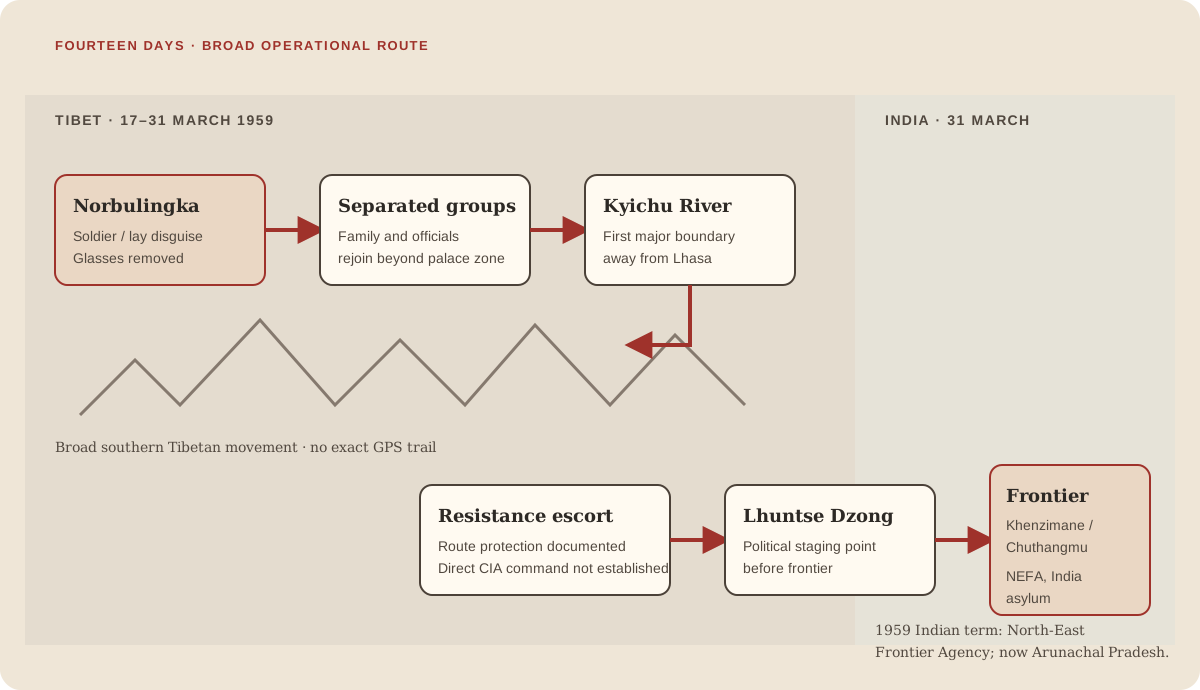
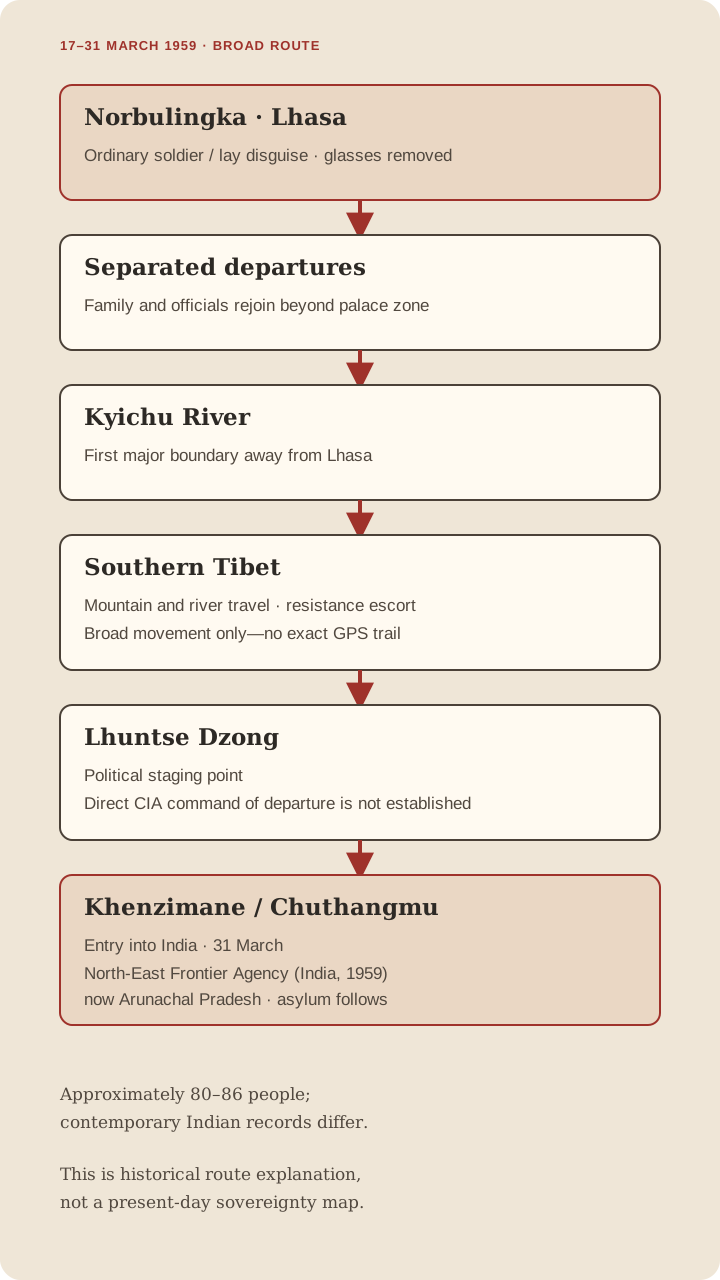
The route shows the operational sequence at a broad scale while keeping disputed palace movements, shelling chronology and modern border questions out of false precision.
- 01
Departure
The Dalai Lama left Norbulingka on 17 March in ordinary soldier or lay clothing.
- 02
Separated movement
Family and officials departed in smaller groups before rejoining.
- 03
South through Tibet
The party crossed the Kyichu and continued through difficult mountain and river terrain.
- 04
Escort and government
Tibetan resistance protected the route; Lhuntse Dzong became a political staging point.
- 05
India
The party entered near Khenzimane / Chuthangmu on 31 March and received asylum.
Simplified editorial route; not to scale. It shows broad historical stages rather than an exact palace-gate path, GPS trail or statement on present-day border claims. North-East Frontier Agency was the Indian administrative term in 1959; the area is now Arunachal Pradesh.
Leaving Norbulingka
The Dalai Lama passed out of the palace shortly before ten. His official biography says he moved through the crowd outside Norbulingka with a small escort and headed toward the Kyichu River.
Detailed later accounts describe a narrow margin between the party and nearby Chinese military positions. The group kept movement and light under control. The Dalai Lama had removed his glasses, which helped conceal his identity but made movement more difficult.
The palace behind him was still the center of the uprising. The road ahead had no guarantee of asylum. At this stage, success meant only one thing:
get far enough from Lhasa before the Chinese authorities fully understood that he was gone.
The Kyichu River was the first real boundary
The Kyichu was not an international frontier. Operationally, it was the first major boundary of the escape. Once the party crossed it, the Dalai Lama was farther from Norbulingka and closer to terrain where Tibetan armed supporters could provide greater protection.
Later accounts describe the river crossing using traditional craft. On the far side, separate groups reunited.
The recognizable religious leader could begin to reappear inside a guarded traveling party because the immediate task had changed. He no longer needed to fool everyone who saw him. Now the party needed to move faster than information and military pursuit.
The road south was not empty country
Maps can make the route look like a wilderness trek. It was not. Southern Tibet contained villages, local officials, armed resistance fighters, supply problems and military danger. The Dalai Lama's party was moving through territory in which Tibetan resistance forces had already established positions.
Chushi Gangdruk—often translated as “Four Rivers, Six Ranges”—had emerged as a major Tibetan resistance organization. Its fighters helped secure the route and escort the Dalai Lama. That assistance is central to the mechanics of the escape. It is also where the CIA question becomes complicated.
Evidence discipline
What the record supports
Status labels distinguish secure conclusions from uncertainty and rejected claims. Color is never the only signal.
DISPUTED
The Dalai Lama was abducted from Lhasa by Tibetan rebels.
Beijing initially made the claim, but the Dalai Lama, Nehru and contemporary CIA reporting describe a deliberate decision to flee. A later Chinese white paper says Beijing announced abduction as political leeway.
Sources: SRC-004, SRC-009, SRC-011, SRC-012UNKNOWN
The CIA planned and commanded the Norbulingka breakout.
CIA support to Tibetan resistance before the escape is documented, but available declassified records do not establish CIA operational command of the palace escape. Formal covert support to the Dalai Lama himself was approved after he reached India.
Sources: SRC-006, SRC-008, SRC-015, SRC-017MYTH
CIA-supported Tibetan resistance had no connection to the escape.
Chushi Gangdruk and other resistance fighters helped secure the route, and the broader resistance had already received CIA support. The exact CIA-linked communications role during the journey is less fully documented.
Sources: SRC-008, SRC-015, SRC-017DISPUTED
One exact party count is securely established.
Contemporary Indian administrative records give roughly 80 and 86. Use 'roughly eighty-plus' unless quoting a specific source.
Sources: SRC-010, SRC-013DISPUTED
The exact first artillery-shelling date near Norbulingka is uncontested.
The Dalai Lama's official chronology and Nehru/CIA accounts do not align perfectly on the first shelling date. All agree that artillery danger was part of the final crisis.
Sources: SRC-002, SRC-004, SRC-009DISPUTED
The 1959 uprising has one uncontested political interpretation.
Tibetan exile and Chinese government narratives fundamentally disagree. Operational escape facts can be distinguished from the competing political interpretations.
Sources: SRC-003, SRC-005, SRC-011, SRC-012, SRC-024What the CIA did—and what the evidence does not prove
There really was a CIA operation in Tibet. That is not a conspiracy theory.
Declassified U.S. records establish that the CIA was supporting Tibetan resistance before March 1959. Tibetan fighters received training, communications support and other covert assistance.
Later U.S. policy histories explicitly date high-level endorsement of covert support to Tibetan resistance to 1958.
That fact has encouraged a much larger claim:
the CIA planned the Dalai Lama's escape.
The available declassified record does not establish that.
Tibetan resistance forces helped secure and escort the route. Some later historical accounts describe CIA-trained radio operators transmitting information about the escape party's progress.
But the direct decision to leave Norbulingka, the disguise, the first movements out of Lhasa and the Tibetan escort structure are not documented as a CIA-designed extraction operation in the surviving unredacted official record. Another date matters.
Later U.S. policy records identify 20 May 1959 as the initial approval of covert support to the Dalai Lama himself.
By then he had been in India for weeks. The evidence therefore supports a careful middle position:
CIA-supported resistance networks formed part of the world through which the Dalai Lama escaped. That is not the same as proving that CIA officers planned and commanded his breakout from Lhasa.
Over the passes
The early stages carried the party away from Lhasa through high passes and toward the Yarlung Tsangpo river system. Detailed modern retellings identify the Che-La area as one of the first major mountain stages.
From high ground, the Dalai Lama could look back toward the Lhasa region. That backward view acquired enormous symbolic meaning later because he would not return.
For the party at the time, the mountain passes were practical obstacles.
Altitude slowed people and animals. Weather could close routes. Pack animals had to be managed. A party containing family members, officials, guards and supplies could not move like a small guerrilla patrol.
Every additional person helped preserve Tibetan political continuity. Every additional person also made the column harder to hide.
The escape was becoming a government on the move
At Lhuntse Dzong, the journey acquired a second function. The Dalai Lama was not simply a refugee trying to reach a border. He remained the head of a Tibetan political system whose capital was being overtaken by war. Tibetan exile sources describe his government as being reconstituted at Lhuntse Dzong and the Seventeen-Point Agreement being formally rejected there.
The political details were part of a rapidly changing situation and should be handled carefully. What matters for the escape is that the traveling party carried state authority with it.
Officials issued decisions. Messages moved outward.
The party was simultaneously:
- an escape convoy;
- a family group;
- an armed-protected column;
- and the surviving leadership of a Tibetan government.
That made interception more consequential than the capture of one individual.
What was happening in Lhasa behind them
The escape party could move south. Lhasa could not.
Open fighting erupted after the Dalai Lama's departure. Chinese military forces attacked Tibetan positions and suppressed the uprising. Norbulingka and other areas were shelled.
This is where source discipline becomes essential.
Tibetan exile institutions, Chinese government histories, U.S. intelligence and later scholars differ over responsibility, casualty totals and the political meaning of the uprising.
Some of the largest numbers repeated in public memory are politically charged and difficult to verify at the precision with which they are often stated. The documented stakes are severe enough without an inflated casualty figure:
serious fighting overtook Lhasa after the Dalai Lama had left, Chinese forces regained control, and Beijing dissolved the existing Tibetan government on 28 March.
The route south was no longer an emergency precaution. It had become an escape from a political order collapsing behind the convoy.
Approaching the frontier
By the final days of March, the party was moving through high country toward India.
Photographs preserved by Tibetan institutions show the Dalai Lama and members of the entourage during the journey. One archival sequence places the party near Karpo Pass on 28 March.
Those photographs are historically invaluable. Their publication rights are less straightforward.
Many are hosted by Tibetan institutions or appear on Wikimedia Commons under public-domain claims based on Indian or Chinese copyright duration. Several Commons pages themselves warn that U.S. copyright status has not been established.
For a monetized publication, “available online” is not the same as “cleared.” The safer visual strategy is to use such images as research references unless item-level global rights are confirmed.
India knew someone might be coming
The last phase required more than geography. India had to decide what to do. The frontier was then administered as part of the North-East Frontier Agency.
Indian authorities had already considered the possibility that the Dalai Lama might seek entry. Later Indian records reproduced in historical research describe instructions reaching frontier officials before his arrival.
An advance Tibetan party reached the Chuthangmu area before the main group.
On 31 March, Assistant Political Officer T. S. Murty was waiting.
One reproduced record places the main party's arrival at the frontier at about two in the afternoon. The Dalai Lama crossed near Khenzimane and proceeded toward Chuthangmu. The fourteen-day escape was over. The administrative problems began immediately.
Weapons had to stop being part of the escape
The Tibetans entered India as a political and refugee party whose route had been protected by armed men. Indian territory changed the rules.
Indian officials arranged porters and escorts. They also addressed the weapons carried by the party.
A reproduced Indian frontier record states that rifles and many handguns were to be surrendered for safekeeping, with limited exceptions pending further orders. That small administrative detail marks the transition between two phases of the story. Inside Tibet, weapons were part of the protection system. Inside India, the party was under the protection and authority of the Indian state.
The armed escape convoy became an asylum party.
How many people crossed with him?
Even contemporary bureaucracy does not give one perfectly clean number. A Rajya Sabha reply in April stated that the Dalai Lama had entered India with a party of 86 persons. Another Indian government account cited in later archival scholarship gave the total as approximately 80. This is exactly the sort of discrepancy that should remain visible.
The difference may reflect who was counted at a particular moment, advance parties, officials arriving just before or after the main group, or differences in administrative reporting. There is no reason to manufacture precision where the records themselves do not agree. The evidence supports the following summary:
roughly eighty-plus people crossed as part of the immediate Dalai Lama party.
Asylum
India's decision was politically delicate.
Prime Minister Jawaharlal Nehru wanted to maintain relations with the People's Republic of China. He was also confronted with a young Tibetan leader who had just crossed the Himalayas after an uprising and military crackdown.
Nehru later told Parliament that India had considered the possibility that the Dalai Lama might seek asylum. When the request came, India granted it. He also addressed one of the central Chinese claims directly. The Dalai Lama, Nehru said, had entered India of his own volition.
That point matters because Beijing's contemporary public position had said rebels had abducted the Dalai Lama.
Was the Dalai Lama abducted?
This is one of the clearest cases where later political language can be checked against multiple independent records. Chinese authorities initially claimed the Dalai Lama had been taken from Lhasa under duress. His own account says he decided to leave. Nehru said the Dalai Lama told him the decision was his.
A CIA briefing prepared in April 1959 likewise described him as deciding to flee after shells fell near Norbulingka.
Later Chinese government writing complicates the original claim further. A Chinese white paper published decades afterward stated that the central government had allowed him “leeway” by announcing that he had been abducted.
That is difficult to reconcile with a literal insistence that abduction is what actually happened. The evidence therefore favors the conclusion that the Dalai Lama deliberately escaped Lhasa. The political argument shifts from whether he chose to leave to why the crisis reached that point and who bore responsibility for it. Those larger questions remain contested.
A border crossing did not settle Tibet's future
The physical escape ended on 31 March. The political story did not.
The Dalai Lama moved through Tawang and Bomdila and eventually reached Mussoorie. Tibetan refugees continued crossing the Himalayas.
The People's Republic of China consolidated its control in Tibet and implemented major political and social reforms that Beijing presents as the abolition of feudal serfdom. Tibetan exile institutions describe the same period through occupation, repression, destruction and forced exile.
The Dalai Lama became the global face of the Tibetan cause. The CIA covert program continued. India became home to Tibetan refugees and exile institutions.
The escape transformed all three relationships at once:
Tibet and China.
India and China.
Tibet and the outside world.
Problem → response
Escape was a sequence of problems
Each response solved a practical obstacle while often creating the next one.
- 01→
Obstacle
Recognition at Norbulingka
The Dalai Lama was highly recognizable and the palace was surrounded by crowds and political scrutiny.
Response
He left at night in ordinary soldier's clothing, without his usual monastic appearance.
- 02→
Obstacle
Chinese military presence near Lhasa
PLA positions made a conspicuous departure dangerous.
Response
The party moved quietly in small groups and crossed away from the city under darkness.
- 03→
Obstacle
Rivers and mountain terrain
The route required river crossings, high passes and sustained movement through remote terrain.
Response
The convoy used local craft, animals, guides and staged movement.
- 04→
Obstacle
Armed conflict and pursuit risk
Chinese forces were suppressing the uprising while Tibetan armed resistance operated across parts of the route.
Response
Resistance fighters secured and escorted portions of the escape corridor.
- 05→
Obstacle
International entry and asylum
The party needed a secure destination beyond the frontier.
Response
Communication reached Indian authorities, frontier officials were prepared to receive the party, and India granted asylum.
What actually made the escape work
The Dalai Lama did not survive because of one brilliant trick. The soldier disguise solved only the first minutes. After that, success depended on a chain. The palace departure had to remain unnoticed long enough.
The family and officials had to regroup. The rivers had to be crossed. The horses and supplies had to keep moving. Resistance fighters had to secure the route.
Information had to travel toward India. The political party had to remain together through high terrain. India had to accept the crossing. Any break in that chain could have ended the escape before the border.
That is why the story should not be reduced to the famous photographs of a young Dalai Lama in flight. The photographs show the convoy. The real escape was the system around it.
Why this case still matters
Many historical escapes end when the fugitive reaches safety. This one created an exile that reshaped international politics for decades. The Dalai Lama crossed a border on 31 March 1959. He also crossed from one political world into another.
In Lhasa, he had been Tibet's religious and political leader trying to operate under the framework created after the Chinese entry into Tibet. In India, he became a refugee whose authority would increasingly depend on an exile community, international attention and the survival of Tibetan institutions outside Tibet. The escape is therefore not simply the story of a man who slipped out of a palace.
It is the moment when the center of Tibetan political life began moving permanently away from Lhasa. Fourteen days carried the Dalai Lama to India. They carried the Tibetan question into exile with him.
Selected chronology
Crisis, flight and asylum
Crowds surround Norbulingka
Tens of thousands gather amid fears over the Dalai Lama's security; Beijing later characterizes the events as an armed rebellion.
Decision to leave
Escalating danger and artillery near Norbulingka lead to the final departure decision.
Norbulingka escape
Disguised as an ordinary soldier, the Dalai Lama leaves the palace and heads toward the Kyichu River.
Major fighting in Lhasa
Open fighting intensifies after the Dalai Lama has left; sources differ over responsibility and casualty interpretation.
Lhuntse Dzong
The traveling Tibetan leadership uses Lhuntse Dzong as a political staging point.
Beijing dissolves the Tibetan government
The PRC announces dissolution of the existing Tibetan government and transfers authority to the Preparatory Committee for the Tibet Autonomous Region.
The Dalai Lama enters India
The party crosses near Khenzimane into the Chuthangmu area and is received by Indian officials.
U.S. covert support to the Dalai Lama approved
Later declassified U.S. policy records identify this as the initial approval of covert support to the Dalai Lama, after he was already in India.