
Mary, Queen of Scots’ Escape from Loch Leven: How She Fled the Island Castle in 1568
On the evening of 2 May 1568, Mary, Queen of Scots crossed the courtyard of an island castle in borrowed clothing, passed through a gate that should have kept her inside, climbed into a small boat, and disappeared across Loch Leven. She had been a prisoner for nearly eleven months.
The escape was not a siege, a rescue by armed men, or a spectacular descent down the castle walls. Its success depended on something quieter: a key left within reach during supper, an insider willing to take it, a boat ready at the correct moment, and supporters positioned on the mainland before the household at Lochleven understood that its most important prisoner had gone.
Within days Mary was again behaving not as a captive but as a claimant to the Scottish throne. Within eleven days, however, her army would be defeated at Langside. Before the month ended, she would be in England—and in another captivity from which she would never escape.
The freedom won at Loch Leven was real. It was also brief.
An island built to contain her
Lochleven Castle occupied an island in the middle of Loch Leven. The setting mattered as much as the stonework.
A prisoner who reached the castle gate was still surrounded by water. A prisoner who reached a boat still needed control of it. A prisoner who reached the mainland required horses, guides, and supporters before the alarm closed the surrounding roads.
The island seen today is not identical to the island Mary knew. Loch Leven was partially drained in 1836, exposing additional land. Historic Environment Scotland describes the sixteenth-century island as far smaller: essentially the walled castle enclosure and its small garden.
The castle's dominant tower house dated from the fourteenth century. The floor above the main hall served as Mary's prison during her captivity. A higher floor, associated with her doctor, is traditionally connected with the preparations for her final disguise.
Mary already knew Lochleven. She had visited as a royal guest in 1561.
In 1567 she returned as a prisoner.
How a queen became a captive
The political collapse that put Mary on the island followed one of the most disputed sequences in Scottish history.
Her second husband, Henry Stuart, Lord Darnley, was murdered in February 1567. Suspicion fell heavily on James Hepburn, Earl of Bothwell. Mary married Bothwell in May. A confederation of Scottish nobles then rose against them.
At Carberry Hill on 15 June 1567, Mary surrendered to the Confederate Lords after Bothwell was allowed to leave. She was taken through Edinburgh and then sent to Lochleven Castle.
Her confinement was political, not judicial in the modern sense. Her opponents needed not merely to isolate her but to replace her government.
At Lochleven she suffered a miscarriage. Then came the most important document signed during her imprisonment.
On 24 July 1567, Mary subscribed instruments renouncing the government in favor of her infant son. The surviving parliamentary record later recited those documents and their date. James was crowned James VI on 29 July. Mary's half-brother James Stewart, Earl of Moray, became regent.
Mary was still alive, still an anointed monarch, and still capable of becoming the center of opposition to the new regime. That made Lochleven more than a prison. It was a way to keep a political alternative off the mainland.

The Douglas household divided around its prisoner
The castle belonged to Sir William Douglas of Lochleven, Mary's custodian. But not everyone around him shared the same interest in keeping her there.
His younger brother George Douglas became associated with efforts to free Mary. Contemporary English reporting described George as emotionally attached to her, although historians should be cautious about turning reported romantic fascination into a complete explanation for his actions.
George was eventually removed from the castle, but that did not end the conspiracy.
A younger member of the household, William Douglas—usually called Willie Douglas in later accounts— became the crucial insider. Historic Environment Scotland credits George and Willie together with enabling Mary's final escape, and the earliest detailed diplomatic report describes the decisive role of a page inside the castle.
The problem was no longer simply how to get Mary out of her room. The problem was how to synchronize the island with the mainland.
The gate had to open. A boat had to be available. People outside had to know when to approach. Horses and shelter had to be ready. And all of it had to happen before the household could organize a pursuit.

The earlier escape story that may not be what happened
One of the most famous stories of Mary's imprisonment says she first tried to escape on 25 March 1568 disguised as a laundress. According to later retellings, the plan failed when a boatman noticed that the supposed washerwoman had unusually white or refined hands and recognized her as the queen. It is a memorable story.
It is not equally well documented.
A Venetian diplomatic report written only weeks after Mary's successful escape says she had previously tried to descend from a window and failed. It does not mention a laundress, a boatman, or betrayed hands.
Later reference works confidently give the laundress version. The two traditions could represent separate attempts, but the evidence presently available does not prove that.
For the escape of 2 May, the documentation becomes much firmer.
The vulnerability was supper
The castle was guarded, but its security changed when the household ate.
Giovanni Correr, the Venetian ambassador in France, reported on the escape on 26 May 1568. His information was not eyewitness testimony from the island, and some details in the report are plainly confused. But it is close enough to the event to be one of the most valuable surviving descriptions.
According to Correr, the castle gate was normally guarded continuously. During supper, however, it was locked and the key was placed on the governor's table.
That routine created a brief concentration of security in one object. If the key disappeared, the stone walls did not need to be breached.
The page helping Mary carried a dish with a napkin. Correr says he used the napkin to cover the key and removed both without attracting attention.
A later account associated with Mary's secretary Claude Nau describes the same essential mechanism: William Douglas removed the gate key while serving the laird during supper and immediately sent word that the route was open. Two sources separated by time but drawing on different traditions therefore agree on the operational center of the escape.
The gate key was stolen during supper.
Mary changes her appearance
The exact clothes are less certain than the fact of disguise.
Correr says Mary was dressed by one of the women attending her. Nau's later narrative describes a red kirtle belonging to one of her women, a mantle, and later a hood of the kind worn by local countrywomen. Other retellings simplify this into a servant's dress or an exchange with one of Mary's attendants.
The evidence supports a straightforward sequence: Mary deliberately altered her appearance using clothing associated with the women around her.
She was not trying to become visually unrecognizable at close range. She needed to cross the castle during a short period when servants were moving and attention was elsewhere.
That distinction matters.
The disguise was not magic. It was part of a timing plan.
Material evidence
Tools of Escape
The objects used in an escape reveal how a plan worked under constraint.
- 01Allowed the escape party to bypass the principal controlled exit without breaking the gate.
Castle gate key
The decisive physical object in the successful escape, removed from the supper table by Mary's inside helper.
- 02Reduced the chance of immediate recognition during movement through the castle.
Borrowed clothing / disguise
Mary changed her appearance using clothing associated with her attendants or local women; exact garments differ among sources.
- 03The water barrier was the second layer of confinement after the gate.
Boat
A small boat carried Mary and her helpers from the castle island to the mainland.
- 04Converted escape from the island into rapid flight from the immediate prison district.
Horses and mainland escort
Supporters waiting beyond the loch provided onward movement and protection.
Across the courtyard
Once the key was secured, delay became dangerous.
Nau's account says Mary hesitated near the bottom of the stairs because servants were moving through the courtyard. Eventually she crossed despite being within sight of household members.
The near-contemporary Venetian account gives the same broad outcome: Mary, the page, and a young female attendant moved quietly to the gate. The page unlocked it. They went through. Then came one of the cleverest features of the operation.
The gate was locked again from the outside.
Correr specifically notes that the people inside could not reopen it without the key. For at least a short period, the jailers became the confined party.
Later stories disagree about what happened to that key afterward. One says it was thrown into a cannon. Others say it went into the loch.
The escape itself does not require either embellishment. The important action was already complete: the gate had opened for Mary and closed against immediate pursuit.
The boat was the second gate
Leaving the walls did not mean leaving Lochleven. Mary still stood on an island.
A small boat used in connection with the castle was ready. The escape party pushed off from shore and crossed the loch.
Correr reports a prearranged visual signal to supporters waiting outside: a piece of Mary's clothing was displayed from the boat so that those watching would know the attempt had succeeded. The exact description should be treated cautiously because it is preserved in a diplomatic report written at a distance, but the existence of prepared supporters on the mainland is well established.
George Douglas and other Marian adherents were waiting beyond the water. That outside party transformed an escape from the castle into an escape from the region. Without it, Mary would have been a conspicuous twenty-five-year-old former queen on foot near a prison whose alarm could be raised at any moment. With it, she had horses, escorts, and somewhere to go.
Escape sequence
Crossing layered island security
The route depended on an inside network, a controlled gate and a boat—the island itself functioned as a second barrier.
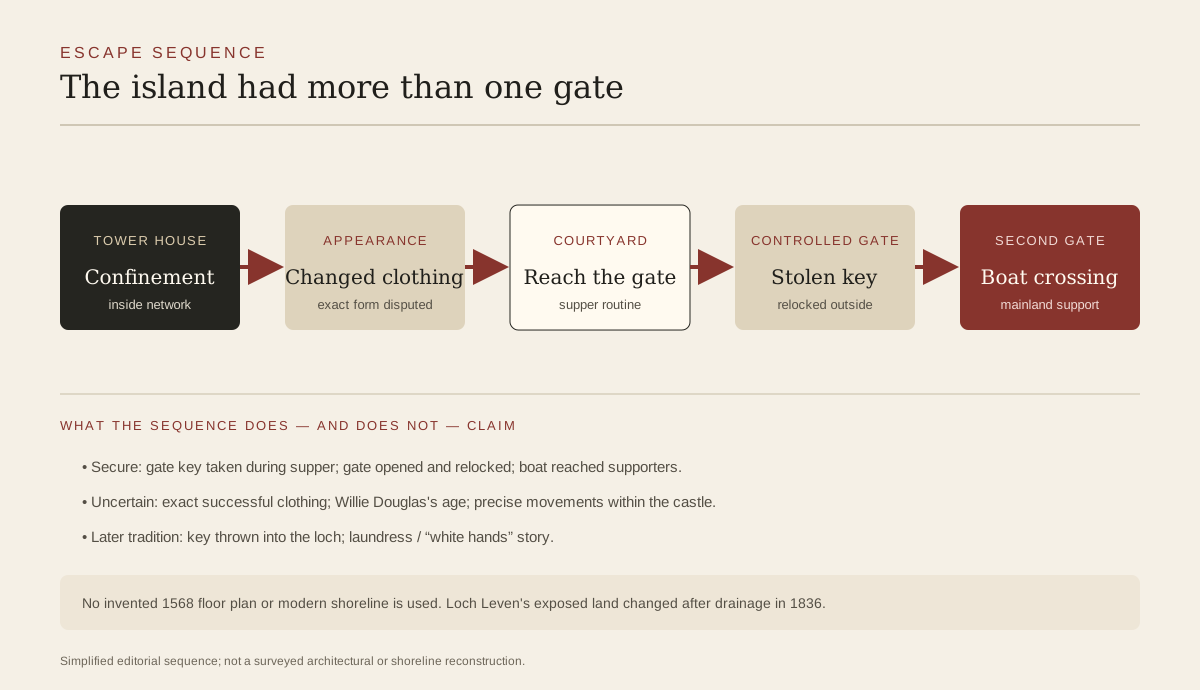
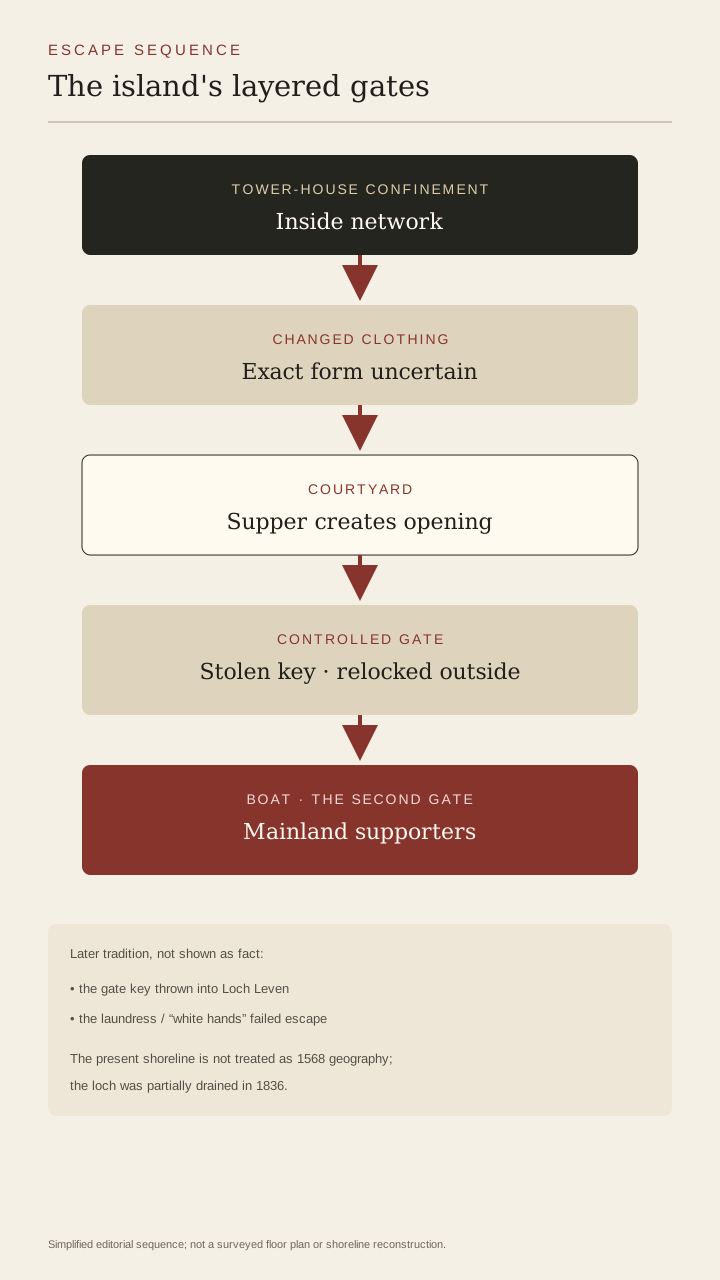
- 01
Inside network
Members of the Douglas household helped create the opportunity.
- 02
Gate key
The key was taken during supper; the gate was opened and relocked outside.
- 03
Changed appearance
Mary changed or borrowed clothing, but the exact successful disguise is disputed.
- 04
Boat
The boat carried the escape across the island's second barrier.
- 05
Mainland
Supporters received Mary before she moved toward Niddry and Hamilton.
Simplified editorial sequence; not a surveyed architectural or shoreline reconstruction.
From Loch Leven to Niddry
The next phase is less important mechanically but more important politically. Mary was received by supporters after the crossing and taken toward Niddry Castle, associated with Lord Seton, before moving on to Hamilton. News traveled quickly.
The woman whom the new regime had required to renounce the government was again physically present among armed supporters. Lords who had not accepted the settlement could now rally around her in person.
At Hamilton, Mary's party rejected the legitimacy of the abdication obtained at Lochleven and mobilized for restoration. For the first time since June 1567, the struggle was no longer about whether Mary could be freed. It was about whether she could recover power.
Eleven days of freedom before Langside
The answer came quickly.
Mary intended to move toward Dumbarton Castle, a strong western fortress whose possession could improve her strategic position. Regent Moray assembled forces against her.
On 13 May 1568, Mary's supporters met Moray's army at the Battle of Langside, near Glasgow. Her side lost.
The defeat destroyed the immediate restoration attempt. Mary fled south-west through Scotland. Historic Environment Scotland records her presence at Dundrennan Abbey on 15 May, during her last hours in the country.
She then crossed the Solway into England. Mary expected that Elizabeth I, a fellow queen and relative, might assist her. Instead, English authorities detained her. The escape from Loch Leven had ended one captivity only to lead, within two weeks, toward another.
The mystery of the Lochleven keys
The physical object most often associated with the escape is a group of iron keys recovered from Loch Leven long after Mary's lifetime. The traditional story is irresistible: Willie Douglas locked the gate, threw the keys into the water, and centuries later the escape tools were found on the lake bed. National Museums Scotland does not accept that conclusion.
The museum describes a bunch of sixteenth-century keys found in Loch Leven and acknowledges the longstanding association with Mary's escape. Its judgment, however, is that they are unlikely to have been the castle keys used that night.
This is exactly the kind of distinction historical storytelling often loses. An object can be old. It can come from the correct place. It can match a famous story.
And it can still lack the provenance needed to become evidence for that story. The keys are therefore a later attributed artifact, not the authenticated tool of escape.
Did Willie throw the key into the loch?
The answer is: we do not know. The earliest detailed account says the gate was locked behind Mary but does not say the key was thrown into the water. Nau's later version places it in a cannon. Other later retellings put it in the loch.
The story of the recovered keys then reinforced the loch version in popular memory. But the museum's rejection of those keys as likely escape artifacts removes the strongest-looking physical support for that tradition. The historically secure sequence does not need the flourish. A key was obtained.
A gate was opened. Mary passed through. The gate was locked behind her. She reached the boat before the household could stop her.
That is enough.
Problem → response
Escape was a sequence of problems
Each response solved a practical obstacle while often creating the next one.
- 01→
Obstacle
Island confinement
Even after leaving the castle enclosure, Mary had to cross open water before reaching the mainland.
Response
A boat was made available at the required moment and supporters waited beyond the loch.
- 02→
Obstacle
Controlled castle gate
The principal exit was guarded and its key controlled by the household.
Response
The key was taken during the vulnerable supper routine, then the gate was opened and locked behind the escape party.
- 03→
Obstacle
Risk of recognition
Mary was one of the most recognizable women in Scotland and had to cross occupied castle space.
Response
She altered her appearance and moved during a moment of household distraction and routine movement.
- 04→
Obstacle
Immediate pursuit
Once the household discovered the escape, the mainland routes could be searched or blocked.
Response
Supporters, horses and destinations were arranged in advance, allowing Mary to move rapidly away from Loch Leven.
Evidence discipline
What the record supports
Status labels distinguish secure conclusions from uncertainty and rejected claims. Color is never the only signal.
LATER CLAIM
Mary's first failed escape involved a laundress disguise and she was recognized by her white hands.
Later reference works repeat the laundress story, often dating it to 25 March 1568. The near-contemporary Venetian report instead mentions a failed attempt to descend from a window and does not record the laundress episode. The two could represent separate attempts, but the reviewed evidence does not establish that securely.
Sources: SRC-001, SRC-010DOCUMENTED
The successful escape depended on a gate key stolen during supper.
The near-contemporary Venetian report describes a page taking the key from the table under cover of a napkin; the later Nau account independently preserves the same core mechanism and identifies William Douglas as the inside helper.
Sources: SRC-001, SRC-011LATER CLAIM
The key used in the escape was thrown into Loch Leven.
The earliest detailed account records that the gate was locked from outside but does not say the key was thrown into the loch. Nau places the key in a cannon, while later traditions move it into the water.
Sources: SRC-001, SRC-011MYTH
The iron keys later recovered from Loch Leven are the keys used in Mary's escape.
National Museums Scotland identifies the traditional association but concludes that the recovered keys are unlikely to have been the castle keys used in the 1568 escape.
Sources: SRC-008DISPUTED
Mary's exact successful disguise is known with certainty.
Sources agree that she changed her appearance but differ on garments and attendant identities. The precise costume should not be reconstructed as certain.
Sources: SRC-001, SRC-002, SRC-011LATER CLAIM
The household was deliberately drugged or made drunk as part of an elaborate May Day revel before the escape.
Colorful later retellings include heavy drinking, May games and deliberate intoxication. The near-contemporary Venetian account explains the opening through ordinary supper routine and does not require this embellishment.
Sources: SRC-001MYTH
Mary abdicated on 24 June 1567.
One Historic Environment Scotland battle page gives 24 June, but the primary parliamentary record reproduces Mary's Lochleven instruments as dated 24 July 1567. The June date is treated as an institutional typo.
Sources: SRC-004, SRC-006Why the escape worked
Lochleven's defenses were formidable against force. They were less effective against cooperation from within. Mary and her supporters solved four different problems: The room: someone inside the household could reach her and coordinate movement.
The gate: the key was temporarily vulnerable during supper. The water: a boat remained available at the critical moment. The mainland: supporters were positioned to turn a boat landing into immediate flight. No single step was extraordinary by itself.
The achievement lay in synchronization.
If the key had disappeared too early, the household could have searched for it. If Mary had reached the gate before the courtyard cleared, she could have been stopped. If the boat were missing, the island would remain a prison. If the supporters arrived late, mounted pursuit might have overtaken her.
The operation succeeded because the island's separate layers of security failed in sequence.
What happened to the people who helped her?
The successful escape is most closely associated with George Douglas and William Douglas.
George operated as an organizer beyond the castle after his removal from the island and was among the men connected with receiving Mary after she crossed the loch. Willie, still inside the household, enabled the decisive movement through the gate.
Lord Seton and other Marian supporters provided the next layer of protection beyond the water. The escape was therefore neither a solitary act by Mary nor a conventional armed rescue. It was a networked escape in which the crucial participants occupied different sides of the prison boundary.
Escape succeeded. Restoration failed.
If success is measured only by the prison wall, Loch Leven was an unqualified victory.
Mary was not recaptured by the Douglas household. She reached political allies and re-emerged as the center of an armed cause.
If success is measured by what she wanted freedom for, the result is more complicated. The restoration attempt ended at Langside.
Her decision to enter England placed her in the hands of Elizabeth's government. She would remain under varying degrees of English custody for nearly nineteen years and was executed at Fotheringhay Castle on 8 February 1587.
That later ending has overshadowed the escape itself. It should not. For one evening in May 1568, a prison built from stone, water, routine, and divided loyalties failed all at once. Mary did not break Lochleven Castle.
Her supporters learned when the castle briefly stopped functioning as a prison—and moved before it could become one again.
Selected chronology
Captivity, escape and immediate aftermath
Carberry Hill
Mary surrenders to the Confederate Lords after the confrontation at Carberry Hill; Bothwell departs.
Mary sent to Lochleven
After her return to Edinburgh, Mary is taken to the island fortress of Lochleven Castle as a prisoner.
Abdication instruments signed
Mary's letters of demission at Lochleven renounce the government in favor of her infant son.
Escape from Lochleven Castle
A stolen gate key, changed clothing, a locked gate behind the escape party and a boat crossing carry Mary off the island.
Battle of Langside
Mary's restoration attempt is defeated by forces supporting Regent Moray.
Dundrennan Abbey
Mary reaches Dundrennan during her final hours in Scotland before crossing to England.