
Dith Pran reached Thailand on 3 October 1979, but the journey that brought him there is often compressed into a misleading sentence: he “escaped the Khmer Rouge.”
He had survived nearly four years under Khmer Rouge rule. By the time of his final border flight, however, the Democratic Kampuchea government had already been overthrown. Cambodia was still violent, divided, and coercive, with Vietnamese forces controlling most territory and Khmer Rouge forces active in border regions. Pran’s last escape was therefore not a jailbreak from an intact Khmer Rouge state. It was an extended refugee flight out of a country emerging from genocide while another war continued.
At a Glance
- Journey: Late July–3 October 1979
- Escapee: Dith Pran
- Starting region: Siem Reap, Cambodia
- Destination: Thailand
- Main method: Extended overland border flight
- Distance: Later accounts disagree—roughly 40 to 60 miles
- Major hazards: Armed forces, mines, disease, and an uncertain border landscape
- Outcome: Reached a Thai refugee site and was reunited with Sydney Schanberg
The Years Before the Border Flight
Pran had worked as a Cambodian journalist and interpreter with New York Times correspondent Sydney Schanberg during the final stages of Cambodia’s civil war. When the Khmer Rouge entered Phnom Penh on 17 April 1975, Pran helped the foreign journalists around him survive the first chaotic days and eventually reach the French Embassy.
The foreigners were later allowed to leave Cambodia. Pran was not.
He disappeared into the society the Khmer Rouge were building. The regime emptied cities, broke apart families, imposed forced labor, suppressed religion and education, and subjected people suspected of disloyalty or foreign connections to arrest and death. The United States Holocaust Memorial Museum estimates that nearly two million people died under Khmer Rouge rule from execution, starvation, disease, and the conditions imposed by the regime.
Pran’s education and work with foreigners made his background dangerous. Later biographies describe him concealing his education and presenting himself as an ordinary peasant or laborer while moving through years of forced work and deprivation. Schanberg did not know whether he was alive.
January 1979 Did Not Mean Immediate Safety
Vietnam invaded Cambodia at the end of 1978 after escalating border warfare. By 7 January 1979, Vietnamese forces had taken Phnom Penh and gained effective control over most Cambodian territory.
The Khmer Rouge government of Democratic Kampuchea had ended. That date is crucial to understanding Pran’s later escape. The collapse of the regime did not restore a normal peacetime state. Khmer Rouge leaders and military forces retreated toward borderland strongholds. Vietnamese troops remained throughout Cambodia, and a new Vietnamese-backed government was being constructed amid the destruction left by the previous regime.
Pran was alive in the Siem Reap area. Later accounts say he returned home and discovered the scale of his family’s losses. The Congressional Record states that he learned that around fifty relatives had died. Other obituaries give different family counts, so the larger point matters more than an exact number: the genocide had devastated his family.
Selected chronology
Selected chronology
Khmer Rouge take Phnom Penh
The Khmer Rouge seized Phnom Penh and began the regime that emptied cities, imposed forced labor, and killed or caused the deaths of enormous numbers of Cambodians.
Pran is separated from the foreign journalists
After helping foreign journalists during the fall of Phnom Penh, Pran could not leave Cambodia with Schanberg and the other foreigners and disappeared into Khmer Rouge-controlled society.
Democratic Kampuchea collapses
Khmer Rouge senior leaders retreated from Phnom Penh and Vietnamese forces took effective control of most Cambodian territory.
Pran begins the border flight
Later biographies date the beginning of Pran’s overland journey toward Thailand to 29 July.
Pran reaches Thailand
Pran crossed the Thai border and entered a refugee/holding site, ending his flight from Cambodia.
Reunion with Sydney Schanberg
A standard biographical chronology places Schanberg’s reunion with Pran on 9 October after news of Pran’s survival reached him.
Pran begins work at The New York Times
After resettling in the United States and reuniting with his family, Pran became a New York Times photojournalist.
Why Leave After the Khmer Rouge Fell?
Pran’s decision to leave Cambodia months after the January regime change can seem puzzling if 1979 is reduced to a simple liberation story. The Dith Pran Foundation says Vietnamese authorities made him a village chief. It also says he became afraid that they knew about his American connections. Encyclopedia of World Biography gives a similar account: after Pran managed to send word of his survival through an East German journalist, he feared that his own foreign-media past would receive closer scrutiny.
There is no need to turn that fear into a documented arrest order that the sources do not provide. The important point is that Pran did not regard his position as secure.
Cambodia remained militarized, and Khmer Rouge formations were still fighting. Leaving meant entering another dangerous landscape, but staying did not guarantee safety.
Leaving Siem Reap
Later biographical sources date Pran’s departure to 29 July 1979. Encyclopedia of World Biography says he left with several other men. Their precise identities and the composition of the group over the entire journey are not documented well enough to reconstruct them as a fixed escape party.
The destination was Thailand. The route was not a straight walk to a marked border checkpoint. Later accounts describe it as circuitous, shaped by the need to avoid fighting, armed patrols, and mines. That uncertainty is also why the familiar mileage figure needs qualification.
Problem → response
Escape was a sequence of problems
Each response solved a practical obstacle while often creating the next one.
- 01→
Obstacle
A country still at war after the fall of Democratic Kampuchea
The Khmer Rouge state had collapsed, but armed Khmer Rouge formations remained active while Vietnamese forces and the new Cambodian government controlled most territory.
Response
Pran moved west toward Thailand rather than treating January 1979 as the end of his danger.
- 02→
Obstacle
Land mines and uncertain front lines
Later accounts consistently describe mine danger and the need to avoid armed forces during the overland journey.
Response
Pran followed a circuitous route rather than a direct, documented road to the border.
- 03→
Obstacle
No secure identity or outside protection inside Cambodia
Pran had survived the Khmer Rouge partly by concealing his education and foreign connections; the Dith Pran Foundation says he later feared his American ties would cause problems under the new authorities.
Response
He chose to leave Cambodia and seek refuge across the Thai border.
Forty Miles or Sixty?
The U.S. Congressional Record says Pran fled 60 miles to Thailand.
The Washington Post likewise described a circuitous route of 60 miles. Its obituary says he moved while avoiding Khmer Rouge soldiers, unmarked minefields, and other dangers.
An Associated Press account published by CBS gives 40 miles, saying Pran escaped from a commune near Siem Reap and dodged both Vietnamese and Khmer Rouge forces on the way to a Thai border refugee camp. The sources do not provide enough geometry to settle the difference.
It is possible that one number approximates the broad distance while another reflects a longer route taken to avoid danger. That remains an inference, not a documented reconciliation. The most accurate modern wording is simply that later accounts put the journey at roughly 40 to 60 miles. A map pretending to know each turn would be less accurate than admitting the route is incomplete.
Documentary reconstruction
A broad evidence-led route to Thailand
A case-local visual focused on the spatial, mechanical or evidentiary relationship established by the surviving record.
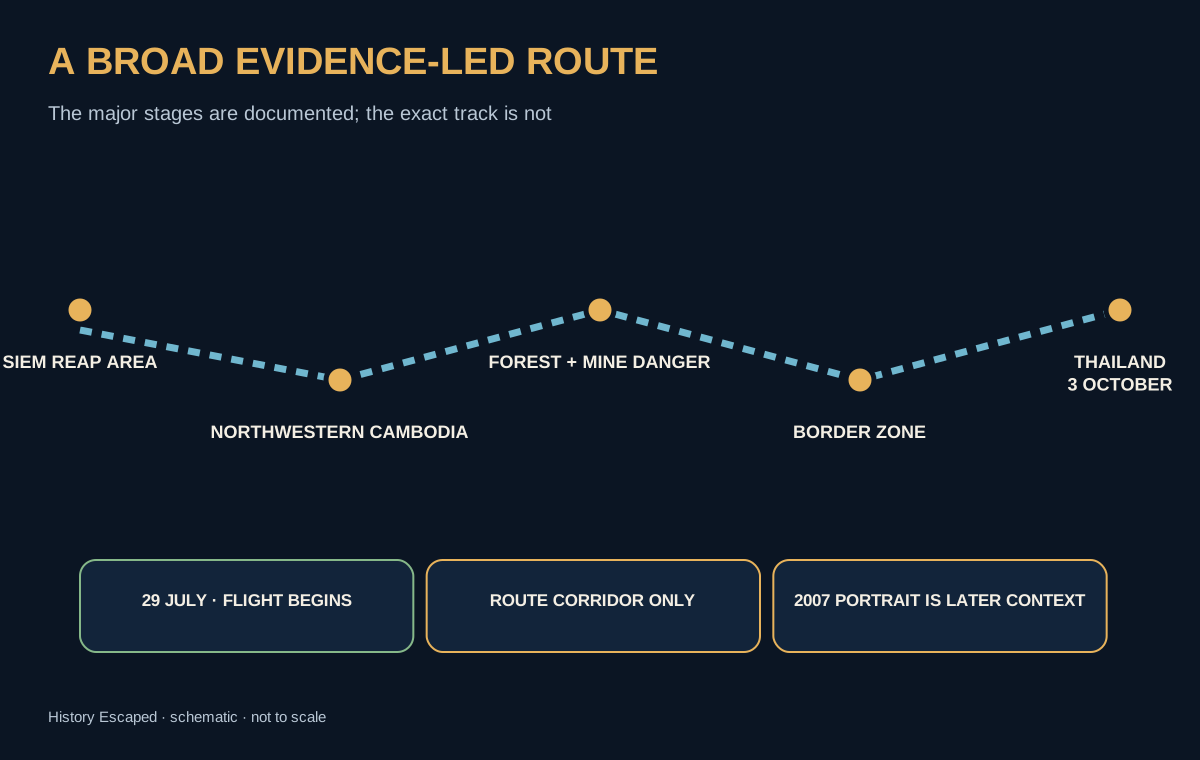
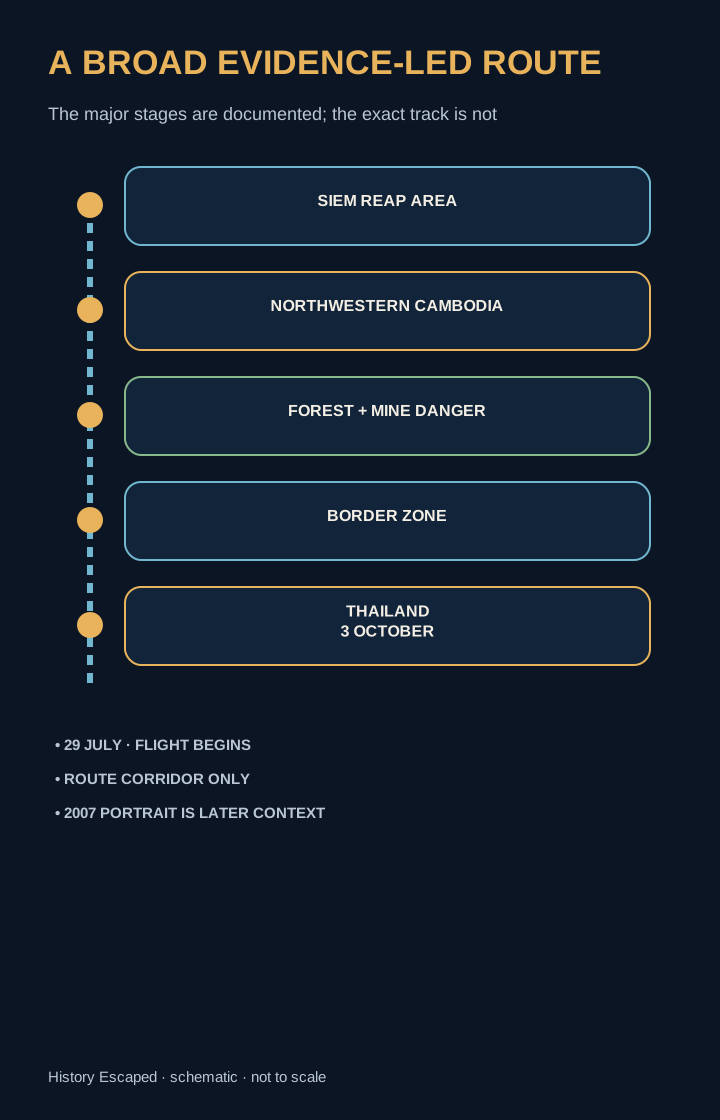
Simplified editorial reconstruction based on the cited historical record; not to scale. Uncertainty is stated directly in the visual and adjacent text.
A Landscape Still Divided by War
The main problem was no longer a prison perimeter. Pran was moving through territory where political authority and military control were unstable. Vietnamese forces dominated much of Cambodia, but Khmer Rouge units remained in the conflict and would continue fighting for years.
Mines added a danger that could not be represented simply as a line on a map. Later accounts repeatedly mention them, but they do not identify a verified sequence of minefields or safe corridors.
For that reason, the escape is better understood at the level the evidence actually supports: Pran moved west through a militarized and mined borderland, avoided armed forces, and kept going until he reached Thailand. The surviving story is about endurance and movement under uncertainty, not a series of reproducible tactical choices.
The “Killing Fields”
One of the most consequential parts of Pran’s testimony emerged from what he saw during his effort to get out. Modern scholarship credits Pran with coining the phrase “the Killing Fields” after encountering sites containing the remains of people killed during Khmer Rouge rule. The phrase became one of the most widely recognized names associated with the Cambodian genocide.
The exact moment when he first spoke or wrote the words is not preserved like a dated dispatch. The connection between his encounters during the flight and the phrase is nevertheless well established in later scholarship. Pran would spend much of the rest of his life trying to make those deaths harder to ignore.
The final accounting
Outcome
Reached Thailand
Pran crossed the border on 3 October 1979 and entered refugee protection.
Reunited with Schanberg and family
Schanberg traveled to Thailand after receiving word that Pran had survived; Pran later resettled in the United States and reunited with his wife and children.
Became a witness and advocate
Pran worked as a photojournalist and later compiled survivor testimony and advocated remembrance and accountability for the Cambodian genocide.
3 October 1979
Pran finally crossed into Thailand on 3 October. The date appears in the U.S. Congressional Record, the Dith Pran Foundation’s biography, and standard reference accounts. It is the strongest chronological anchor for the end of the escape.
What is much less secure is the name of the first camp or holding site where he arrived. Modern retellings can easily project the best-known Cambodian refugee camps backward onto his story. That creates a chronological problem. The organized Sa Kaeo holding center began receiving its first large intake later in October. Khao-I-Dang, which became the most famous Cambodian refugee camp on the Thai border, opened in November.
Pran had already crossed on 3 October. Unless a contemporary record identifies the earlier location more precisely, a Thai border refugee or holding site is the responsible description.
Evidence discipline
What the record supports
Status labels distinguish secure conclusions from uncertainty and rejected claims. Color is never the only signal.
DOCUMENTED
Dith Pran crossed into Thailand on 3 October 1979.
The date appears in the U.S. Congressional Record and is repeated by the Dith Pran Foundation and major biographical accounts.
Sources: SRC-003, SRC-004, SRC-009MYTH
Pran escaped directly from a still-functioning Khmer Rouge state in October 1979.
The Democratic Kampuchea regime had fallen in January. Khmer Rouge forces remained active and dangerous, but Vietnamese forces and the new People’s Republic of Kampuchea controlled most territory during Pran’s later border flight.
Sources: SRC-005, SRC-006, SRC-008DISPUTED
Pran’s escape route was exactly 60 miles.
The Congressional Record and Washington Post use 60 miles, while the Associated Press/CBS account says 40 miles. Because the journey was circuitous and its exact path is unknown, the article uses an approximate 40–60 mile range rather than forcing one figure.
Sources: SRC-003, SRC-007, SRC-008UNKNOWN
The exact route from Siem Reap to the Thai border can be reconstructed.
Sources describe mines, armed forces, and a circuitous westward journey but do not provide a sufficiently secure day-by-day path, crossing point, or modern route geometry.
Sources: SRC-007, SRC-008, SRC-009MYTH
Pran entered Khao-I-Dang or Sa Kaeo refugee camp on 3 October 1979.
Those famous organized holding centers opened later: Sa Kaeo began receiving its first large organized intake on 24 October, and Khao-I-Dang opened in November. Pran’s first Thai site should therefore remain unnamed unless a source specifically identifies the earlier border facility.
Sources: SRC-012WELL-SUPPORTED
Pran’s encounters with mass graves helped produce the phrase 'the killing fields.'
Modern scholarship explicitly credits the phrase to Pran’s encounters while escaping Cambodia, though the precise moment when he first used the wording is not documented like a dated quotation.
Sources: SRC-010MYTH
The 1979 journey is best classified as a conventional prison escape.
Pran had survived coercive labor and Khmer Rouge control, but his final 1979 journey was an extended border flight through post-regime conflict rather than a breakout from a guarded prison or camp.
Sources: SRC-001, SRC-005, SRC-006News That Pran Was Alive
Pran’s arrival changed a story that had remained unresolved for years. The New York Public Library’s Sydney Schanberg papers summarize the moment directly: after years in labor camps, Pran escaped Cambodia to a refugee camp in Thailand; when Schanberg received word, he traveled there and reunited with him.
Encyclopedia of World Biography places their reunion on 9 October 1979. For Schanberg, who had spent years searching for information about Pran, the message ended more than four years of uncertainty. For Pran, it reconnected him to a network outside Cambodia and, eventually, to his family in the United States.
The reunion later became one of the best-known scenes associated with The Killing Fields. The historical significance does not depend on reproducing the film’s dialogue or staging. Pran had survived and reached a place where the outside world could find him again.
Life After the Escape
Pran resettled in the United States and reunited with his wife and children. In 1980 he joined The New York Times as a photojournalist.
He also became an important public witness to the Cambodian genocide. Years later, he compiled Children of Cambodia’s Killing Fields, a collection of survivor accounts published by Yale University Press. His work extended beyond telling his own story: he helped preserve testimony from others whose childhoods and families had been shattered by the Khmer Rouge.
That later work matters to the meaning of the escape. Reaching Thailand did more than end Pran’s physical flight. It allowed a survivor who had spent years hiding his education and foreign connections to use both openly again.
Why This Is an Escape Case
Pran’s story sits near the outer boundary of conventional escape history. There was no final cell door, tunnel, fence, or guard post to defeat in October 1979. The system that had controlled him from 1975 to early 1979 had already lost national power.
Yet the conditions that made flight necessary had not disappeared. Cambodia was devastated, armed factions were still fighting, mines cut through the borderlands, and Pran believed his own position remained dangerous.
His final act was therefore a border flight from a coercive post-genocide conflict environment. That classification preserves the full chronology. Pran survived the Khmer Rouge first. Months after their government fell, he still had to get out of Cambodia.