
Subhas Chandra Bose's Great Escape: From Calcutta to Berlin in 1941
At about half past one in the morning on 17 January 1941, a German-made Wanderer car rolled away from a house in Calcutta that British intelligence officers were supposed to be watching.
At the wheel was a young medical student, Sisir Kumar Bose. In the car was his uncle, Subhas Chandra Bose, one of the most famous nationalist politicians in India.
He was not dressed as himself.
Bose had spent the previous weeks allowing the people around him—and the police outside—to believe that illness and religious seclusion had removed him from active politics. Instead, he and a small circle were preparing something far more dangerous. Bose intended to disappear from British India, cross the frontier under an assumed identity and seek international support for a new phase of the struggle against British rule.
Leaving the house was only the first problem.
The complete journey would take him from Calcutta to eastern India, across the subcontinent to Peshawar, through the frontier into Afghanistan, into the Soviet Union and finally to Berlin. By the time he arrived in Germany on 2 April, British officials had spent weeks trying to work out where one of their most closely watched political opponents had gone.
The operation remembered as Bose's Great Escape was therefore not one escape but a succession of them: from surveillance, from recognition, from British territory and finally from diplomatic isolation in Kabul.
A prisoner the government did not want to die
By 1940 Bose was already one of the most prominent—and divisive—figures in Indian nationalist politics.
He had twice been elected president of the Indian National Congress but had broken politically with Gandhi and the Congress high command over strategy. Bose believed Britain's entry into the Second World War created an opportunity that Indian nationalists should exploit more aggressively. He founded the Forward Bloc and continued anti-British political mobilization.
British authorities detained him in July 1940 after agitation connected with the campaign against Calcutta's Holwell Monument. While imprisoned, Bose began a hunger strike in late November.
His health created a political problem for the colonial government. Officials did not want a nationally known leader dying in custody. On 5 December 1940, Bose was sent back to his family's house at 38/2 Elgin Road.
Calling the arrangement “house arrest” is convenient, though the administrative reality was slightly more complicated. The government still intended to control him and, once he recovered, expected to put him back into custody. Police surveillance surrounded the house and his communications were watched.
Bose understood what that meant. If he resumed open political activity in India, he could be arrested again. So he began planning to leave India instead.

The first problem: how do you leave a watched house normally?
The plan did not begin with a hidden tunnel or a forged police order. It began with an attempt to make departure look ordinary.
Bose brought his nephew Sisir into the plan. Sisir was young, a medical student and an experienced enough driver to undertake a long night journey. The family had more than one car available. A large American Studebaker President was considered, but its connection with the prominent Bose family made it conspicuous.
The alternative was a German Wanderer, registration BLA 7169, registered in Sisir's name. They chose the Wanderer.
The decision mattered because the escape depended on the police failing to interpret the movement of one family car as the departure of Subhas Bose. Sisir even made a long trial drive toward Burdwan in advance, testing both the car and his own ability to remain behind the wheel.
Meanwhile, another part of the plan was being constructed around an invented man. His name was Mohammad Ziauddin.
Accounts differ slightly in how they style the identity, but the basic cover was that of a Muslim insurance representative from outside Bengal. Clothing, luggage and other details were prepared to make the role plausible. Bose had also grown a beard, changing one of the most recognizable faces in Indian politics.
The disguise was only useful if the police did not realize immediately that they needed to look for it. So Bose created one more layer of deception.
Disappearing before leaving
In the days before the escape, Bose withdrew from ordinary contact.
He presented himself as entering a period of religious seclusion. Visitors stopped seeing him directly. Food could be left without face-to-face contact. The arrangement helped create uncertainty about exactly when he was present behind the closed portion of the house.
The deception worked partly because it did not require the guards to believe anything spectacular. They merely had to accept that a sick political detainee had become withdrawn.
Late on 16 January, the operation moved from preparation to action.
Shortly after midnight—around 1:30 a.m. on 17 January in the best-supported accounts—Bose emerged in the Ziauddin disguise. Sisir took the driver's seat of the Wanderer. Bose sat behind him.
The car passed through the gate. The watched house had been breached without a confrontation. But Calcutta was not the destination. It was the beginning.

Escape route
Two escapes joined into one journey
The first phase broke British surveillance and reached Peshawar. The second crossed the frontier, stalled in Kabul and depended on diplomatic assistance for Soviet transit to Berlin.
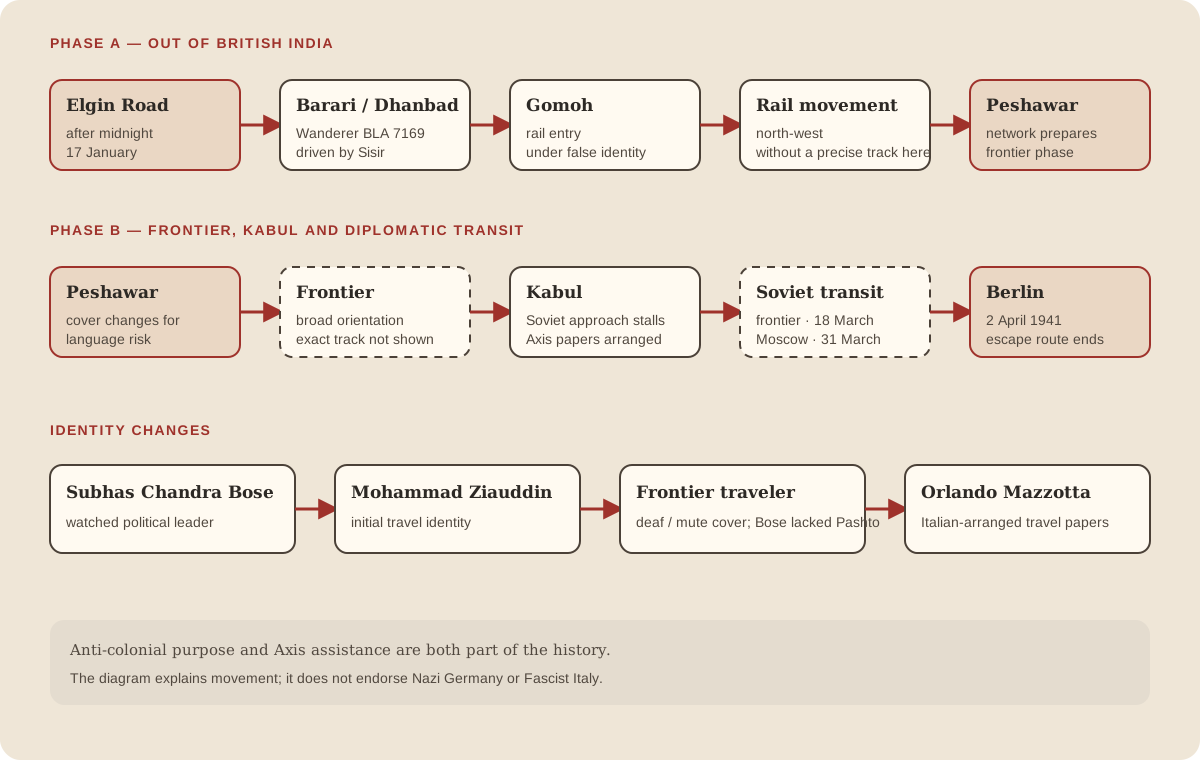
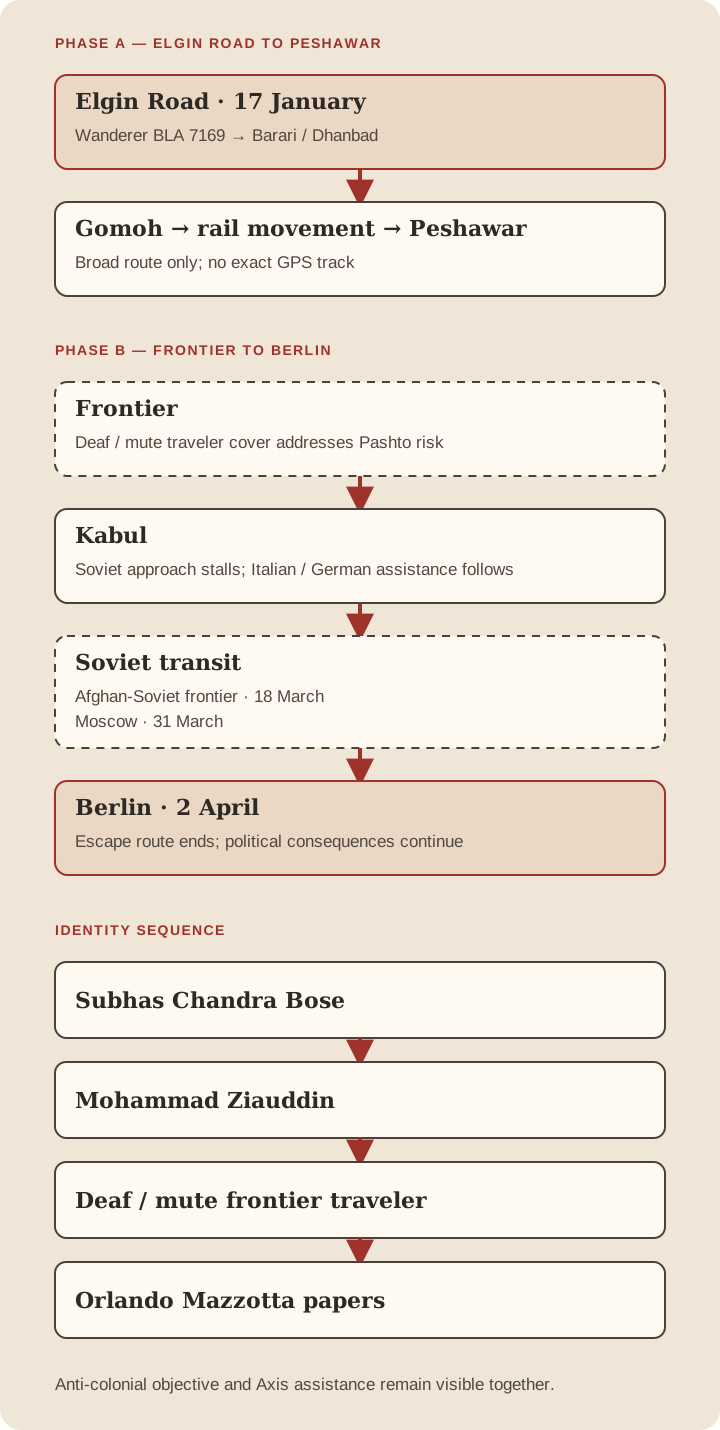
- 01
Elgin Road
Bose left after midnight in the Wanderer BLA 7169.
- 02
Gomoh
Rail travel carried the Mohammad Ziauddin identity toward Peshawar.
- 03
Frontier
A deaf-and-mute cover addressed Bose's lack of Pashto.
- 04
Kabul
Soviet representatives were initially unreceptive; Italian and German aid produced travel papers.
- 05
Berlin
Transit through Soviet territory ended in Berlin on 2 April.
Simplified editorial reconstruction; not to scale. It shows established route phases without inventing exact mountain tracks, safe-house coordinates or a station-by-station rail itinerary.
Why Gomoh mattered
Taking a train from a major Calcutta station would have exposed Bose to a different kind of danger. Rail travel was unavoidable if he wanted to cross northern India quickly, but the place where he entered the rail network could be controlled.
Sisir drove westward from Calcutta. During the journey the pair made use of a family connection near Barari, in the Dhanbad area, where Bose could remain out of sight while Sisir maintained the appearance of ordinary movement.
The next key destination was Gomoh, a railway junction far enough from Calcutta to separate Bose from the immediate police search around his home. There, Sisir's direct role in the escape came to an end.
Bose boarded the rail system as Ziauddin and continued toward northern India. Accounts differ on some details of the train changes, but the strategic line is clear: he travelled west and north, eventually reaching Peshawar near the North-West Frontier.
The most dangerous part of the journey was still ahead.
Material evidence
Vehicles, identities and papers
The objects used in an escape reveal how a plan worked under constraint.
- 01Key transport asset for escaping the immediate surveillance perimeter and avoiding departure from a major Calcutta railway station.
Wanderer W24 sedan, BLA 7169
The relatively inconspicuous German car chosen over the Bose family's more recognizable Studebaker for the first stage from Calcutta toward Gomoh.
- 02Reduced the risk that Bose's appearance and travel behavior would be immediately associated with a nationally recognizable political leader.
Mohammad Ziauddin identity
A prepared Muslim insurance-related cover identity used during the departure from Calcutta and rail phase.
- 03Turned a linguistic weakness into a plausible reason for Bose not to speak.
Frontier clothing and deaf-mute cover
A second-stage cover tailored to travel through the North-West Frontier where Bose's lack of Pashto posed a risk.
- 04Solved the passport and international-transit problem that had stranded Bose in Kabul.
Italian-arranged Orlando Mazzotta papers
Travel documentation used to move Bose from Afghanistan into Soviet territory and onward toward Germany.
A disguise that created a new problem
Mohammad Ziauddin could plausibly travel by train. The frontier required something else.
Bose did not speak Pashto. In the North-West Frontier region, a man whose clothing suggested one identity but whose speech betrayed another could attract exactly the attention the escape was designed to avoid.
The solution was not to teach Bose a language in a few days. It was to remove speech from the role.
With help from the network assembled around Mian Akbar Shah, Bose's cover evolved into that of a deaf and mute Pathan travelling in the company of a relative or guide. Abad Khan helped with local arrangements. Bhagat Ram Talwar, using the name Rahmat Khan, became the crucial guide for the next phase.
This was no longer primarily a family escape. It was a clandestine frontier operation.
Problem → response
Escape was a sequence of problems
Each response solved a practical obstacle while often creating the next one.
- 01→
Obstacle
Continuous police surveillance
British intelligence watched the Elgin Road residence and intended to return Bose to custody once his health improved.
Response
Bose created the appearance of illness and seclusion while a small circle prepared an ordinary-looking nighttime departure.
- 02→
Obstacle
Recognizable family vehicles
The Bose family's larger Studebaker was too conspicuous for a clandestine long-distance departure.
Response
Sisir and Subhas selected the less conspicuous Wanderer and tested it before the escape.
- 03→
Obstacle
Recognition during long-distance travel
Bose was nationally known and could not safely travel as himself across British India.
Response
He travelled as Mohammad Ziauddin and entered the rail network away from Calcutta at Gomoh.
- 04→
Obstacle
Language on the North-West Frontier
Bose did not speak Pashto and could have been exposed by conversation.
Response
The network presented him as deaf and mute and paired him with an escort who could speak for him.
- 05→
Obstacle
Uncontrolled frontier terrain
Leaving British India required movement through politically and geographically difficult frontier territory rather than ordinary passport control.
Response
Mian Akbar Shah, Abad Khan, Bhagat Ram Talwar and local networks provided guidance and concealment.
- 06→
Obstacle
No straightforward onward travel from Kabul
Bose reached Afghanistan without a normal passport route to Europe and initially found Soviet representatives unreceptive.
Response
Italian and German diplomats coordinated papers and Soviet transit, allowing him to leave Afghanistan under the Orlando Mazzotta identity.
Leaving British India
On 26 January 1941, the date celebrated by the Indian National Congress at the time as Independence Day, Bose began the frontier movement that would take him out of British India. The symbolism was striking, but the physical problem was severe.
The official frontier could not simply be crossed like an ordinary international border by a famous political fugitive without valid travel documents. Bose and his guides moved through the tribal frontier, at points travelling on foot over difficult terrain.
The sources disagree on some minor itinerary details, and later retellings often turn the crossing into a continuous cinematic mountain trek. The evidence supports a more mixed journey using local guides and several forms of transport as the party moved through the frontier and into Afghanistan.
By the end of January, Bose had reached Kabul. That was an enormous success. It was not yet an exit.
The Kabul trap
Afghanistan was outside British India, but Bose still had no straightforward legal way to travel to Europe.
His original strategic hope centered heavily on the Soviet Union. At that moment, Germany and the USSR were still bound by the Nazi-Soviet non-aggression pact, and Bose hoped Moscow might assist an anti-British nationalist effort.
The Soviet representatives in Kabul did not immediately embrace him. British intelligence records examined by modern historians indicate that Soviet officials were wary and suspected that the approach might even be a provocation.
Bose and his associates therefore turned toward the Italian and German legations. The diplomatic phase of the escape lasted weeks.
Italian minister Pietro Quaroni became particularly important. After communication among Kabul, Rome, Berlin and Moscow, arrangements were eventually made for Bose to transit Soviet territory.
He would need another identity. The man who had left Calcutta as Mohammad Ziauddin would leave Afghanistan on papers identifying him with the Italian name Orlando Mazzotta. The escape had changed shape again.
From a false insurance agent to an Italian identity
The “Orlando Mazzotta” papers were not simply another costume. They solved the legal-document problem that had trapped Bose in Kabul.
British records and German diplomatic material allow this phase to be dated more confidently than some later memoir chronologies. Bose crossed the Afghan-Soviet frontier on 18 March 1941 with Axis-arranged documentation and companions connected with the diplomatic operation.
He travelled across Soviet Central Asia toward Moscow. A German diplomatic report establishes him in Moscow on 31 March.
The Soviet Union did not become the political sponsor Bose had originally hoped to find. His stay was brief. He continued west.
On 2 April 1941, after more than ten weeks of clandestine movement, he reached Berlin. The British Empire had lost track of one of its most famous opponents. Bose had placed himself at the center of another problem entirely.
Escape did not make his political choices uncomplicated
The Great Escape is often told as an uncomplicated adventure story: a nationalist leader fools British police, changes identities and crosses continents. That is true as far as it goes. It does not go far enough.
Bose had escaped British colonial control because he intended to use the world war to advance Indian independence from outside India. In Europe, that strategy meant seeking assistance from Nazi Germany and Fascist Italy. Later, after moving to Asia, he would work with Imperial Japan and lead the Indian National Army.
Those choices remain historically and morally controversial.
They do not make the British colonial system benevolent, and the brutality of Axis regimes does not erase Bose's anti-colonial objective. Nor does Bose's objective erase the nature of the governments whose support he sought.
A serious reconstruction has to hold all of those facts together. The escape was operationally brilliant because it enabled Bose to pursue his strategy. Whether that strategy was wise, necessary, reckless or morally compromised is a larger historical argument.
Evidence discipline
What the record supports
Status labels distinguish secure conclusions from uncertainty and rejected claims. Color is never the only signal.
DISPUTED
Bose escaped on 16 January 1941 rather than 17 January.
The operation began on the night of 16 January, but participant-derived and scholarly accounts place the actual departure after midnight, around 1:30 a.m. on 17 January. Use 'night of 16–17 January' where both conventions matter.
Sources: SRC-001, SRC-003, SRC-009MYTH
Bose escaped in a Studebaker President.
The Studebaker was considered during planning, but the escape car was the German Wanderer BLA 7169, which survives at Netaji Bhawan. One recent scholarly article appears to misidentify the vehicle in its opening scene.
Sources: SRC-001, SRC-006, SRC-009, SRC-011MYTH
Bose used one unchanged Pathan disguise for the entire escape.
The cover evolved. Bose left Calcutta as Mohammad Ziauddin, an insurance-related Muslim identity. In the frontier phase he was presented as a deaf and mute Pathan because he did not speak Pashto. Later he travelled on papers in the name Orlando Mazzotta.
Sources: SRC-001, SRC-002, SRC-003, SRC-004DISPUTED
Bose reached Berlin on 28 March 1941.
Some later memoir traditions give an earlier Moscow and Berlin chronology. Archival diplomatic evidence places Bose in Moscow on 31 March and supports arrival in Berlin on 2 April; that wartime documentary chronology is stronger.
Sources: SRC-003, SRC-006MYTH
Bose's escape was a solo operation accomplished only by his disguise.
The escape relied on a relay of family members, political associates, frontier guides and ultimately Italian and German diplomatic assistance. Sisir Kumar Bose, Mian Akbar Shah, Abad Khan and Bhagat Ram Talwar were among the important participants.
Sources: SRC-001, SRC-002, SRC-003, SRC-004The car that survived the story
Unlike many famous escape artifacts, the vehicle at the center of the first stage still exists.
The Wanderer BLA 7169 is preserved at Netaji Bhawan, the former Bose family home on Elgin Road in Kolkata. Modern photographs show the car behind glass, transformed from an inconspicuous family vehicle into one of the best-known physical objects associated with Bose.
Its survival also helps resolve a surprisingly persistent source error.
The Bose family owned a Studebaker, and the larger American car was considered for the operation. But the actual escape car was the Wanderer. A recent scholarly article calling the departing vehicle a Studebaker conflicts with the participant record, family archive and surviving artifact.
In this instance, the object itself is part of the evidence.
The escape was a network, not a solo act
Bose was the person escaping, but the operation succeeded because different people solved different problems. Sisir Kumar Bose solved the first transport problem and assumed enormous personal risk in driving his uncle away from the watched house. Mian Akbar Shah helped build the frontier connection. Abad Khan assisted with concealment and local movement around Peshawar.
Bhagat Ram Talwar guided Bose through the frontier and into Afghanistan. Talwar's later history as an extraordinary multi-sided wartime intelligence agent complicates his biography, but it does not erase his documented role in the escape.
Members of the Bose family maintained the deception in Calcutta. Italian and German diplomats ultimately made the Kabul-to-Europe phase possible. That is why the best reconstruction should not show a single dotted line marked “Bose escapes to Germany.” It should show a relay.
Why the Great Escape mattered
In immediate terms, the escape humiliated British surveillance.
Officials had expected to control Bose through physical observation and the threat of renewed detention. Instead, he left Calcutta, crossed British India and exited the empire's frontier before the government understood what had happened.
In larger historical terms, the escape changed the geography of Bose's politics. Before January 1941, British authorities could jail him, watch his house and restrict his movements. After April 1941, he was operating internationally.
He established a Free India center in Germany and broadcast propaganda toward India. In 1943 he made another extraordinary wartime journey—by German and Japanese submarines—to East Asia, where he assumed leadership of the Indian National Army and the Provisional Government of Azad Hind.
Those later events belong to another story. But they were made possible by the night the Wanderer left Elgin Road. The cleverest part of the Great Escape was not that Bose possessed one perfect disguise or discovered one gap in British security. It was that whenever the form of the obstacle changed, the escape changed with it.
A watched house required deception. A recognizable family required an inconspicuous car. A railway journey required a new identity. The frontier required silence.
Afghanistan required diplomats. International travel required another name. By the time British intelligence understood that Subhas Chandra Bose had not merely gone underground in India, the man they were searching for was already moving through a different political world.
Selected chronology
From surveillance to Berlin
Bose detained
British authorities detain Bose amid anti-colonial agitation in Calcutta.
Hunger strike begins
Bose begins a hunger strike while in detention, sharply increasing the political and medical risk of keeping him in prison.
Returned to Elgin Road under surveillance
Bose is released from prison because of his deteriorating condition and kept under intensive surveillance at the family home.
Escape from Elgin Road
Bose leaves the watched house as Mohammad Ziauddin in the Wanderer driven by Sisir Kumar Bose.
Peshawar phase begins
Bose reaches the Peshawar region, where the escape passes into the hands of the North-West Frontier network.
Moves toward the frontier
Bose leaves the Peshawar area with guides to cross beyond British Indian control.
Reaches Kabul
Bose reaches the Afghan capital, where the problem shifts from physical escape to securing international passage.
Crosses into Soviet territory
With Axis-arranged papers and Soviet transit approval, Bose crosses Afghanistan's northern frontier into Soviet territory.
In Moscow
German diplomatic reporting records Bose's arrival in Moscow.
Arrives in Berlin
Bose reaches Berlin, completing the 1941 Great Escape and beginning the European phase of his wartime political strategy.