
Ogyen Trinley Dorje left Tsurphu Monastery in Tibet on 28 December 1999 and appeared in Dharamsala, India, eight days later. He was fourteen years old. His arrival immediately became more than a border-crossing story because his religious position had unusual political weight: the Dalai Lama had recognized him as the 17th Karmapa, and authorities of the People’s Republic of China had also approved his 1992 enthronement at Tsurphu.
That agreement did not mean that the Karmapa succession was uncontested. Within the Karma Kagyu tradition, Shamar Rinpoche and his supporters recognized Trinley Thaye Dorje instead. The 1999–2000 journey therefore unfolded inside two overlapping disputes—one concerning Chinese state control of Tibetan religious life, the other concerning recognition within the Karma Kagyu lineage itself.
The escape is well documented at its beginning and end. Its detailed route is known chiefly from Ogyen Trinley Dorje’s own later account, supplemented by contemporary reporting. That distinction matters. The broad journey through Nepal and into India is secure; every clandestine turn, checkpoint encounter, and travel detail should not be presented as independently verified fact.
At a Glance
- Departure: 28 December 1999
- Departure point: Tsurphu Monastery, near Lhasa
- Age: 14
- Nepal: reached by 30 December according to his later first-person account
- Arrival in Dharamsala: 5 January 2000
- Religious status: recognized as the 17th Karmapa by the Dalai Lama and approved by PRC authorities; that recognition was contested within Karma Kagyu by supporters of Trinley Thaye Dorje
- Main source conflict: Chinese authorities initially presented the journey as temporary travel to obtain religious objects, while Ogyen Trinley Dorje later said repeated refusals of permission to travel and study with lineage teachers had driven him to leave
- Immediate consequence: a diplomatic and religious controversy involving Beijing, New Delhi, the Tibetan exile community, and rival Karma Kagyu constituencies
Why Tsurphu mattered
The Karmapa is the central reincarnate lineage of the Karma Kagyu tradition of Tibetan Buddhism. After the death of the 16th Karmapa, Rangjung Rigpe Dorje, in 1981, senior figures disagreed over the identification of his successor. Tai Situ Rinpoche and other supporters accepted Ogyen Trinley Dorje, who was born in 1985 and enthroned at Tsurphu in 1992. The Dalai Lama accepted that recognition, and the Chinese state authorized the enthronement.
That convergence was politically unusual. Chinese authorities exercised extensive regulatory authority over religious institutions in Tibet and had deep conflicts with the Dalai Lama and the Tibetan exile leadership. Ogyen Trinley Dorje’s state-approved position could therefore be presented by Beijing as evidence that a major Tibetan Buddhist institution could function within the PRC system.
At the same time, the recognition dispute did not disappear. Shamar Rinpoche recognized Trinley Thaye Dorje as the reincarnation of the 16th Karmapa, and separate networks of monasteries and practitioners supported the two claimants. An accurate account of the 1999 departure does not need to decide that theological dispute. It needs only to establish that Ogyen Trinley Dorje’s position was recognized by both the Dalai Lama and Chinese authorities while remaining contested by an important faction within his own lineage.
Leaving Tibet
On the evening of 28 December 1999, Ogyen Trinley Dorje left Tsurphu with a small party of attendants. Contemporary reports initially knew very little about how the group had gone. Chinese authorities acknowledged that he had left the monastery with several companions, while Tibetan and international reporting described an arduous winter journey toward Nepal.
A much more detailed sequence became public later. At a press meeting in April 2001, and in a statement preserved by his administrative office, Ogyen Trinley Dorje said that preparations had been concealed behind the announcement of a religious retreat. He described leaving the monastery after dark, traveling westward across Tibet, and reaching Mustang in Nepal on the morning of 30 December.
From there, his account described a mixed journey through Nepal involving travel on foot and horseback, followed later by helicopter and road transport. He said the group reached Manang, flew onward within Nepal, then continued toward the Indian border. After entering India, they traveled through northern India before arriving in Dharamsala early on 5 January.
Those later details are valuable because they come from a participant who was at the center of the journey. They are still recollection and self-report. Contemporary coverage often gave simpler or conflicting versions, including varying estimates of the number of companions and sweeping descriptions that made the entire trip sound like one continuous trek across the Himalayas. A responsible reconstruction keeps the broad stages while avoiding a turn-by-turn clandestine route.
Why he said he left
The strongest source conflict concerns motive.
On 7 January 2000, China’s State Council Information Office issued a statement through Xinhua acknowledging that Ogyen Trinley Dorje had left Tsurphu. The statement cited a letter said to have been left at the monastery. According to the official account, he had gone abroad to retrieve religious implements and Black Hat regalia associated with earlier Karmapas, and his departure did not constitute betrayal of the state, nation, monastery, or leadership.
That presentation left open the possibility that he would return. It also reduced the political damage of the departure: a temporary religious errand was very different from the defection of a state-approved Tibetan religious figure.
Ogyen Trinley Dorje later rejected the Black Hat explanation. At his April 2001 press conference he confirmed that he had left a letter, but said it stated that he had repeatedly requested permission to travel internationally and had not received it. He said the letter did not mention the Black Crown. His office has consistently framed the journey primarily as an effort to receive teachings, empowerments, and transmissions from senior Karma Kagyu masters living in India.
The U.S. State Department’s 2000 religious-freedom report similarly recorded his explanation that restrictions on his movement and the inability either to travel to his teachers or bring them to Tibet were central reasons for leaving. The same report also repeated stronger allegations that he faced political-religious pressure involving the Dalai Lama and the state-recognized Panchen Lama. Those claims require qualification because his own later statements were more specific and, on the Panchen Lama question, more restrained.
The historical conclusion does not require choosing between propaganda slogans. Beijing publicly framed the journey as temporary retrieval of religious objects. Ogyen Trinley Dorje later described it as a self-directed departure caused chiefly by restrictions on travel and religious education. The fact that he stayed in India, received refugee status, and continued his religious training there strongly contradicts the idea that the journey functioned merely as a short collecting trip, but it does not make every later allegation about Chinese intentions independently proven.
Dharamsala
Ogyen Trinley Dorje arrived in Dharamsala on 5 January 2000 and met the Dalai Lama. The arrival surprised observers in India and abroad because Chinese authorities had treated him as an officially approved high-ranking Tibetan Buddhist figure. For Tibetans in exile, his appearance carried obvious symbolic force.
India faced a more complicated decision. New Delhi had hosted the Dalai Lama and a large Tibetan refugee community since 1959, but it also had to manage relations with China. Chinese officials reminded India of its commitments concerning Tibet and warned against allowing the Karmapa’s presence to become a platform for anti-China political activity.
India ultimately allowed him to remain and granted refugee status in 2001. Permission to stay did not mean unrestricted movement. Indian authorities imposed significant travel controls, and later reporting documented a prohibition on visiting Rumtek Monastery in Sikkim, the principal Indian seat established by the 16th Karmapa. That restriction placed Ogyen Trinley Dorje in a peculiar position: he had escaped limitations on movement in Tibet but continued to face politically driven constraints in India.
What changed at Tsurphu
The consequences were also felt at the monastery he had left.
The U.S. State Department, drawing in part on Tibet Information Network reporting, recorded restrictions at Tsurphu after the escape. Visitors were limited, monks and laypeople were questioned, and authorities reportedly intensified political-education measures. Reports also said members of the monastery’s management structure were replaced or investigated.
Chinese officials disputed some of those claims, including reports that monks had been arrested and that Ogyen Trinley Dorje’s parents had been placed under restrictions. Those denials belong in the record. What is more broadly supported is that the departure prompted greater official scrutiny of Tsurphu and contributed to concern about unauthorized Tibetan border crossings.
The escape therefore had consequences beyond one individual’s relocation. It exposed the limits of Beijing’s attempt to present a state-approved reincarnate lama as proof of a stable relationship between Tibetan Buddhism and Chinese state authority. At the same time, it created new security and diplomatic problems for India and did not resolve the internal Karma Kagyu succession dispute.
The recognition dispute did not disappear
Ogyen Trinley Dorje’s arrival in India was sometimes described in news coverage as though it settled the question of who the 17th Karmapa was. It did not.
Shamar Rinpoche continued to recognize Trinley Thaye Dorje, who had already left Tibet for India in the 1990s and had his own body of supporters. Scholars and specialists have repeatedly noted that literature on the controversy is often partisan because publications tend to originate within one or the other claimant’s network.
For historical purposes, the neutral formulation is straightforward: two men have been recognized and enthroned by different Karma Kagyu constituencies as the 17th Karmapa. Ogyen Trinley Dorje received recognition from the Dalai Lama and approval from PRC authorities. Trinley Thaye Dorje received recognition from Shamar Rinpoche and associated supporters. None of those institutional facts allows an outside historical publication to adjudicate reincarnation.
The later relationship between the two claimants also complicates narratives that treat the dispute as permanent personal hostility. In October 2018, Ogyen Trinley Dorje and Trinley Thaye Dorje met in France and issued a joint statement saying they wished to build a personal relationship and work to heal divisions within the Karma Kagyu lineage.
Escape, exile, and religious authority
The 1999–2000 journey succeeded in its immediate objective: Ogyen Trinley Dorje left Tibet without authorization, crossed through Nepal, reached India, and remained there. He was able to receive teachings from senior Karma Kagyu masters who were outside Tibet. In that sense, the escape changed the setting in which his religious education and public role developed.
It also produced a paradox. China had been one of the governments that approved his status in Tibet, yet his departure became evidence cited by critics of Chinese religious policy. India gave him refuge but restricted some of his movements. His presence strengthened one side of the Karmapa succession dispute without ending that dispute.
The episode is best understood neither as a purely spiritual pilgrimage nor as a simple political defection. It was a clandestine departure by a fourteen-year-old religious leader whose position sat at the intersection of Tibetan Buddhist lineage, Chinese state religious policy, Tibetan exile politics, and India–China diplomacy. The journey itself lasted eight days. Its political and religious consequences lasted far longer.
Evidence discipline
What the record supports
Status labels distinguish secure conclusions from uncertainty and rejected claims. Color is never the only signal.
DISPUTED
Ogyen Trinley Dorje left Tibet only temporarily to retrieve Black Hat regalia and religious instruments.
This was the January 2000 Chinese government explanation based on its presentation of the letter left at Tsurphu. Ogyen Trinley Dorje later said the letter did not mention the Black Hat and that repeated denials of permission to travel were central to his decision.
Sources: SRC-001, SRC-002, SRC-005WELL-SUPPORTED
Restrictions on travel and access to Karma Kagyu teachers were a principal reason Ogyen Trinley Dorje gave for leaving Tibet.
He stated this publicly after reaching India, and the explanation was also recorded by the U.S. State Department. It is well supported as his stated motive, while the internal intentions of Chinese officials remain separate questions.
Sources: SRC-001, SRC-003, SRC-008MYTH
Every detailed stage of the clandestine route is independently documented.
The detailed route comes primarily from Ogyen Trinley Dorje’s later first-person account. Contemporary reports establish the departure, Nepal transit, and arrival but often give simplified or conflicting mechanics.
Sources: SRC-001, SRC-004, SRC-005MYTH
Ogyen Trinley Dorje’s arrival in India resolved the dispute over the identity of the 17th Karmapa.
Trinley Thaye Dorje continued to be recognized by Shamar Rinpoche and associated supporters. The two claimants later acknowledged divisions in the lineage and jointly called for healing them.
Sources: SRC-009, SRC-010DISPUTED
Reports that Chinese authorities arrested monks and restricted Ogyen Trinley Dorje’s family after the escape are uncontested facts.
The U.S. State Department recorded reports of arrests, surveillance, and increased restrictions at Tsurphu but also recorded Chinese government denials of arrests and family restrictions.
Sources: SRC-003Documentary reconstruction
A route reconstructed from differing accounts
A case-local editorial visual separates the documented sequence from uncertainty without implying exact modern geography or operational detail.
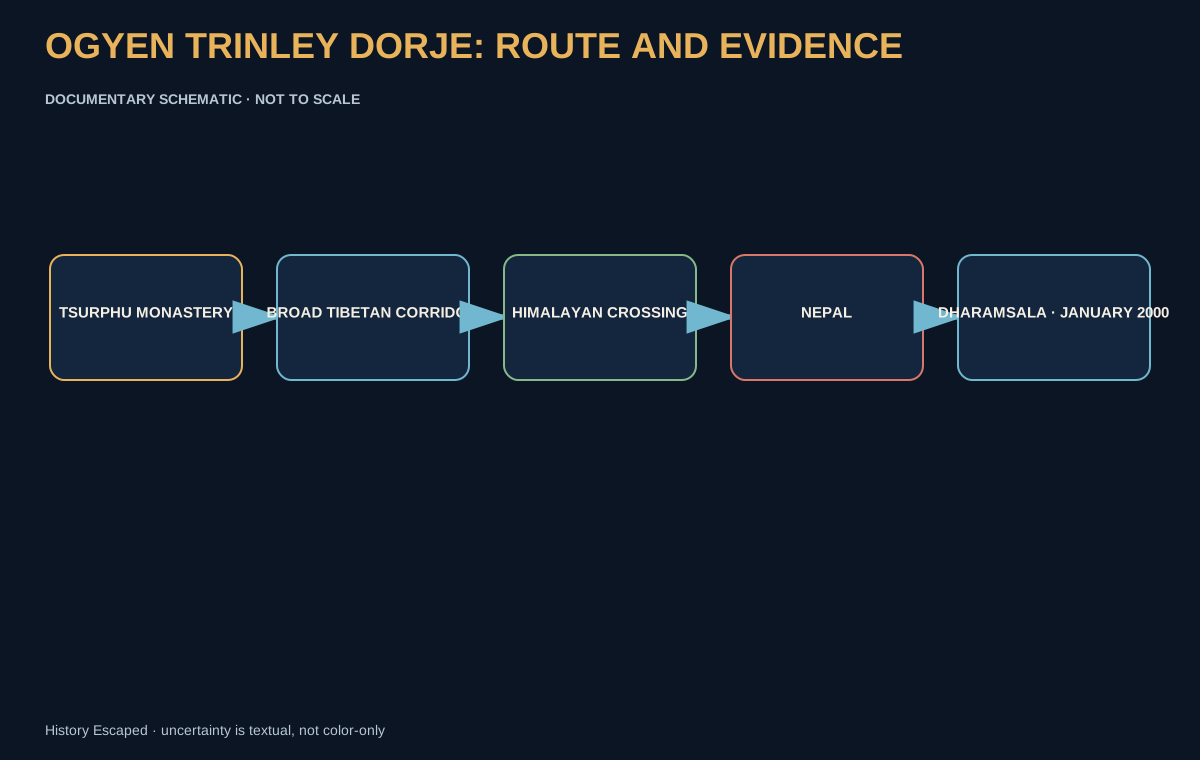
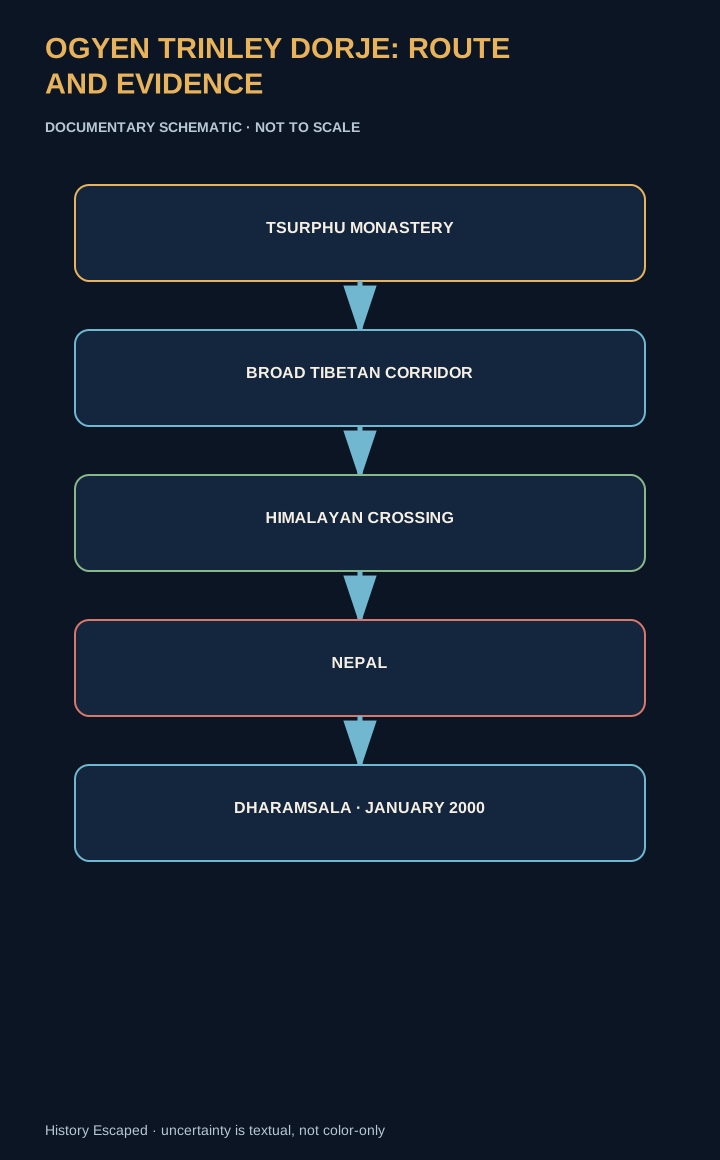
Simplified editorial reconstruction based on the cited historical record; not to scale. Uncertainty is stated directly in the visual and adjacent text.
